More precisely, Jinn, Brio and Matiz: these three cars are competing in our test. Our interest in the Chinese babies FAW Jinn and Hafei Brio is not at all due to their market demand. On the contrary, the total sales of all officially represented Chinese brands in Russia for three quarters of 2006 barely reached 11 thousand units. But the Daewoo Matiz sold 17,545 units over the same period!
So, Chinese products are still a novelty for us. What are their strengths and weaknesses?
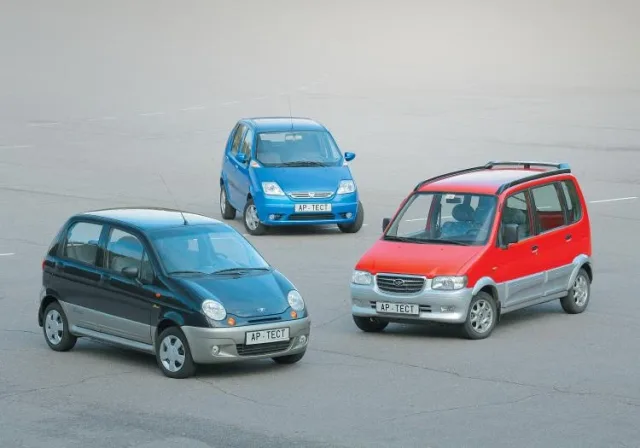
It is unlikely that fans of "Chinese cars" choose them out of a special love for technical perfection of forms. A clear (and, alas, not the most attractive) example is the tall, angular FAW Jinn. Although its donor, the Daihatsu Move, which was assembled under license at the First Automobile Works of China (FAW), was not distinguished by beauty either.
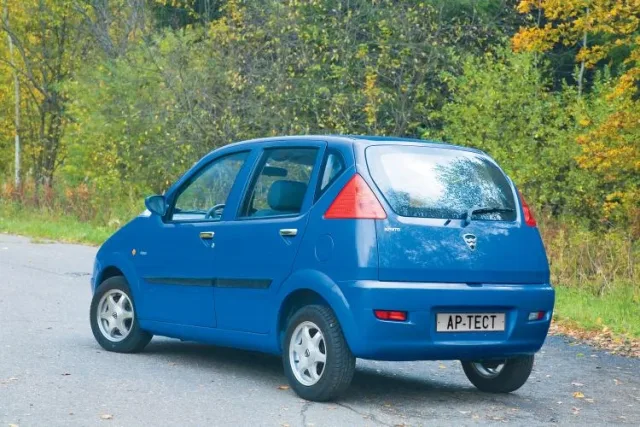
But the Hafei Brio is a representative of the new wave of the Chinese auto industry. The internals are its own, but the exterior was ordered from the Pininfarina studio. The result is, to put it mildly, unusual: striking elements like turn signals placed under the windshield and triangular rear lights attract attention to the Brio.
But just look at the Matiz... This is truly a harmonious A-class car. Even if it is no longer new and has become familiar, it is normal!
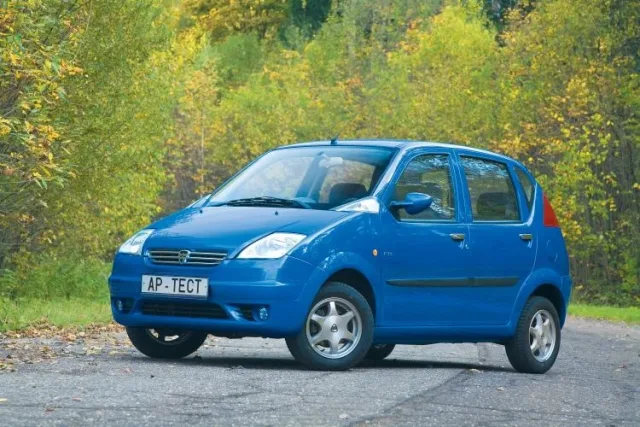
Hafei Brio: unusual, isn't it? And the color pleases the eye...
The Daewoo's interior is gray and clearly "plastic", but you can sit comfortably behind the wheel (as much as is really possible in such a cramped little box). The seat is comfortable, all pedals and buttons press easily.
Think it can't be any other way? Try sitting in the Hafei Brio.
At first glance, the cabin looks interesting — especially the instrument panel placed in the center of the front panel. But the glossy, like a polished boot, gray plastic panels do not cause delight. We got a Brio from the updated batch: previously all cars had a light interior popular in China, but in the most loaded places the white paint quickly wore off, exposing colorless plastic. Since summer, at the insistence of Russian dealers, the Chinese switched to gray plastic, painted "in mass".
 |  |
| Central instrument panel — a bold decision, but ambiguous. But the Brio's steering wheel is the most convenient of the three | On the tunnel — a cup holder and ashtray for rear passengers |
 |  |
| The seat cushion is not bad, but the backrest is modeled unsuccessfully | The Brio's transformation is the most modest — only the one-piece backrest folds |
But the main problem of the Brio in the cabin is ergonomics. Simply terrible!
With the steering wheel, gearbox and pedals — everything is in order. In the steering wheel hub, a driver's airbag is even hidden (for the Jinn it is also available). But the driver's seat adjustment range in length is catastrophically small. Even a person 170 cm tall wants to move back, but it is impossible. And a tall driver is completely uncomfortable: you sit bent over, spread-eagled, with the steering wheel on your knees. The left hand constantly touches the door, the right foot rests against the gear lever... Real torment!
The seat itself is also unsuccessful — the hard convex backrest literally pushes the occupant out. It is doubly offensive, because before that very modernization, the Brio had quite decent seats.
 |  |  |
| The Matiz's rear seat (left) is the widest, softest and most comfortable. The Jinn's separate seats (center) are hard, but sitting on them is more pleasant than on the Brio's rear seat (right) with a reclined backrest. In terms of legroom in front, the FAW leads, while Brio and Matiz passengers press their knees against the front seats | ||
In short, a short and very hardy Chinese person might endure a trip behind the wheel of a Brio. But what is good for a Chinese person is a complete nightmare for a Russian! Phobos and Deimos, as the ancient Greeks used to say...
 |  |
| Apparently, the designers from Pininfarina who worked on the Brio "disliked the oval since childhood" and drew angles wherever possible. Triangular mirrors worsen visibility | |
 |  |
The FAW Jinn turns out to be better. The seat is high, the seating position is almost vertical. The adjustment range in length is just enough for a tall driver, but still sufficient. The seat itself pleased: both lateral support is felt, and the profile is successful. The three-spoke steering wheel, however, let us down — large, with a thin rim, slightly turned to the center and strongly tilted forward. The clutch and gas pedals are loose and press hard, and the long gear lever has too much travel.
The picture is completed by a gloomy, frankly cheap and carelessly assembled interior. The only bright spot is the digital instrument panel, which "comes to life" after turning the ignition key.
In the back of these little ones, it is cramped by definition: both for two, and even more so for three. But the worst of all is the Hafei Brio. Yes, there is a cup holder and ashtray, but the rear seat cushion is too hard, and the backrest is strongly reclined.
The Matiz and Jinn are better off. The rear seat in the Jinn is also a bit hard, but thanks to the "vertical" seating position, there is noticeably more room for knees and above the head. Moreover, the rear seat here slides forward and backward, and the backrests change the angle of inclination! Moreover, rear passengers sit higher than front ones: here you have both a better view and seating comfort. But it is almost unrealistic for three to sit here — the Jinn is too narrow in the shoulders.
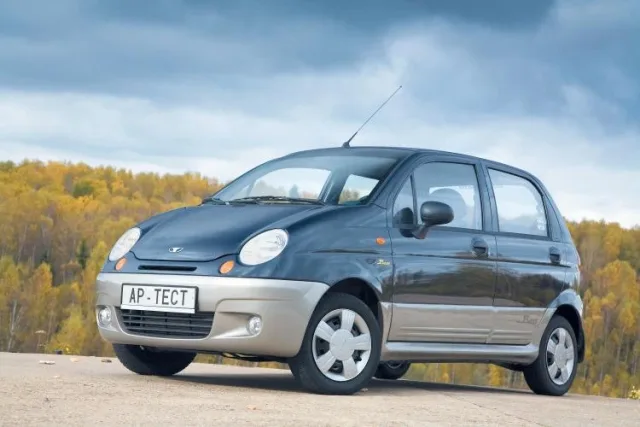
Daewoo Matiz: the design "by Giugiaro" (the baby project was created at the ItalDesign studio) still looks decent
The Matiz is also narrow. But three can still sit: in terms of rear space, it is similar to the Brio, but it pleases with a soft and quite comfortable rear seat.
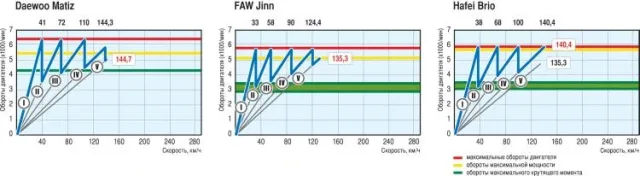
We selected the cars correctly — all with 1.0–1.1 liter engines. Even the Daewoo Matiz was taken not the usual three-cylinder, 800-cc, but with a liter "four" with a power of as much as 63 hp. Not a car, but a hurricane! A small, pocket-sized one. If the gear ratio range were "shorter", the dynamics would be even more — on fifth gear, traction at "low revs" is clearly lacking. But even with such a "stretched" gearbox, the little Matiz outperforms the "Chinese" both in acceleration and in "top speed". And the gears shift easiest here too.
 |  |  |
| The Daewoo's cabin is gloomy and cheap, but in terms of ergonomics — head and shoulders above the "Chinese" | The Matiz's seats are the softest, but they hold the body well | Both the cushion and the backrest fold, but not separately |
The engine of the FAW "little box", despite a volume of 1.1 liters, produces only 52 hp. But the transmission here is very "short". We could not even measure acceleration on third gear to 100 km/h, because you have to shift to fourth! And the "top speed" of 136 km/h is achieved on fifth gear.
Such a selection of gear ratios helps the Jinn not fall far behind the Matiz, but at the cost of too frequent shifting. And the gearbox drive works so poorly that over time it starts to irritate. One joy: on the highway, you engage fifth — and you roll along leisurely, as if on an "automatic"...
| Daewoo's instrument panels (left) look playful and quite informative, but there is no tachometer. FAW's digital panel (center) looks unusual, although the tachometer arc is too small and hard to read. In the Brio (right), the white background interferes during the day, and the blue backlighting at night | ||
The Brio's powertrain is the most powerful in this group (1.1 L, 65 hp), but the gears are poorly chosen. On higher gears, the engine lacks power: the Hafei struggles to reach 100 km/h in fourth, and in fifth it can no longer hold speed. The gearbox, however, works flawlessly.
Incidentally, only the Brio of this trio is equipped with ABS. But on dry asphalt, this does not shorten the braking distance — you only notice the electronics working when braking on uneven surfaces, where the car behaves more stably. Plus, of course, during emergency braking, the Hafei maintains controllability.
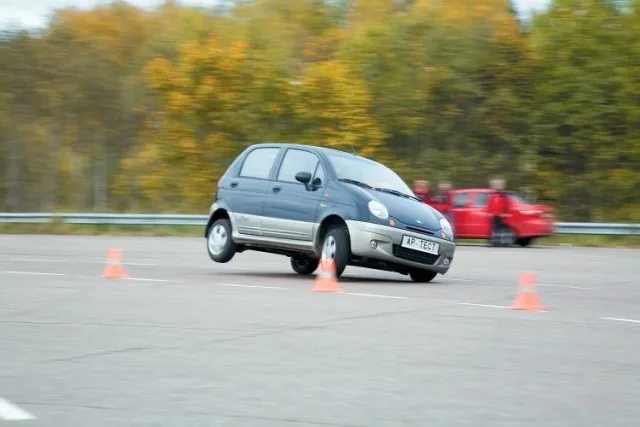
If you overdo the speed in a corner, the Matiz is too eager to lift two wheels. Of course, the highly experienced Autoreview expert Alexander Nikolaevich Divakov has the situation under control. But what if you are behind the wheel?
The FAW Jinn brakes the worst. In normal modes, the pedal sinks, and during emergency braking it is hard to catch the moment of lockup — the actuation responds with delays, including releasing the brakes. The Jinn also weaves slightly when slowing down.
And what about the Matiz? Alas, it brakes worse than it accelerates: the longest stopping distance! The Daewoo's pedal is the most "precise" and informative, but the brake mechanisms grip unevenly and also heat up very quickly, causing their efficiency to drop instantly. Bad pads?
 | |
| Daewoo Matiz: the top trim bears an immodest name | Rear power windows are available only for the Daewoo |
 | |
| Each front occupant gets their own cup holder | The mirror shape is good, but they are shifted too far back |
It's a pity, because the Daewoo's chassis in this Asian trio is the most... Honestly, I can't bring myself to call it "the best." It's more or less normal. Alas, nothing more. And it wins against the "Chinese" only because they are much worse!
The Brio's problem is the "empty," uninformative steering combined with "raw" suspension kinematics. This extravagant little car has a very rare feature in today's civilized world — it has oversteer. That is, you turn the wheel expecting to enter a corner of a certain sharpness, but the Hafei dives into the arc too eagerly, forcing you to "unwind" the wheel. On straights, the Brio wanders significantly even on small gentle waves in the road. In sharp corners — strong body roll, diagonal pitching... The only joy for us was that on the test track's bends we could have some fun, since the Brio readily goes into a slide when you lift off the throttle and holds the arc quite tenaciously. But it's hard to imagine someone who values excitement and handling in slides willingly getting behind the wheel of this marvel of automotive engineering.
Meanwhile, for beginners, the tendency to oversteer is dangerous!
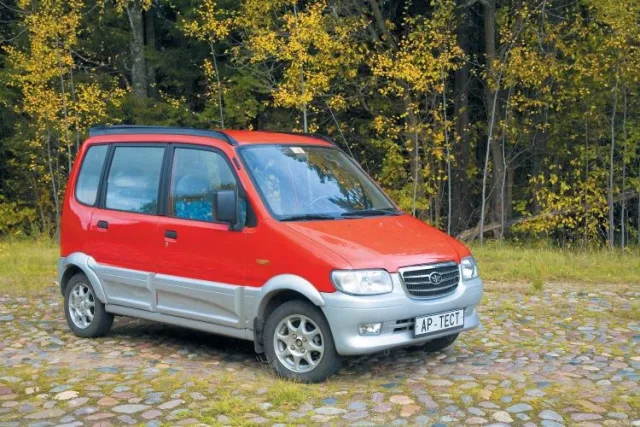
The FAW Jinn is a Japanese Daihatsu Move after a Chinese "restyling"
The FAW Jinn is the complete opposite of the Brio. There, the steering is "empty" and weightless; here, it's the opposite — too heavy. The Jinn has no power steering, so its absence is partially compensated by a "long" steering mechanism: the wheel makes 4.3 turns from lock to lock. As a result, the Jinn reminds me of the VAZ "classic" — the same feeling of "play" in the straight-ahead position and a sharp increase in effort as the steering angle grows. Because of this, you don't feel the car at all on straights, and in corners it's hard to keep the wheel in your hands: even a short drive on a winding road is terribly tiring. And yet the chassis is generally well-tuned: the Jinn holds the straight perfectly, behaves very calmly and predictably in lane changes, rolls moderately, and precisely tracks the arcs of sharp bends. On waves in corners — no pitching or deviation from the trajectory. In a limit corner, the FAW calmly slides outward on nearly all four wheels...
But how can you be happy about that when you literally have to wrestle with the steering wheel?
 |  |  |
| Daewoo Matiz (left) and FAW Jinn (center): the center consoles are similarly laid out. The climate controls in the Daewoo are the easiest to operate. The Jinn's knobs and sliders are also acceptable, but look archaic. As for the Brio (right), its air conditioning knobs are inconvenient and stiff | ||
The Daewoo Matiz, against this backdrop, is a confident C-student among inveterate repeaters. Fairly sharp responses, a lack of steering feel, near-neutral understeer — the Matiz enters corners willingly but with significant body roll. On bumps in a turn, the little car suffers from diagonal pitching and wanders, and on a steep wave it even "jumps" sideways when hitting potholes.
Not much fun, but you can drive it. The main thing is to brake before corners. Because in a high-speed turn, the Matiz can easily lift two wheels — and could roll over! The Matiz has a known increased tendency to roll over — this has been noted by foreign colleagues and by us during previous tests. Now we've seen it again...
 |  |
| Power windows — only in front, but with auto mode | These "spread" mirrors are good on narrow streets, but they don't improve visibility |
In terms of comfort, the Matiz and Hafei Brio are similar. The extravagant "Chinese" car has the softest suspension — a blessing on small and medium bumps, but large potholes at high speed cause bottoming out, and weak shock absorbers cannot contain unsprung mass vibrations and cause pitching on waves. The Daewoo is about the same, only the suspension's energy capacity is slightly higher. The difference in noise is more noticeable: while the Matiz is an example of balanced vibration and acoustics (even the little engine sounds pleasant), the Brio's engine squeals at high revs like a stuck pig, and wind noise grows louder with speed.
But both of them lose badly to the FAW Jinn. The suspension here is stiff: on one hand, it perfectly keeps the body from pitching and demonstrates excellent energy capacity on large potholes, but on the other, it transmits small road irregularities into the cabin too thoroughly, annoying occupants with sharp jolts. And the sound accompaniment... Every seam and joint in the asphalt echoes inside the Jinn with loud thuds and creaks. During hard acceleration from low revs, the engine booms hollowly. The transmission gears whine. The wind whistles as it hits the large "burdock" side mirrors and blows into the gaps around the doors. Sand grains drum loudly in the wheel wells, and the exhaust system knocks against the body, vibrating and catching on something...
 |  |  |
| The Jinn's interior is frankly outdated, and the execution is cheap and sloppy. The steering wheel is set at a shallow angle and turned to the right | The simple seats turned out to be unexpectedly "grippy" | The transformation possibilities are the widest. It's a pity it's inconvenient to do |
Horror! As the ancient Greeks would say — Deimos. Or Phobos?
In the end, the Jinn confidently took last place in the test — due to noise, uncomfortable suspension, overly heavy steering, and sluggish acceleration. Pay even the "base" $8,490 for it? No thanks. And "our" Jinn in the rich trim turned out to be the most expensive — $10,490!
The Hafei Brio is more comfortable and unusual in appearance. But to pay $8,990 for it (and with the top trim, all of $10,090), you need to be too undemanding — and too short: so that it doesn't hurt to sit behind the wheel with such an uncomfortable driving position.
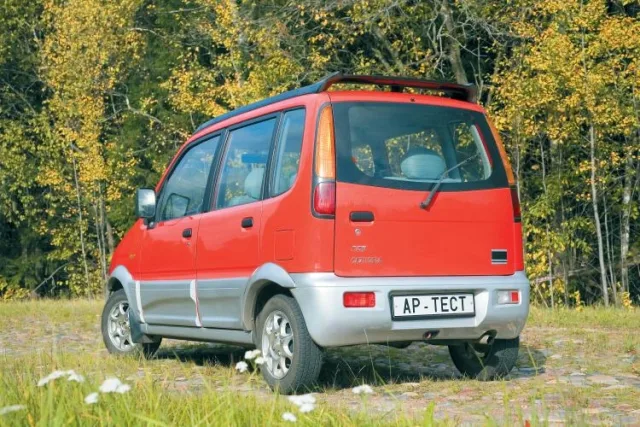
If we had to choose among these three cars, we would unhesitatingly go with the Matiz. It feels like the most "real" car. True, it also costs the most: the base "liter" Matiz is priced at $9515. However, you can save money and get the version with the 800cc engine. The main thing is not to forget to be careful in corners!
And what about the Chinese cars? Their invasion is still postponed: cars of this level for such money are unlikely to become mass-market even in our market, which is still ready to accept anything. Although the Chinese are actively refining their first models, and in a couple of years they promise a third wave of "independent" cars that should be noticeably better. Let's wait!
 |  |  |
| The most modest trunk is in the Matiz (left). The Jinn (center) has the most convenient and spacious one. The Brio (right) features a narrow opening and high loading height, but it has the best quality and finish. Under the floor of all three are full-size spare wheels, only the Brio does not come with a jack | ||
Who is who?
Hafei Motor appeared in 1994 as part of the aviation concern Hafei Aviation Industry. Factories in Harbin can produce up to 300 thousand cars and 550 thousand engines annually, but in the first nine months of this year they assembled only 150 thousand cars. In Russia, Hafei so far sells only the Brio hatchback, but from November it will be joined by the Princip sedan, created by Pininfarina on Mitsubishi Lancer components, and another compact — the Hafei Simbo, a copy of the Mitsubishi Mirage Dingo. In addition, Hafei has several of its own microvans and mini-trucks based on them.
The Brio is the result of work with Pininfarina: the Lobo concept (as the model is called at home) was shown at the Beijing Auto Show in 2002. The Italians were only responsible for the body design, while Hafei developed the interior and technical content itself. Both engines for the Brio are proprietary, differing in displacement (1.0 or 1.1 L). By mid-next year, the appearance of an "automatic" is expected — Hafei closely cooperates with Mitsubishi. At the request of Russian dealers, the Chinese have already made adjustments: for example, they replaced the light interior with a dark one. In the queue for refinement are the small climate control knobs, the uncomfortable rear seat back, and the short front seat rails. They promise to fix them soon.
FAW (First Automotive Works) is the leader of the Chinese auto industry, which started in 1953 with the assembly of ZIS-150 trucks. Currently, the production base consists of joint ventures with Japanese and European brands — they assemble modern Volkswagen, Audi, Toyota, Daihatsu, and Mazda models. But only their own models go for export. The Landmark SUV never appeared in Russia, the Besturn sedan is promised only for spring, the C1 hatchback is waiting its turn, and the only available model is the FAW Jinn, a modernized first-generation Daihatsu Move (1997–2001) produced since 2002 under an official license. The eight-valve FAW engine is a copy of the Japanese engine, which had its displacement increased (the liter unit of the Move produced 56 hp), and the gearbox ratios also changed.
About 600 such cars have been sold in Russia. By the end of the year, the Jinn will receive a new three-cylinder twelve-valve engine (58 hp) and a robotic gearbox. A power steering is planned, and an electric power steering is being developed for the new engine. Already in November, dealers will have Jinns with improved sound insulation, a larger battery, and a powerful heater. Later, they promise to change the appearance and improve the plastic in the interior. The new Jinn will come out in two years.
Autoreview readers' forecast
Before the test, we asked visitors of www.autoreview.ru which car from the participants they would choose. The votes were distributed as follows:
Daewoo Matiz — 93.66%
Hafei Brio — 4.36%
FAW Jinn — 1.98%
A total of 2522 people voted
"Moose test"
The tests for avoiding a sudden obstacle are carried out in two stages. First, several drivers who have already become accustomed to the cars in normal modes try to "avoid the moose" in one attempt at a speed of 65 km/h. Then an expert, through a series of runs, determines the maximum speed of the maneuver.
| Maximum speed in the "moose test", km/h | |
| Car | Speed |
| Daewoo Matiz | 76.5 |
| Hafei Brio | 74.1 |
| FAW Jinn | 73.7 |
| "Moose test" on the first attempt at 65 km/h* | |
| Car | Maneuver completed |
| Daewoo Matiz | 3 out of 4 drivers |
| Hafei Brio | 4 out of 4 drivers |
| FAW Jinn | 2 out of 4 drivers |
| * 4 drivers participated in the tests | |
The Matiz showed the best result — 76.5 km/h. In single runs, only one of the four drivers made a mistake — the lack of steering feedback let it down.
 |  |  |
Behind the wheel of the Brio, all four coped with the emergency. For most, the car's reactions were sharper than expected, but their speed gave drivers time to correct small mistakes. The tester was hindered by strong drifts, which limited the maximum speed to 74.1 km/h.

The FAW Jinn made half of the drivers make mistakes. The reason was unexpectedly low sensitivity and too much effort on the steering wheel. This also prevented the tester from accelerating faster than 73.7 km/h — the speed was limited by the physical impossibility of turning the "lazy" and heavy wheel faster.
What if there's an accident?
Small cars are more dangerous than big ones by definition. And especially those from China or Uzbekistan...
Reliable passive safety data is available only for the Daewoo Matiz. It passed EuroNCAP tests: in 2000, the car for Europe with two airbags and belt pretensioners scored 6 points out of 16. At the end of 2003, we ourselves tested the Uzbek Matiz without airbags and pretensioners — in a frontal impact according to EuroNCAP rules, the little one scored 12 points out of 16! The test data was confirmed by a real accident, after which an Autoreview employee (belted) escaped without injuries. After a frontal impact at 64 km/h with 40% overlap, little remains of the Matiz's front end, but the passenger compartment's "cage" is strong, and the interior is quite injury-safe.
 |  |
| Daewoo Matiz (64 km/h) | Hafei Brio (56 km/h) |
What will happen to the driver and passengers of the Brio or Jinn in a similar situation can only be guessed — they have not undergone independent tests. The Daihatsu Move, on which the FAW Jinn is based, was tested in 2000 under the Japanese JNCAP program with three impacts: frontal against a concrete wall (55 km/h), frontal with overlap (64 km/h), and side (55 km/h). Out of six possible stars, the little Daihatsu earned two — modest. And the Jinn differs from its ancestor in both design and metal quality, and especially plastic.
As is known, the FAW Jinn only passed a certification crash test under old Chinese norms — a frontal impact into a concrete wall without offset at a speed of 51.2 km/h. More modern offset impact tests are planned only for the restyled version, which is scheduled for next year. However, the Hafei Brio has already passed such a test — also in China. The car met the standards, and the loads on the dummies were not dangerous. But from the photos, it is clear that the little car endured the offset impact into a deformable barrier at 56 km/h quite heavily, with the door opening noticeably deformed. What will happen in an impact at 64 km/h, which EuroNCAP norms require? One can only guess... Or check — which we will do if Russian sales show the popularity of the Brio.
What costs how much?
Prices for the Uzbek Daewoo Matiz start at $7590 — that's the asking price for the base STD trim with an 800cc three-cylinder engine (51 hp), which includes only a radio and two speakers. The next step is the DLX version, offering front power windows, power steering, central locking, and a cassette stereo with four speakers. It costs $8410. The modification with a four-speed automatic is $1130 more expensive — from $9540. The flagship Daewoo Matiz Best version is equipped with a 1.0-liter four-cylinder engine (63 hp) and a manual transmission. The equipment list adds rear power windows, fog lights, a right mirror with electric adjustment, and a CD player with MP3 support. Price — from $9330. For any trim, air conditioning can be installed for an additional fee (plus $620), and for DLX and Best — alloy wheels and roof rails (another $310).
Warranty — 5 years or 100,000 km.
FAW Jinn in the base Smart trim sells for $8490. Equipment includes fog lights, audio preparation, roof rails, and metallic paint, but the bumpers remain unpainted black plastic. The Comfort version features body-colored bumpers and a split rear bench with adjustable backrests and headrests. Also added to the equipment list are alloy wheels, central locking, and front power windows. Price — $9790. The top Luxe trim ($10490) offers air conditioning, power mirrors, silver bumpers, and a decorative body kit. For an extra charge, you can order seats with leather inserts ($400), driver airbag ($400), and passenger airbag ($250). There's only one powertrain here — a four-cylinder 52-hp 1.1 engine paired with a five-speed manual.
Warranty — 2 years or 40,000 km.
Hafei Brio in the "bare" L trim costs $7990, but such cars are only available on order, with a waiting time of four months. The base engine is a 1.0-liter four-cylinder with 46 hp. Freely available are cars in the LX version (alloy wheels, metallic paint, central locking, front power windows, fog lights, radio with two speakers). Price — $8190. The Brio LX with a 16-valve 1.1 engine (65 hp) is $800 more expensive ($8990). The Brio SX with air conditioning costs $8690, and cars with the 1.1 engine ($9490) come with power steering "included." The top SLX version additionally features ABS and a driver airbag. Price — $9350 for the 1.0-liter version and $10090 for the 1.1 variant. The only option is wood-look plastic interior trim and a leather steering wheel ($150).
Warranty — 3 years or 100,000 km.
 |  |  |
| Expert ratings from Autoreview | ||||
| Evaluated parameters | Max score | Cars | ||
| Daewoo Matiz | FAW Jinn | Hafei Brio | ||
| Design | 160 | 100 | 75 | 90 |
| Exterior | 80 | 50 | 35 | 45 |
| Interior | 80 | 50 | 40 | 45 |
| Ergonomics | 160 | 120 | 100 | 85 |
| Driver's workplace | 80 | 55 | 45 | 30 |
| Visibility | 80 | 65 | 55 | 55 |
| Dynamics | 280 | 210 | 180 | 200 |
| Acceleration dynamics | 90 | 60 | 50 | 50 |
| Braking dynamics | 100 | 80 | 70 | 85 |
| Handling | 90 | 70 | 60 | 65 |
| Ride comfort | 200 | 140 | 120 | 135 |
| Ride smoothness, vibration protection | 70 | 55 | 50 | 55 |
| Acoustic comfort | 70 | 45 | 30 | 40 |
| Climate control | 60 | 40 | 40 | 40 |
| Cabin comfort | 200 | 135 | 145 | 125 |
| Passenger seats | 70 | 50 | 50 | 45 |
| Trunk | 70 | 45 | 50 | 45 |
| Cabin transformation | 60 | 40 | 45 | 35 |
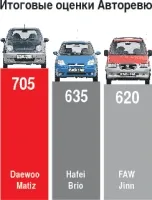
| Total score | 1000 | 705 | 620 | 635 |
Final Autoreview ratings
| Some Autoreview measurement results | ||||
| Parameters | Cars | |||
| Daewoo Matiz | FAW Jinn | Hafei Brio | ||
| Maximum speed, km/h | 144.7 | 135.3 | 140.4 | |
| Acceleration time, s | 0—50 km/h | 4.5 | 5.3 | 5.5 |
| 0—100 km/h | 15.8 | 20.4 | 19.9 | |
| over 400 m | 19.9 | 21.1 | 21.3 | |
| over 1000 m | 37.6 | 40.0 | 40.4 | |
| 60—90 km/h (III) | 7.6 | 8.1 | 9.5 | |
| 60—100 km/h (III) | 10.7 | — | 13.4 | |
| 60—100 km/h (IV) | 17.7 | 16.2 | 20.7 | |
| 80—120 km/h (V) | 31.4 | 34.7 | 42.1 | |
| Coast-down, m | from 50 km/h | 559 | 557 | 475 |
| 130—80 km/h | 713 | 683 | 747 | |
| Braking from 100 km/h | distance, m | 47.5 | 45.9 | 45.7 |
| deceleration, m/s² | 8.1 | 8.4 | 8.4 | |
Autoreview measurement results

Acceleration graphs