The newest double-deck Airbus A380 is approaching for landing above the highway — aviation giants are assembled right here, in French Toulouse. If I were in an ordinary car, I would hardly notice the airliner soaring high in the sky. But the new Citroen C4 Picasso compact van with a panoramic windshield allows you to spot even planes overhead…
Usually during tests in the south of France I don't see much: I focus on assessing the steepness of turns, estimating braking points… And if I do manage to glance around, it's only at the stone or metal barriers of mountain serpentines.
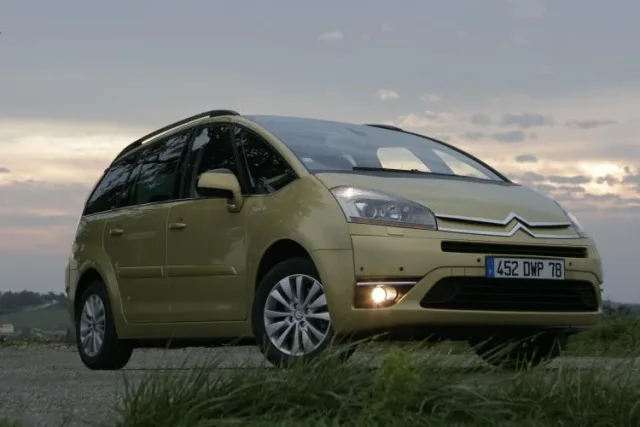
Sitting behind the wheel of the C4 Picasso compact van, I feel like I'm getting to know these regions anew. Picturesque slopes with vineyards, narrow streets of old towns, castles… And above Toulouse — aviation too. Not only the monster A380, still undergoing test flights, but also the wide-body Airbus Beluga, which transports entire sections of future airliners.
 |
| On the front panel there are four compartments, the central one — with cooling |
Without the panoramic windshield of the new Picasso, I wouldn't have seen those planes. The vertical viewing angle, which in ordinary minivans is limited to 35°, is increased here to 70°! Stopping before the stop line, you don't need to stretch and peek at the traffic light from under the roof. And on a clear day, you can "reduce" the glazing area by extending the sunshades by 30 cm — separately for the driver and passenger.
The huge windshield plus the optional sunroof bring the total glazing area of the new Citroen to 6.4 m². According to Citroen representatives, this is the best figure in its class. Interestingly: I've heard the same claim at the presentation of the Renault Grand Scenic compact van, but there they cited a figure of 6.88 m² (see AR No. 7, 2004)…
 |  |  |
| In sunny weather, the windshield can be covered with sliding sunshades | The robotic gearbox is controlled by an elegant steering column stalk | The five-disc CD changer is always at hand |
Actually, the Scenic and C4 Picasso are similar in many ways: it's clear that Citroen aimed precisely at the Renault compact van — as the class leader. And they tried to do roughly the same, but better. The Scenic has digital instruments in the center? The C4 Picasso also has a "central" cluster. However, the speedometer digits here are larger and located closer to the driver, and the tachometer is easier to read — it's made as a full-size ring "scale". Press a button — and only the speed digits, engine revs, and engaged gear remain on the display. The driver can also change the instrument lighting — from neutral white to blue, with varying intensity.
 | |
| The digital instrument cluster has several display modes and lighting options | |
 | |
| The main climate control unit is located to the left of the steering wheel, and the passenger has a separate temperature regulator (shown on the right) | |
Citroen didn't manage to catch up with the Scenic in the number of small compartments and boxes. But there are still quite a few — just on the front panel there are four, including a spacious glovebox and a separate cooler box of 5.4 liters, which fits two half-liter bottles or one 1.5-liter bottle.
But the steering wheel is like in the C4 hatchbacks, with a fixed "hub" where buttons and four rollers are gathered. From the "hub" you can activate the speed limiter, cruise control, and… the parking assistance system! True, this is still just assistance — an "electronic tape measure" for those with eye-measurement problems. Moving at no more than 20 km/h along a row of parked cars, the Picasso driver activates the system and turns on the right "turn signal": as soon as a sufficient gap between cars appears, the system emits a sound signal and displays a message on the screen. But you'll have to park yourself — "advanced" auto-parking systems, which are already standard on Toyota, Lexus, and Volkswagen, will appear on Citroens in about five years.
 |  |
| In the seven-seat cabin, the middle row seats are full-fledged. And the luggage seats are for children | The "plush" seats are soft but excellently contoured |
 |  |
| To get to the rear row, you need to slide the seat, whose cushion then rises vertically | In the seven-seat version, only 208 liters remain for luggage |
The cabin has excellent seats with wide adjustment ranges and surprisingly pleasant trim materials. The soft texture of the front panel, rubberized air vent handles, mats in the niches — from these little things, like small cubes, a feeling of quality is built. And the new Picasso even offers four-zone climate control! True, the zones are not equal: rear passengers only have airflow intensity knobs located on the central pillars.
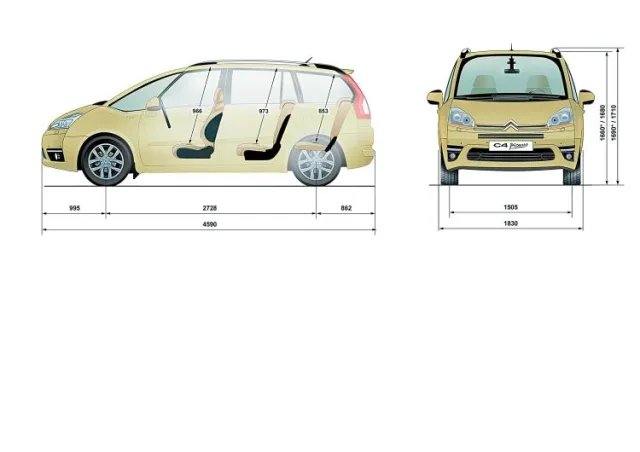
The cabin is seven-seat, and folding the seats is very easy. The rear space is, of course, exclusively for children, and the trunk is small — only 208 liters. But as the seats fold, it increases to almost two cubic meters.
 |  |
| The seats in the new Citroen are not removable, but they fold easily and don't interfere with transporting bulky cargo | The tools are hidden in one of two niches under the rear passengers' feet |
But on the middle row, there's plenty of space. Whether two or three… The ceiling is high, the floor is flat, the door windows lower all the way, and there are fold-down tables. In expensive versions, DVD player screens can be installed above the tables. Don't like sitting in a "transparent" cabin — you can order sunshades for the windows of the second and even third row! And a child seat with Isofix mounting can be installed not only in the outer positions but also in the middle — so the little one can see the road and enjoy the flickering numbers on the displays.
Is the new Citroen good on the road? I admit, it's better than I expected!
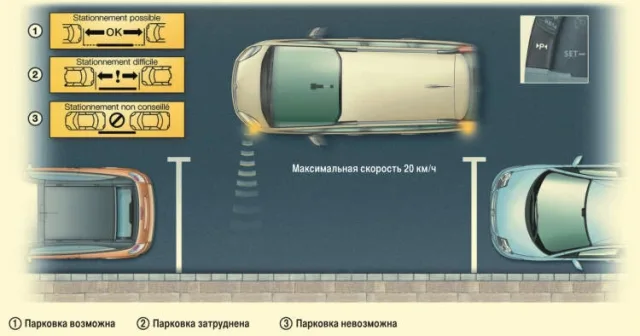
Parking space assessment system: the Citroen C4 Picasso itself finds a suitable gap between cars
We will receive the C4 Picasso exclusively with petrol engines — 1.8 liters (127 hp) and 2.0 liters (143 hp). Cars with the 1.8 engine are equipped only with a manual five-speed gearbox, while two-liter versions come with a four-speed "automatic" or... You think, "manual"? Not at all — the French found that more expensive versions of compact vans with a purely manual gearbox are no longer ordered. Therefore, for those who prefer cheaper options, the C4 Picasso 2.0 is equipped with a six-speed robotic "manual".
When I learned that I'd be driving exactly such a Picasso, my mood dropped in advance. After all, our experience with robotic gearboxes can't be called positive. But I was upset in vain: in most situations, the "robot" is almost as good as a traditional "automatic"! Confident start, quick gear changes… Moreover, the gearbox is adaptive: press the accelerator to the floor a couple of times — and the electronics starts using lower gears more widely and "holds" them more actively when releasing the gas, allowing better engine braking. In parking, when you maneuver back and forth, the gearbox also keeps up with the driver's commands.
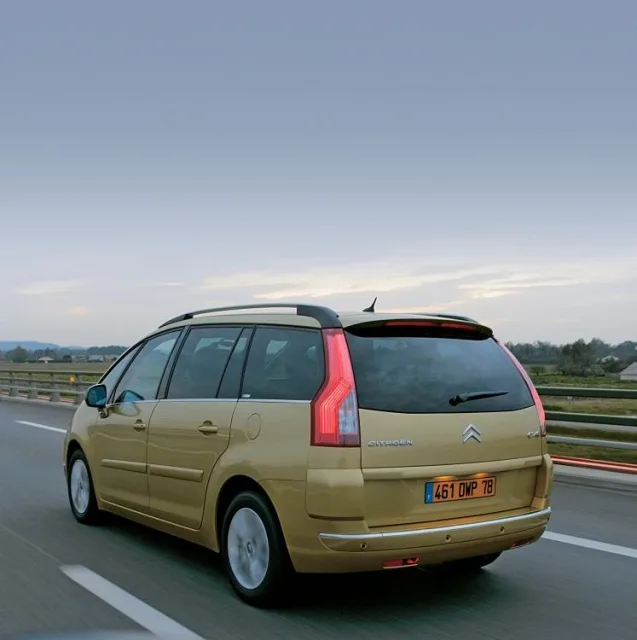
The rear lights resemble neon advertising — each has four tubes illuminated by twelve LEDs
The main discomfort occurs during overtaking. When you press the accelerator all the way, instead of the expected surge, there's a pause: the electronics disengages the clutch to shift to a lower gear. However, there's a solution — manual mode with steering wheel "paddles", which reduces shift time from 0.75 to 0.65 seconds. Moreover, it works "for real", holding the selected gear.
The engine is quite decent — sufficiently torquey and revs smoothly across the entire range. The braking system also doesn't let you down, no complaints at all. An interesting detail: on the C4 Picasso, starting off with the "handbrake" on is a common thing, not a sign of absent-mindedness. The culprit is the electromechanical parking brake: it engages itself after the ignition is turned off or when the button on the console is pressed, and it releases automatically when you start moving.
 |  |
| Lane departure warning activates at speeds above 80 km/h: when crossing lane markings without a turn signal, a vibration signal is triggered in the driver's seat | Optional — swiveling bi-xenon headlights |
Plus, there's a hill-start assist that holds the car on an incline for two seconds. The level of comfort is maximum!
The chassis also pleased. A winding road? The tires squeal slightly, but the car holds its line steadily and obediently transitions from one corner to another. Body roll is moderate, and steering responses are precise. The only thing missing is feedback at the steering wheel — the same story as with the regular C4. The electronic stability control is excellent: when driving along the correct line, it doesn't interfere at all, and in a critical moment it engages smoothly and unobtrusively. Trying to switch off ESP? Not possible — the system reactivates itself after 50 km/h.
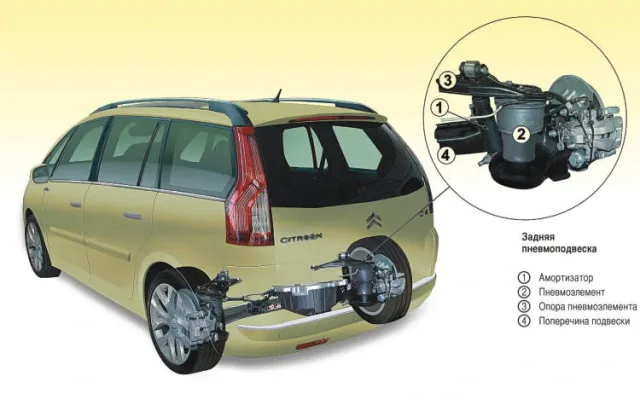
Rear air suspension (optional) keeps the body level, and when loaded, lowers the trunk sill by 14 cm
Handling is perfectly fine! But comfort is a bit more modest. The suspension is rather stiff: all joints and bumps are transmitted into the cabin, but there's no pitching. For European roads — ideal, for ours — you'd want it softer. Moreover, I tested the car with optional air bladders at the rear, which primarily keep the body horizontal under varying loads. But they also contribute positively to ride smoothness. The base version of the C4 Picasso has conventional springs at the rear.
 |
| The cabin is flooded with light: you lower your hand into the door pocket — the lighting comes on, and in the trunk there's a removable flashlight |
However, personally testing it in our conditions won't be possible until the beginning of next year, when the C4 Picasso reaches Russia. By the way, the five-seat Xsara Picasso is in no hurry to retire — its production will continue until 2010. And the new C4 Picasso will be positioned between the more affordable Xsara and the large minivan Citroen C8.
But for expanding your horizons, you'll have to shell out a tidy sum: if the Xsara Picasso 1.6 starts in Russia at $19,300, then the C4 Picasso 1.8 (with ABS, seven airbags, power windows, and a CD stereo) starts at $27,300! Compare: the seven-seat Ford S-MAX 2.0 — from $25,900, Renault Grand Scenic 1.6 — from $24,700, seven-seat Mazda 5 1.8 — from $24,400. And the seven-seat Opel Zafira 1.6 — only from $20,190.
So it turns out that a broader view is not a cheap pleasure…
| Specifications | |||
| Vehicle | Citroen C4 Picasso | ||
| Modification | 1.8 | 2.0 | 2.0 |
| Body type | 5-door wagon | 5-door wagon | 5-door wagon |
| Number of seats | 7 | 7 | 7 |
| Trunk volume, l | 208—1951 | 208—1951 | 208—1951 |
| Curb weight, kg | 1510 | 1560 | 1600 |
| Gross weight, kg | 2200 | 2240 | 2260 |
| Engine | petrol, with multipoint fuel injection | ||
| Location | front, transverse | front, transverse | front, transverse |
| Number and arrangement of cylinders | 4, in-line | 4, in-line | 4, in-line |
| Displacement, cm³ | 1749 | 1997 | 1997 |
| Cylinder bore/piston stroke, mm | 82.7/81.4 | 85.0/88.0 | 85.0/88.0 |
| Compression ratio | 11.0:1 | 10.8:1 | 10.8:1 |
| Number of valves | 16 | 16 | 16 |
| Max. power, hp/kW/rpm | 127/92/6000 | 143/103/6000 | 143/103/6000 |
| Max. torque, Nm/rpm | 170/3750 | 200/4000 | 200/4000 |
| Transmission | manual, 5-speed | automated manual, 6-speed | automatic, 4-speed |
| Drive | front-wheel drive | front-wheel drive | front-wheel drive |
| Front suspension | independent, coil spring, McPherson | independent, coil spring, McPherson | independent, coil spring, McPherson |
| Rear suspension | semi-independent, coil spring | semi-independent, coil spring (with air elements)* | |
| Front brakes | disc, ventilated | disc, ventilated | disc, ventilated |
| Rear brakes | disc | disc | disc |
| Tires | 205/65 R15 | 215/55 R16 | 215/55 R16 |
| Maximum speed, km/h | 185 | 195 | 190 |
| Acceleration 0—100 km/h, s | 11.9 | 11.5 | 12.2 |
| Fuel consumption, l/100 km | |||
| urban cycle | 11.3 | 11.1 | 12.9 |
| extra-urban cycle | 6.1 | 6.2 | 6.6 |
| combined cycle | 8 | 8 | 8.9 |
| Fuel tank capacity, l | 60 | 60 | 60 |
| Fuel | AI-95 | AI-95 | AI-95 |
| * Rear air suspension is available at extra cost | |||