
Citroen C4 Picasso
Calm, the main thing is calm
Engine: 1997 cc.
Max power: 143 hp at 6000 rpm.
Max torque: 200 Nm at 4000 rpm.
Max speed: 195 km/h
Transmission: robotic,
6-speed.
Fuel consumption:
city — 11.1 l
highway — 6.2 l
combined cycle — 8 l
Dimensions:
length 4470 mm
width 1830 mm
height 1680 mm
ground clearance 175 mm
tires 215/55 R16
Curb weight: 1586 kg
Gross weight: 2040 kg
Equipment: ABS+EBD+Brake Assist+mountain brake, ESP+ASR, power steering,
4-zone climate control, 4 electric windows with closer, driver airbag,
MP3 radio, alarm with siren, rain and light sensors, headlight washer
Andre Citroen was born on February 5, 1878, into the family of a successful entrepreneur. His father owned a share in companies that processed and sold precious stones. When the future car maker was only six years old, Levi Citroen took his own life. However, he left the family a decent fortune: a significant inheritance and useful connections in Parisian business and financial circles.
In that era, heirs usually followed in their fathers' footsteps. But Andre was not interested in commerce. In 1889, he became a student at the Polytechnic School, and after graduating at the age of twenty-three, he got a job in the workshops of his friends, the Esten brothers, where parts for steam locomotives were made.
In 1905, Citroen, investing everything inherited from his parents, became a co-owner of the Esten enterprise. He organized the production of gears at the factory, which significantly surpassed competitors' products in quality. Their design was developed by an unknown self-taught Polish mechanic. And Citroen timely appreciated the prospects of the technology and bought the patent for it.
The gears quickly conquered the international market — they were ordered in London, Brussels, and even Moscow, bringing the company's owners a solid income. This is where the company's emblem in the form of inverted letters "V" comes from, symbolizing bevel gears. In France, this sign is called "double chevron".
Once he visited America, where at Ford's enterprises he studied the American car assembly system, and in 1919, together with designer Jules Salomon, author of the popular model Le Zebre, he launched production of cars at a former arms factory on the Quai de Javel. He planned to produce a hundred cars daily.
Unlike European rivals, Citroen organized production on the American model, starting with a single model. His key task was to make the car a mass product, not an expensive curiosity.
Inexpensive small cars sold out instantly. The model range gradually expanded, and in the first ten years, car production grew almost 50 times. The first model was Type A (Citroen A) with a 1.3-liter engine and power of 7.4 kW (10 hp), which came out in May 1919.
A hundred cars a day — for the French auto industry of those years, this seemed unthinkable.
Secretly from everyone, Andre Citroen disassembled such famous American cars as Buick, Nash, Studebaker at his factory, studying possible methods of mass production. In essence, his Citroen A became the first mass-produced car in Europe.
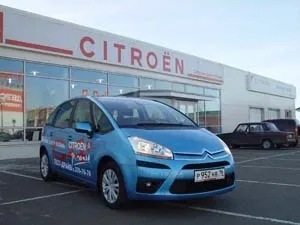
C4 Picasso
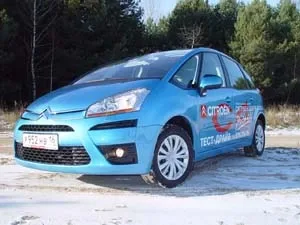
The immodest charm of the bourgeoisie is very close! The new versatile 5-seat compact van from Citroen sets you up only for perceiving the beautiful.
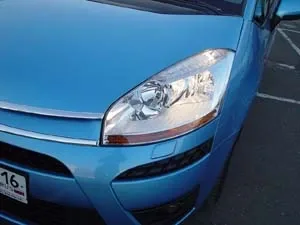
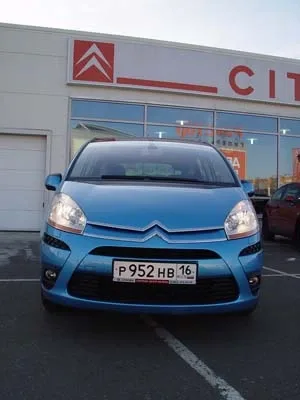
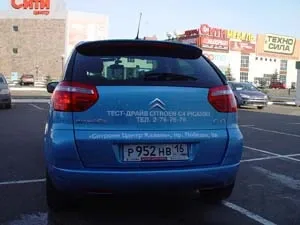
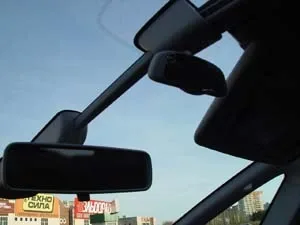
The French charm of Picasso is bright nuances, vast possibilities, and unprecedented impressions. Five symmetrically diverging rays-pillars from the roof, stylish eyes-lanterns, an exquisite small step of the window sill line. But the main thing in the C4 Picasso is the "widescreen" windshield that turns into a panoramic roof. 6.2 square meters of pure emotions!
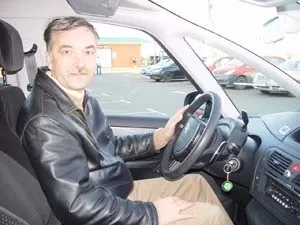
Vadim. Driving experience — 10 years
Minivans are becoming increasingly popular in Russia. And not only for travel, but also for "ordinary" use. So we gladly took on testing the Citroen C4 Picasso. Especially since we also liked the C4 hatchback in its time.
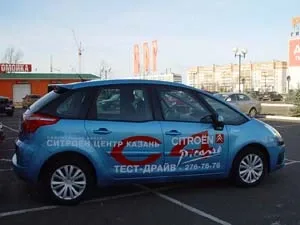
Engine and gearbox. Contrary to usual practice, let's start not with the appearance and listing of "bells and whistles", but with the two most important things in any car. If the C4 has a 1.6 engine, then the C4 Picasso (its weight is just over one and a half tons) has 1.8 and 2.0. In our test we had a 2.0 (143 hp at 6000, 200 Nm at 4000) with a 6-speed "robot". The combination is extremely successful. As we were told at "Citroen-center-Kazan", only one car was sold with a "manual", all the rest are with a "robot" and so far none with a 4-speed automatic. And rightly so: a car with a "robot" accelerates better (almost a second faster) and consumes less fuel (almost 2 liters less) than with a 4-speed automatic. One of the "birthmarks" of the "robot" in the C4 Picasso still remains: the moment of gear shifting is slightly noticeable. But if you slightly release the gas pedal when shifting, the gear change happens super smoothly. It must be said that this moment of shifting is very easy to catch. And the very release of the "gas" is easy to explain if you remember that the "robot" is the same "manual", only the computer commands the clutch release and gear shifting. And on a "manual" we first release the "gas" and then press the "clutch".
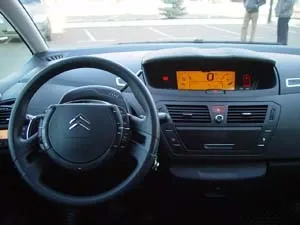
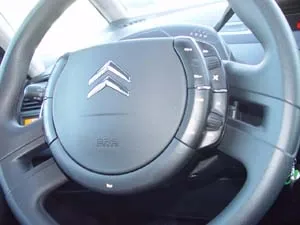
However, you can do none of this and drive like on a regular "automatic", because there are, of course, no terrible jerks here. This "robot" underwent a long break-in and refinement, which clearly benefited it. During leisurely driving, the "robot" engages the highest possible gear, which ensures good fuel economy. During aggressive driving, gears shift at high revs. And if you need to sharply gain speed, the "robot" can quickly shift from 6th gear to 3rd, and even to 2nd. The gearshift lever itself is made in the American style: near the steering wheel. Manual gear shifting is possible using paddle shifters. And since the steering wheel hub is fixed (a proprietary invention for the C4), it is always convenient to use these paddles, even in a turn.
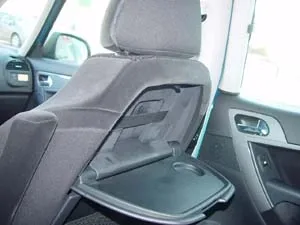
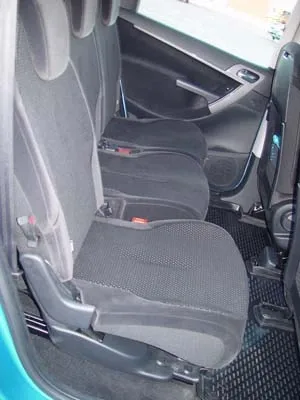
Inside. There is a lot of space. Spacious. Comfortable. The rear sofa is divided into 3 seats, each with an adjustable reclining backrest. Perhaps my only complaints were about the armrests on the doors; they are too small to be used for their intended purpose. It seems that the main thing in this car is considered the passenger: maximum comfort for him. In the driver's seat, I immediately noticed two rearview mirrors. True, one is small, and nothing is visible in it, and the other is quite tiny, but it allows you to monitor children in the back seat. This lack of mirrors is successfully compensated by the "burdocks" on the sides: everything is clearly visible.
Road behavior. The car is quite soft. With the correct trajectory and adequate speed, it enters corners well. And you can't demand more from a soft minivan. Overtaking — both in the city and on the highway — is done quickly, helped by the 2.0 engine and the "robot", which quickly shifts down several gears. The element of the C4 Picasso is the highway; it is there that its best features are noticeable. I got true pleasure from driving outside the city with cruise control. Naturally, the programmed speed can be increased or decreased (in steps of 1 or 5 km/h). The gas pedal, and with light traffic the brake pedal too, will not be needed. Soft, smooth movement towards the chosen goal, in a very comfortable car — what could be better?
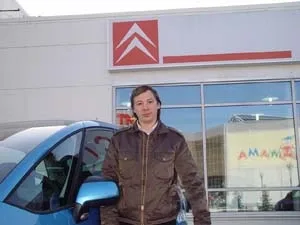
Alfred. Driving experience — 12 years
Before getting acquainted with this car, I decided to study what owners write about it. There were few reviews, but they all agreed on one thing: the robotic gearbox here is not distinguished by briskness, and the steering wheel by informativeness. Why so few impressions? Perhaps the point is that the model has not yet managed to gain popularity in the Russian market. I, frankly, am glad that more and more different brands are appearing on city streets — this is a gradual movement towards "European" diversity of the car fleet. Perhaps, following this, the quality of roads will also improve. As for Citroen, now three models have received the right to bear the signature of Pablo Picasso: Xsara Picasso, our C4 Picasso, and Grand C4 Picasso. The test C4 Picasso, like the Ford C-Max, inherited little in common from its "donor" — the Citroen C4 hatchback. The similarity is only in the interior styling, but here it is developed much more seriously and brought to a fundamentally different level. The main thing is that the car has a clear idea that it would fully embody.
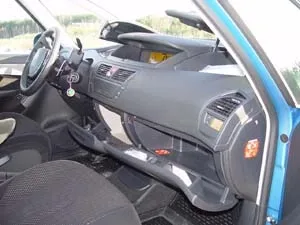
The C4 Picasso handled its task, but I won't rush to conclusions — let's take it step by step. Appearance is where any car begins, and here the Picasso is magnificent. Looking at it, you marvel at how the French manage to turn the logo into the leitmotif of the entire design. Every body line echoes the brand emblem in some way. Inside, there's incredible space and an abundance of light, thanks to the huge windshield that extends onto the roof. From the driver's seat, you can not only survey the surroundings but also admire tree canopies overhanging the road, and if you wish, even see traffic lights if you've nearly passed them. By the way, this car is a record holder in its class for glass area; nothing else comes close. Returning to the model's concept: it's a typical family car designed for long journeys. It's equally welcoming to all passengers. The cabin is full of cubbies and niches, and up front there's even room for a cooled mini-bar with drinks.
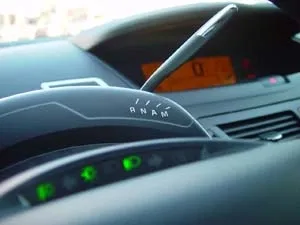
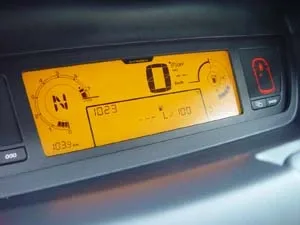
Each of the three rear seats can be slid and have its backrest angle adjusted. They fold individually, freeing up a trunk volume of up to 1734 liters. Rear passengers have access to climate control. The front seat backs have fold-down tables built in, like on airplanes, though without lighting in our version. There's plenty of room in the back both in width and height, and the doors open wide, not hindering entry. The driver's workstation layout is familiar from the C4: the steering column is fixed, and bright digital readouts are placed on the central panel. At first, such a cluster seems overloaded, but you get used to it quickly. However, I never managed to get used to the climate control unit located under the left hand. The buttons are small and sit too close together, making them hard to press. The only consolation is that you rarely need to use them: set a comfortable temperature once, and the climate control does the rest. The front seats are designed so that lateral support only reaches shoulder level. This is done deliberately so that parents can easily turn around and see children in the back row, aided by a small "parent's" mirror. Incidentally, there are four ISOFIX mounts here. The steering wheel is literally covered in buttons, and convenient paddle shifters hide beneath it.
Since the column remains stationary when the wheel turns, the paddles don't rotate with it. Now, about that "thoughtful" robot. I can say it's the best robot I've ever encountered. If you work the gas pedal smoothly, you can achieve confident acceleration with very soft shifts. I think many simply don't understand that you need to compare like with like: robot with robot, automatic with automatic, not with a "KAMAZ" or a bulldozer. This robot is tuned for efficiency and works excellently, so there's no desire to switch to manual mode at all. As for handling: despite the high center of gravity (ground clearance 175 mm) and comfortable suspension, the car corners surprisingly briskly and changes lanes easily. But believe me, on the C4 Picasso you won't want to do that. It encourages calm, measured driving around town. On the highway, the convenient cruise control with clear controls is a delight — something you don't find in every car. You truly appreciate this car only after spending a few hours behind the wheel. Only then do you realize how comfortable it is. Its whole essence is a family car for those who value peace and the safety of loved ones. It sets a leisurely pace, it's reliable: 5 stars in Euro NCAP crash tests, nine airbags (including a driver's knee airbag), and even in the base version — ABS with EBD, emergency braking assist, and hill descent control. Stability control systems are also standard. And on top of all that, it's very attractive.
Maintenance schedule: service interval — 15000 km or once a year.
Service 0 — 1500-2000 km — free
Service 1 — 15000 km — 4700 RUB
Service 2 — 30000 km — 4700 RUB
Service 3 — 45000 km — 7500 RUB
Service 4 — 60000 km — 7500 RUB
© “Autoclub-Kazan”