
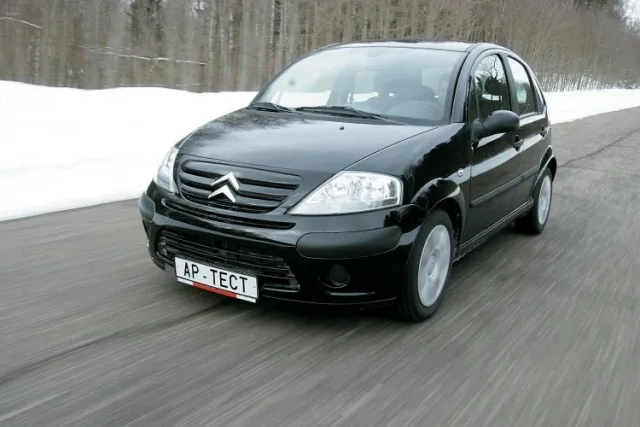
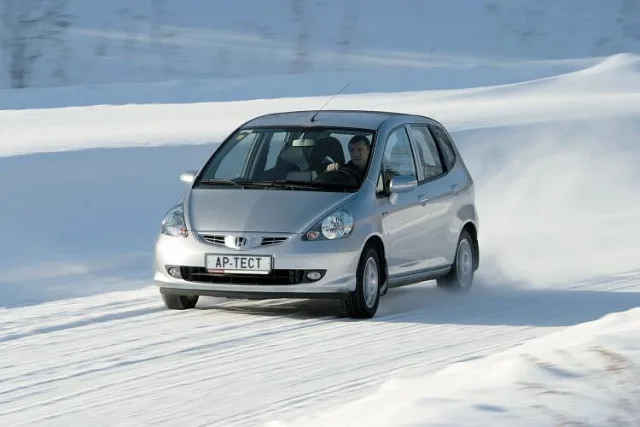
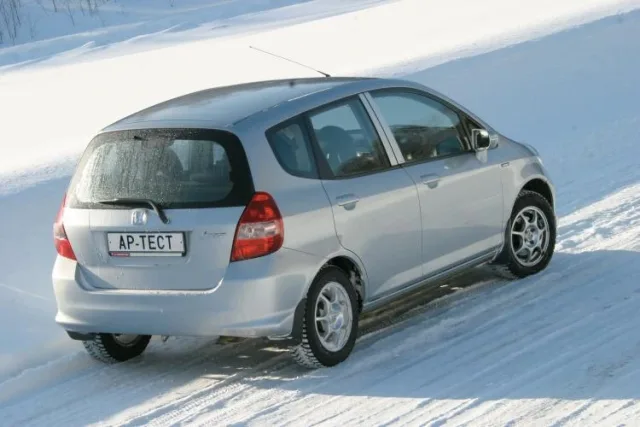
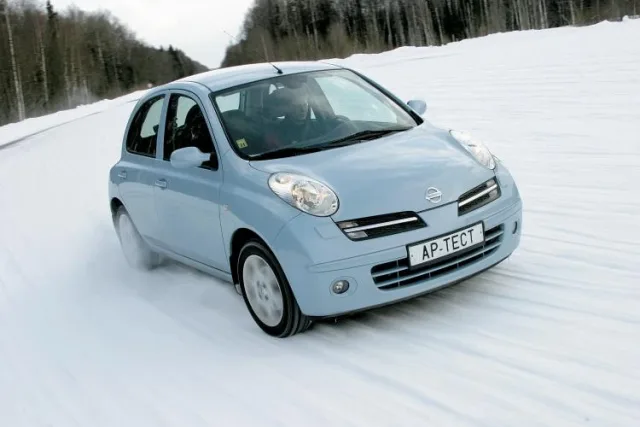
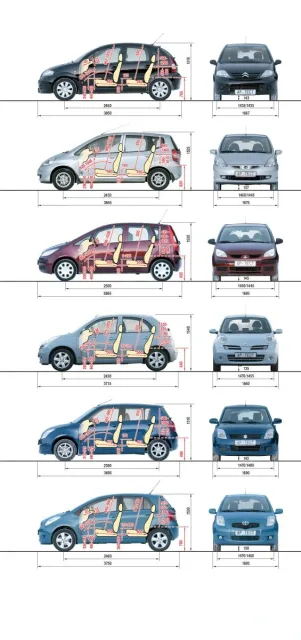
Toyota sellers are clearly aiming at gentlemen. They skillfully turn their weakness for women into commercial gain. The fresh Yaris hatchback, like the new RAV4, arrived at dealers just in time for March 8, saving wealthy men from the headache of choosing a gift for their better half. The calculation is correct. But if we assume that the gift could be another brand, doubts are inevitable. In what ways does the new Yaris surpass such charmers as the Nissan Micra or Citroen C3? And what does it do worse than the Suzuki Swift, Mitsubishi Colt, or Honda Jazz?
One thing is clear: a car for a woman must have two pedals — an automatic, a robotized manual, or a CVT. We took this into account. The Micra has a classic automatic with a torque converter, the Yaris, C3, Colt, and Swift have robotized manuals, and the Honda Jazz is equipped with a CVT.
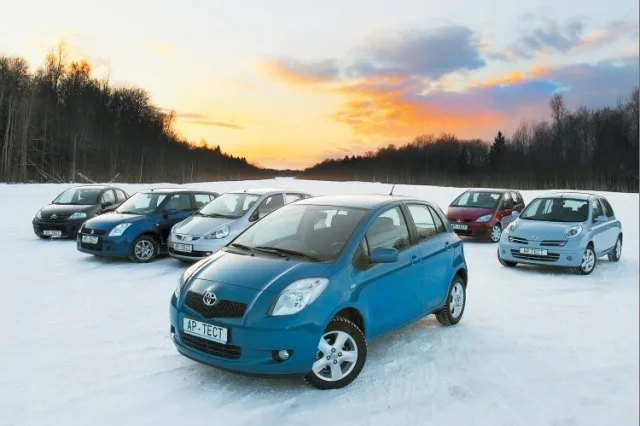
The gifts are not cheap! The most affordable participant in our test — the Mitsubishi Colt 1.3 — is priced at $15,490. That's more than they ask for the base Mitsubishi Lancer! And the Yaris 1.3 we got costs as much as $20,450... In Europe, such cars are much more affordable, so they sell like hotcakes. The first-generation Yaris sold 1.2 million units over six years and became Toyota's most successful model in the Old World. The Japanese attributed the failure of the "firstborn" in Russia to the immaturity of the market. Simply put, they set a price on the Yaris that made it impossible to approach. Especially since a cute Peugeot 206 soon appeared, which cost much less. The market turned out to be quite ready for it. Now, judging by the price tag of the new Yaris, the market has matured for it too.
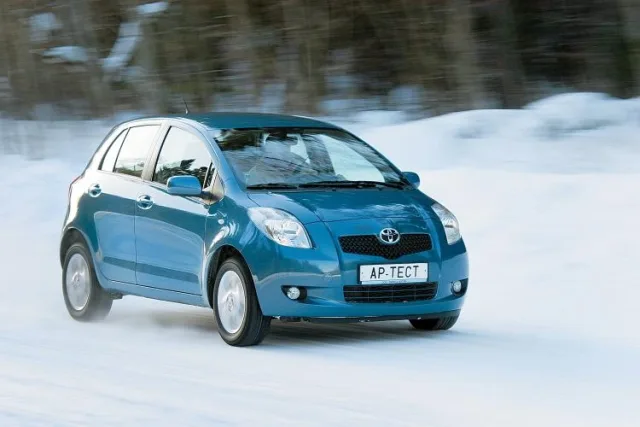
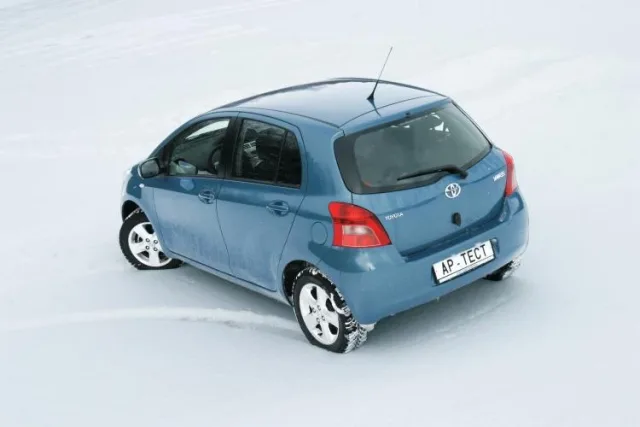
If we set aside the price, it is in this class that design plays almost the main role. And here — choose to any taste! Some will be won over by the "toy-like" nature of the Micra, others by the "hemisphere" of the C3... And the new Yaris seems to have gathered the features of all: it is "one-box" like the Colt, and "rounded" like the Micra. And although compared to its predecessor, the car has lost a lot of charm, it looks fresh and cohesive. But the Yaris's gaze is somehow dissatisfied, as if it just woke up.
 |  |  |
| You need to get used to reading the extravagant instruments | The Yaris has the most original interior with a "central" instrument cluster | In the top R3 version, the engine is started with a button |
The interior is tastefully done. Light plastic on the doors visually "rings" the windows, the symmetrical front panel is decorated with a centrally located instrument cluster and a "traffic light" of microclimate controls, and the front seats have "stampings" in the shape of the letter "Y". To remind you: this is a Yaris. The materials can't be called expensive, but the build quality is impeccable. Six closed compartments for small items are hidden in the front panel, and there are also two open ones on the sides of the central console.
 | |
| The climate "traffic light" is aesthetic but not very practical | The MultiMode gearbox "stumbles" during shifts but works a bit softer than other robotized manuals |
 |  |
| The Toyota has good seats with stylish "stamping" | There is enough space and transformation options in the back |
Behind the wheel, a person up to 190 cm tall can sit without problems, and for those who are shorter, there is seat height adjustment. The only thing missing is an adjustable lumbar support (only the Micra has it) and a greater range of steering column adjustment. Although it adjusts in two directions, shorter drivers want to "pull" the wheel a bit more toward themselves, and taller ones want to raise it higher. But the "donut" itself with audio system control buttons is good, and the digital instruments are at least original — thanks to a clever optical scheme, their readings seem recessed into the bowels of the engine compartment. The microclimate control is also unusual — the vertically arranged knobs can be both turned (to select air temperature or fan speed) and pressed (to control ventilation modes and window heating). It's beautiful but not very convenient: you have to reach for the lower button-knob, and when selecting air flow directions, you need to check the display, which is distracting.
 |  |  |
| The Yaris's front panel is the most "spacious" | Easy Flat system: the backrests fold flush with the floor with one hand movement | |
Visibility in the Yaris has minor complaints: when looking for the exterior mirrors, the eye stumbles upon the corner windows in the doors, and the interior mirror could be larger. But access to the cabin is perfectly convenient: you can open and close the car without taking the key out of your pocket — just press a button on one of the front doors or on the trunk lid. The engine is also started with a button. By the way, a similar "key" is also in the Micra, but there the engine is started by turning a plastic handle.
The Micra's interior, though not as original as the Yaris's, is no less cozy. On the two-tier front panel and doors, there are plastic inserts with a fabric texture, and the climate control buttons and automatic selector are made of "ivory"... But the Micra's ergonomics are not flawless. The steering wheel can move vertically, although it clearly lacks reach adjustment. The seats lack contouring and adjustment ranges: drivers taller than 180 cm are already uncomfortable here.
In the Colt, on the contrary, even a person 190 cm tall has a couple more clicks of the seat rails in reserve (after all, the Colt was created before Mitsubishi's "divorce" from Mercedes, and Mercedes have always been famous for excellent longitudinal adjustment ranges!). The only flaw is the slippery steering wheel, adjustable only for height. But the design is good: the instruments are hidden in deep wells, the round ventilation deflectors are framed with pronounced rims, and the microclimate knobs, audio system, and the pillar under the central console are illuminated in pale green. But the unusual body shape causes visibility problems: the "minivan" pillars interfere with looking to the sides, the exterior mirrors are noticeably shifted back, and as a result, you have to turn your head more.
| Citroen C3: extravagant but not informative | Under the steering wheel — gear shift "paddles" |
There is also a highlight in the Honda's interior. The instruments here are "optitron", and the audio system and climate control buttons are of the rocker type, tick-tock. Unlike traditional buttons, they are easy to manipulate by touch. And duplicate control of the stereo, as on the Micra and Yaris, is placed on the steering wheel. The driver's seat is one of the best in our company, with good lateral support and an impressive longitudinal adjustment range. True, miniature female drivers may find the seat too large, but they can raise it. It's a pity that there is no steering wheel reach adjustment and no footrest for the left foot.
 |  | |
| The C3's interior harmonizes with its exterior | The SensoDrive gearbox is not smooth in shifts | The Citroen has the most inconvenient "climate" control |
 |  |
| Front seats — amorphous and flat… | … and the rear bench is the tightest |
 |  |
| But the glovebox is huge | The C3's trunk is roomy, but it lags behind competitors in transformation options |
 |  |  |
| The Honda's interior is brighter than its exterior | A button on the steering wheel switches the CVT to sequential mode with paddle shifters | Audio and climate control are the most convenient to operate |
 |  |  |
| Honda: the most beautiful instruments in the sextet | Two-tier glovebox in A4 format | The CVT works flawlessly |
 |  | |
| Seats — a dream for the "average-sized" person | The Jazz's rear backrests can be folded, and the cushions lifted | |
 |  |  |
| The Jazz is spacious in the back | Voluminous trunk — with a flat floor | Fashionable repeaters on the mirrors |
 |  |  |
| Micra: stylish interior, but ergonomically not flawless | The climate control "knuckles" are convenient, but the display lens glares |
 |
 |
 |
| The instruments are perfectly readable |
In the glove box there is a tray for documents | By sliding the rear seat forward, you can increase the trunk volume by a third |
 |
 |
|
| The Micra's seats are not ideal — the adjustment ranges are small, and the lateral support is somewhat weak | The rear is a bit cramped, especially for tall passengers |
The Honda's steering wheel behaves quite differently — it transmits almost no information to the driver, and in our company it is the most "empty" steering wheel. For fast driving on a winding road, this is a minus, but in everyday situations it does not cause much trouble: the clearly "relaxed" nature of the Jazz's steering invites a calm driving style, and the suspension treats bumps quite indulgently.
|
|
|
| The instruments are perfectly readable |
In the glove box there is a tray for documents | By sliding the rear seat forward, you can increase the trunk volume by a third |
|
|
|
| The Micra's seats are not ideal — the adjustment ranges are small, and the lateral support is somewhat weak | The rear is a bit cramped, especially for tall passengers |
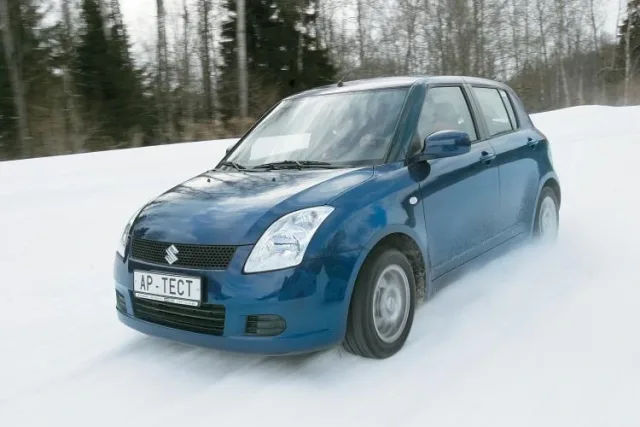
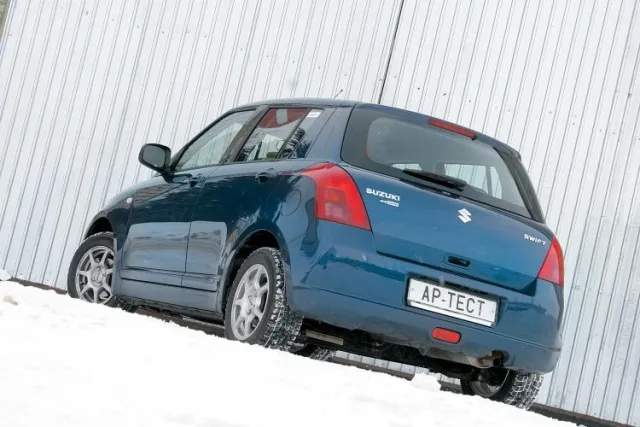
Suzuki, like Honda, almost does not notice bumps in corners. No rocking, no yawing — and the smallest body rolls. On a straight line, the Swift holds perfectly, and the electric power steering, if it yields to the Citroen's in terms of feedback, then only slightly — mainly due to a more stretched "zero". But the reactions to steering turns are just as soft, precise, and predictable, and, unlike the Mitsubishi, at any speed.
On a straight line, the Colt holds up well, and in calm corners it pleases with a decent, albeit slightly artificial, build-up of steering effort. But as soon as you enter a corner a bit more actively, the car squats on the outer rear wheel — and spontaneously "turns" into the bend or, worse, sharply slides into a deep oversteer. To say the least, not the best behavior! Especially given the "sluggish" electric power steering. This car desperately needs a stability control system, but it does not have one — just like all the other hatchbacks (a stability control system can only be installed on the Citroen — naturally, for an extra charge). But if the Colt compensates for this "shortcoming" with a more or less humane price, then the reasons for the absence of stability control systems on the Yaris and Micra are unclear. After all, for the $18,530 that the Micra costs, one would like to have an additional "insurance" — just in case.
The Yaris and Micra can be described in two words: softness and predictability. Both cars readily dive into a corner, confidently hold the line, and even at the limit try to save the driver's nerves — very reliable handling. The differences are only in details. For instance, the Micra reacts more sharply to rough bumps, while the Yaris reacts to ruts. The electric power steering in both cases intervenes too intrusively, but in the Micra the steering wheel is still slightly more responsive.
 |
 |
 |
| Suzuki: the interior is strict and functional | The "E" button can improve the behavior of the "robot", but fuel consumption will increase |
There is no climate control even for an extra charge |
Meanwhile, the Yaris surpasses all competitors in ride smoothness — its ability to swallow deep potholes could be the envy of cars in a higher class, not to mention its classmates. The only thing the newcomer is sensitive to is waves in the road surface: it does not rock on them, but it "renders" all the "ripples" in too much detail. And the Yaris is also the quietest: tires, engine, and wind are almost inaudible. It is no wonder the Japanese "conjured" with the placement of engine mounts, new sound-absorbing materials, and double door seals.
 |
 |
 |
| The instruments are simple and clear, with indication of transmission modes |
The glove box is not large |
The rear seat folds in parts and in two stages |
 |
 |
|
| The Suzuki's seats have a successful profile and a good range of adjustments |
The rear of the Swift is more spacious than the Nissan's, but the seats lack adjustments |
The Honda is slightly less comfortable: on waves, the body rocks a bit, and at speed, aerodynamic noises begin to annoy around the B-pillar. But it is pleasant that the CVT does not make the engine "hang" at high revs during acceleration — they build up smoothly. So passengers can easily listen to jazz or blues...
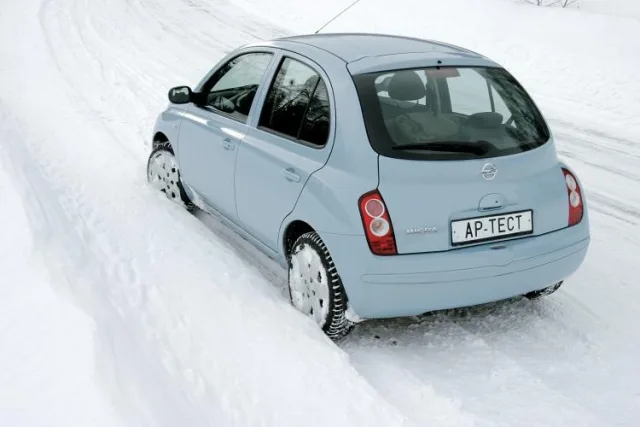
Following the Honda in comfort are Nissan, Suzuki, and Citroen. Mitsubishi closes the list: the Colt has the stiffest suspension, and it reacts more sharply to rough joints and small surface defects. Plus, the Colt is the noisiest: the howl of the engine during downshifts is especially annoying.
So, the main trump cards of the Mitsubishi are the most spacious and multifunctional interior, as well as the price: $15,490.
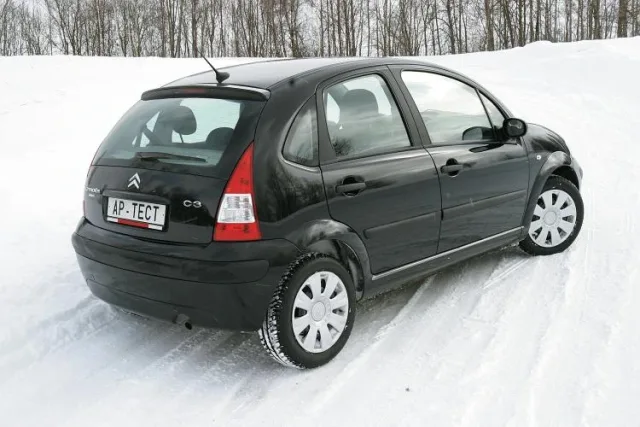
The Citroen looks and handles great, but it is a bit cramped and not too comfortable ($16,360). The Nissan is more spacious and more pleasant to drive, but it is as much as $2,200 more expensive ($18,530). Beauty demands...
The Suzuki is a more traditional car, but no less stylish than the Micra or Citroen C3. It handles excellently, its interior is attractive and ergonomic, and the price is quite competitive ($16,650). In short, the golden mean.
As for the Jazz, which, like the Nissan Micra and Citroen C3, has already celebrated its fourth anniversary, it is expensive for its age ($17,900). But the Honda has a very convenient interior and the most "driver-oriented" powertrain.
Toyota Yaris... This is perhaps the most "high-tech" car in the test. A well-tuned chassis, a spacious and comfortable interior, excellent transformation capabilities, and a level of comfort and equipment that competitors cannot yet reach. In "our" trim level, it had a CD/MP3 stereo, power windows and heated mirrors, climate control, push-button engine start, a full set of "brake" assistants, and seven (!) airbags. But for all this — $20,450. A luxurious gift.
Are they safe?
Small cars are becoming safer year after year — and the results of crash tests by the independent organization EuroNCAP confirm this. All six hatchbacks successfully passed the tough tests!
The leader is the Yaris with the highest rating of five stars and a unique in this class inflatable knee airbag for the driver. True, on the Russian market, the Yaris in the two initial versions is equipped with "only" four airbags. And the side "curtains" for head protection and the "knee" airbag are the prerogative of the most expensive R3 trim, for which the EuroNCAP crash test results are fully valid.
The other hatchbacks are "good students" with four stars out of five possible. These cars also do a lot to protect belted (we emphasize!) occupants in an accident. But there are minor shortcomings noted by experts that affected the reduction of the overall rating. Thus, the Micra was "fined" for the airbag failing to prevent contact of the driver's chest and head with the steering wheel — fortunately, not severe. In the Mitsubishi, the driver's airbag also did not work optimally, and the electric power steering mechanism deformed the floor under the driver's feet. In the Suzuki, sensors recorded increased loads on the driver dummy's chest. And the Honda Jazz and Citroen C3 drew expert complaints in side crash tests.
What's the price?
For the Citroen C3 in the base version, they ask 10,500 euros ($12,915) — this is a three-door with a 60-hp 1.1 engine in the X trim, which includes power steering, a pair of front airbags, central locking, an immobilizer, and front electric windows. The version with the 1.4 SX engine, supplemented with side airbags and heated power mirrors, costs from 11,850 euros ($14,580) on manual, and for the version with the SensoDrive "robot" — exactly the one we tested — you will have to pay 1,450 euros more ($16,300). Slightly cheaper is the C3 1.6 SX (110 hp) with a manual gearbox — 13,150 euros ($16,200). For this engine, the "robot" (+$740) or a classic "automatic" (+$1,990) are optionally available.
The entry ticket to the Nissan Micra world is a three-door hatchback with a 1.2-liter engine producing 65 hp for $12,990, which is equipped with ABS, heated front seats, and a one-piece rear bench (Comfort-M package). In the Comfort trim, where air conditioning and folding rear seats appear, a more powerful 80-hp 1.2 unit is installed — for the three-door and five-door they ask the same, $14,300. For an automatic transmission, you need to pay an extra $1,000. The Tekna version, which includes side airbags, climate control, an audio system, fog lights, and rain and light sensors, exists only in a five-door body and only with manual — the price starts from $16,950, and under the hood can be a 1.2 (80 hp) or 1.4 (88 hp) engine. The top Luxury trim, available with an automatic gearbox, will cost at least $17,750 for the three-door — it was such a car for $18,530 that we got for the test.
The Mitsubishi Colt 1.3 (95 hp) in the starting Invite version for $14,490 pleases with richer equipment than the base Jazz: here there is semi-automatic air conditioning and heated seats. For the version with the 1.5 engine (109 hp) in the Instyle body, they ask $2,000 more, but in return they give four airbags, alloy wheels, fog lights, and electric windows on all doors. Any of the versions can be equipped with a six-speed Allshift "robot" instead of manual for an additional $1,000 — it was such a unit that was on our 1300-cc hatchback.
The Suzuki Swift is offered only in a five-door body and only with a 90-hp 1.3-liter engine — the buyer chooses only the trim level. The initial GLA version for $15,550 already has six airbags, ABS, air conditioning, heated front seats, and power mirrors. The test car with a robotic transmission costs $1,100 more. The flagship GLX for $17,670 adds an audio system, fog lights, 15-inch wheels, and a chip key, familiar from the Micra and Yaris. True, climate control is not offered even for an additional fee.
The Honda Jazz 1.2 (78 hp) in the base costs $15,900, although it already includes four airbags, ABS, air conditioning, electric front windows and mirrors, and a CD player. For $16,900, the 1.4 LS version is available with an 83-hp engine, climate control, improved trim, and different optics, and the version with the CVT-7 variator and side airbags already costs $17,900.
The most expensive in this company is the Toyota Yaris. It is always a five-door hatchback with a 1.3 engine (87 hp), available in three variants. The base R1 version for $17,390 includes four airbags, air conditioning, an adjustable steering column, front electric windows, heated seats, and a CD/mp3 radio. For the R2 with the MultiMode automated gearbox, they ask $600 more, and the top R3 for $20,450 adds climate control, keyless entry, curtain airbags, a "knee" airbag, fog lights, and alloy wheels.
All five models are covered by a 3-year or 100,000 km warranty.
Before this test, on the website www.autoreview.ru, we conducted a survey: "Which car from the upcoming Autoreview test would you choose?"
The votes were distributed as follows:
Citroen C3 — 8.0%
Honda Jazz — 18.8%
Mitsubishi Colt — 13.8%
Nissan Micra — 6.1%
Suzuki Swift — 13.7%
Toyota Yaris — 39.6%
A total of 12,199 people voted
| Expert Ratings from Autoreview | |||||||
| Parameter | Max Score | Citroen | Honda | Mitsubishi | Nissan | Suzuki | Toyota |
| Design | 160 | 140 | 135 | 140 | 140 | 140 | 145 |
| Exterior | 80 | 70 | 65 | 70 | 70 | 70 | 70 |
| Interior | 80 | 70 | 70 | 70 | 70 | 70 | 75 |
| Ergonomics | 160 | 120 | 130 | 130 | 120 | 140 | 125 |
| Driver's Seat | 80 | 60 | 70 | 65 | 60 | 70 | 65 |
| Visibility | 80 | 60 | 60 | 65 | 60 | 70 | 60 |
| Dynamics | 280 | 215 | 230 | 225 | 235 | 240 | 225 |
| Acceleration | 90 | 65 | 75 | 70 | 70 | 75 | 65 |
| Braking | 100 | 80 | 80 | 90 | 90 | 90 | 90 |
| Handling | 90 | 70 | 75 | 65 | 75 | 75 | 70 |
| Ride Comfort | 200 | 150 | 160 | 145 | 165 | 155 | 180 |
| Ride Smoothness, Vibration | 80 | 60 | 65 | 60 | 65 | 60 | 70 |
| Acoustic Comfort | 60 | 45 | 45 | 40 | 45 | 45 | 55 |
| Climate Control | 60 | 45 | 50 | 45 | 55 | 50 | 55 |
| Interior Comfort | 200 | 125 | 140 | 165 | 140 | 145 | 145 |
| Passenger Seats | 70 | 40 | 55 | 55 | 45 | 50 | 55 |
| Trunk | 70 | 50 | 40 | 55 | 50 | 55 | 40 |
| Interior Transformation | 60 | 35 | 45 | 55 | 45 | 40 | 50 |
| Total | 1000 | 750 | 795 | 805 | 800 | 820 | 820 |