
Citroen C3 Picasso
PICASSO
Engine — 1.4 L
Max power — 95 hp
Max torque — 135 Nm/4000 rpm
Max speed — 178 km/h
Acceleration to 100 km/h — 12.2 s
Fuel consumption:
city — 9.2 L
highway — 5.6 L
combined — 6.9 L
5-speed manual
Curb weight — 1334 kg
Tires — 195/55R16
Suspension: front — pseudo McPherson,
rear — torsion beam
Equipment:
Air conditioning with cooled glove box, cruise control,
power mirrors,
audio system with 6 speakers, tables in front seat backs, ABS, REF, AFU, 6 airbags
Service interval:
15,000 km
Service 1 — $208 (1,657 UAH)
Service 2 — $208 (1,657 UAH)
Service 3 — $208 (1,657 UAH)
Service 4 — $314 (2,505 UAH)
Price: 555,000 UAH
Base trim — $16,842 (134,730 UAH)
Marat Makhmutov, «Kazan School of Higher Driving Skills»
This time, our focus was on another representative of the French auto industry — the Citroen C3 Picasso. We had barely said goodbye to the Peugeot 207 hatchback when we met another guest from France. Moreover, the connection between these cars is not only ideological: both belong to the PSA concern, and the C3 Picasso even shares a platform with the 207 and the regular C3.
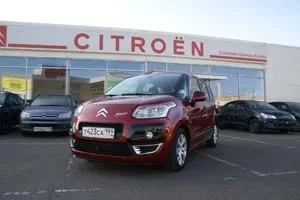
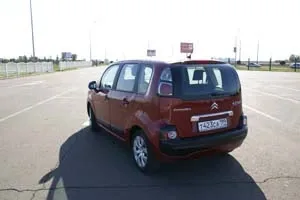
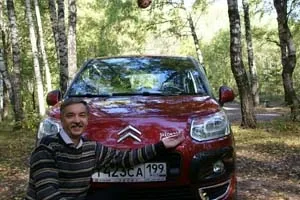
On a sunny September morning, a compact, neat microvan in red appeared on our site. This bright color seemed to deliberately emphasize the beauty of fading nature — the combination of yellow-green hues and a rich red body looked surprisingly harmonious. On the fully closed front section, where the fake radiator grille is usually located, next to the manufacturer's emblem, there is a facsimile of the great impressionist. The air intake is made in a sporty style — wide and low, and on the sides it is complemented by round fog lights. The classic one-box layout here is supplemented by a small but distinctly protruding hood.
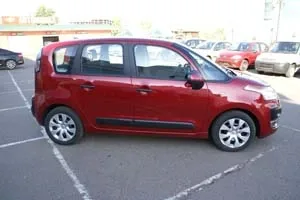
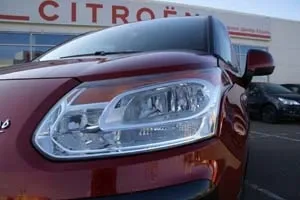
It seems the designers managed to find a successful compromise between one-box and two-box bodies. Behind the hood begins a rounded-cubic part that, with modest external dimensions (only 4.08 m in length), allows for a spacious interior and maximum comfort for the driver and passengers. Familiar notes of the «Berlingo» can be seen in the exterior, but the design is clearly refreshed in a modern key. The C3 Picasso has a friendly «face» with large headlights with pointed corners, and the rear lights, located somewhat unusually, visually continue the line of the rear window. Overall, the exterior is quite worthy of bearing the autograph of the famous artist. And what about the inside — is everything so extravagant?
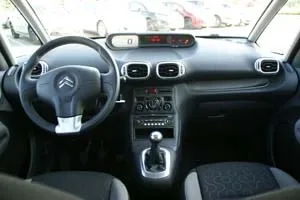
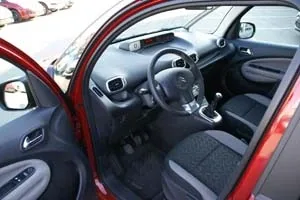
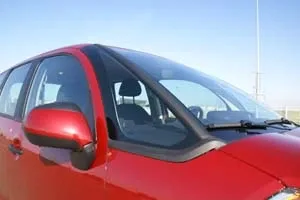
The interior is also full of pleasant surprises. Despite its fairly compact size, the microvan can boast a huge glazing area: without the panoramic roof it is 3.4 sq. m, and with it (optional) — already more than 4.5 sq. m. Our car did not have a panoramic roof, but even without it, visibility, especially through the front pillars, turned out to be excellent. This is largely due to the large, heavily raked windshield and triangular windows behind the thin pillars. It feels as if there are no pillars at all, and the vent windows are just a continuation of the «windshield». I was comfortable behind the wheel, although there are questions about ergonomics. Due to the layout, the seats are installed high, almost like in a bus — this is how they fight for capacity. But the handbrake lever is hidden somewhere deep down, and you have to reach for it. You can forget about any «police turnaround» with such a handbrake…
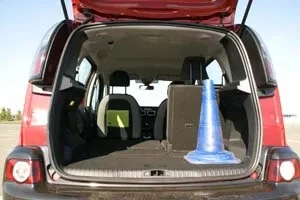
In the back, two people will sit comfortably, with enough space both in length and width. The rear bench can be moved forward and backward by 150 mm, and it is split — each part can be moved separately. Depending on the seat position, the trunk volume also changes: from 385 L with the bench pushed all the way back to a quite respectable 500 L if moved forward. And if you fold the seat completely, you get 1.5 cubic meters of regular geometric shape — it can accommodate both solid luggage and bulky household items.
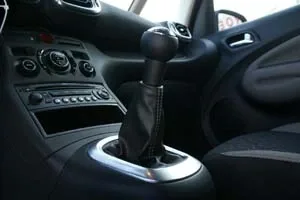
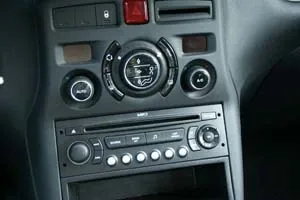
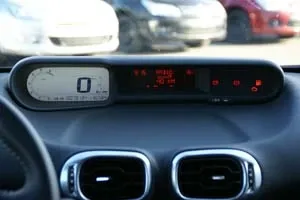
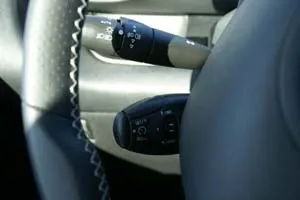
The two-tier front panel looks very refined, and the air vent grilles are additionally trimmed with «aluminum-look» material. Again, that French charm — the Peugeot 207 immediately comes to mind! The top of the panel and the armrest inserts are made of soft, pleasant-to-the-touch high-quality plastic, while the lower part and other details are already made of hard plastic. The instrument cluster itself deserves special attention. Despite the seemingly familiar central placement, here it is three-section and has its own features. The section closest to the driver shows the most important information: speed, rpm, mileage, and fuel level. I admit, I am not a big fan of such instrument placement, but here the panel is installed directly under the windshield and made semi-transparent — data can be read with peripheral vision without taking your eyes off the road. This is very convenient and informative (I repeat — specifically on this car). The speedometer numbers are so large that it is simply impossible not to notice them. The middle section is responsible for radio settings and service messages, and the far right is given over to warning indicators: open door, low oil level, and the like.
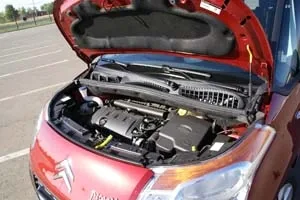
Now about the driving characteristics. Under the hood of this Citroen is a 1.4-liter gasoline engine with 95 hp, paired with a manual transmission. The range also includes a 1.6-liter gasoline unit and two diesels, but we got exactly this version. At first, the power and displacement figures did not impress, but everything changed as soon as we moved off. It turned out that even with four adult men in the cabin, the C3 Picasso accelerates quite briskly, and without revving the engine to a scream — everything happens within decent acoustics. So much for the «family slowpoke»! True, there were complaints about the selectivity of the manual transmission. Each of us made at least one mistake in gear selection — I, for example, managed to engage fifth instead of third. You can get used to this, as with domestic cars, but you expect more from a modern, beautiful car. Perhaps the appearance of versions with an automatic or robot will solve this problem — but that is a question for the near future.
The chassis, inherited from the 207 but loaded with almost 100 kg more, pleasantly surprised. The ride smoothness exceeded all expectations: while we drove along city roads towards the suburban area, it seemed that road workers had perfectly leveled the asphalt overnight and filled all the potholes — so soft and comfortable was the ride. And this medal has a flip side, which, to our surprise, turned out to be not negative at all. Usually, a stiff suspension means good handling, while a comfortable one means roll and vague behavior in sharp maneuvers. But the «slalom» test showed that it is possible to combine seemingly incompatible things. In my opinion, completing this exercise at 75 km/h for such a tall car is an outstanding result, all thanks to a perfectly balanced chassis. Within its class, of course. On the highway, the coordinated operation of the engine-gearbox pair also pleased: the Citroen quickly reached the permitted speed and imperceptibly allowed acceleration to almost twice that (test drive!). Also, on the suburban highway, I really liked the large exterior mirrors — everything is perfectly visible in them, and at high speed they do not make the slightest whistle.
In the end, I can admit: the C3 Picasso won me over with the combination of all its practical qualities. If a family needs a single car for everything, this is a very worthy candidate. If only it had an automatic... And, by the way, there are rumors that the reliability of this model is noticeably better than before.
Vadim Sadykov, «Autoclub-Kazan»
In the West, the station wagon or minivan format has long been held in high esteem: there, a family often has several cars — a small car for the city, a station wagon, a crossover. A minivan is great for supermarket shopping, long trips, or transporting all sorts of things. But for such a car to have acceptable dynamics, you need to put an engine of at least 1.8 or 2.0 under the hood, and they also have problems with fuel efficiency given their solid mass. So the idea was born to make a car in the same concept but more compact — a microvan. And this approach appealed to many. Judge for yourself: a 1.4 or 1.6 engine is enough; the modest width (almost like a B-class) simplifies maneuvers in the city; and the cargo area with the rear seats folded is ready to accept almost anything. An inexpensive car that is an ideal city dweller on weekdays, and on occasion — almost a truck. Isn't that a dream for most drivers?
This is exactly the car we intended to test. The memory of meeting its older brother, the C4 Picasso minivan, which impressed us with its smooth ride, spacious interior, and exemplary operation of the 6-speed robot, is still fresh. Here, alas, an automatic is not provided — only a time-tested 5-speed manual. But we don't set off right away: while Alfred is busy filming the car, I have time. I settle into the back row and study the specifications. And then the door unexpectedly opens, and I hear Alfred's voice through laughter: "You're sitting like in an office!" And indeed — I didn't notice how I lounged, crossing my legs, and there's still plenty of free space around. Time to tear myself away from the papers and look around. The ceiling is high (I didn't sit in a papakha, but I suspect I would have fit anyway), there's plenty of space both in front (though that won't surprise anyone — push the seat back, and done) and in the back. The rear seat backs can be reclined. Not quite as much as I'd like (you can't get semi-reclined), but the very possibility of adjustment is pleasing. Finding a comfortable position is easy.
Okay, let's get back to the numbers. Power — 95 hp at 6000 rpm. Not bad, but there are more powerful 1.4s. However, peak power isn't the main thing for a city car. On the track — yes, there you squeeze out every drop, but in city traffic, how often do we rev the engine to at least 5000? Much more important is low-end torque. Unfortunately, assessing it from just the numbers in the table, without torque and power graphs, is only approximate. But rough estimates are possible. The maximum torque here is 135 Nm at 4000 rpm. A lot or a little? Let's compare. The Opel's same 1.4 produces 125 Nm at the same 4000. It's impossible to say with 100% certainty that at 3000 rpm the C3 Picasso's pull is better than the Opel's (we don't have graphs), but it looks very plausible. After all, an 8% power advantage at 4000 rpm is unlikely to evaporate to zero at 3000. The attentive reader, I hope, noticed that the talk about torque smoothly transitioned into talk about power. But there's no contradiction here: P(power)=C(constant coefficient)*Mcr(torque)*N(rpm). The coefficient C varies — it depends on the units of measurement. Power can be measured in hp (and English ones differ from European ones), or in watts. Torque is most often in Nm, but KIA, for example, prefers kgm. So it's safe to say: at 4000 rpm, the C3 PICASSO's engine is more powerful than the Opel's by a solid 8%.
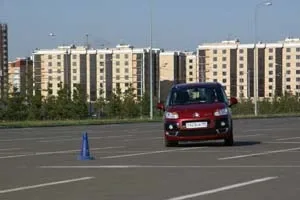
"Practice is the criterion of truth." No matter how much you guess from the specifications, only real driving in different modes will give the full picture. My first acquaintance with the C3 Picasso behind the wheel happened on the test site, during the "slalom," and here disappointment awaited me: the gearbox is somehow vague, third gear is hard to find. And the clutch pedal — you need to get used to it. In short, I wouldn't recommend this car to a beginner — they'll suffer. And an "automatic" in the form of a robot or torque converter is still only in the plans. But, surprisingly, such a tall car behaved quite decently in the "slalom": if you don't demand the impossible from it, the trajectory remains adequate and predictable. I'm sure this reserve is more than enough for the city. But on the highway, the car pleased even more: it holds the road tenaciously, overtakes confidently (given the modest 1.4). The favorite winding country road was also conquered without problems, but there was no desire to exceed the speed limit — the limit of the safety margin was felt. Although, honestly, handling exercises aren't that important for a microvan. Besides comfort and decent dynamics, the cargo aspect is important here. Alas, if you go south with a large family, there will be barely enough space for luggage. The choice is simple: either we go with kids and a minimum of things, or the two of us — fold the rear seats and load as much as fits. There's no third option, unlike a full-size minivan. The trunk is frankly small. But the microvan was conceived as a purely city car, capable of transporting a lot of goods on occasion.
I just can't get used to the new prices. The C3 Picasso 1.4 with a couple of options — total 602 thousand rubles. By today's standards, that's, of course, not expensive. I understand with my mind. But I can't get used to it.

Alfred Mardanov, "Autoclub-Kazan"
The Citroen brand in our country, unfortunately, doesn't enjoy the popularity it deserves. I recall that in our tests, every Citroen caused either pleasant surprise or genuine delight. It all started with the C4 — it pleased with its behavior, style, and fresh technical solutions, especially regarding the instrument panel. Then there was the C4 Picasso, which simply stunned Vadim and me. The magnificent, thoughtfully designed interior and the robotic 6-speed gearbox still remain the benchmark for us. The C5 turned out to be like a control shot to the head that resisted and didn't want to succumb to Citroen's charm. I can't describe the feelings in two words — the car turned out to be so interesting that we sincerely wondered why they are so rarely seen on our roads. And now another Frenchman with a double chevron on the hood stands, bathed in the rays of the autumn sun, at the entrance to the dealership. At first glance, I immediately noticed its resemblance to the recently released Kia Soul. And this is no coincidence — ideologically, these cars are direct competitors. But credit must be given: Citroen doesn't try to pass the C3 off as a crossover and doesn't put it in the same league as them, unlike the Koreans. The French consider it an ordinary city compact van. I rarely enjoy the process of photographing a car, but this case is an exception. It's not even ten in the morning outside, it's not May on the calendar, and I'm in a light shirt, but I'll do my job even if I freeze completely. The car, like a professional photo model, willingly poses, showing off its forms. The dealership managers claim that the C3 Picasso's trunk is larger than the Kia Soul's (sorry for the comparison), I can't determine that visually, and I don't remember the specifications by heart. But the fact that the rear seats can be slid forward, freeing up additional space, is indisputable.

If you need more space, just fold the rear seats — and you get a flat area with the trunk. Moreover, the trunk itself is cleverly arranged: it has a small convenient compartment for small items. Overall, the car is literally packed with pleasant details. For example, a cooled glove box or a magnet that holds the seatbelt of the middle passenger and prevents it from dangling, creating extra noise. There's even a small mirror to keep an eye on rear passengers — convenient if there are children.
The first thing that wins you over in this car is the incredible feeling of spaciousness in the cabin. High ceilings, large windows all around, and thin pillars provide excellent visibility. The unusual design, non-standard trim materials, and the unconventional instrument panel create a special atmosphere inside. What can I say, the picture turned out interesting. Outside, the car, like many modern models, seems quite compact, but inside it turns out to be if not huge, then definitely roomy. I remember how Vadim sat in the back with his leg crossed, and nothing bothered him, and there was still space left to the front seat.
So, the photo shoot is over, time to test the car in action. This time we're going to the test site near the hippodrome. But first, we need to refuel, otherwise we won't make it. We pull into a gas station with the dealership manager, and then I notice that the fuel tank cap is locked with a key. This is quite inconvenient — you have to turn off the engine, give the key to the attendants, and so on. A whole hassle. I'm used to the flap opening from the cabin, without any keys.
On the way to the site, it becomes noticeable that the car's character is calm, with a good balance between comfort and handling. But the engine... seems not as simple as it appears. Back at the dealership, they told us it's a joint development with BMW, and the Bavarians certainly know a thing or two about engines.

Let Vadim describe the technical side of the engine — he loves to rattle off specifications and terms. I'll just say that the engine amazes with its elasticity. On the test site, the car, contrary to expectations, showed a rather interesting character. Marat and I both completed the slalom at 75 km/h, and at 78 (mine) and 79 (Marat's) we already missed the last gate. Despite the high center of gravity and quite comfortable suspension, the car responds excellently to the steering. 75 km/h is not a record, but for such a car, it's very respectable.
After the slalom — the familiar route along the highway with the "washboard." And here's what's interesting: we got so carried away in conversation that we almost missed that very "washboard." I was the first to come to my senses, exclaiming where we were even driving. The car, meanwhile, rolled along calmly and, notably, didn't bother us with shaking at all. Reactions to bumps are elastic and dense. Everyone liked that without exception. And when Marat easily accelerated the C3 to 157 km/h, and the aerodynamic noise came only from the rear windows, not from the expected "burdock" mirrors, we were simply surprised. Many cars, for the sake of design, suffer from blind mirrors, but here there are informative "burdocks" that also don't whistle.
In the city bustle, I stalled a couple of times — the late clutch is to blame, it takes getting used to. But the brakes are perfectly tuned: the pedal effort is dosed precisely, and they work accordingly. The overall impression is that Citroen has again remained true to itself and provided plenty of pleasant moments. A very interesting car: it's good on long trips and looks harmonious in city traffic. Many pleasant little details do their job and create a coherent, very positive picture. And the chassis tuning and excellent engine are simply beyond all praise.