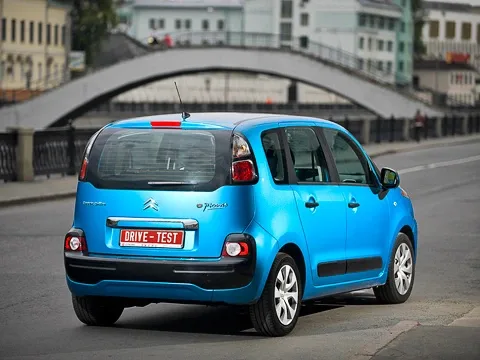
We keep circling around this little one and just can't get over it. Just take a look at it! A three-tiered face with intricate headlights sticks out of the body shell. The windshield is unusual—its sections flow onto the sides, and the rear is also non-trivial, with glass noticeably curved at the back. Pablo Picasso wouldn't mind if rumor attributed such a creation to him.
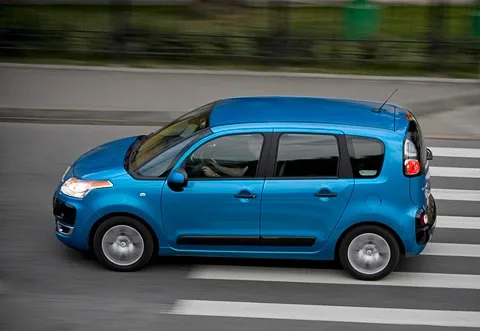
Unfortunately, the test car didn't have a stability control system. But if your driving style is calm, you won't worry about it—the grip limit in corners for this Citroen is quite high.
The exterior attracts the glances of passersby. We deliberately parked on Chistoprudny Boulevard, as if to study the interior. We move things, fold them... And we note the behavior of those around us. The first victim of curiosity—an employee of the Kazakh embassy. Question after question, and in the end we chatted for about forty minutes. And all about the "Frenchman."
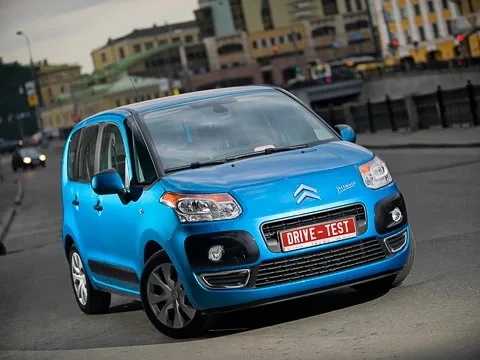
Our Citroen wasn't equipped with a panoramic roof, which turns an already transparent car into a real aquarium.
Women break into smiles, children in the yard, dropping their toys, run to the blue "wagon" at full speed, men approach and gladly ask about the car. Our C3 was photographed a couple of times in traffic jams, and a young artist with a tablet, crossing the road in front of the "cube," gave a thumbs up. That's right!
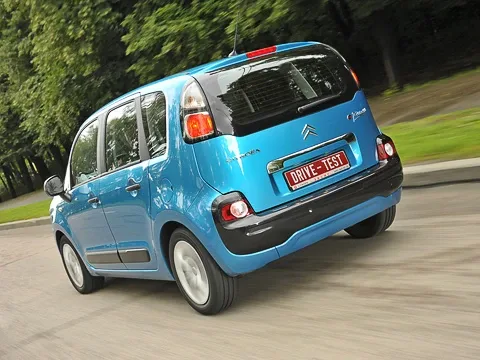
The upward-curving glass on the tailgate door appealed to us only because of its original design. It's non-functional: the rear wiper, passing over the curved part of the glass, can't clean it.
And yet, for a family car—a separate calibrated family. My friend and his two boys know a thing or two about cars. The kids are absolutely delighted, and the father can barely hold back a smile. The rear seat can be slid back by 150 mm, so even two tall people of similar build can, if desired, sit one behind the other, keeping a five-centimeter gap between knees and the front seatback. Above the head—complete freedom! And the quietness in the cabin would be envied by many representatives of the golf class.
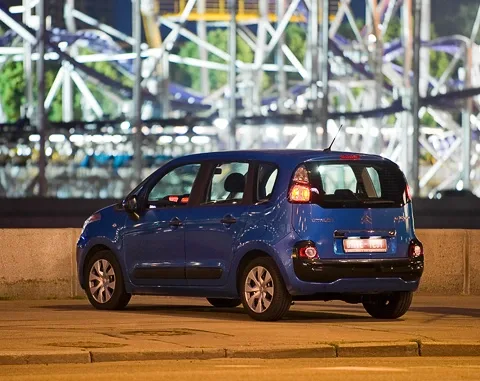
The fancy configuration of the rear lights is good from a safety standpoint: turn signals are visible in traffic, and the reverse light also does its job perfectly.
And the ride smoothness is such that all the road small stuff, rare cobblestones, potholes, and cracks are mostly digested by the Citroen's suspension. What remains is just a light sound background. It's like floating on a cloud. And only when driving over protruding thermal expansion joints on overpasses or large potholes does the "Frenchman" shudder with a clang throughout its body. True, passengers pay for comfort with rocking: longitudinal, lateral, diagonal... Nose dives during braking are also noticeable.
So with the C3 Picasso, you can forget about energetic cornering on Moscow region roads. Anyway, the high seating position doesn't encourage it. The seats are moderately firm, but with a short cushion and no lateral support. Adjustments are also scarce: a tall driver is unlikely to sit perfectly. You slide the seat back for legs—you can't reach the steering wheel. You move forward—you stomp on the pedals from above.
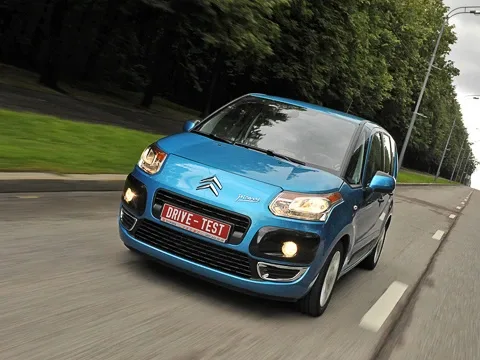
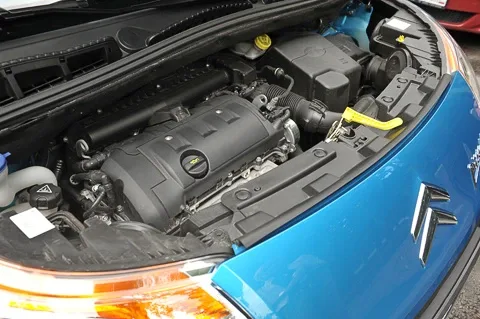
The main source of noise in the cabin is not at all the wind turbulence around the tall body or large mirrors. Aerodynamics is surprisingly good. Unlike the sound insulation of the wheel arches and engine bay—the hum from tires and the loud grumbling of the engine after 3500 rpm intrude into the cabin persistently.
The steering wheel moves in reach within a tiny range. But for its shape, we give it a "five plus"—many "hot" cars would envy it. However, in motion, the steering is too light and uninformative, and the Picasso responds to its deviations with laziness, leaning heavily. Handling is exceptionally reliable: the car holds its line to the last, and in extreme modes it gently slides with the front axle, which is easy to correct by lifting off the gas pedal.
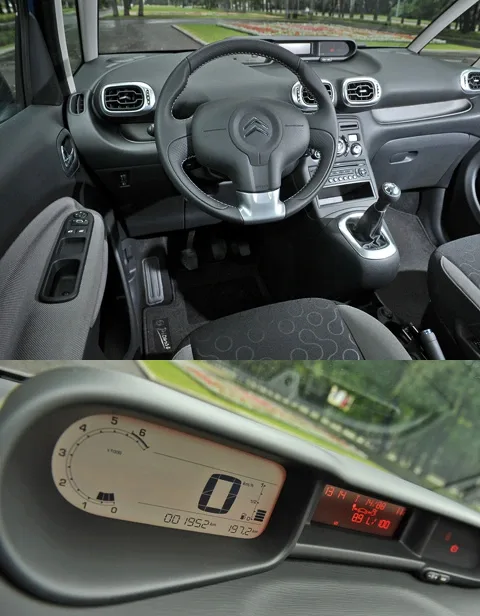
In the "designer" interior—only the upper part of the front panel is made of soft plastic. But what a trim texture! As if water flows along the clay bottom of a river.
The stylishly designed and comfortable "manual" lever turns out to be anti-driver in practice: with long throws and vague engagement. In addition, it delivers the whole bouquet of transmission vibrations into the driver's palm. So calm down and think about the family settled in the cozy cabin. French engineers made sure you don't feel like darting through corners, and you'll have more than enough longitudinal dynamics.
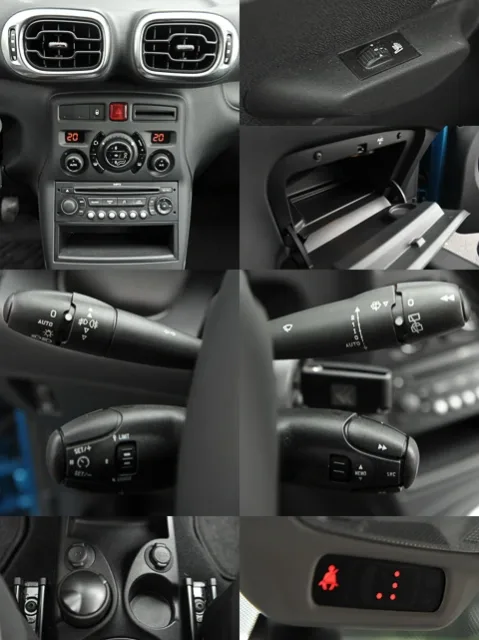
Despite ergonomic miscalculations like the uncomfortable seat and lack of backlighting for the knob that adjusts seat heating, being in the cabin is pleasant. It's all about sensations: the pleasant leather of the steering wheel gives rest to your hands, and your nose eagerly inhales the aroma of a new cabin. Only Citroens smell like that!
The test car—with the "four" 1.4 Vti (95 hp), developed by the BMW group. At low revs it sleeps, after three thousand revs it shakes off its drowsiness, and at four it's already vigor itself. True, you can expect adequate acceleration from it only up to 120 km/h. And is it worth paying extra for the BMW 115-horsepower 1.6 Vti engine? Our answer is no. Don't disturb the harmony.
Anyway, you're unlikely to be able to race at full speed in the presence of, say, your spouse. She will be your non-disableable speed limiter. The graphics of the large display on the front panel are too clear. There's speed on display, engine revs, and even in large symbols—everything needed to scare your better half.
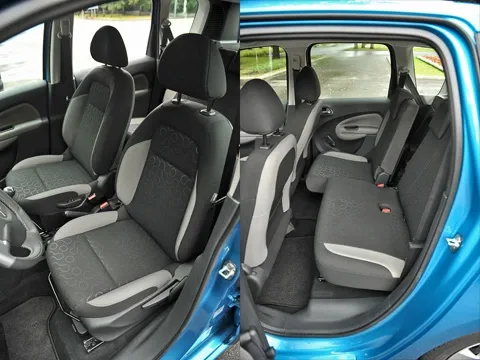
The second row of seats in the Citroen is quite comfortable, despite the frankly flat bench. Special thanks for seating comfort go to the high roof, the almost unnoticeable central tunnel, and the adjustments provided for the rear seats. The bench moves forward-backward within 150 mm, and the backrests recline by 5 degrees. By the way, for an extra charge, you can also get tables that grow out of the front seatbacks.
People don't buy a Citroen to scare their wives. For that, as we know from advertising, there are Kia cars. The Picasso, however, is a real Citroen. And a "Frenchman." If it's not a handsome car, it's at least charming. Its forte is positive emotions. And Carlos Bonzanigo's design is just one of the strong points of the "C-three." What about, for example, the interior transformation! Parts of the rear bench, divided in a 2:3 ratio, fold flush with the floor with a light movement of the hand.
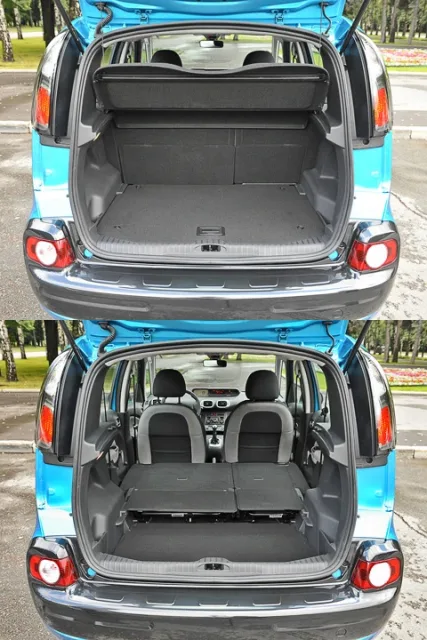
The cargo area pleased with a wide opening and low loading height. By the way, 385 liters of volume was enough for us for a couple of large suitcases and a bunch of other small items. The latter can also be stowed in the compartment under the removable floor.
Plus decent equipment for 499 thousand rubles—that's exactly what they ask for the standard C3 Picasso minivan. The base includes ABS, two airbags, power-adjustable and heated side mirrors, and, of course, a full set of adjustments for the rear bench. The only thing that could mar the picture is the lack of automatic transmissions. However, a bit later the French promise a robotic alternative to the awkward "manual." That's when this will be one of the most harmonious cars in its class. The main thing is, when getting behind the wheel, to tune in to the wave of a peaceful family future.
Technical specifications
| Model | Citroen C3 Picasso |
| Body |
| Number of doors/seats | 5/5 |
| Length, mm | 4078 |
| Width, mm | 1730 |
| Height, mm | 1624 |
| Wheelbase, mm | 2540 |
| Track front/rear, mm | 1472/1470 |
| Curb weight, kg | 1259 |
| Gross weight, kg | 1742 |
| Trunk volume, l | 385–500 |
| Engine |
| Type | petrol |
| Location | front, transverse |
| Number and arrangement of cylinders | 4, in-line |
| Number of valves | 16 |
| Displacement, cc | 1397 |
| Max power, hp/rpm | 95/6000 |
| Max torque, N•m/rpm | 135/4000 |
| Transmission |
| Gearbox | manual, five-speed |
| Drive | front |
| Chassis |
| Front suspension | independent, coil spring, McPherson |
| Rear suspension | semi-independent, coil spring |
| Front brakes | disc, ventilated |
| Rear brakes | disc, ventilated |
| Ground clearance, mm | 174 |
| Performance characteristics |
| Maximum speed, km/h | 178 |
| Acceleration time from 0 to 100 km/h, s | 12.2 |
| Fuel consumption, l/100 km |
| — urban cycle | 9.1 |
| — suburban cycle | 5.5 |
| — combined cycle | 6.8 |
| Toxicity standard | Euro-4 |
| Fuel tank capacity, l | 50 |
| Fuel | AI-95 |
Citroen C3 Picasso trim levels
Standard equipment
- Front airbags
- ABS
- Electric power steering
- Front electric windows
- Immobilizer
- Anti-theft system
- Electrically adjustable and heated rear-view mirrors
- Central locking
- On-board computer
- Steering column with tilt and reach adjustment
- Audio preparation
- Space-saver spare wheel
Additional equipment
- Side airbags and inflatable “curtains”
- Dual-zone climate control
- Heated front seats
- Front fog lights
- Audio system with MP3 support and six speakers
- Cruise control
- Rain and light sensors
- Leather-wrapped steering wheel and gear lever
- Metallic paint
Price of base trim — 499 thousand rubles
Price of tested car — 595 thousand rubles
Technology
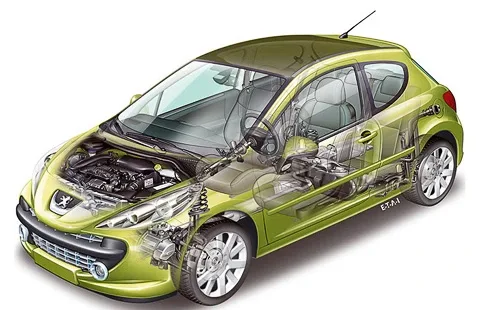
The platform on which the Citroen C3 Picasso is built is the old “cart No. 1” from PSA Peugeot Citroen. It debuted back in 1998 on the Peugeot 206 hatchback. For the new compact MPV it was refined: the wheelbase was increased, the track was widened, and the rear suspension was slightly modernized, leaving a torsion beam. This same version of the platform is also used in the Peugeot 207 family.
Under the hood of our car is a 1.4-liter petrol unit producing 95 horsepower and 135 newton-meters. This engine with distributed injection and variable valve timing belongs to the Prince family, which was fully designed by BMW engineers. These engines are assembled at Peugeot plants. The same story applies to the more powerful 1.6-liter “four” (115 hp, 160 N•m) — it also has distributed injection.
Behind the scenes
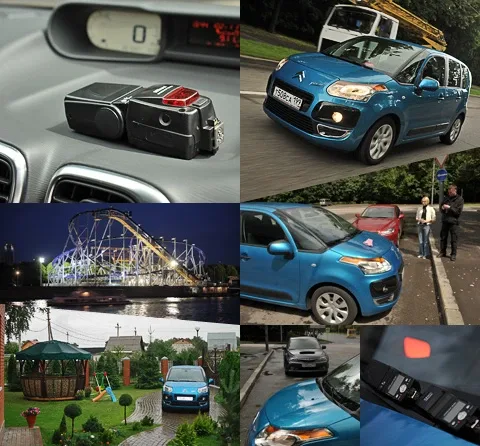
The ideal environment for the C3 Picasso is a country house with a well-kept lawn, scattered toys, and running children. It is this atmosphere that best highlights the character of this car. By the way, our photographer Vlad Klepach noticed that on the clean sides of the “Frenchman,” the light from the flashes falls almost perfectly.