
Citroen C2. Yin or Yang
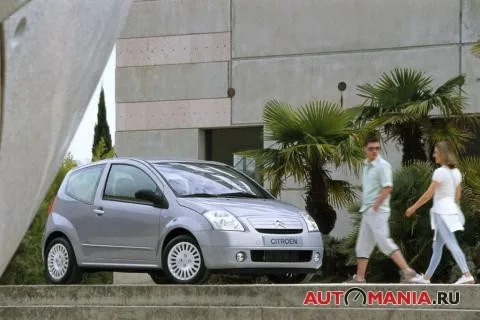
In Europe, small cars have long become a common means of transportation, and their compact size is considered more of a plus than a minus. There, no one is surprised that a successful businessman or a housewife drives such a car — the gender and status of the driver are irrelevant. It's just that such cars are more practical and economical to operate. In our country, however, for some reason, a stereotype has taken root that such cars are exclusively a women's option. It seems it's time to get rid of this prejudice.
Take a look at the Citroen C2: despite its modest dimensions, it looks so fit and muscular that you wouldn't dare call it "feminine." Unlike the more subdued and elegant C3, this little one's appearance clearly reads sporty notes and even some aggression. The swift front end with large three-dimensional optics and a radiator grille crossed by wide horizontal stripes, almost flat side panels, a broken window line emphasizing the contours of the doors, non-standard geometry of the glass and rear lights... In short, we have a small, stylish, but at the same time daring and fast car for energetic people. It is built on the same platform as the C3, so about 60% of the components and parts are shared.
Inside, this kinship is also felt. The front panel, seemingly floating above the floor, round ventilation deflectors, a leather-wrapped steering wheel with three spokes, climate control and stereo control units on the center console — all this is already familiar from the C3, so the C2 doesn't shine with originality here. Ergonomics also didn't become a revelation: like the "big brother," this Citroen doesn't have everything smooth with it. Despite the sporty seat profile, their lateral support is somewhat weak — in corners, you have to hold yourself in place by force. The seats themselves are clearly designed for a driver of average build, and a larger person will find them too small. Because of this, the back and legs are constantly tense, and after a couple of hours they start to ache. So for long trips, it's better to look for something else, but for short city commutes, these shortcomings are not critical. Besides, it's worth remembering that cars of this class have rarely been known for perfect ergonomics, and the Mini Cooper here is rather an exception to the rule.
Despite its compact size, the C2's interior can quite accommodate four. The driver's seat adjusts in three directions, the steering wheel in two (height and reach), so almost anyone can find a comfortable position. The space for rear passengers, of course, directly depends on how far the front seats are pushed back. But overall, it's not that cramped here. The French, by the way, abandoned the solid bench in favor of two separate seats, immediately declaring that the car is a four-seater. And this is rather a plus: it's unlikely anyone will try to squeeze three people into such a small compartment, but those sitting in the back can independently adjust the backrest angle and the distance to the front seat — just like in minivans. True, if a very tall person is driving, then the rear passengers will have a hard time — even a teenager will feel cramped. And there will be problems with the legs: when the front seat is lowered to the limit, there's simply nowhere to put your feet. However, this problem can be solved, because the 15-centimeter headroom above the front occupants is not so easily exhausted. Moreover, the tightness in the second row is a typical feature of all C2's classmates.
The trunk also doesn't impress with its size, but it's quite enough for a few bags from the store. If you fold the rear seats, the volume doubles. Interestingly, the French approached the design of the rear door: it is divided into two parts that open up and down, like on the BMW X5. The lower half remains horizontal and can withstand up to a hundredweight of weight — at a picnic, it can be used as a table or bench. By the way, despite its purely urban character, the C2 is also capable of light off-roading. The short wheelbase, small overhangs, and acceptable ground clearance allow it to move on relatively flat dry dirt roads. Of course, you shouldn't venture into serious ruts, but for a dacha or a picnic, its capabilities are enough, regardless of the chosen engine (1.4 or 1.6 liters) and gearbox ("manual" or "robot" for the younger engine, "robot" for the older one).
There are essentially two trim levels: the base SX and the sporty VTR. For the base version, dealers ask about $15,500, but it only includes airbags for convenience. ABS, ESP, air conditioning, an audio system with steering wheel controls, curtain airbags, and other options will have to be ordered separately. The VTR version is nominally not much richer — it differs mainly in decor like a spoiler on the rear door and sport seats.
I got a hatchback in the VTR version for the test, but not with the top 1.6-liter engine, but with the younger 1.4-liter one producing 90 hp, paired with the proprietary SensoDrive "robot." Control of this transmission, as on the C3, is organized through a selector on the center tunnel and paddle shifters behind the steering wheel: right for upshifts, left for downshifts, almost like on Formula 1 cars. So the driver has a choice: use the paddles on the column or the traditional selector (by the way, you can only engage "neutral" or reverse from it). SensoDrive can work in both manual and automatic modes — what to choose depends on preferences and the road situation.
Personally, I preferred the manual mode. In motion, the C2 turned out to be quite lively — the engine willingly revs to the top and brakes well with the engine on lower gears. The car easily picks up speed, although it makes quite a bit of noise. The only difficulty for a beginner is getting used to the shifts. In principle, the transmission works fine, but in manual mode, you need to learn how to handle the gas pedal properly to make the movement smooth. Essentially, you need to act the same as with a regular "manual": release the gas, shift... But the automatic mode disappointed me somewhat. The electronics are clearly tuned for economy, but fifth gear at 60 km/h is overkill. When you need to accelerate sharply, it's simply unrealistic. Moreover, the unit reacts strangely to "kick-down," revving the first two gears to the limit — the speedometer already shows 90 km/h, and it doesn't think about shifting. However, as I said, all this can be avoided by switching to manual control.
Otherwise, this hatchback is clearly designed for an active and temperamental driver. The chassis settings confirm this: the car holds the road excellently, body roll in corners is minimal. It handles bumps a bit stiffly but collectedly. However, you shouldn't provoke it — on serious potholes, it starts to shake noticeably, and it's unlikely to do the suspension any good. The sharp steering with electric power assist is very handy in city traffic, but it lacks a bit of feedback... As speed increases, it becomes more informative, but it still remains too light. But the suspension and brake settings pleased me more.
In general, contrary to popular opinion, the C2 is a small but not at all "ladies'" hatchback. It's time for the stronger sex to stop being self-conscious about size.
Technical specifications
| Dimensions | Citroen C2 |
| Length (mm) | 3665 |
| Width (mm) | 1660 |
| Height (mm) | 1470 |
| Wheelbase (mm) | 2315 |
| Weight (kg) | 1050 |
| Trunk volume (l) | 165/880 |
| Engine displacement (cm3) | 1360 |
| Max. power (hp) | 90 at 5250 rpm |
| Max. torque (Nm) | 133 at 3250 rpm |
| Max. speed (km/h) | 181 |
| Acceleration 0-100 km/h (s) | 13 |
| Average fuel consumption (l/100km) | 5.8 |
Magazine "Autogid" June 8, 2007 No.19(19)
Source – www.automania.ru