
Chrysler Sebring. AMERICAN VALUES
In the days when American cars were a real exotic for Russia, most of such cars reached us through unofficial channels. Today everything is different: overseas brands operate on our market legally, and Chrysler is one of them. This brand recently introduced several new models in Russia, but until now its models like Crossfire, PT Cruiser or 300C could hardly be called mass-market — rather, they interested a narrow circle of enthusiasts. Finally, they started selling Sebring here — a spacious sedan that in Europe would be classified as business class, because it is larger than the same Toyota Camry or Nissan Teana. However, European and American standards do not always coincide.
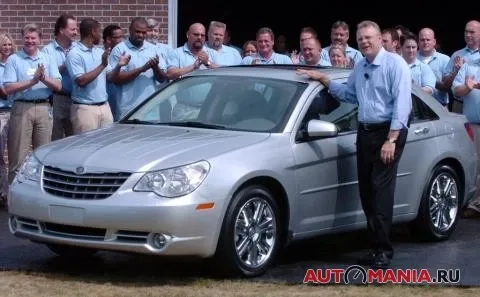
By dimensions, Sebring is a typical car for a business person, but calling it luxurious is hard. The interior does not reach luxury standards, and the exterior is more practical than flashy. At the same time, the huge sedan looks truly elegant, and its body is exactly what our drivers love. A long hood, noticeable side moldings and a smooth roofline create the impression that you are looking at a five-door. Glossy black inserts on the B-pillars emphasize the abundance of glass, and the sculpted surfaces give the body a sporty "muscularity". The front and rear ends also do not go unnoticed: wide optics integrated into the sides, a ribbed hood with a massive "nose" and large taillights make drivers of oncoming cars turn their heads.
The name Sebring is already familiar to Russians — many used cars of the previous generation are still found on the roads. But nothing remains of the old model in the new one except the name. The car is built on a completely different, more modern platform, has become noticeably more spacious and acquired rich electronics. Of course, all this affected the price, although it cannot be called prohibitive. But the interior will most likely surprise the domestic driver — and not only because of the materials. In the Limited version, which I got for a test, the interior is trimmed in cream-gray leather, and the usual combination of "light top, dark bottom" is literally turned upside down here.
For America, such a solution is common, and practicality is not lacking: the light top does not glare in the sun, and sand is invisible on the beige carpet. True, this layout is designed for a warm climate, while our drivers are used to seeing the lower part of the interior black.
The interior is made solidly — smooth and rough surfaces combine pleasantly, and the architecture constantly hints at the signature "wing" motif. The eye catches both the analog clock and the deep "wells" of the instruments, although such details are present in any car. Cheap plastic typical of many "Americans" is also here, but it is almost invisible: everything you have to touch is covered with decent soft materials.
Full electric package will not surprise anyone now, but in Sebring it is truly full. Already in the base, the driver's seat is adjusted electrically in all eight directions, not to mention windows, mirrors and other little things. And if you add leather with heating, Boston acoustics with six speakers, climate control with cruise control, and even heated and cooled cup holders — a thing that even more expensive cars do not have — then the picture becomes completely clear.
To say that Sebring is spacious is to say nothing. Compared to the predecessor, the interior has gained everywhere: headroom in front — 45 mm, shoulder room — 31 mm, hip room — 75 mm, and in the rear it became 67 mm higher and 43 mm wider. The rear sofa folds both in parts 60/40 and entirely, and the front passenger seat even turns into a flat table — convenient both for a snack on the road and for transporting long items. For a classic sedan, this, you will agree, is a rarity.
But the ergonomics of the driver's seat are rather in the European spirit — apparently, the influence of Daimler-Benz, under whose wing Chrysler is, is felt. The adjustment ranges are simply huge: if you move the seat all the way back, even a two-meter giant will not reach the pedals, and there is enough height reserve with a margin. But a short driver will have a hard time here — he risks "drowning" in the seat and stretching his neck, trying to look out from behind the steering wheel. True, thanks to many adjustments, a comfortable position can still be found.
The main drawback of the seats is weak lateral support, which does not save in active turns. However, this should be expected: European competitors have always bypassed Sebring in this component. So be prepared that in corners the driver will have to cling to the steering wheel, and passengers will have to fidget in their seats, fortunately, everyone has seat belts.
The chassis has changed no less than the exterior. The suspension has become stiffer, the steering — sharper, and this resembles Opel, Peugeot or Mercedes more than a classic American car. The chassis settings have noticeably improved the car's behavior on the road, but rear passengers are unlikely to like such elasticity — on our bumps they will be shaken quite a bit. But on smooth asphalt, the interior is quiet, cozy and truly comfortable.
In matters of safety, Chrysler also focuses on Europe. Already in the base — ABS, stability and traction control systems that can deal with oversteer and understeer, plus a traction control system. The developers expect that Sebring will get the maximum stars in European crash tests — at least, the durable body and six airbags inspire optimism. The standard equipment also includes mandatory things like BeltAlert, which reminds about an unfastened seat belt, ISOFIX mounts, tire pressure monitoring and an immobilizer.
The World Engine — the same as on Compass and Caliber — produces 170 hp and 220 Nm of torque. And these figures are not lost in a wobbly suspension, but are fully realized on a rigid chassis. The engine pleased with confident pickup and brisk revving, although during sharp acceleration it makes a strained sound that even improved sound insulation does not muffle. Perhaps this is intended — so that the owner feels the power and character of the car.
Sebring is equipped with everything that is familiar to the American buyer, but the Russian driver rarely uses cruise control, and cup holders with heating and cooling are unlikely to become a decisive argument when choosing. So in Europe and here, this car will have a hard time: its character is now European, but the price for the Russian market is still high — while in the States Sebring costs almost half as much. Later, a version with a 2.7-liter engine from Chrysler 300C will appear here, but it will be even more expensive.
TECHNICAL SPECIFICATIONS
This car is hard to call just a sedan — it is rather an attempt to combine in one body the representative solidity and dynamics that will appeal to those who are used to driving themselves. The car offers a compromise between comfort and handling, but with some reservations that are worth knowing in advance.
The interior greets the driver with thoughtful ergonomics: all key controls are in their places, and you quickly get used to them. Rear passengers are not cramped here either — there is enough legroom to avoid discomfort on a long journey. True, the trunk, whose volume is 441 liters, is unlikely to please those who are used to carrying a lot of luggage — for a car of such dimensions, it could be more spacious.
On the move, the car behaves confidently. The 2.4-liter engine, producing 170 horsepower and 220 Nm of torque, works in tandem with an automatic transmission. Acceleration from standstill to 100 km/h takes 11.3 seconds, and the maximum speed is limited to 200 kilometers per hour. In the city rhythm, such indicators are enough with a margin, but if you expect explosive dynamics from this engine, you should be prepared for the fact that it rather prefers measured driving.
Handling is one of the main trump cards of this model. The steering is quite informative, and the suspension is tuned to absorb small irregularities, but at the same time not to rock the body in corners. However, for this composure you have to pay with rigidity on large bumps — potholes and asphalt joints are felt quite clearly. However, for those who value driving qualities first of all, such a shake will seem more of a plus than a minus.
Fuel consumption in the combined cycle, declared by the manufacturer, is 8.9 liters per hundred. In real conditions, with active driving, this figure may increase, but in general the car does not seem gluttonous for its class.
The price of the car varies from 25,900 to 29,100 euros depending on the configuration. For this money, you get a spacious and well-equipped sedan that, perhaps, is not without some compromises, but offers an interesting balance between comfort and driving excitement.