
"Quite symbolic," — a thought flashed through my mind as I drove the brand-new Chrysler Sebring sedan onto Lisbon's legendary Vasco da Gama Bridge. For nine years now, DaimlerChrysler bosses have been trying to build a kind of crossing between the European Mercedes Cars Group division and the American Chrysler Group. And the next pillar of this structure is precisely the new Sebring, destined for sale on both sides of the Atlantic.

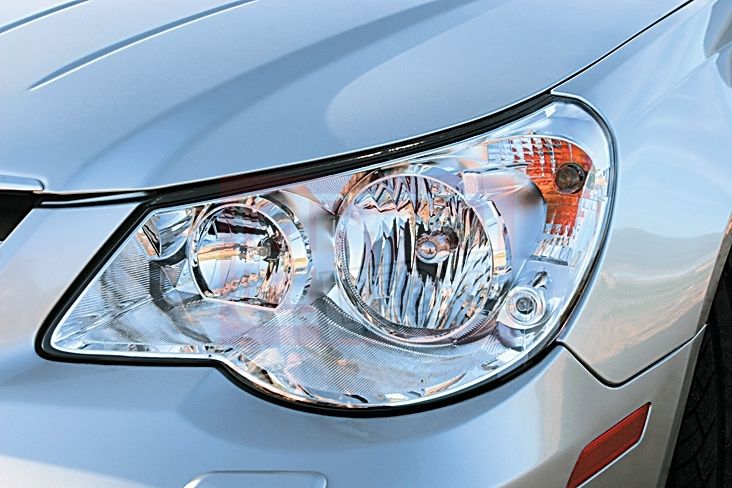 The Chrysler representatives in Portugal had a tough time. Imagine: you're presenting the new Sebring to the press, promising it a bright future, while at the same time the media is abuzz with talk of a possible sale of the Chrysler Group division! And this sale, of course, isn't born of good times: while Mercedes-Benz reliably brings in profit, the American wing of the concern is going into the red.
Shared platforms for new models could fix the situation, but so far only the brutal, rear-wheel-drive Chrysler 300C, built on the basis of the Mercedes E-Class, has been a success. What about the new Sebring? How does it plan to lure buyers?
With its looks? If the 300C has a powerful and unique charisma, the Sebring doesn't stir any particular feelings — it's just a regular modern sedan. And the massive "jaw" of the front bumper suggests it was attached to the car solely to stretch the body length to an impressive 4.85 meters. After all, in the States, size matters: both European and Japanese class rivals are 20–30 cm shorter.
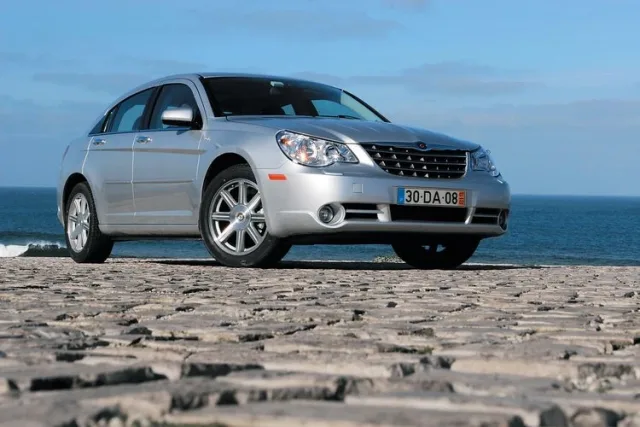
Alas, length doesn't equal charisma — there's none in the exterior. Maybe it's hidden under the hood? In Europe, base versions of the Sebring will get two-liter engines: a gasoline "four" producing 156 hp, and a turbodiesel with 140 hp. But in America and Russia, the new Sebring will start with the 2.4 version with 170 hp — with the so-called "world" engine, created jointly by DaimlerChrysler, Mitsubishi, and Hyundai, and familiar to us from the Dodge Caliber, Mitsubishi Outlander, and Hyundai NF. A V6 version will arrive in the summer, but even its power isn't impressive — just 188 hp.
Okay, there's no charisma under the hood. Maybe it's in the trunk?
There aren't even handles there — neither outside nor inside. And there's no full-size spare either — only a "donut" under the mat.
Maybe in the back row? Indeed, the high roof doesn't press down, but for legs in such a long sedan, there could be more space. However, if the front seat is empty, you can sit cowboy-style in the Sebring, throwing your legs over its backrest — it folds down.
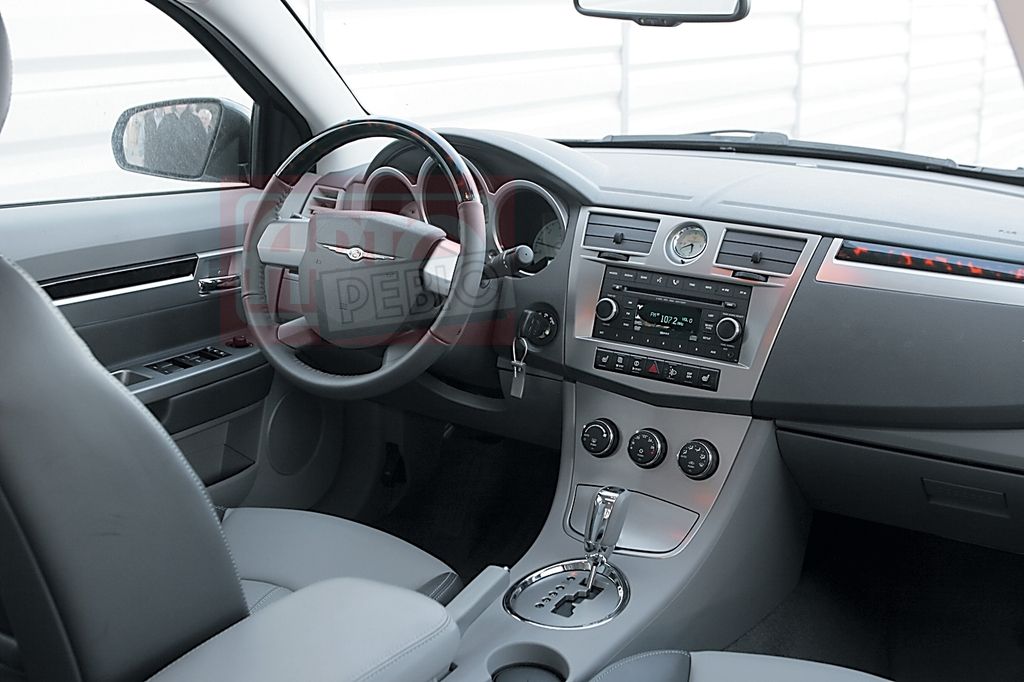 | 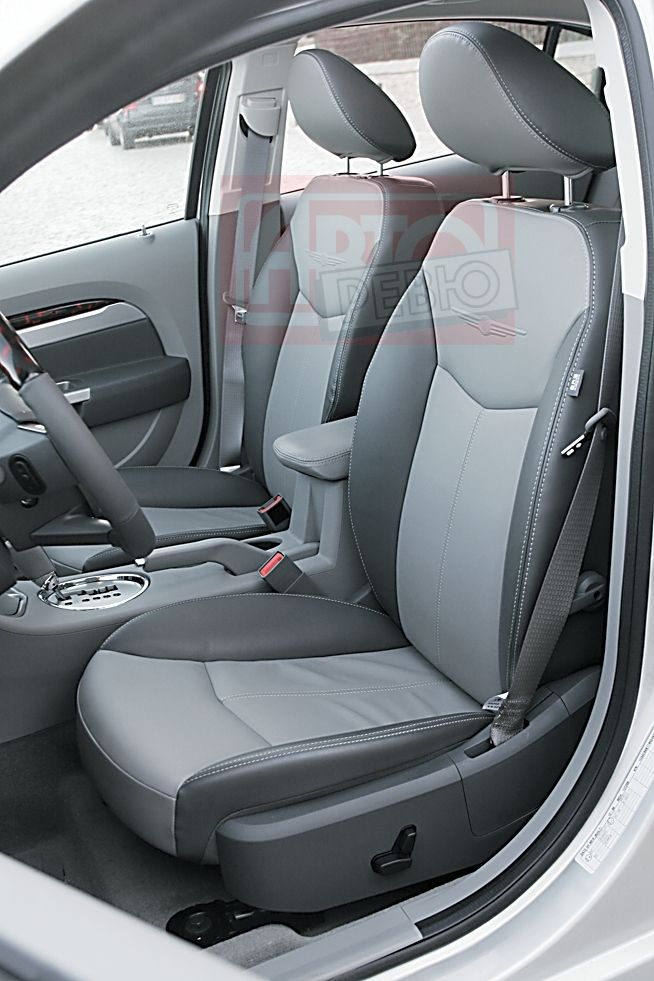 |
| The interior is nice, but the trim materials aren't of the best quality | Power-adjustable front seats — already in the base trim |
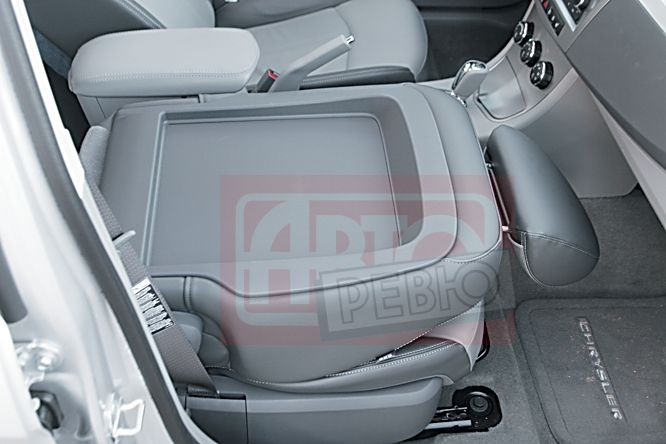 | 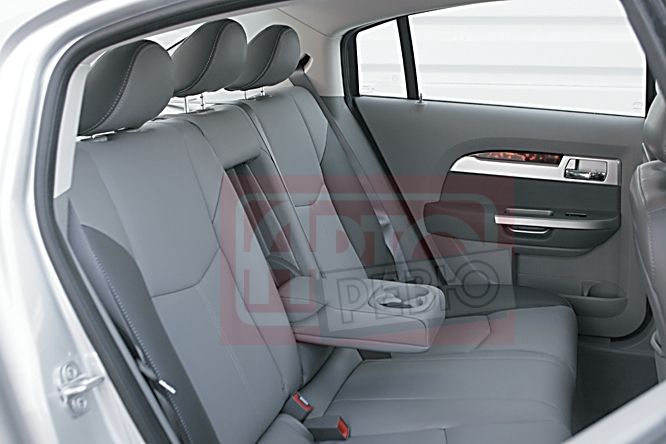 |
| The front seat easily turns into a table or footrest for the rear passenger | Not much space in the back; among extra comforts, only a fold-down armrest |
And only behind the wheel did I feel a certain American charm. The seating position is high — the driver's seat is raised by 6.5 cm compared to the previous model. Before your eyes is the hood with an eye-catching longitudinal groove, reminiscent of the Chrysler Crossfire coupe. The dashboard is tastefully done — without excessive "trinkets," but with a small cornice in the form of spread wings, echoing the Chrysler emblem's contours. The center console is trimmed "in aluminum," and the options list includes navigation with a color interactive screen, a DVD changer, and even a heated/cooled cup holder. American-style! There's a place to cool your cola or warm your coffee.
But the seat turned out to be not the most successful. It's comfortable for drinking coffee, but not for driving on European serpentines. You constantly slide somewhere: the backrest desperately lacks lateral support! At least the adjustments are in order — at my height of 190 cm, I settled behind the wheel without trouble (fortunately, it adjusts in two directions).
But in motion, the Sebring 2.4 with the "automatic" didn't impress. In the city, the dynamics were enough for me, but on the highway, the engine falls short. You sit behind the wheel of a big, solid car, press the gas to the floor — the engine roars, tries hard, frantically adjusts the valve timing (here it's variable), but... The acceleration is sluggish. The deficit of "horses" is especially acute on inclines — with such an engine, overtaking is a bit scary. And the four-speed gearbox works with noticeable pauses during kick-down. The Chrysler folks know these weaknesses well, but they just throw up their hands: "We're adapting a six-speed 'automatic' to the Sebring, but it will only appear at the end of summer paired with the V6."
 |  |
| The "automatic" is still only the old four-speed | At night, the instruments with turquoise backlighting look much more interesting than during the day |
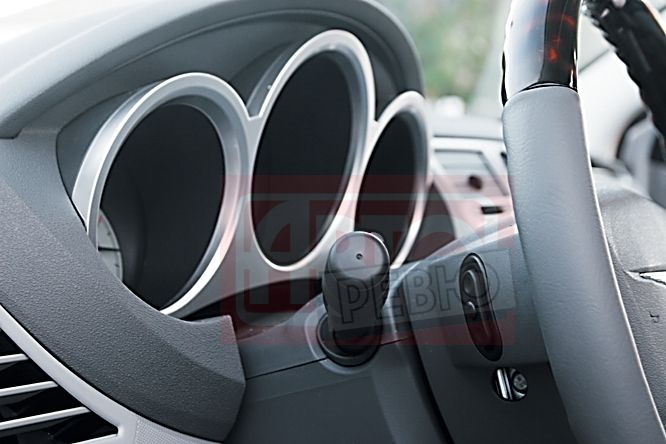 | 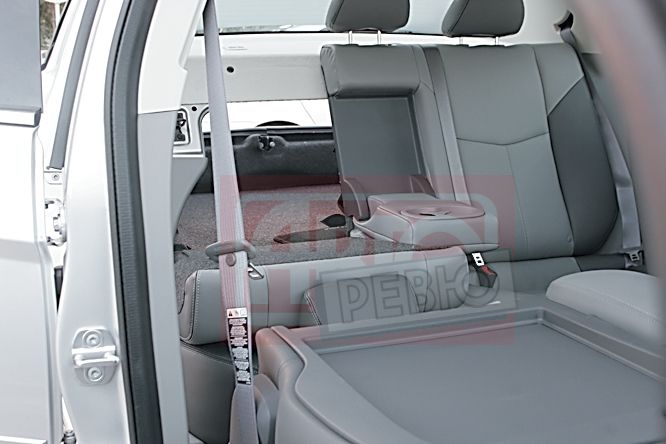 |
| On the back of the steering wheel — buttons for controlling the "music" | By folding the front and rear seat backrests, you can load long items into the Sebring |
But the brakes are good, and the handling pleasantly surprised. Not with ultimate capabilities, which are limited by the high center of gravity and the modest grip of the Kumho tires, but with the "transparency" of the steering. The power steering provides clear feedback and allows you to hold the line precisely. And if you miss — the clearly working stability control system is on guard. The only complaint — in the city, there's a lack of sensitivity: you have to turn the wheel a lot.
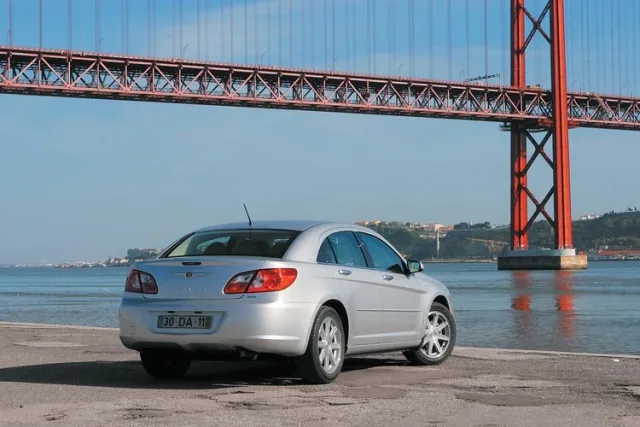
I tested the ride smoothness... on the bridge. Besides the "new" one, named after Vasco da Gama, Lisbon has another legendary bridge over the Tagus River — the 25th of April Bridge, named after the day the dictatorship of António Salazar was overthrown in 1974. This steel bridge is interesting not only for its length (2.2 km) but also because its structure replicates the "Golden Gate" in San Francisco. Moreover, the asphalt is laid only in the two right lanes, while the far left lane is a frequent metal grating.
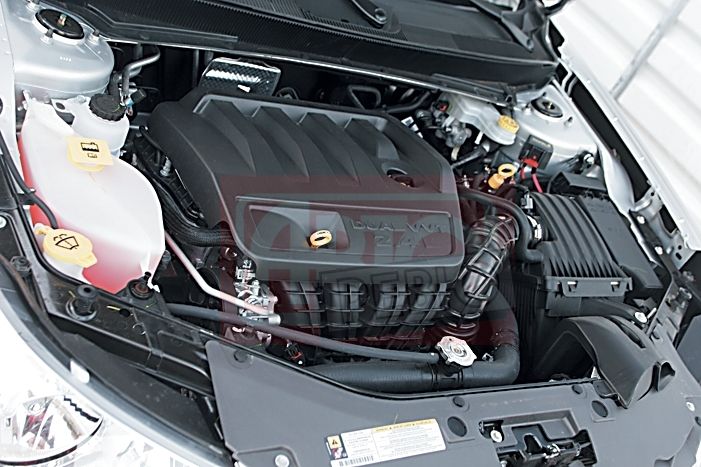 |
| The "world" engine with a displacement of 2.4 L (170 hp) with variable valve timing — a joint development of DaimlerChrysler, Mitsubishi, and Hyundai. The Sebring gets engines from the American Chrysler plant |
Yes, the Sebring's suspension is a bit stiff for such a surface... And on a good road, the Chrysler even sways slightly on the asphalt waves, creating a feeling of softness and comfort! But on small bumps — not only on the bridge but also on regular roads — vibrations and impacts are noticeable. And you can't blame the tires — the Sebring is shod with relatively high-profile tires 215/55 R18.
There's also a lack of harmony in terms of acoustic comfort. The "world" engine turned out to be quite noisy — already from 3000 rpm, its squealing voice dominates the cabin.
Yes, a Chrysler is not a Mercedes...
Although, judging by the prices, it really wants to be one: from €25,900 for the base version. True, it's well-equipped. But there are countless competitors in this price category! And the Sebring lacks the powerful charisma to outshine the offers from others — and this will matter even in Russia. Moreover, the old Sebring, albeit under a different, as-yet-unknown name, will be produced in Nizhny Novgorod from 2008 and cost about $20,000. Is that good for the image of the new car? Hardly.
And what about the capricious Europe, which has never been interested in large overseas sedans?
Perhaps in America, the new Sebring with its local starting price of $19,000 will be in demand. But it's unlikely to become a span of the bridge between continents. At least, in the traditional sense of the word "span."
| Specifications | ||
| Parameters | Vehicle | |
| Chrysler Sebring | ||
| Modification | 2.4 | 2.7 |
| Body type | sedan | sedan |
| Number of seats | 5 | 5 |
| Dimensions, mm | ||
| length | 4850 | 4850 |
| width | 1843 | 1843 |
| height | 1497 | 1497 |
| Wheelbase, mm | 2765 | 2765 |
| Track front/rear, mm | 1570/1570 | 1570/1570 |
| Trunk volume, l | 441 | 441 |
| Curb weight, kg | 1585—1635 | 1595—1690 |
| Gross weight, kg | 2040 | 2040 |
| Engine | petrol, with distributed fuel injection | |
| Location | front, transverse | front, transverse |
| Number and arrangement of cylinders | 4, in-line | 6, V-shaped |
| Displacement, cm³ | 2360 | 2736 |
| Cylinder bore/piston stroke, mm | 88.0/97.0 | 86.0/78.5 |
| Compression ratio | 10.5:1 | 9.9:1 |
| Number of valves | 16 | 24 |
| Max. power, hp/kW/rpm | 170/125/6000 | 188/138/6500 |
| Max. torque, Nm/rpm | 220/4500 | 256/4000 |
| Gearbox | automatic, 4-speed | |
| Drive | front-wheel drive | |
| Front suspension | independent, coil spring, McPherson | |
| Rear suspension | independent, coil spring, multi-link | |
| Front brakes | disc, ventilated | |
| Rear brakes | disc | |
| Tires | 215/55 R18 | 215/55 R18 |
| Maximum speed, km/h | 200 | 206 |
| Acceleration time 0—100 km/h, s | 11.3 | 10.3 |
| Fuel consumption, l/100 km | ||
| urban cycle | 12.3 | 13.9 |
| extra-urban cycle | 6.9 | 7.3 |
| combined cycle | 8.9 | 9.7 |
| Fuel tank capacity, l | 64 | 64 |
| Fuel | AI-95 | AI-95 |