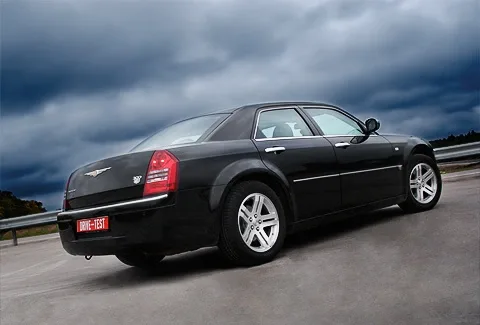
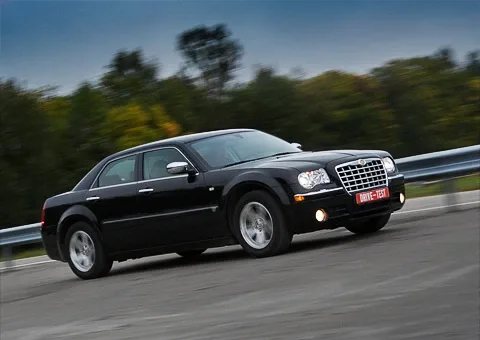
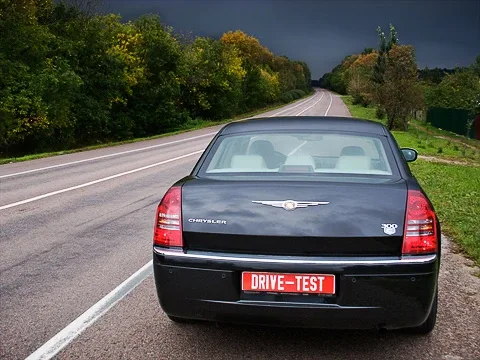
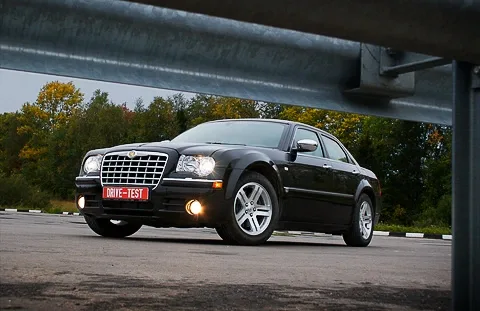
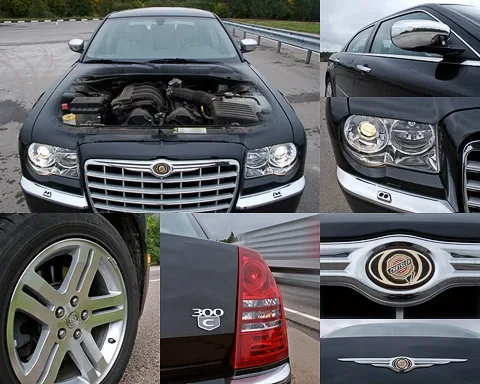
Although those times are long gone, the 300C still remains an attractive car. The flagship SRT-8 modification boasts eight cylinders and 435 horsepower, fully living up to the spirit of its legendary predecessors. However, our test features a more modest version — with a 2.7-liter engine producing 193 horsepower and a four-speed automatic transmission. But the price is significantly more humane — from 1,466,500 rubles (41,900 euros). With this setup, the model becomes a competitor to both overly technological large Japanese sedans and relatively affordable business-class representatives. But what can it offer against them, besides its undeniable charisma?
Our example is in the middle trim level. It features xenon headlights, dual-zone climate control, leather interior, electric adjustments for the steering wheel and seats, a quality Boston Acoustics audio system, and other pleasant touches. Moreover, almost this entire set is included in the base equipment, and the only available options are a sunroof, navigation, heated rear seat, a more powerful Kicker audio system with 12 speakers and a subwoofer, as well as power-adjustable pedals.
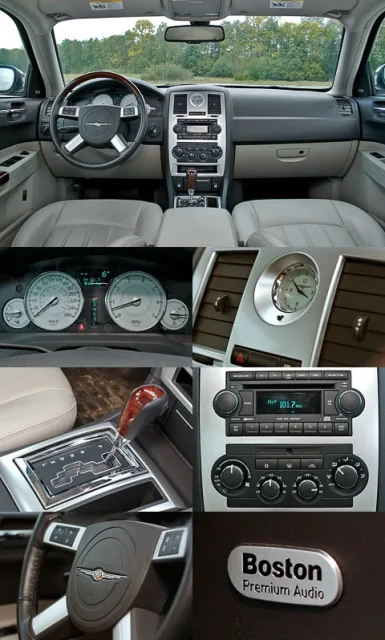
The interior looks simple, but only in terms of design.
However, the main trump card of this car is its dimensions. There is an abundance of space in every corner: both front and rear, in the trunk, in the glove box, and in the box between the seats. Absolutely everywhere. Anyone can fit behind the wheel — from a person of small stature to a true giant, especially with the adjustable pedal assembly. The huge steering wheel, which initially seems uncomfortable, actually only adds charm: it enhances the feeling that you are sitting at the helm of a true road cruiser. And this feeling does not deceive.
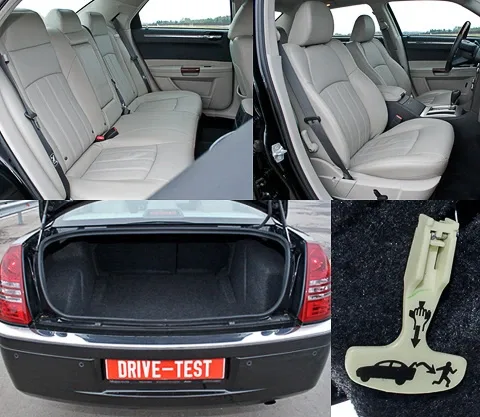
There is plenty of space in the front and rear. The trunk is also not lacking in volume.
From the soft captain's chairs, the view through the small windows, which so effectively emphasize the brutal appearance of the "three hundredth," leaves much to be desired. It is far from claustrophobia, of course, but it is stressful when parking. The parking sensor saves the day, which, by the way, is absolutely identical to the one installed on the Mercedes E-Class.
Surprisingly, you don't want to find fault with the interior of this American at all. We are used to grumbling about the sloppy assembly of "Yankees," but this does not apply to the Chrysler 300C. The quality of finishing is top-notch. It probably doesn't reach the level of Mercedes-Benz, but Chrysler doesn't claim to. The only thing that spoils the overall impression is the design, which is too simple and straightforward. It is the styling that prevents this sedan from being perceived as a truly expensive thing, although there are no complaints about the equipment and build quality at all.
However, you forget all this as soon as you start moving. Looking at the endless hood stretching beyond the horizon, you stop noticing the interior and everything else. You are the king of the road! And you move accordingly: smoothly, majestically, with a sense of self-worth. Everyone around you yields the road unconditionally.
But as soon as you press the gas pedal harder... the royal status evaporates. You can't say that the 300C with the 2.7-liter engine is a slowpoke, but the exhaust sound lacks that bass note you expect from such a car. Yes, we know that the older versions have engines that "growl" as they should. But if they had put a slightly weaker engine here, we would grumble worse than any Hemi owner. So the 2.7 is the bare minimum, a starting point. Especially paired with a four-speed "automatic," which, although it shifts smoothly, is clearly lacking both in the number of gears and responsiveness.
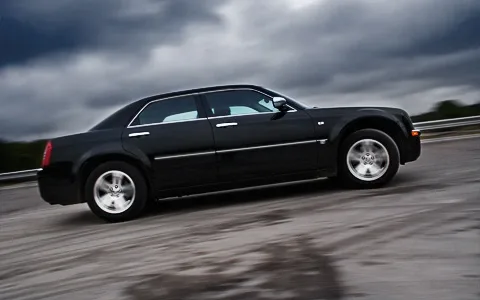
The 300C is built on the basis of the previous Mercedes-Benz E-Class. And this is felt in corners.
Our Chrysler shares with Mercedes not only the same parking sensor and the fact that many mistakenly take the model name for the engine displacement designation. The "three hundredth" stands on the same platform as the previous generation E-Class. And this automatically promises excellent comfort, doesn't it? Theoretically — yes, but the Americans still retuned the chassis to their own preferences.
Overall, the suspension remains incredibly comfortable, because Americans value convenience no less than Germans. But the huge wheels, which look so impressive, are too heavy and sometimes transmit unpleasant vibrations at joints. Moreover, the steering wheel twitches more on bumps than we would like. If you add light bouncing on sharp bumps — you get a complete list of our complaints about the chassis accumulated during the test.
But otherwise — everything is fine. For such a large car, the 300C handles well, the suspension easily swallows most potholes and bumps without rocking the body on waves. The car stays composed, rolls moderately in corners, and is completely unlike most of its compatriots.
You might ask, what about 41,900 euros? The amount is not that small. You could add a little and take, say, a Mercedes E 200 Kompressor, already of the current generation, albeit with poorer equipment. But finding another such giant for this money is unlikely. Especially considering that size is far from the only advantage of the 300C.
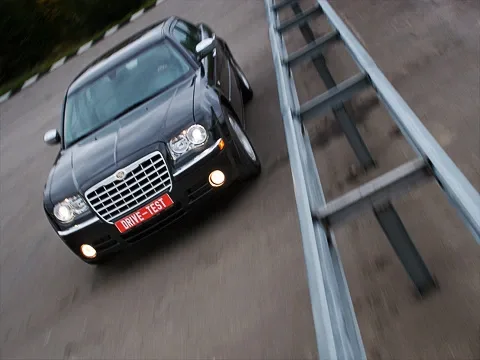
Of course, this car begs for a more serious engine under the hood. Preferably an eight-cylinder one.
The huge "brick" 300C will definitely not get lost among the uniformly polished cars in traffic. And it is especially pleasant that its charisma is not limited to just the appearance. The Chrysler has both rich equipment and a solid chassis. Yes, the 300C is not the most advantageous offer on the market. But its price includes not only the technical content but also the opportunity to stand out from the crowd. And this, you must agree, is also worth money.
Technical specifications
| Specifications | Chrysler 300C 2.7 |
| Body |
| Number of doors/seats | 4/5 |
| Length, mm | 5015 |
| Width, mm | 1880 |
| Height, mm | 1535 |
| Curb weight, kg | 1774 |
| Gross weight, kg | 2159 |
| Trunk volume, l | 450 |
| Engine |
| Type | Petrol, with distributed injection |
| Location | Front, transverse |
| Number and arrangement of cylinders | 6, V-shaped |
| Number of valves | 24 |
| Displacement, cm3 | 2736 |
| Max power, hp/rpm-1 | 193/6400 |
| Max torque, Nm/rpm-1 | 257/4000 |
| Transmission |
| Gearbox | Automatic, four-speed |
| Drive | Rear |
| Chassis |
| Front suspension | Independent, double wishbone |
| Rear suspension | Independent, multi-link |
| Front brakes | Disc, ventilated |
| Rear brakes | Disc, ventilated |
| Tires | 225/60 R18 |
| Turning diameter | 11.9 |
| Number of steering wheel turns | 2.75 |
| Performance characteristics |
| Maximum speed, km/h | 201 |
| Acceleration time from 0 to 100 km/h, s | 11.6 |
| Fuel consumption, l/100 km |
| urban cycle | 15.2 |
| extra-urban cycle | 7.8 |
| combined cycle | 10.5 |
| Emission standard | Euro-4 |
| Fuel tank capacity, l | 68 |
| Fuel | AI-95 |
Equipment of the tested car
Standard equipment - Power steering with variable assist
- Rain sensor
- 6 Boston Acoustics speakers
- Rear parking sensor
- Exterior mirrors folding, heated, power-adjustable, with memory, with auto-dimming on the driver's side
- Rearview mirror with auto-dimming
- Immobilizer with remote control
- Dual-zone climate control
- Steering column with electric adjustment for height and reach
- Tire pressure monitoring
- Cruise control
- Headlight washer
- Leather interior
- Rear shock absorbers with automatic level adjustment
- Heated front seats
- Eight airbags
- Fog lights
- Steering wheel with leather trim and audio controls
- On-board computer
- Security alarm
- Xenon headlights with auto-leveling
- Power tailgate
Here is the revised test drive text:
The interior of this car welcomes the driver and passengers with thoughtful ergonomics and quality finishing materials. The front seats are equipped with electric adjustments, allowing you to quickly find a comfortable seating position. The base equipment includes a repair kit, but for an additional fee you can order a compact spare wheel.
Among the options installed on the tested car, it is worth noting decorative inserts made of California walnut, which adorn the steering wheel and gear shift lever. An audio system with an AM/FM tuner and a six-disc CD changer supporting MP3 and RDS formats is responsible for entertainment on the road. The sound is reproduced by seven Boston Acoustics speakers with an amplifier power of 368 watts. Heated second-row seats are provided for rear passengers. The body is painted in metallic, and the color can be chosen to your taste.
The base version is priced at 1,466,500 rubles, which is equivalent to 41,900 euros. The test vehicle with additional equipment would cost 1,512,000 rubles (43,200 euros). The car for testing was kindly provided by CJSC "DaimlerChrysler Automobiles RUS".