
Chevrolet Lacetti. Crusader
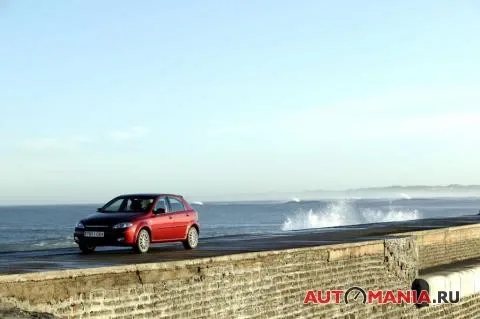
Initially, the Lacetti was conceived solely as a hatchback, but Daewoo's financial problems hindered these plans. However, the project did not sink into oblivion: when GM absorbed the Korean manufacturer, not one car but three body styles appeared at once — hatchback, wagon, and sedan. In such a metamorphosis, seemingly strange at first glance, there is actually its own logic. General Motors, although not broke, is not in luxury either, so a couple of inexpensive and sought-after models in the lineup certainly won't hurt. The bet here is not so much on Old Europe, but on the rapidly growing CIS markets and, of course, on ours.
Let's return, however, to the car itself. As it turned out, the name Lacetti is historically assigned to the hatchback, which was supposed to replace the Daewoo Lanos, revived a couple of years ago under a new American brand. But the sedan and wagon trace their lineage from the Nubira. This, by the way, explains the difference in their appearance. The design of the hatchback was drawn at the Giugiaro studio, while the appearance of the others was handled by stylists from the no less famous Pininfarina. The American owners had to slightly adapt the appearance, although the intervention was minimal.
The transformation of the Daewoo Nubira into the Chevrolet Lacetti did not require surgical intervention. The Koreans, under the supervision of the Americans, replaced the radiator grille, hood, and slightly adjusted the bumper — for the hatchback, it was limited to a simple change of emblem. But not only the body changed. Even at the family's presentation, GM representatives emphasized that the car became lighter, more economical, safer, and, most importantly, quieter. They also touched on the engine range then... But more on that later.
The interior of all three Lacetti models differs no less than the exterior, although it is maintained in a common style. Here, the sedan stands out from the overall picture — it is simpler and more democratic, almost American-style. The interior, frankly, does not impress with either design or materials, although some versions can even find imitation wood or fashionable aluminum. As for ergonomics, there are no serious problems. Even a tall driver will sit behind the wheel: the seat is well profiled, has all the necessary adjustments, plus the steering column adjusts in three planes. The steering wheel itself is comfortable, but the steering column switches are archaic and stiff, clearly inherited from the Daewoo Nexia. From there, apparently, comes the "trough" instead of the door handle for the driver — an inconvenient thing, except perhaps to hold small items in it. Passengers have normal handles with a natural grip. But this, as they say, is a matter of taste.
The hatchback and wagon here, of course, do not lag behind. The materials are the same, but due to the fresher architecture, everything looks richer: the plastic of the front panel, although inexpensive, no longer seems so budget-friendly, and the "aluminum" inserts suit it. But again, this is a matter of taste, so let's return to comfort. Since the front passenger seat is almost a copy of the driver's seat, let's look at the second row. The rear sofa here is quite adequate: designed for three (as indicated by three headrests), but only two will fit comfortably. There is generally enough legroom, but if the front seats are pushed all the way back, feet will rest against the low-set backrests. Some may also dislike the profile of the sofa itself — without special anatomical frills. Otherwise, everything is normal, Korean-style: without original solutions, but also without obvious flaws. The same can be said about the trunks of all three versions.
Finishing with the second row, I note that the sofa backrest folds in a 60:40 ratio, increasing the already sizable compartment. Directly comparing the three body styles is pointless, so let's focus on the most popular sedan here. Its cargo compartment is spacious. Of course, it's far from the Skoda Octavia, but it easily meets average indicators. The trunk lid opens with an electric drive, the button is on the driver's door. True, there is no handle on the lid itself, but at least they didn't skimp on the polyurethane panel.
But where the importer saved was on engines. True, only at the beginning, when only 1.4- and 1.6-liter engines were offered, and even then with restrictions: the wagon, for example, came only with a 1.6-liter engine and manual transmission. Now everything is simpler. The same wagon is now available with two engines: the previous 109-horsepower one and a more powerful 1.8-liter one producing 122 hp. But "automatics" for it still haven't appeared. However, sedans and hatchbacks have a choice of transmissions: the "automatic" is paired only with the 1.6-liter engine. The base 1.4-liter engine comes only with a "manual"... However, enough theory, let's move to practice.
The most popular here, as usual, is the 1.6-liter engine — we'll focus on it, especially since it's the only engine that can be combined with both gearboxes. It's clear that many will choose the "manual" and be right. The manual transmission works better with such an engine than any "automatic," especially since the gearbox itself is quite good: shifts are clear, gears are well chosen. But for some reason, I was more interested in the automatic — a regular torque converter without any "sport" modes. In its characteristics, it's an average: slight delays during sharp acceleration, doesn't like engine braking. But the shift algorithm surprised me. When trying to move the selector from "D" to "R," it got stuck firmly in the middle and gave up only after an accidental press. It turns out that in the Lacetti, this is how the "foolproof protection" works — a barely noticeable inscription near the lever indicates this. Usually, there's a button for this, but GM decided to stand out. However, recalling the "looped" manual transmission, where reverse is engaged only by lifting a barely noticeable stop under the handle, such a solution no longer seems strange. Otherwise, the car proved to be a typical representative of the small family class. Moderately noisy, quite nimble in the city, relatively lively, but rolly in corners, while somewhat stiff on bridge joints and speed bumps.
That's probably all. It's worth adding that we deliberately did not describe all trim levels — there are countless of them. The hatchback has three, the sedan four, and the wagon five. And that's not counting options and packages. There's plenty to choose from, but let the reader explore that themselves.
Technical specifications:
| Dimensions: | Chevrolet Lacetti (sedan) |
| Length (mm) | 4515 |
| Width (mm) | 1725 |
| Height (mm) | 1445 |
| Wheelbase (mm) | 2600 |
| Maximum mass (kg) | 1660 |
| Trunk volume (l) | 405/1225 |
| Engine displacement (cm3) | 1598 |
| Max. power (hp) | 109 at 5800 rpm |
| Max. torque (Nm) | n/a |
| Max. speed (km/h) | 187 |
| Acceleration 0–100 km/h (s) | 10.7 |
| Average fuel consumption (l) | 7.1 |
| Price (rub.) | from 356,200 |
Magazine "Autogid" August 10, 2007 No. 28(28)
Source – www.automania.ru