
Chevrolet Epica. Korean epic
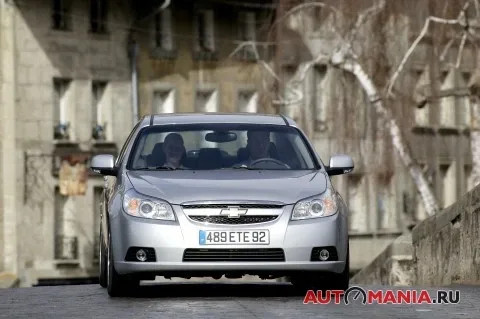
So, what does the Chevrolet Epica offer? The first thing such a car should use to attract a future owner is striking looks, i.e., impressive dimensions backed by appropriate design. The newcomer's dimensions are in perfect order: almost five meters in length, about two meters in width, and a wheelbase of more than two and a half meters. The business-class standard is met with a noticeable margin, so in this discipline, it's a confident pass. As for style, the Koreans stayed true to themselves, mixing European technological sophistication with a dose of Eastern charm. Complex, architecturally precise details, clearly borrowed from European designers, elegantly coexist with more restrained touches of the Eastern school. Headlights that smoothly extend onto the side panels, like on the Citroën C5, pair well with typically Korean taillights. The wedge-shaped silhouette, smoothed corners, and seemingly blurred edges — all this is familiar for modern Korean models, so the newcomer doesn't shine with particular originality. The appearance can be called neither revolutionary nor conservative: by today's standards, the Epica is an ordinary middle-of-the-roader, reliable and solid, but without a spark — one of many. Nevertheless, the looks clearly deserve a positive rating, so I give it a solid four.
I'd like to say the same about the interior, but alas... Here, the car barely earns a three, and even that is a stretch. The Koreans, for some reason, approached the cabin design with far less enthusiasm than the exterior. It's clear the car isn't for oligarchs, but that's no excuse for such deliberate simplicity — some older and smaller cars look much more interesting inside. In short, the cabin is modest, but taste-wise, it's not for everyone. Dreary gray plastic, shapes in the spirit of late-nineties German sedans. This is no longer the Evanda, which once openly copied the old Camry, but there's no talk of an original style either, which is completely unacceptable for the business class.
However, the price is quite acceptable — $22,990. It's hard to find a large sedan for that money on the new car market, except maybe on the secondary market. So let's be more lenient with the newcomer, especially since it does have merits. For example, the ergonomics are quite well thought out. It doesn't reach the level of the Camry or Teana, of course, but the comfort level of the Hyundai NF or Kia Magentis is provided with a margin. Add to that a full five-seat cabin and a spacious 480-liter trunk. And what about equipment? In the base version — ABS, six airbags, full power accessories, air conditioning, and an MP3-compatible radio. With a small extra payment, you can get a car with alloy wheels, parking sensors, a rain sensor, an information display on the center console, a six-disc CD changer with more advanced audio, and wood trim. In short, any whims for your money. The maximum price is $30,000, whereas for competitors, that's just the starting point.
Nominally, the Epica is equipped with a two-liter 144-horsepower inline engine and a manual gearbox. Although, almost certainly, the version with an automatic will be more in demand. However, it's worth noting right away: don't expect any special surprises from this duo — the automatic is rather sluggish and responds lazily to sharp throttle presses. In general, the buyer should decide in advance about the car's temperament. If you need a large sedan for calm driving, this is your option. If you want a livelier car, it makes sense to pay extra and get a Chevrolet with a 2.5-liter V6. Here, the nearly one-and-a-half-ton "Korean" has enough power reserve both for overtaking a truck and for a more or less dynamic start from a traffic light (in the latter case, you can switch to manual mode and let the engine work to its full potential).
However, it's unlikely anyone would use the Epica so radically — a car with such dimensions is not suited for the role of a sports car by definition. Brake efficiency, steering response, and highway stability correspond to average indicators and are adequate to the driver's actions. The only noticeable drawback against this background is the rather mediocre ride smoothness. The suspension is clearly tuned for our roads, and apparently, for the sake of reliability and durability, the Koreans chose to sacrifice some comfort: on uneven surfaces, passengers will feel noticeable shaking. But on the other hand, they won't get motion sickness.
That's essentially it. All that remains is to talk about the Epica's prospects. Obviously, despite GM's support, the Koreans traditionally didn't enter the fight with such monsters as the Mitsubishi Galant, Nissan Teana, Toyota Camry, Hyundai NF, and Kia Magentis. As before, they bet on the lower price segment, where I see the main rivals of the Epica as the Taganrog-built Hyundai Sonata and smaller sedans like the Mazda 6 and Opel Vectra. This is undoubtedly dictated by the newcomer's starting price. For that money, a person gets a modern car with pleasant looks and decent equipment, so the battle for buyers' sympathies promises to be fierce. But let's not forget: the Chevrolet is bigger, younger, and fresher than its competitors, and such conditioning only works in its favor.
As for the described shortcomings, you'll agree — without them, the price would be completely different, and in that segment, there are other leaders and higher stakes.
Technical specifications:
Chevrolet Epica
Dimensions (mm) 4805x1810x1450
Wheelbase (mm) 2700
Weight (kg) 1460
Trunk volume (l) 480
Engine displacement (cm3) 1993
Max power (hp) 144
Max torque (Nm) 195
Max speed (km/h) 207
Acceleration 0-100 km/h (s) 9.9
Average fuel consumption (l) 8.2
Price ($): 22,990-30,040
Source – www.automania.ru