
Chevrolet Epica. Quite an epic Korean
In reality, in Russia you won't find a Chevrolet with a made in USA badge even with a search party — except maybe from "gray" dealers, and even then these are mostly huge vans. The TrailBlazer and Tahoe SUVs are assembled in Kaliningrad, as is the Hummer. But the rest of the model range (Lacetti, Aveo, Spark, Rezzo) is one hundred percent Korean. The exception is the Lanos, but that's a separate story with roots in Zaporizhzhia. Even its engine is local, from ZAZ. The confusion didn't arise by chance: GM marketers, after buying Daewoo, allowed cars to be produced under this brand only in Uzbekistan (the Matiz model). All other Daewoos — Lacetti, Aveo, Spark, Rezzo — were renamed Chevrolet. It's clear that under such a logo, goods sell much more briskly, especially in countries where demand for everything foreign hasn't subsided — like in Russia. The result is logical: in 2007, Chevrolet became the best-selling brand in the country.
But while the four listed models have obvious predecessors in the form of Daewoo, the two new models on a shared platform — Epica and Captiva, which appeared at the end of last year — have nothing to do with these "ancestors." These are completely new developments, created virtually from scratch. We'll get to the Captiva — GM's first Korean SUV — later, but for now we have the chance to test the no less interesting Epica sedan. It's this car that replaced the decent and comfortable Evanda, which, although classified as business class, eventually stopped resonating with buyers. Mainly, I think, due to its outdated exterior and interior that didn't fit modern trends.
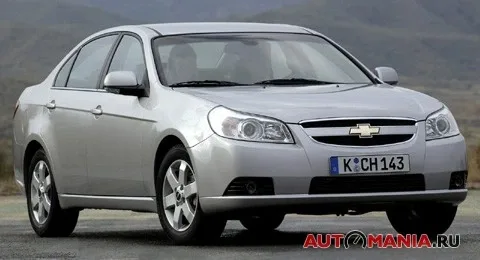
The first visual encounter with the Chevrolet Epica leaves you puzzled. The car looks like a true giant, not inferior in dimensions to the BMW 5 Series, as well as two fresh competitors in this class — the Mitsubishi Galant and Nissan Teana. Moreover, the Korean designers clearly borrowed tricks from their neighbors in China. But while they simply copy well-known models — be it Toyota or SEAT — the Koreans turned out to be smarter and don't sin with directness.
The Epica's exterior is pure eclecticism. The radiator grille is something from Saab, the headlights are a dead ringer for the Citroen C4, the huge side mirrors with turn signals are clearly from Mercedes, and the rear is almost entirely borrowed from the new generation VW. As people say: stealing from one is plagiarism, but borrowing from many is already creativity. And all together it doesn't irritate, but on the contrary, gives the appearance a special charm. The main highlight is the crease line running along the body on both sides. Take a closer look when you get the chance — it's truly beautiful and very unusual.
Inside, there's noticeably less eclecticism, and it's no longer related to competitors. Here too, there's a bit of everything, but it all belongs exclusively to the GM concern. We've already seen the instrument panel (speedometer, tachometer, etc.) on the Lacetti, while the center console with dual-zone climate control, a convenient and good-sounding audio system, and auxiliary functions has completely migrated here from the Saab 9-3/9-5. No need to be surprised — after all, for GM now both Saab and the former Daewoo (now Chevrolet) are one and the same.
In the cabin, besides quality leather, there's the aforementioned audio system with eight speakers, a CD changer, and MP3 support. You can control all of this directly from a button on the steering wheel. It's no worse than in much more expensive D-segment classmates.
The onboard computer might seem overloaded to some, but it's a matter of habit. By the second day of driving, you get used to it as if it were your own. Also, the display has an unusual compass (apparently, the Epica is also being prepared for the American market). Moreover, it's not a four-section one, but only a three-section. If you sharply turn from west to east, it automatically rearranges and shows the other cardinal directions, discarding the unnecessary. Quite unconventional. I haven't seen this on pure-blooded "Americans."
Inside, the cabin is spacious, but for a business-class car, there's one significant drawback. Unlike, say, the Nissan Teana or Mitsubishi Galant, the rear seats only fold in a 60/40 split. And there's no traditional "ski" hatch for long items here.
The Epica is offered in two versions: with a 2.0-liter 24-valve engine producing 144 hp (manual or automatic) or with a 2.5-liter (also 24 valves) — 156 hp, and only with an automatic. Both engines are six-cylinder. For the test, we got the most expensive version — in terms of engine and equipment.
In terms of driving characteristics, there are no complaints. The automatic doesn't hesitate, unlike, for example, the Mitsubishi Galant, and 2.5 liters is quite enough for a ton and a half of weight. Even in the city cycle, fuel consumption didn't exceed 11–11.5 liters — which is good, considering you can also fill the tank with 92-octane gasoline. We, of course, didn't accelerate to the claimed 209 km/h, but we appreciated the car's potential given the suspension and handling. A very worthy player in the business class. Visibility is excellent — both front and sides (thanks to the truly "SUV-like" mirror ears) and rear. Parking sensors are present, but by and large, they're not really needed.
The only thing that might scare off buyers is the price of the 2.5-liter version at $30,040. On one hand, it's adequate money for a very high-quality car. But Daewoo (sorry, Chevrolet) is not yet Hyundai with their super players in the same segment, like the Grandeur or NF, which offer a five-year warranty. And again, the buyer strongly hesitates when purchasing a "Korean" (Russians stubbornly refuse to acknowledge the reliability of cars from this Asian country), and having those same $30,000 in hand, would rather go and buy a three-year-old Lexus RX-300 for the same money.
But as a service or corporate car, the Epica is the best choice. Especially for a manager who hasn't yet fully promoted their business or simply doesn't want to attract unnecessary attention.
Technical specifications:
| Dimensions (mm) | 4805 x 1810 x 1405 |
| Wheelbase (mm) | 2700 |
| Weight (kg) | 1500 |
| Engine displacement (cc) | 2492 |
| Power (hp) | 152 |
| Max torque (Nm) | 237 |
| Top speed (km/h) | 205 |
| Fuel consumption (avg.) | 9.3–10.4 |
| 0–100 km/h acceleration (s) | 9.9 |
| Fuel | A-92/95 |
| Price ($) | 30,040 |
Dmitry Shavyrin
Source — www.automania.ru