
Chevrolet Captiva. Branded Brother
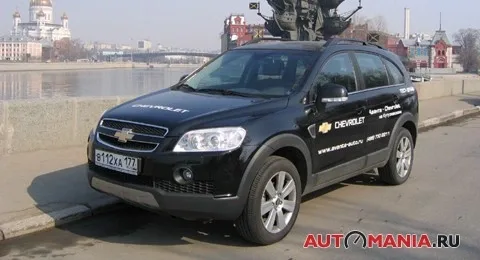
Today, almost all Chevrolets sold here are assembled right in Russia and have little in common with their overseas relatives. It all started when the Korean Daewoo ended up under GM's wing. An American wouldn't even dream of a Chevrolet without air conditioning and a tachometer on the highways of Los Angeles or Kansas — but here, such cars are everywhere on the roads. The Chevrolet cross, stuck where the Daewoo logo used to be, is supposed to boost the credibility of the Lanos and Spark in the eyes of naive buyers. But doesn't it drag the Chevrolet brand itself through the mud?
Daewoo had long been nurturing the idea of taking on its Korean rivals — Hyundai and KIA. Those had stylish full-size SUVs like the Santa Fe and Sorento in their lineup, which Daewoo desperately lacked. As did the money to create them. And then luck struck — the alliance with GM. Funding appeared, and things got moving. True, the process dragged on for a good ten years, but in the end it happened — and here it is, the "answer to Chamberlain," the Jeep Chevrolet Captiva, the hero of our article. Design — Korean, testing — Chinese, assembly — Kaliningrad, price — of course, purely Russian.
What can be said about this car? On one hand, it's a perfectly decent SUV just over 4.5 meters long. Eight airbags, leather interior (leather not of the highest quality, but still), spacious trunk, flat floor in the back — second-row passengers are comfortable. Plus, the current "GM-style" center console, which has migrated to almost all models, including SAAB. The instrument panel, alas, does not adorn the pseudo-SUV. The instruments are placed conventionally — above the steering wheel. The speedometer and tachometer are the same as on the Aveo, even though the Captiva costs almost a million, and the Aveo is 60% cheaper.
When handing over the car for the test, the dealership managers asked to be understanding about the version with the 2.4-liter engine. And they honestly listed all the shortcomings that surfaced during previous tests. The first and main miscalculation is the engine. How could they put a 2.4-liter unit with 136 hp on a 1.7-ton SUV? Later, a version with a 3.2-liter engine with 230 hp appeared, but according to colleagues, even that didn't radically change the situation — only the price increased.
If the Captiva is GM, then why put an engine on it comparable in power to what was on the 2.0-liter Vectra back in 1998? I drove such a car for eight years and understood all that time: the Opel lacked both power and torque. And that was a station wagon that didn't claim to be a powerful SUV. The Captiva seemed much more "sluggish" compared to my station wagon. Neither the gas pedal nor the gearbox perceives the "kick-down" command at all. You press the pedal to the floor — the engine roars, but there's no acceleration whatsoever. Not only does the 4-speed gearbox hesitate, it outright refuses to accelerate the car. But that's not all. The Captiva also has issues with sound insulation. After 3,500–4,000 rpm, when speed exceeds 100 km/h, talking in the cabin becomes impossible. The noise is such that rear passengers can't hear the driver. And on gravel — it's a "percussion concert with orchestra."
The verdict on the interior — spacious, hard, noisy. Moreover, "hard" applies to both the seats and the suspension. You won't be able to calmly drive over a speed bump at speeds above 40–50 km/h. It'll shake so much that you'll test the ceiling's strength with your own head! I don't want to compare the Captiva with anyone else unnecessarily, but the Korean KIA Sorento performs this maneuver without any problems, even if driving over a hundred.
In general, our hero has a lot in common with the Sorento. For example, electric seat adjustment is only available for the driver — in both. Both cars, besides the onboard computer, have a compass, and the BC is easily reconfigured: it shows miles instead of kilometers, and turns degrees Celsius into Fahrenheit if that's more convenient for you. However, the Sorento loses in that it can't show average fuel consumption — a rather important indicator. The Captiva, by the way, managed 12.4 l/100 km with calm driving.
A bit later, its design twin appeared on the market — the Opel Antara (just like with the Daewoo Matiz and Chevrolet Spark). I think we'll get to its test sooner or later. Though we don't expect any special revelations. There are few differences: a slightly changed interior and a couple of exterior details, and everything else is the same, including the engines. So, even without driving the Antara, conclusions can be drawn. Unfortunately, the interiors of modern Opels are almost indistinguishable. At the same time, hard plastic, a convoluted onboard computer, and non-latching turn signals don't add charm to a car that costs more than 700 thousand rubles.
Another drawback of the tested SUV is glare on the windshield. Above the center console in the Captiva, besides the air vents, there's an audio speaker and a central mini-glovebox. It seems the car was only tested in cloudy weather, because as soon as the sun comes out, the "Corsa effect" appears — that's what motorists dubbed it a couple of years ago. The glare from direct sunlight is so strong that a blind spot forms in the center of the windshield, right at eye level. The KIA Sorento avoided this — and again came out ahead compared to the Chevrolet.
The design of the two involuntarily compared cars is a matter of taste. It seems to me the Chevy looks more elegant from the front. And from the back, due to the taillights, it resembles the little Spark. From the side — a draw. As for engines, the Captiva, despite its lower price (a difference of 100 thousand rubles in the 2.4 version), clearly loses to the Sorento with the 3.2 engine. And the Sorento's lack of a factory stereo doesn't compensate for that.
The choice, as always, is up to the buyer. Whichever car you take, you'll love it. And like someone in love, you'll look for its merits, not its flaws, which we, however, have warned you about in advance.
And we're preparing for new tests. Not long ago, the Mitsubishi Outlander XL gained twins — the Peugeot 4007 and Citroen C-Crosser. The first one, apparently, got boring, and people started actively buying the Peugeot. Well — let's drive, sniff, and feel! But that's a topic for another test. Read on www.automania.ru.
Technical specifications:
| Dimensions (mm) | 4635 x 1850 x 1750 |
| Curb weight (kg) |
1750 |
| Gross weight (kg) |
2275 |
| Wheelbase (mm) |
2705 |
| Engine displacement (cm3) | 2405 |
| Power (hp) |
136 |
| Max. torque (Nm/rpm) | 136/5000 |
| Maximum speed (km/h) | 178 |
| Acceleration time 0-100 km/h (s) |
12.5 |
| Tires |
255/55 R 18 |
| Minimum turning radius (m) |
5.7 |
| Trunk volume (l) |
930/1565 |
| Price of the tested car (rub.) | 961,800 (+ 13,100 for metallic paint) |
Dmitry Shavyrin
We thank the "Avanta" dealership on Kutuzovsky for providing the car for the test.Source – AUTOMANIA.RU