
Korean brands Kia, Hyundai and Daewoo have long been at war with each other in European markets. But in the "crossover" SUV segment, only two companies competed — Kia and Hyundai. GM, which took control of Daewoo, was not satisfied with this arrangement. The result — a new Chevrolet Captiva crossover, assembled in Korea. Plans include starting production in Russia as well.
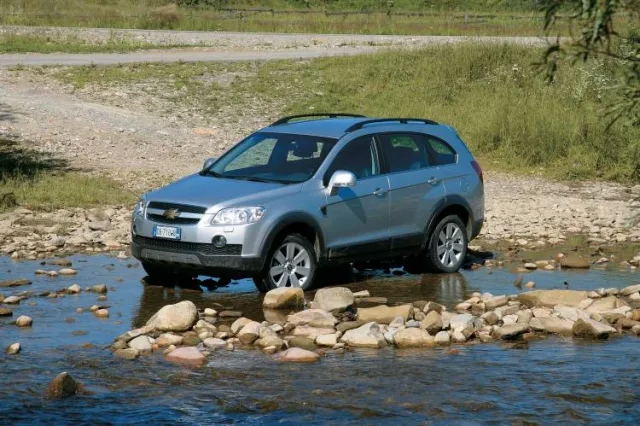
It's immediately clear that the same designers who worked on the restyled Chevrolet Aveo worked on the Captiva. Sculpted sides, recessed headlights, expressive hood, and a grille with a massive horizontal bar. And of course, the signature emblem — two large gilded Chevrolet crosses. The sloping roof and round fog lights give the car a dynamic look, while the unpainted plastic cladding along the bottom of the body adds an off-road appearance.
Inside, the Captiva also echoes the Aveo. From the subcompact, it inherited the instrument panel, stereo, and climate control. Metal inserts on door handles, steering wheel, central vents, and gear lever, along with "carbon" trim, look inexpensive but lift the mood. To keep the buyer from feeling cheated, the front panel is made soft — both visually and to the touch.
The ergonomics of the new "Korean" earn a solid four. The seat is mounted high, SUV-style, with a comfortable profile and noticeable lateral support. However, the leather is a bit coarse. The steering wheel is oversized but adjusts for height, and for an extra fee — also for reach, with a huge range. The handbrake lever disappointed: it's shifted too far back, forcing you to stretch your arm and hit your wrist on the armrest. The release button was placed on top for some reason instead of the end — awkward to press.
In the second row of the seven-seat car, there's plenty of room. However, the cup holders are hidden not in the armrest but slide out from the box between the front seats. In the third row, despite full headrests, only children can fit: it's very cramped both in length and height. The trunk behind the third row is just a couple of grocery bags, and even those have to be placed on the lid of the tool compartment.
I start the 136-horsepower 2.4-liter gasoline engine and... Where does this vibration at idle come from? Even domestic cars don't have this anymore. Everything shakes — steering wheel, pedals, seat! The engine is surprisingly archaic: where do you find a cast-iron cylinder block these days? Here, even the cylinder head is cast iron! Forty-year-old technology...
To say the acceleration is phlegmatic is an understatement. The engine doesn't pull at low revs, and enthusiasm doesn't increase with rpm. A UAZ accelerates more briskly! The claimed 11.5 seconds to 100 km/h is hard to believe. The long-throw gear lever, stirring the metallic "guts" of the gearbox in transmission oil, doesn't add joy — the selectivity and feedback of the drive are terrible. At least the clutch pedal is long-throw but understandable, allowing smooth starts.
And of course, the Captiva 2.4 with an automatic is even slower. Engaging cruise control and nodding off in an afternoon nap is a dangerous activity...
A two-liter diesel was developed specifically for the Captiva — it's more powerful and torquier, but we weren't allowed to test it: this version won't come to Russia.
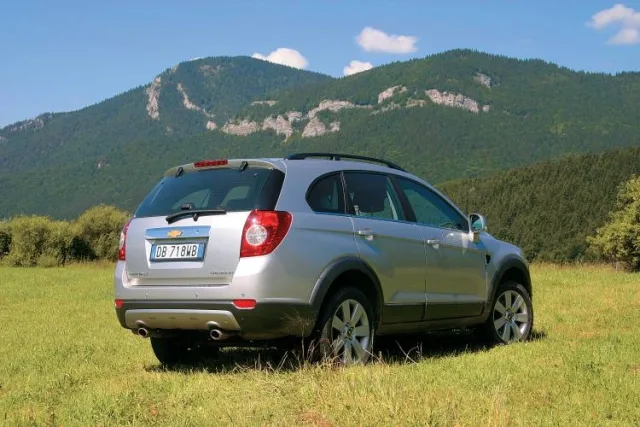
All hope rests on the modern aluminum V6 with 230 hp, which comes only with an automatic. Externally, the top version is distinguished by side "turn signals": on four-cylinder cars, they are at the rear edge of the front fenders, while on the V6, there are ventilation grilles in their place, and the "blinkers" have moved to the mirrors.
 |  | |
| The cheerful and modern interior isn't spoiled even by the black spot of the small-items compartment lid between the central vents (photo shows the interior of a car with the 2.4 L engine and automatic without manual mode) | The cabin is seven-seat only formally — adults are cramped in the third row | The "expander" handbrake lever hits the armrest |
The Captiva V6 lunged from a standstill, but... The "six's" temperament is only enough for confident movement in traffic. On mountain roads, for overtaking, you have to switch to manual mode, using the engine's torquey character. On the highway, it's no easier: after 120 km/h, the speedometer needle crawls up the scale very reluctantly. The five-speed automatic isn't a gift either — the only pluses are the predictable delay at start, smooth shifts, and stable behavior: when "playing" with the pedal at a constant speed, it doesn't "jump" between gears. But everything else... You press the pedal to the floor when overtaking, kick-down engages, but the automatic doesn't want to downshift, even though the tachometer shows only 3500 rpm. The electronics consider this sufficient — but the engine can rev up to 6800! And as soon as you ease off the gas, the gearbox immediately shifts up. Engine braking seems to be a thing of the past...
However, engine assistance isn't needed here. The brakes are grippy, precise, and informative — a rarity for a heavy SUV. Although calling a practically front-wheel-drive car an SUV is hard. Drive to the rear wheels is engaged via a clutch with a pack of "wet" friction plates, commanded by electronics only when the front wheels noticeably slip. How noticeable? I tried driving up a grassy slope: as soon as the front wheels broke into wheelspin, the Captiva "hung" and didn't advance a millimeter further. Automatic engagement of the rear wheels after about two seconds yielded no result. And you can't lock the clutch manually — there's no button.
By the way, in Europe, the Captiva will also be sold in a front-wheel-drive version. But for Russia, front-wheel-drive cars weren't planned, and it's a shame — with such all-wheel drive, front-wheel drive would be better — at least cheaper...
The Chevrolet handles well. On dry asphalt, it has a clear and understandable front-wheel-drive character. And ESP is tuned correctly — the system logically combats understeer, easing off the grip right after intense sliding stops.
You can, of course, complain about slight diagonal rocking, the "empty" steering wheel in sharp turns, and low sensitivity — all of this exists. But the high center of gravity and the pliability of high-profile tire sidewalls are hard to "deceive" — even with the four-link rear suspension.
 |  |
| The two-liter diesel developed from scratch with 150 hp is unavailable to Russian buyers | Thanks to the transverse engine placement and independent suspensions, the Captiva has a very spacious cabin |
Comfort? While driving on the highway, everything is fine: no rocking on waves, tires are quiet, and neither the engine nor wind noise is heard. But as soon as you get onto a lower-class road, the charm disappears. Both gasoline engines squeal like pigs when "revved" during overtaking. The suspension transmits the road's oscillogram in detail right to the seat, accompanied by juicy sound effects. And the rattling of sand and pebbles on the wheel arches shows that the Koreans haven't stopped saving on body sound insulation.
What's the bottom line?
In the end, the Chevrolet Captiva is a spacious family wagon with increased off-road capability. A sort of Audi Q7 for the poor? However, the poor can't shell out $29,990 for the base all-wheel-drive car with a four-cylinder engine — let alone $39,960 for the top V6 version in maximum trim. Not cheap! With such prices, the prospects of the new crossover on the Russian market are murky. But GM is full of optimism: sales start at the end of August, and of the 10,000 cars planned to be sold in Europe by the end of this year, 10% are earmarked for Russia. And considering that the European market is betting on diesel (75% of sales), Russians are expected to absorb 40% of all gasoline cars allocated for the Old World!
For 2007, the Russian plan is even more ambitious — 4,000 cars. However, the Russian market is now more omnivorous than ever. For comparison: the Kia Sorento SUV sold 3,065 units in 2005.
| Chevrolet Captiva (manufacturer data) | |||
| Body type | 5-door wagon | ||
| Modification | I4 2.4 | V6 3.2 | 2.0 D |
| Curb weight, kg | 1730/1760* | 1770/1805* | 1770/1820* |
| Gross weight, kg | 2255/2395* | 2295/2440* | 2505/2505* |
| Weight distribution at full load, % | 50:50/47:53* | 50:50/47:53* | 47.5:52.5/47.5:52.5* |
| Engine | petrol | petrol | turbodiesel |
| Location | front, transverse | ||
| Number and arrangement of cylinders | 4, in-line | 6, V-shaped | 4, in-line |
| Displacement, cm3 | 2405 | 3195 | 1991 |
| Number of valves | 16 | 24 | 16 |
| Cylinder bore/piston stroke, mm | 87.5/100.0 | 89.0/85.6 | 83.0/92.0 |
| Compression ratio | 9.6:1 | 10.3:1 | 17.5:1 |
| Maximum power, hp/kW/rpm | 136/100/5000 | 230/169/6600 | 150/110/4000 |
| Maximum torque, Nm/rpm | 220/2000 | 297/3200 | 320/2000 |
| Gearbox** | M5/A5 | A5 | M5/A5 |
| Gear ratios | |||
| I | 3.95/4.58 | 4.58 | 3.82/4.58 |
| II | 2.04/2.98 | 2.98 | 1.97/2.98 |
| III | 1.35/1.95 | 1.95 | 1.30/1.95 |
| IV | 1.03/1.32 | 1.32 | 0.97/1.32 |
| V | 0.85/1.00 | 1 | 0.77/1.00 |
| reverse | 3.62/5.02 | 5.02 | 3.62/5.02 |
| final drive | 4.36/2.61 | 2.7 | 3.82/2.40 |
| Drive to rear wheels | all-wheel drive, with pluggable electromagnetic clutch drive | ||
| Front suspension | independent, coil spring, McPherson | ||
| Rear suspension | independent, coil spring, four-link | ||
| Front brakes/disc diameter, mm | disc, ventilated/296 | ||
| Rear brakes/disc diameter, mm | disc, ventilated/303 | ||
| Steering | rack and pinion, with power steering | ||
| Number of steering wheel turns from lock to lock | 3.2 | ||
| Tires | 215/70 R16, 235/60 R17, 235/55 R18 | ||
| Maximum speed, km/h | 183/178 | 204 | 186/180 |
| Acceleration time 0-100 km/h, s | 11.5/12.5 | 8.8 | 10.6/12.2 |
| Fuel consumption, l/100 km | |||
| urban cycle | 12.5/14.6 | 16.4 | 9.0/11.0 |
| extra-urban cycle | 7.3/8.0 | 8.6 | 6.5/7.3 |
| combined cycle | 9.3/10.4 | 11.5 | 7.4/8.7 |
| Fuel tank capacity, l | 65 | 65 | 65 |
| Fuel | petrol AI-95 | petrol AI-95 | diesel (Euro 4) |
| * For vehicles with third row of seats | |||
| ** M5 - manual 5-speed gearbox, A5 - automatic 5-speed gearbox (option for four-cylinder modifications) | |||