
Not long ago, we would have condescendingly called cars of this design — with a unibody, front-wheel drive, a coupling on the rear axle, and raised ground clearance — "soft-roaders." However, this word doesn't fit the new Hyundai Santa Fe, Chevrolet Captiva, and Mitsubishi Outlander XL — they look too imposing. Moreover, each of the trio costs over $40,000, since for the comparative test we chose top versions with gasoline V6 engines and automatic transmissions.
So which of these soft... that is, crossovers — is the best?
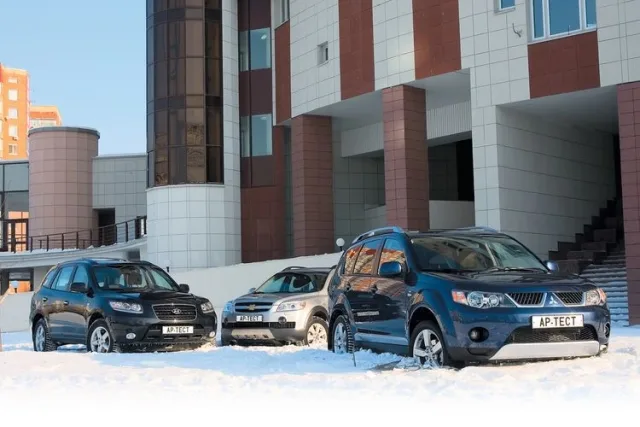
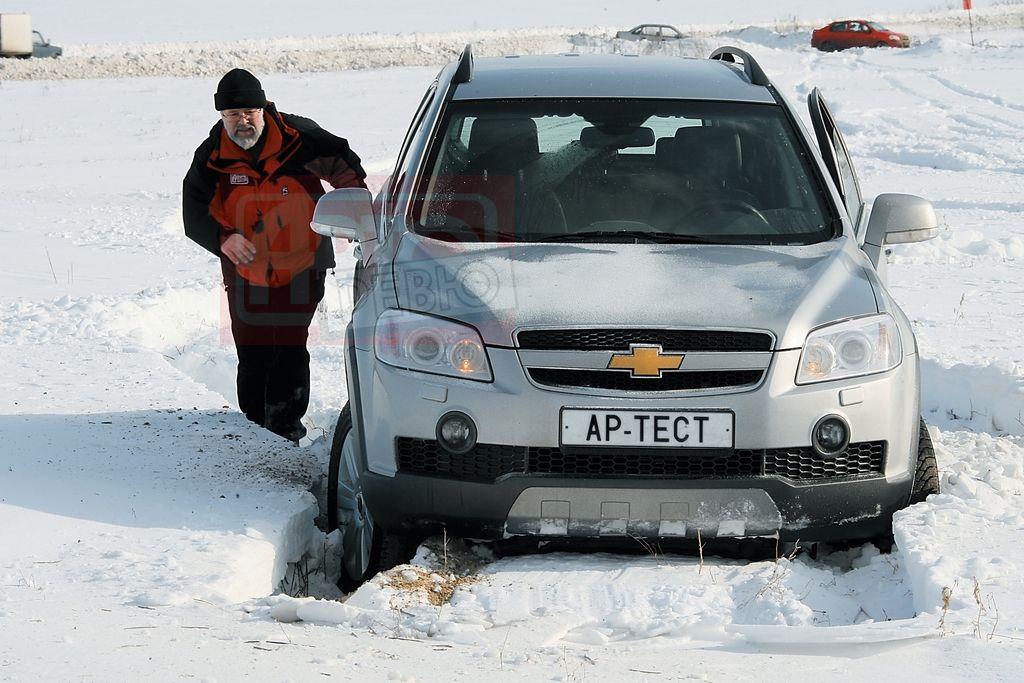
Three against one! In this company, there is one Japanese crossover — the new Mitsubishi Outlander, which bears the XL suffix on the Russian market — and the other two are Korean. Have you forgotten that the Chevrolet Captiva was designed in South Korea by Daewoo engineers, now known as the GM DAT division? However, with such an appearance, wearing a golden cross is not shameful — the Captiva, with its "muscular" sides and "off-road skirt" of unpainted plastic, looks hefty and solid.
The Hyundai Santa Fe is also not devoid of charm: a couple of ribs on the hood and slanting Asian headlights add originality. But the Japanese from Mitsubishi, under the leadership of chief designer Akinori Nakanishi, managed more: no matter from which angle you look at the new Outlander — it's a blade! Albeit not a light Japanese katana, but rather a heavy damask sword.
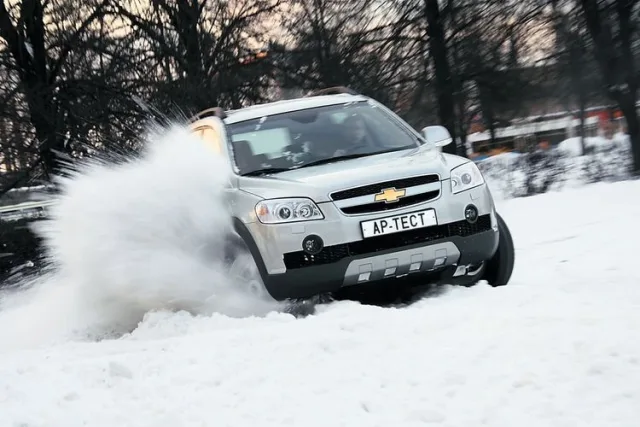
On a slippery road, the Captiva with the stability control system turned off behaves unpredictably: a sharp understeer is replaced by a deep oversteer. So it's better not to touch the ESP
And what about the interior? The excellently sculpted seat firmly holds you in the embrace of its side bolsters, the small donut steering wheel beckons to your hands, and the instruments adorned with "aluminum" attract the eye. And here, style does not interfere with functionality — using all the knobs and buttons is easy and pleasant: from the standard Rockford audio system, which plays powerfully and richly in the Outlander, to the three classic climate control knobs. The trim is top-notch: the hard ribbed plastic doesn't creak, and the panels are fitted with Japanese precision. It's just a pity that the steering wheel doesn't adjust for reach, and the small range of backrest tilt and the lack of lumbar support won't let fans of an almost vertical seating position get comfortable.
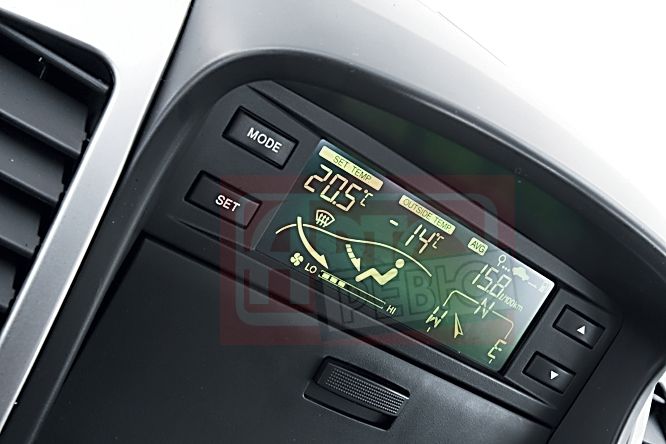 | 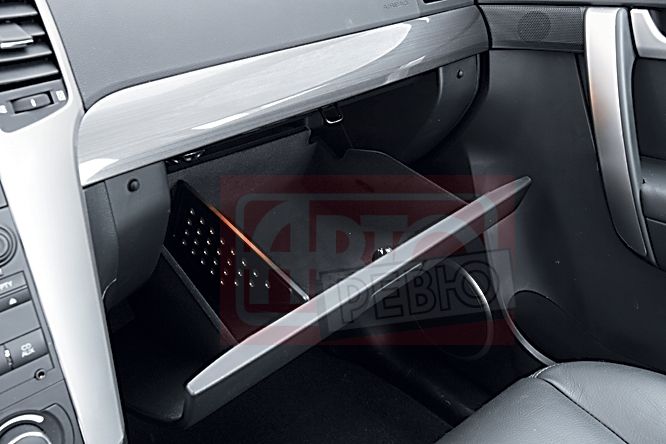 |
| On the screen — climate control modes, three indicators of the onboard computer, and a compass | A hoarder's dream — a spacious glove box |
 |  |
| With its mix of trim materials, the Captiva resembles the small Chevrolet Aveo. But instead of ribbed plastic — a soft coating | Overheating of the coupling — the end of off-road adventures in all three cars. All that remains is to wait for it to cool down… |
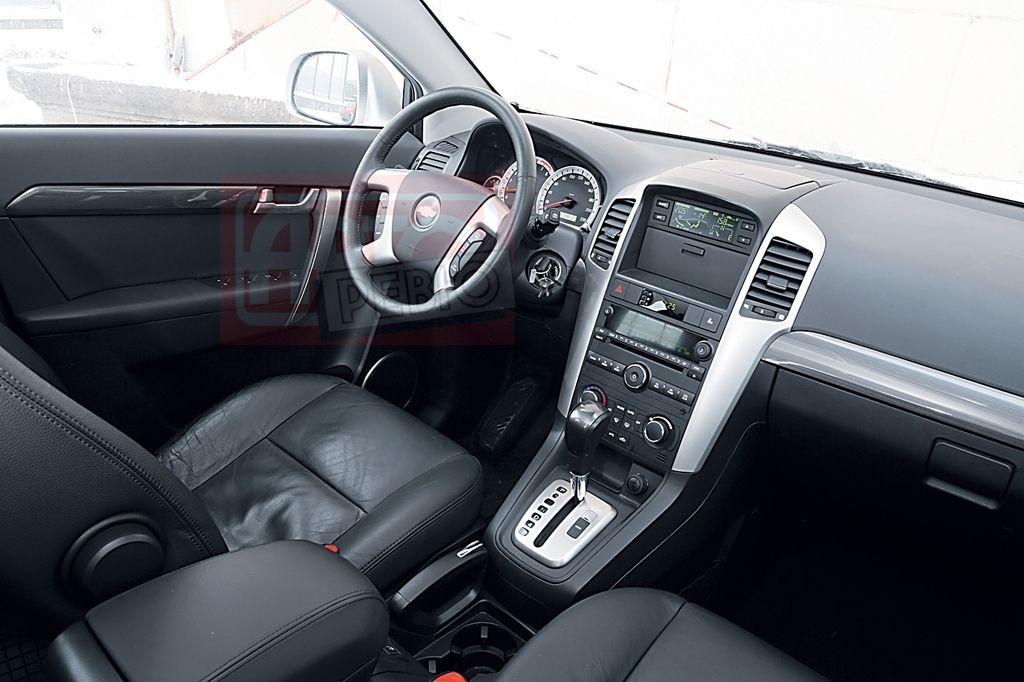
You move into the Chevrolet — and the mood is completely different, leisurely. A large steering wheel, a flat seat, large instrument scales... The front panel of soft plastic is enlivened with "carbon" and "metal" inserts — but the panels are pressed through under your fingers, and in some places uneven gaps spoil the impression of quality. The high seating position is comfortable: the steering wheel and seat adjust over wide ranges. Controlling the "climate" is a pleasure: all settings with two knobs with rubberized rims are visible on the high-mounted display. However, the button for selecting airflow distribution has to be searched for among eight neighboring ones.
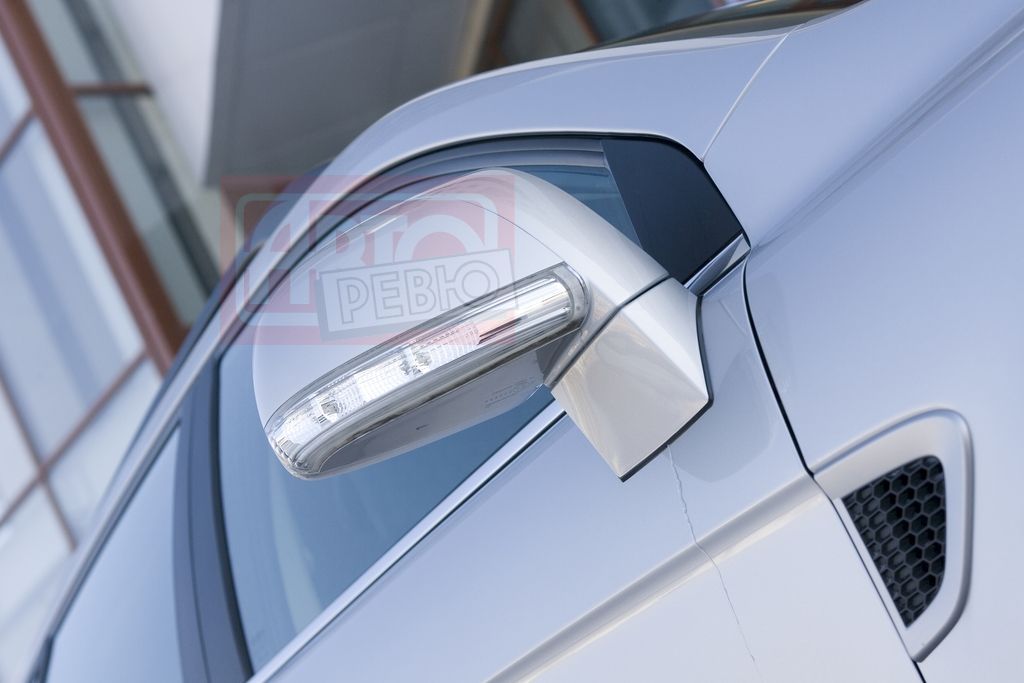 | 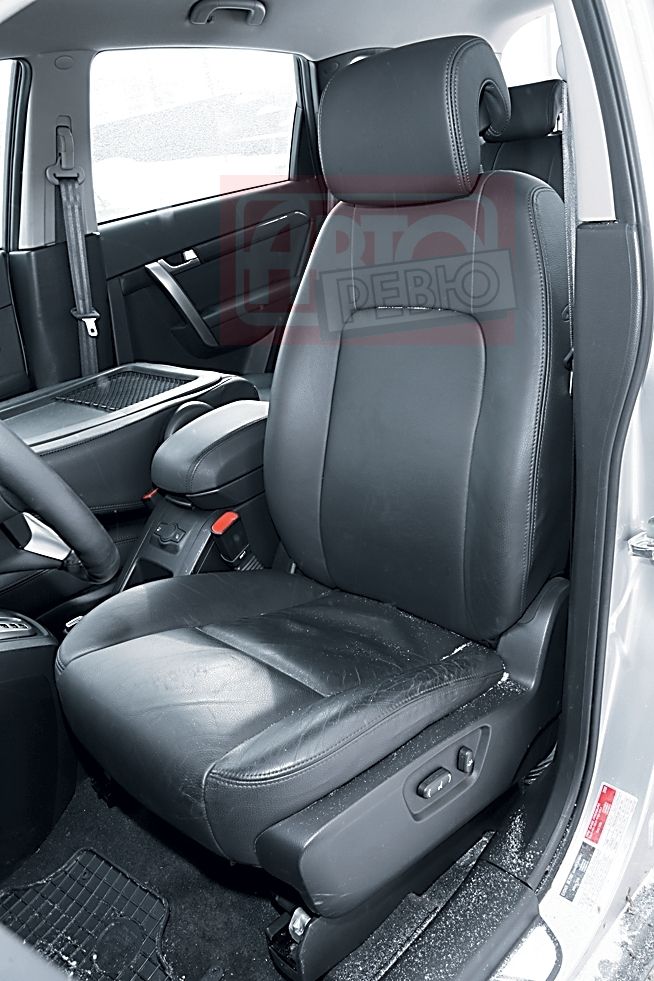 | 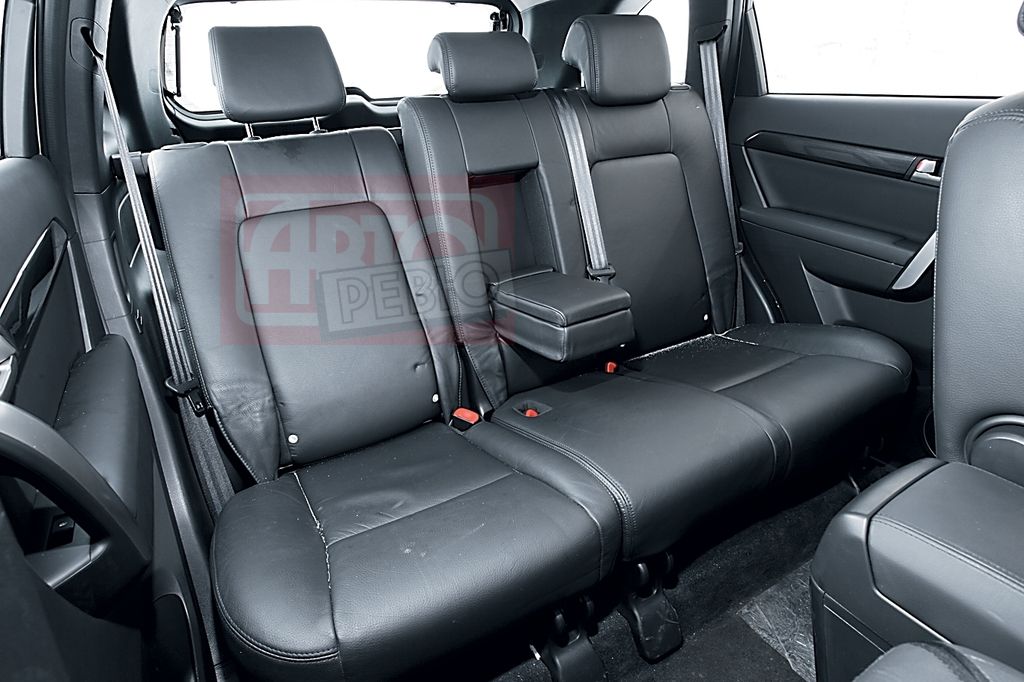 |
| In the housings of the large mirrors — turn signal repeaters | The Captiva's seat distributes the load well, and the lack of lateral support is a plus for drivers of solid build | Passengers have plenty of room. And you can also order two seats in the trunk — for children |
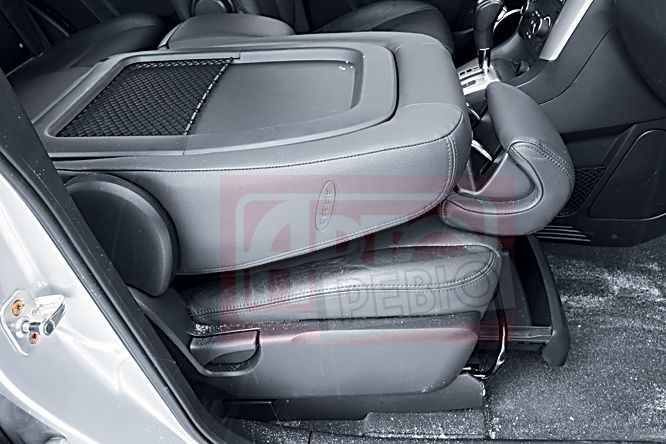 | 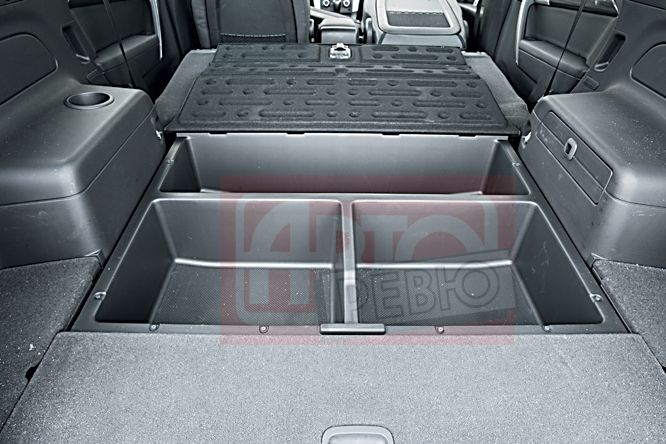 | 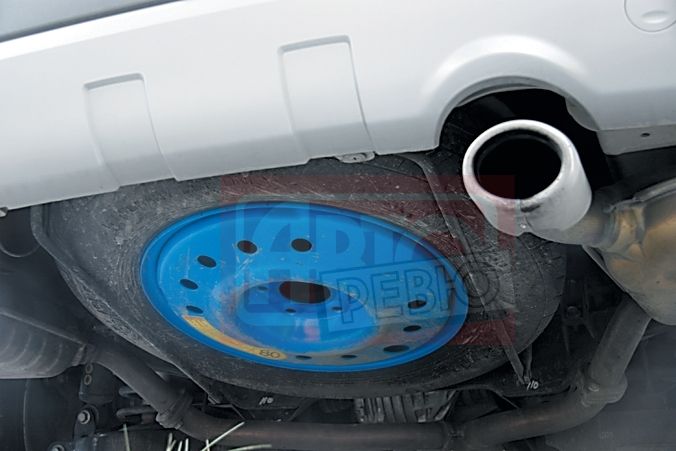 |
| Transporting a three-meter baseboard in the cabin is not a problem: the front seat folds down | Five spacious niches on the trunk floor are covered by two rigid lids | Under the floor of the Captiva, a "donut" spare tire is hidden, which doesn't hinder off-road capability |
The interior of the Hyundai Santa Fe is a vinaigrette of contradictions. Serious, almost natural "wood," but on the instruments from the NF sedan — playful blue stripes on the scales. Expensive perforated leather seats, and right there — hard plastic on the front panel. The seat adjustment ranges are sufficient, but the steering wheel wobbles on a short lever in the American style. All buttons are at hand, but controlling the dual-zone climate control distracts from the road — its display is located too low. The moderately soft seat distributes the load excellently, and the steering wheel is optimal in cross-section and diameter.
And what about the second row? The new Santa Fe is a large car, and there's plenty of legroom here. And it's not cramped in the shoulders, even with three people. But the seat cushion is set too low, so your knees are raised up. And there's not much space above your head — the ceiling is a bit low.
| Chevrolet Captiva | Hyundai Santa Fe | Mitsubishi Outlander XL |
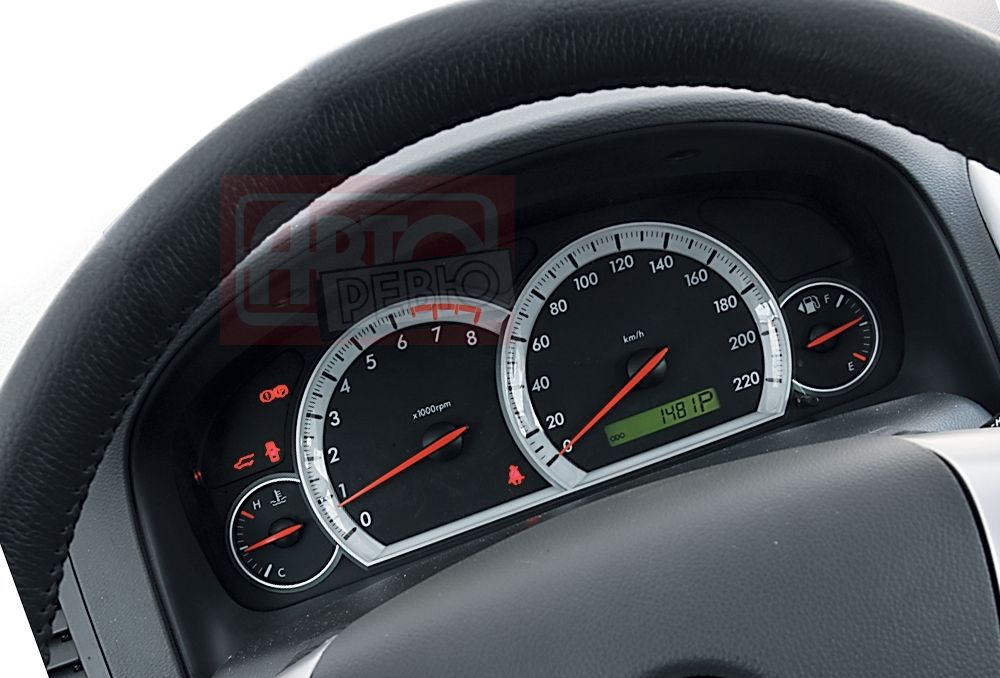 | 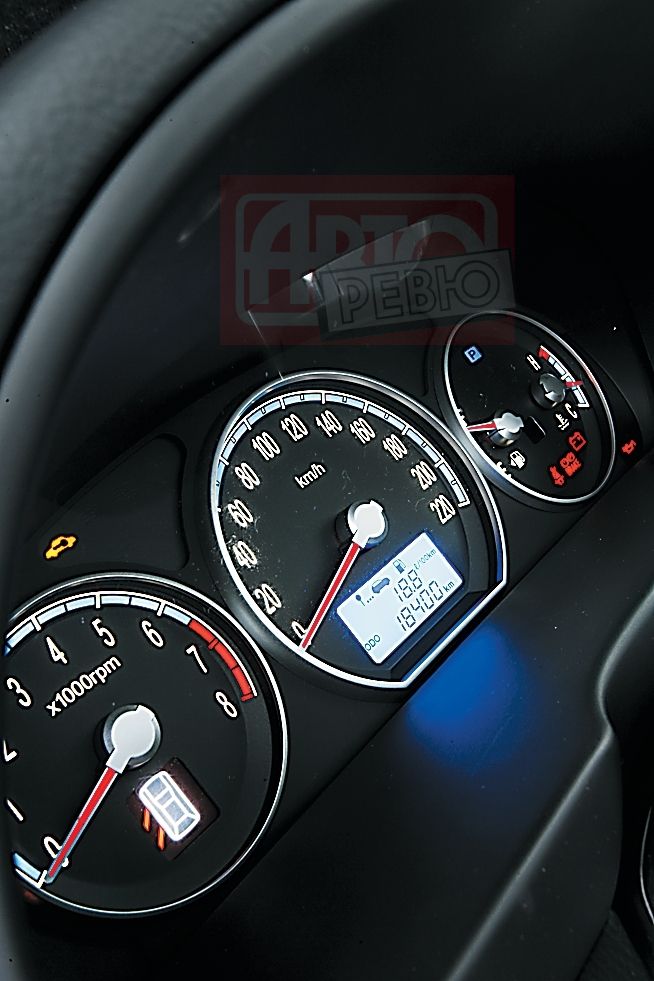 | 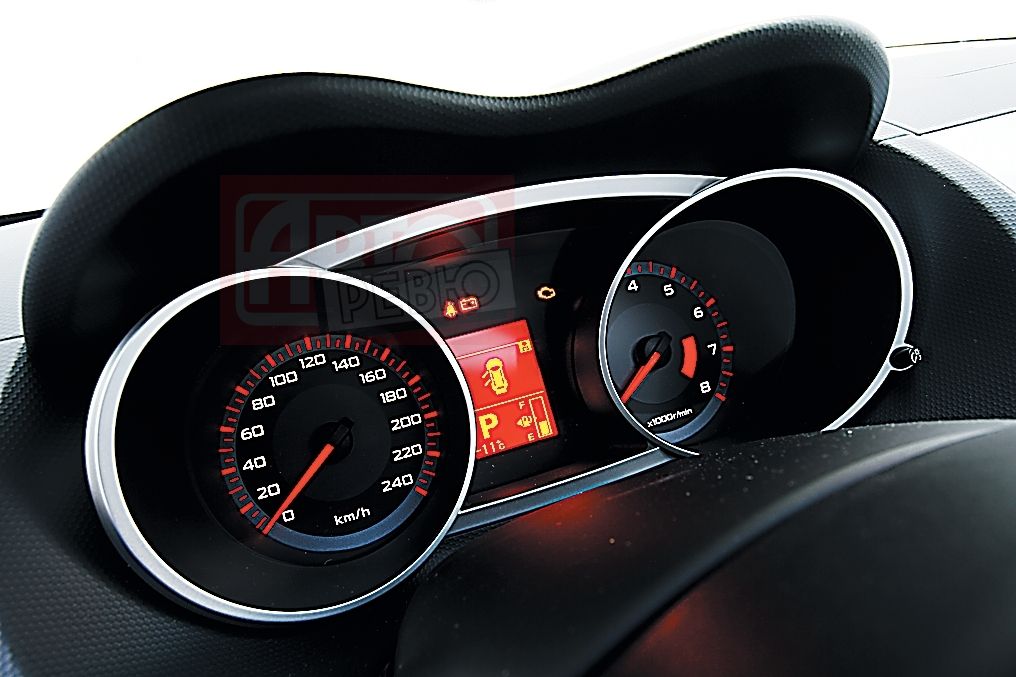 |
| The instruments in all three are perfectly readable. The blue scales of the Santa Fe are too playful, but the Chevrolet calms with its pale green backlight. And the most striking white-lunar digits with red sword-like needles are in the Mitsubishi | ||
In the Chevrolet, it's more comfortable in the back: there's no less space in length and width, and the ceiling is higher. But there's also its own drawback — the hard plastic of the front seat backs.
And the most comfortable for passengers is the Outlander XL. Unlike the "Koreans," where only the backrest tilt adjusts, in the Mitsubishi, the asymmetric halves of the rear seat also slide forward and backward on rails. But even in the extreme forward position, your knees barely touch the front seats. And if you slide all the way back... Exactly — XL, "extra large." A very big Outlander.
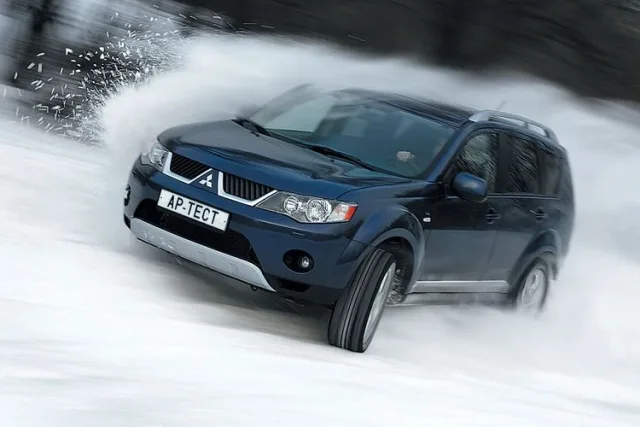
The sporty chassis and the rigid coupling lock in Lock mode — a driver's cocktail!
And the trunk is huge: there's no less space for cargo here than in the "Koreans," even despite the protruding wheel arches and the subwoofer lurking on the left. That's because the Mitsubishi's trunk is deeper by more than ten centimeters. And the loading height is 20 cm less! It's a pity that there's no "underground" for tools and small items, as in the competitors.
The Outlander is also the best transformer: the rear seats fold electrically. You lower the headrests, pull the button in the trunk — and before you is one and a half cubic meters of space. And the central section of the rear bumper is not a bumper at all, but a fold-down tailgate. Both the Santa Fe and the Captiva look pale against this background — with their standard set of manually folding asymmetric parts of the rear seat.
And what if it's not about transporting cargo, but about simple and pleasant movement in space? And not just movement, but about getting driving pleasure?
And here Mitsubishi takes the lead. The six-cylinder Outlander responds instantly to the accelerator pedal, powerfully 'shooting' at lower gears. The engine clearly prefers high revs. And what a sound it makes! Angry, sharp, with a metallic edge... It makes you want to shift gears yourself using the convenient paddle shifters. Press one, and the gearbox immediately switches to true manual mode. Returning to Drive is also easy: just hold the right upshift paddle for a couple of seconds. But you don't want to go back—in fully automatic mode, shifts are less predictable, and jerks during gear changes are more noticeable.
If you drive without haste, the Outlander XL becomes less appealing. The engine hum starts to annoy at 2000 rpm, and the excessive sharpness of throttle response is simply irritating...
For relaxed driving, the Captiva and Santa Fe are much better suited. They don't react as sharply or stubbornly to the gas pedal (especially the Chevrolet), and their automatic gearboxes work smoother and more predictably. Moreover, during full-throttle acceleration, the Captiva doesn't lag behind the Mitsubishi! The Santa Fe, however, is noticeably slower—due to both lower engine power and the stretched gears of its four-speed automatic.
All three cars brake excellently. But the Outlander is still slightly better than the others: it has the shortest pedal travel and the most understandable feedback. In the Captiva, the 'background' force on the pedal during free travel is a bit distracting, but its ABS tuning is more successful.
On highways, all our subjects hold confidently, even despite ruts in the asphalt. But when you turn the steering wheel... Here, the characters of the cars diverge again!
Quick responses to steering inputs, rich and natural reactive force—that's Mitsubishi. A true driver's car! True, body rolls during sharp lane changes are a bit large, and when turning the wheel quickly, it feels like it's sticking slightly. Another nuance is a noticeable tendency to oversteer when lifting off the throttle. It seems this is a family trait of Outlanders—the old Outlander without the XL index behaves the same way. But the oversteer is easily controlled, and importantly, the 'very big' Outlander has stability control as standard. And the electronics work excellently: the ASC system itself dampens too-deep slides without waiting for driver action, but allows some enjoyable sliding within acceptable limits.
Moreover, if the Mitsubishi's transmission switch is in 2WD mode (front-wheel drive), the Outlander XL behaves like a typical front-wheel-drive car. In 4WD Auto mode, when the electronics engage the rear wheels upon front wheel slip, the car first still slides with the front, but then breaks into oversteer under power. And if you want to spin around on a snowy lot with ASC off, it's better to immediately select 4WD Lock mode with the rear coupling locked—oversteer under power will occur more smoothly, faster, and more decisively.
Chevrolet is a completely different story. In calm responses, there's a sense of haughty laziness; the reactive force on the steering wheel is only sufficient during smooth lane changes. Sharp maneuvers like the 'moose test' are difficult for the Captiva—low sensitivity to steering input gets in the way. And a noticeable tendency to oversteer during sharp maneuvers quickly discourages any desire to dart between lanes. Good thing there's stability control. However, with ESP off (on 'our' car, the system didn't work), you feel uneasy on slippery roads.
No, it's better to drive the Captiva unhurriedly. As well as the Hyundai Santa Fe.
From the perspective of a calm driver, the Hyundai handles best of all—unlike the Captiva, it doesn't tend to oversteer, doesn't wiggle during lane changes. The Santa Fe holds its line reliably, corners decently, and the reactive force on the steering wheel is sufficient in all situations except the 'moose test' (where a noticeable step in effort appears). No spark? But there's a stability control system that works reliably in emergency situations. And if you turn it off, the Hyundai slides evenly on all four wheels under power. Forcibly locking the coupling isn't necessary—it would only increase the understeer phase.
But for good handling, both Hyundai and Mitsubishi require paying with a stiffer suspension. Small and medium irregularities respond with stronger jolts than desired, and the road profile is repeated too meticulously, especially in the Mitsubishi. The Captiva, however, is noticeably softer and more comfortable: fewer vibrations in the cabin from rough surfaces, and acceleration peaks on bumps are lower. True, the energy intensity of the Mitsubishi and Hyundai suspensions is noticeably higher—the Chevrolet shudders more on large potholes.
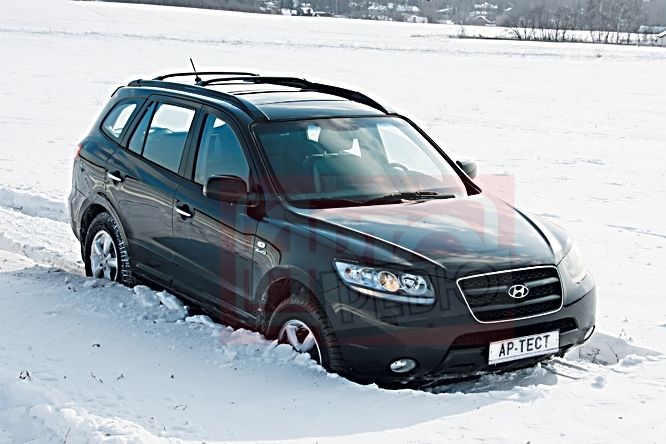 | 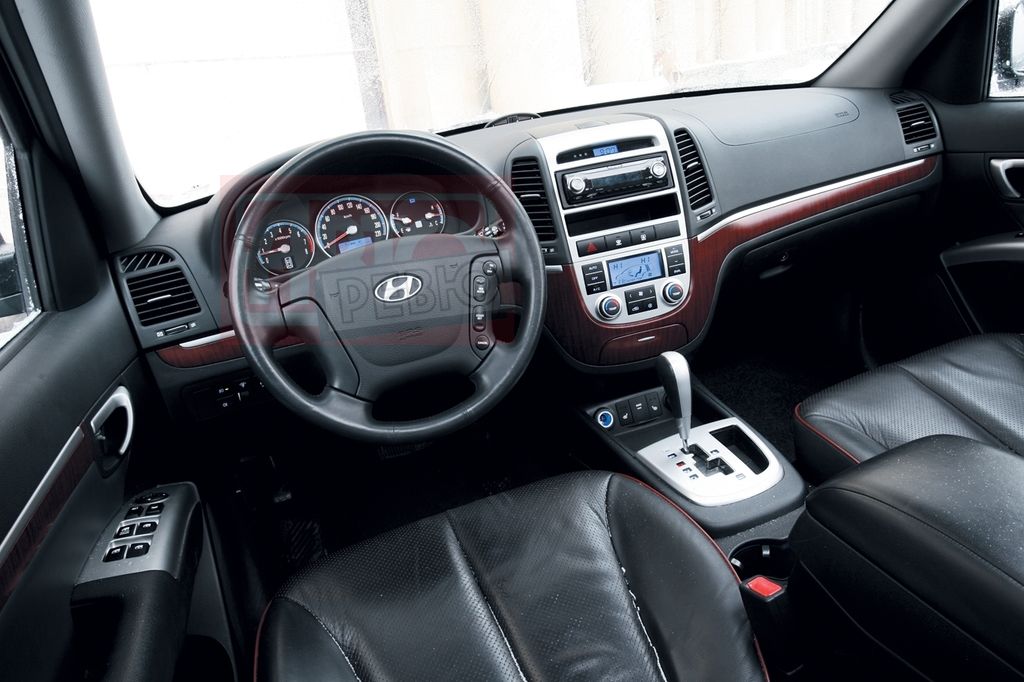 | 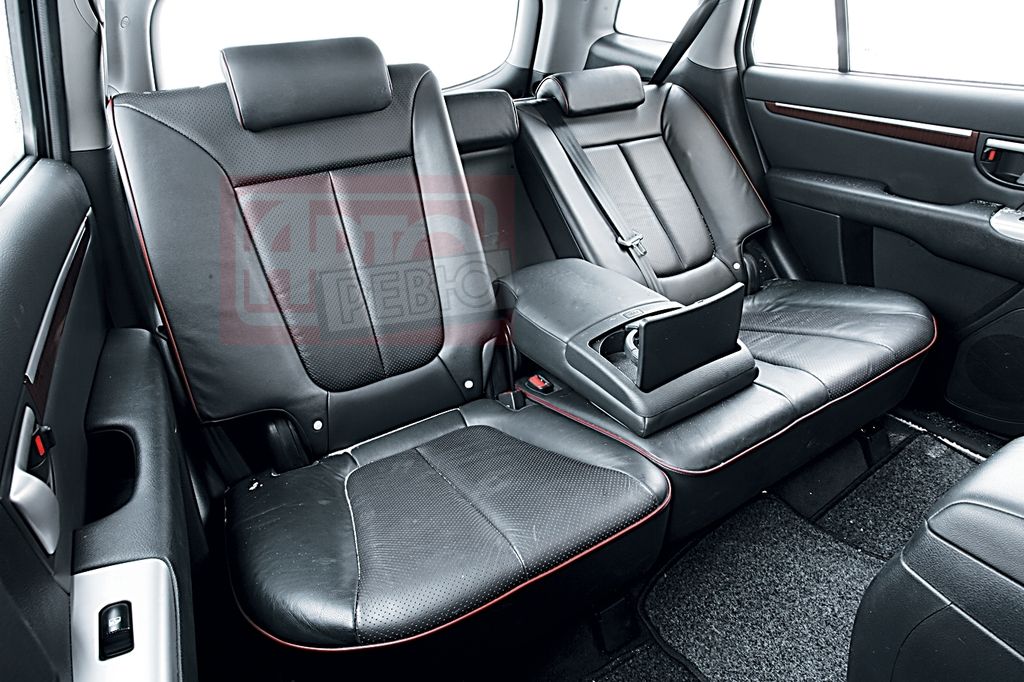 |
| The front of the Santa Fe digs in first | The steering wheel, climate control block, and much more in the Santa Fe are borrowed from the NF sedan | Due to the low seat cushion height, the rear of the Santa Fe is uncomfortable |
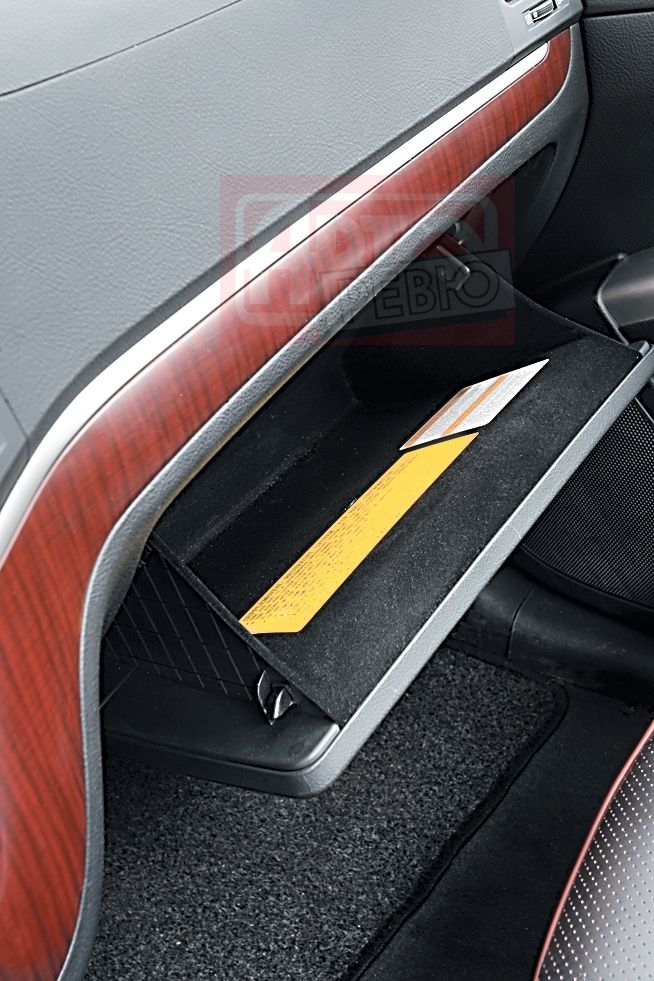 | 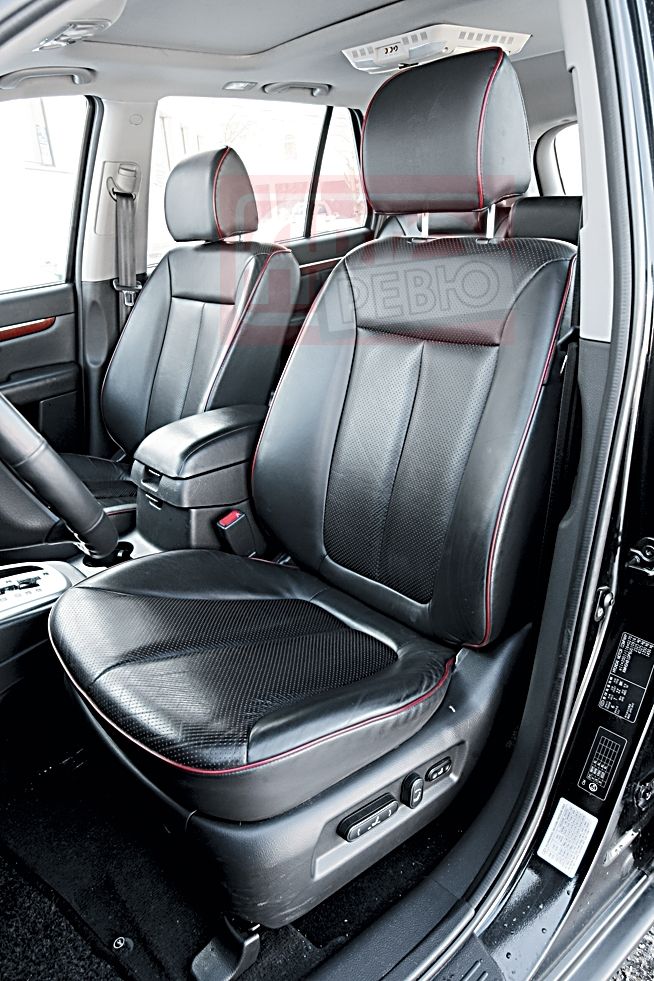 | 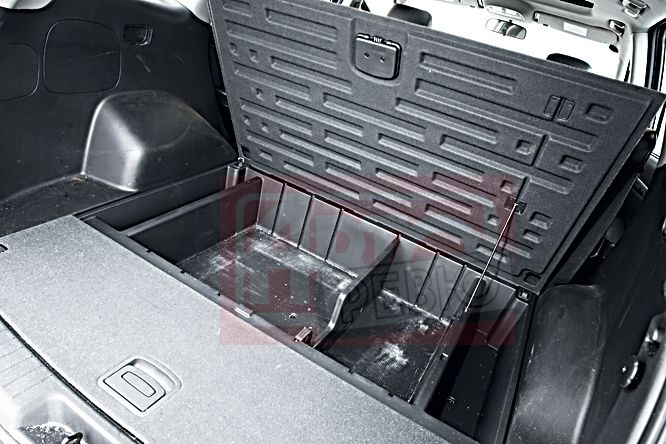 |
| The glovebox is small | Hyundai seat: perforated 'grippy' leather and a decent profile | Two hard covers for the 'underfloor' compartments—like in the Chevrolet |
These jolts are also accompanied by plastic creaks in the Captiva's cabin. If not for this creak, I would rate the Chevrolet's acoustic comfort higher—its engine operation is almost inaudible. In the Hyundai, the engine raises its voice louder during acceleration, and I won't even mention the Mitsubishi: its motor sounds lively even at a constant speed. Otherwise, the behavior of all three cars is similar: tire and wind noise are within normal limits, except that the sound of sand and small stones hitting the wheel arches is clearly audible.
So, on asphalt, the balance of power is clear. What about off-road?
It's obvious that crossovers, or as they're also called, 'soft-roaders', aren't designed for truly heavy off-roading. But can they get to the dacha if the road is snowed in?
We went to find the answer to this question on a suitable snowy field.
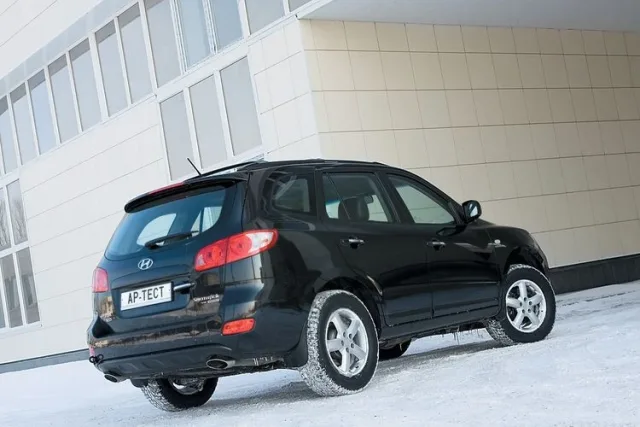
On virgin snow, the Captiva advanced best—thanks to the grippiest tires (Goodyear UG 500) and the greatest ground clearance. Even when the Chevrolet got stuck, it easily backed out—the 'donut' spare hanging at the rear doesn't interfere, nor does the slight pause before the rear wheels engage.
The Outlander in 4WD Lock mode digs with the rear wheels more confidently. But it sits on its belly earlier, and sits thoroughly. The reason is... the 'spare tire'. The fact is that on most world markets, the new Outlander is sold without it. But for Russia, they decided to place a full-size wheel under the floor, which hangs inadmissibly low—and serves as an anchor off-road!
| Chevrolet Captiva | Hyundai Santa Fe | Mitsubishi Outlander XL |
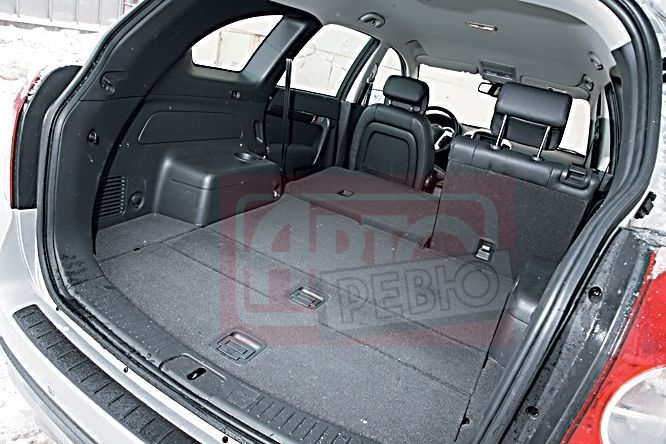 | 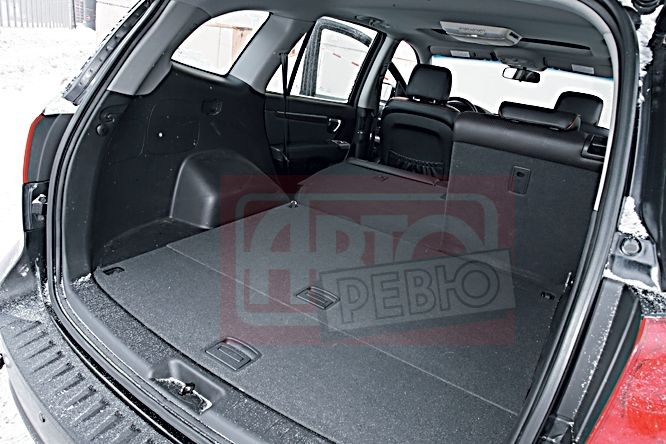 | 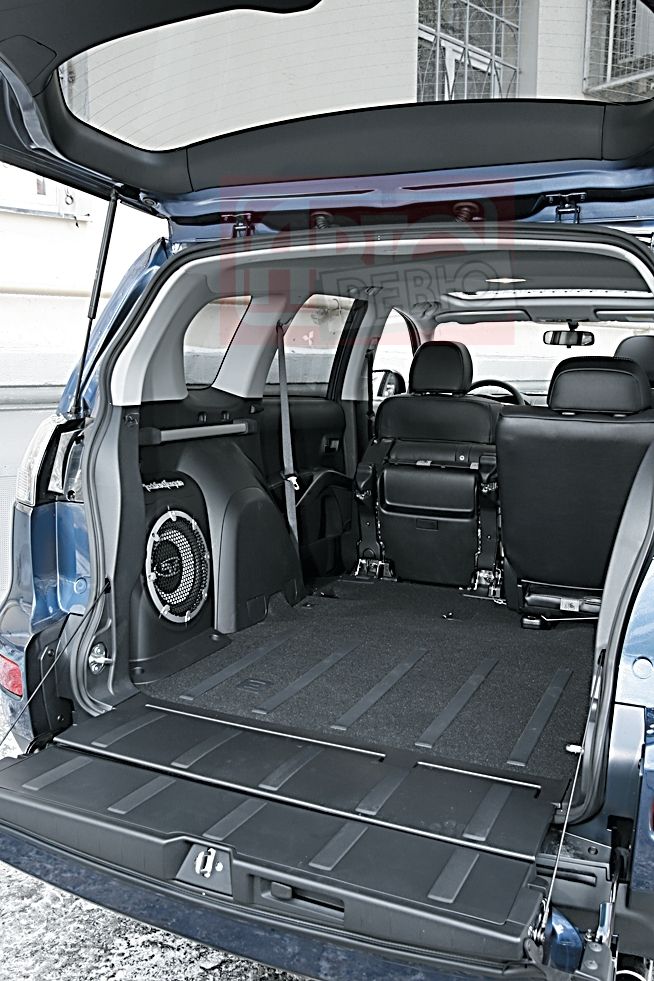 |
| The trunks of the Hyundai and Chevrolet are like twin brothers, only the Santa Fe's bumper protrudes more, and the Captiva's wheel arches. The Outlander XL is out of competition: the lowest floor plus a folding bumper-tailgate | ||
And the Hyundai Santa Fe moved worst of all on virgin snow. The culprit is the Michelin tires (X-Ice North) and suboptimal torque distribution between axles—the front wheels manage to dig in before the rear axle engages.
By the way, diagonal wheel hanging, when one of the wheels is in the air, none of these crossovers can overcome. The electronic stability systems, trying their best to imitate differential locks, are powerless here—on snow, the electronics simply 'strangle' the engines, and the cars can't move.
So you can call them crossovers, you can call them 'soft-roaders', but the essence is the same—these cars can only handle light off-roading. And even then with a caveat: 'combat operations' shouldn't last longer than 20 minutes. It was during this time that the slipping couplings in all three cars overheated—even the forced lock on the Mitsubishi and Hyundai didn't help. It seems the electronics even in this mode allow disc slippage.
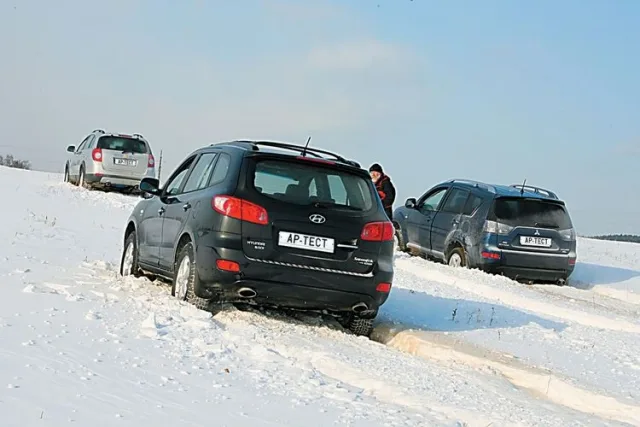
This is the balance of power off asphalt: Captiva is the 'king of the hill', Outlander XL lags behind, and Santa Fe digs in earlier than all
So, a 'soft-roader' can overcome a hundred meters of snowdrift or get out of an uncleaned parking lot. But covering a kilometer of virgin snow, even if shallow, is unlikely.
However, for someone who rarely leaves the asphalt... Which of these three large crossovers would we recommend?
The Mitsubishi Outlander XL leads in most of our expert categories. It is the most stylish, the most spacious, the most versatile, and at the same time the most driver-focused. And the high price adequately reflects this advantage — $46,930 for the top-spec Inspire version we tested. Just keep in mind: driving this car slowly is difficult, and one of the side effects is high fuel consumption, around 18 l/100 km.
For those who prefer leisurely movement and value comfort, the Chevrolet Captiva and Hyundai Santa Fe are more suitable. There is a difference between them, though not a big one: the Santa Fe handles better, but accelerates not as briskly as the Chevrolet. True, the Hyundai is more expensive — its price is comparable to the Mitsubishi. However, the Santa Fe can be bought without waiting.
And the Chevrolet is offered in Russia with an extra pair of seats in the trunk — it can be a seven-seater! Isn't that an Audi Q7 for the middle class? Moreover, prices for the Captiva start from $29,990 for the base version with a 2.4 engine and manual transmission. And when these cars start being assembled at the GM plant near St. Petersburg, the Captiva could become more affordable. If only the build quality could be improved...
Autoreview Readers' Forecast
Before this test, we asked visitors of the website www.autoreview.ru to answer the question: "Which of the cars participating in the next Autoreview test would you prefer?"
Here is how the votes were distributed:
Mitsubishi Outlander XL 72.87%
Hyundai Santa Fe 19.40%
Chevrolet Captiva 7.73%
10,427 people voted
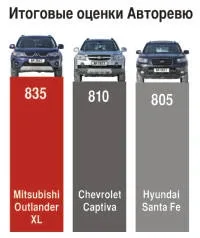
| Autoreview Expert Ratings | ||||
| Evaluated Parameters | Max Score | Vehicles | ||
| Chevrolet Captiva | Hyundai Santa Fe | Mitsubishi Outlander XL | ||
| Design | 160 | 130 | 125 | 140 |
| Exterior | 80 | 65 | 65 | 70 |
| Interior | 80 | 65 | 60 | 70 |
| Ergonomics | 160 | 130 | 130 | 135 |
| Driver's workspace | 80 | 65 | 65 | 70 |
| Visibility | 80 | 65 | 65 | 65 |
| Dynamics | 330 | 270 | 270 | 275 |
| Acceleration dynamics | 80 | 70 | 65 | 70 |
| Braking dynamics | 100 | 85 | 85 | 90 |
| Handling | 80 | 60 | 70 | 65 |
| Off-road capability | 70 | 55 | 50 | 50 |
| Ride comfort | 180 | 150 | 150 | 135 |
| Ride smoothness, vibration protection | 70 | 60 | 55 | 55 |
| Acoustic comfort | 60 | 50 | 50 | 45 |
| Climate control | 50 | 40 | 45 | 35 |
| Interior comfort | 170 | 130 | 130 | 150 |
| Passenger seats | 70 | 50 | 50 | 60 |
| Trunk | 60 | 50 | 50 | 55 |
| Interior transformation | 40 | 30 | 30 | 35 |
| Total score | 1000 | 810 | 805 | 835 |
Are they safe?
All three crossovers are well equipped in terms of safety — both active and passive. They have ABS, stability control systems (for the Hyundai Santa Fe — only on the top version), and all six-cylinder cars have six airbags, including side curtain airbags. The exception is the Chevrolet Captiva with a four-cylinder engine, which has only two front airbags. However, Isofix child seat anchors are present on all cars without exception.
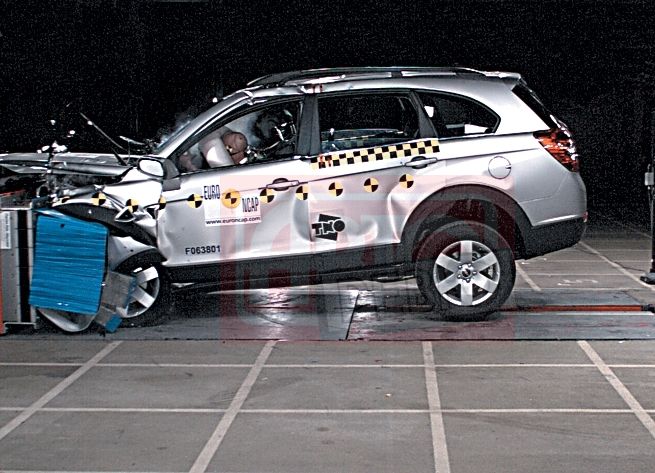
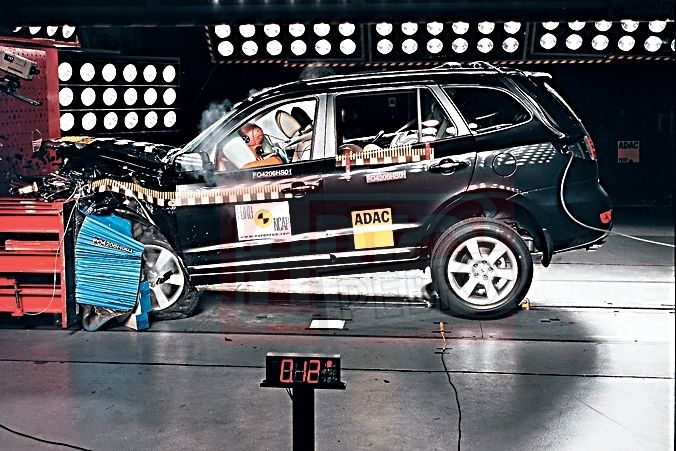
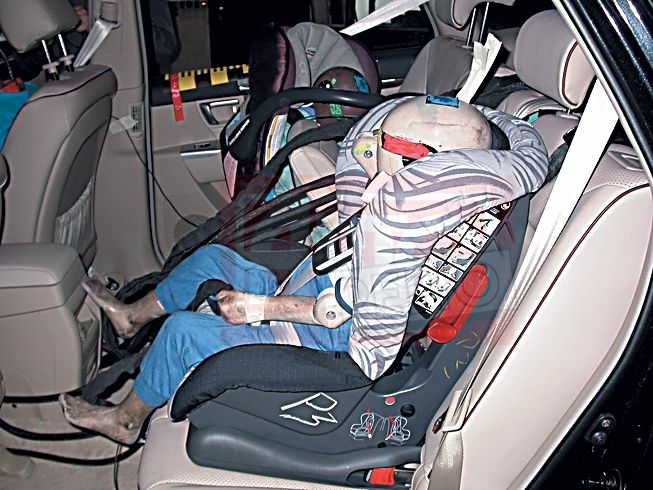
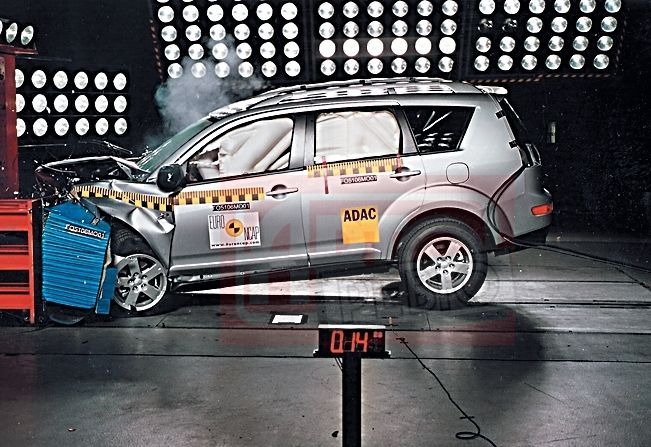
According to EuroNCAP methodology, all three crossovers performed well, with identical results in frontal impact tests. Specialists highly rated the safety level but pointed out a potentially hazardous front panel, and for the Chevrolet and Hyundai, they additionally noted a rearward displacement of the brake pedals by almost 100 mm. In the side crash test, the Mitsubishi Outlander demonstrated the best result, earning the maximum score, while the Chevrolet Captiva and Hyundai Santa Fe lost one point each due to incomplete deployment of the side curtain airbags. The result — all three cars earned the same four stars.
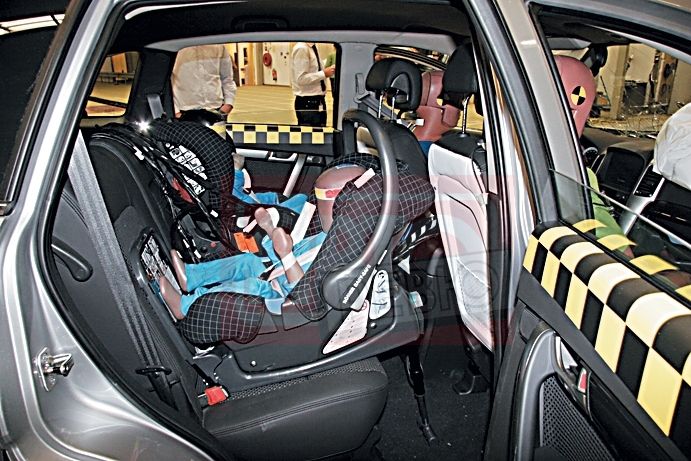
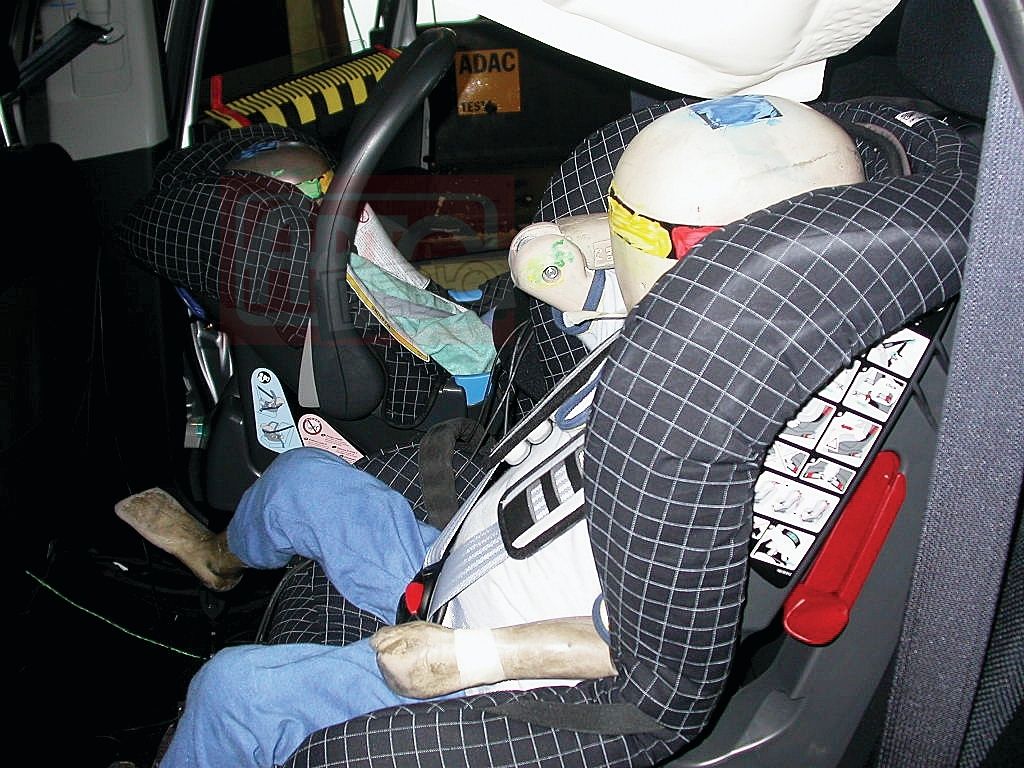
As for the protection of child passengers, all models had one common issue — excessive load on the chest. In the Captiva, during a frontal impact, the chests of both "dummies" experienced increased pressure, and in the Mitsubishi, the load on the chest of the one-and-a-half-year-old "child" in the vertical plane was even more significant. The Hyundai Santa Fe performed best in this test, but even its 18-month-old "passenger's" chest was overloaded.
Pedestrian safety for the Chevrolet and Mitsubishi is rated as average — both crossovers have too rigid hood edges. However, the Hyundai failed to score a single point in this discipline.
| Chevrolet Captiva* | |
| Overall rating | 31 |
| Frontal crash test | 12 (75%) |
| Side crash tests | 17 (94%) |
| SBR** | 2 |
| Child passenger protection | 36 (73%) |
| Pedestrian protection | 17 (47%) |
| Curb weight | 1905 kg |
| * Tests conducted according to EuroNCAP rules | |
| ** Seatbelt reminder | |
 |  |
| Hyundai Santa Fe* | |
| Overall rating | 29 |
| Frontal crash test | 12 (75%) |
| Side crash tests | 17 (94%) |
| SBR** | 0 |
| Child passenger protection | 37 (76%) |
| Pedestrian protection | 0 (0%) |
| Curb weight | 1869 kg |
| * Tests conducted according to EuroNCAP rules | |
| ** Seatbelt reminder | |
 |  |
| Mitsubishi Outlander XL* 4 | |
| Overall rating | 32 |
| Frontal crash test | 12 (75%) |
| Side crash tests | 18 (100%) |
| SBR** | 2 |
| Child passenger protection | 35 (71%) |
| Pedestrian protection | 17 (47%) |
| Curb weight | 1655 kg |
| * Tests conducted according to EuroNCAP rules | |
| ** Seatbelt reminder | |
 |  |
Visibility
Visibility is in perfect order for all three cars — the differences lie only in details.
The Chevrolet Captiva can boast the largest mirrors and the maximum windshield cleaning area — the driver's side wiper falls just a couple of centimeters short of the pillar. Total visibility is 263.5°. True, the edge of the tailgate window is positioned a bit high — a car parked behind is visible only by its roof.
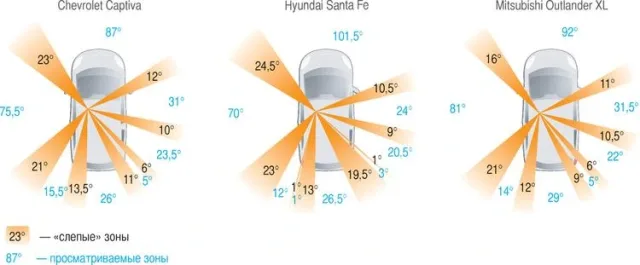
The Santa Fe has thicker pillars, and the wipers clean a smaller area — the final viewing angle is 5° less. The mirrors are also smaller. However, the view through the interior mirror is better: the lower edge of the rear window is positioned lower.
But the Mitsubishi Outlander pleases with the largest total viewing angle (274.5°) and a spacious opening of the fifth door window. The wiper operation zone is at the level of the Santa Fe. The downside is that the mirrors are not wide enough, which hinders confident maneuvering in city traffic.
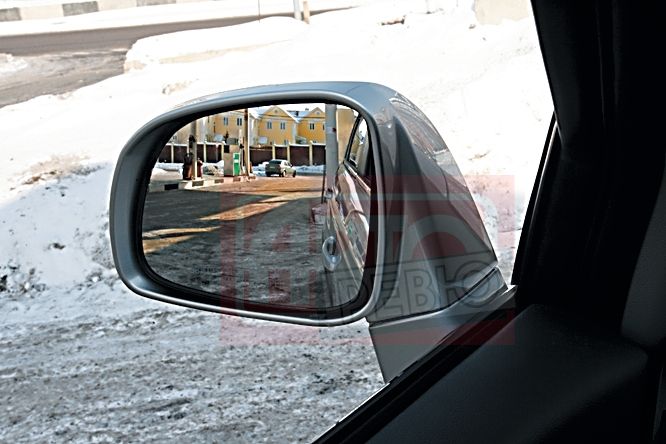 | 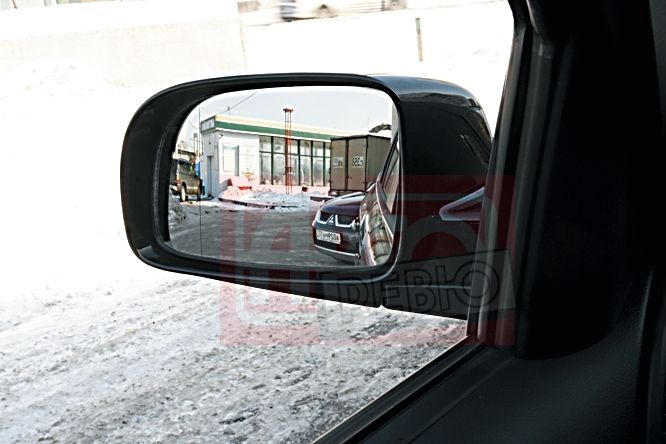 | 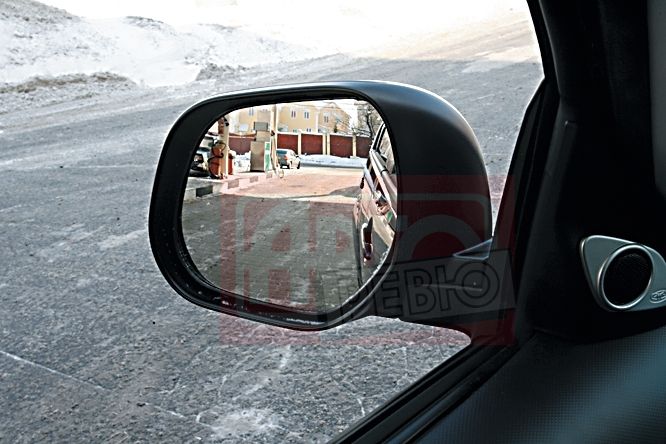 |
| Chevrolet Captiva | Hyundai Santa Fe | Mitsubishi Outlander XL |
How the interiors warm up
To understand how effectively the climate systems work, we measured the interior warm-up rates. To do this, the cars were left overnight in the cold, and in the morning at minus 12 degrees Celsius, we turned on the climate control to maximum, directing airflow to the windshield and footwells. Temperature was recorded in four zones: at the driver's feet and head, as well as at the rear passenger's feet and head. Readings from the sensors were taken every minute for twenty minutes.
The temperature around the head of both the driver and the rear passenger rises almost identically in all three cars. However, the driver's feet are best warmed by the Hyundai. Only the Captiva managed to bring the air temperature in the rear footwell to a comfortable fifteen degrees within the allotted time. In the Mitsubishi, this figure did not rise above six degrees of warmth, even though there are air ducts. The culprit is the foam "podium" for the rear passengers' feet, which forms a step under the front seat in the Outlander and prevents heat from spreading evenly.
What's the price?
Chevrolet Captiva 2.4 LS (136 hp) with a manual transmission, four airbags, ESP, air conditioning, CD/mp3 stereo, parking sensors, and heated electric mirrors costs only $29,990. For metallic paint, you'll have to pay an extra $500. The LT version for $32,230 features climate control, cruise control, and light and rain sensors. For the "automatic" and third row of seats — an extra $2,200. Leather interior, CD changer, heated front seats, and power-adjustable driver's seat — another $2,900. Prices for the Chevrolet Captiva V6 LT (3.2 L, 230 hp) start at $38,510 for a seven-seat car with six airbags, while the five-seat top version with leather interior, which we tested, will cost $39,960. Payment at dealers is at the current Central Bank of Russia exchange rate. Order fulfillment time is from three to six months.
Warranty — 2 years without mileage limit. Chevrolet sales are handled by 79 dealers in 49 Russian cities.
Hyundai Santa Fe is sold in Russia only with a 2.7 L gasoline V6 (189 hp). The base GL version (six airbags, air conditioning, heated front seats, power mirrors) with a manual transmission is priced at $36,990. The extra charge for the "automatic," climate control, and heated mirrors is $3,100. We tested a Santa Fe with leather interior, CD/mp3 stereo, power driver's seat, stability control, and an electric sunroof. Its price is $43,390 (at the internal rate of most sellers of 26.9 rubles per dollar set by the dealer). And when recalculated at the current Central Bank rate, the price of such a car, including the cost of parking sensors ($370) and a metal engine protection plate ($150), rises to $45,135* — $5,160 more than a similar Captiva. Order fulfillment time for Hyundai is 2–3 months.
Warranty — 3 years or 100,000 km. Hyundai car sales are handled by 79 dealers in 48 Russian cities.
Mitsubishi Outlander XL (3.0 L, 220 hp) is more expensive, but even in the base Intense trim it is well equipped: "automatic," six airbags, ASC stability control, climate control, CD/mp3 stereo, heated front seats, heated power mirrors, and a light sensor. The price is corresponding — $39,490. The extra charge for leather interior is $3,500. The top Inspire version with sunroof, xenon headlights, and an advanced Rockford audio system with CD changer, which we tested, is priced at $44,990 (taking into account the internal rate of many dealers of 27.3 rubles per dollar). If we proceed from the current Central Bank rate, the car will cost $46,930*. More affordable cars with 2.4 four-cylinder engines will appear in the fall. The Outlander XL is supplied only to order. You can get the car no earlier than in two months, and at some dealers the queue has already stretched to seven months.
Warranty — 3 years or 100,000 km. Mitsubishi car sales are handled by 85 dealers in 62 Russian cities.
* At the exchange rate of $1=26.17 rubles.
| Cost of scheduled maintenance with consumables and parts* | |||
| Scheduled service | Cars** | ||
| Hyundai Santa Fe | Mitsubishi Outlander XL | ||
| Cost per standard hour | 45 | 55 | |
| Mileage, km | 3000 | — | 134 |
| 7500 | 203 | — | |
| 15000 | 326 | 275 | |
| 30000 | 554 | 409 | |
| 45000 | 446 | 294 | |
| 60000 | 1242 | 420 | |
| 75000 | 287 | 294 | |
| 90000 | 700 | 1337 | |
| Total | 3758 | 3163 | |
| * Prices are in US dollars | |||
| ** The cost of scheduled maintenance and parts for the Chevrolet Captiva has not yet been determined | |||
| Approximate prices for original parts at Moscow dealers* | ||
| Parts | Cars** | |
| Hyundai Santa Fe | Mitsubishi Outlander XL | |
| Oil filter | 7 | 14 |
| Fuel filter | 56 | 840*** |
| Air filter | 24 | 88 |
| Cabin filter | 33 | 73 |
| Spark plug | 22 | 54 |
| Front brake pads | 161 | 220 |
| Rear brake pads | 116 | 220 |
| Front shock absorber | 183 | 273 |
| Rear shock absorber | 130 | 223 |
| Front headlight | 680 | 1030 |
| Rear taillight | 142 | n/a**** |
| Front fender | 251 | 377 |
| Front bumper | 324 | 661 |
| Hood | 782 | 668 |
| Windshield | 650 | 540 |
| * Prices are in US dollars | ||
| ** The cost of parts for the Chevrolet Captiva has not yet been determined | ||
| *** Complete with fuel pump | ||
| **** N/a — no data | ||
What else?
There aren't many crossovers with six-cylinder engines on the Russian market, but there is still a choice!
The most affordable is the Hyundai Tucson V6 (from $33,600) with a de-tuned to 175 hp version of the 2.7 engine from the Santa Fe and a four-speed "automatic." The twin brother Kia Sportage V6 is slightly more expensive — from $34,400. Drive to the rear wheels is via an electromagnetic friction clutch that can be locked manually. These are well-balanced cars with good ride smoothness and boring but reliable handling. Details — in AR No. 22, 2005.
Land Rover Freelander of the second generation is still noticeably more expensive — cars with an inline "six" of 3.2 L (233 hp) and a six-speed "automatic" cost from $52,000. The transmission is also "parquet," with a Holdex clutch in the rear-wheel drive.
And at the end of spring, the twin brother of the Captiva will appear in Russia — the slightly shortened and exclusively five-seat Opel Antara, distinguished by better finishing, sound insulation, and proprietary options (for example, a built-in bike carrier that slides out from the rear bumper). But prices will also be 10–15% higher.
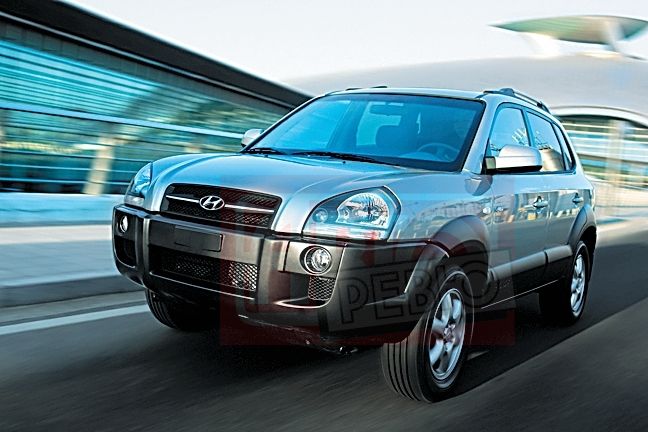 | 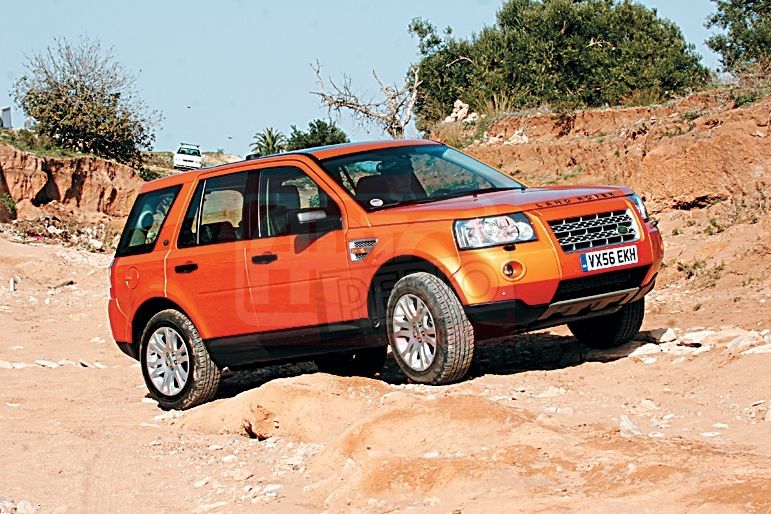 |
| Hyundai Tucson | Land Rover Freelander |
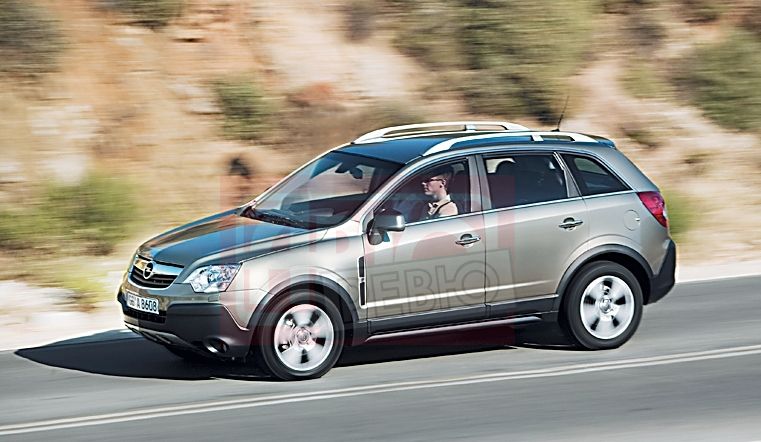 | 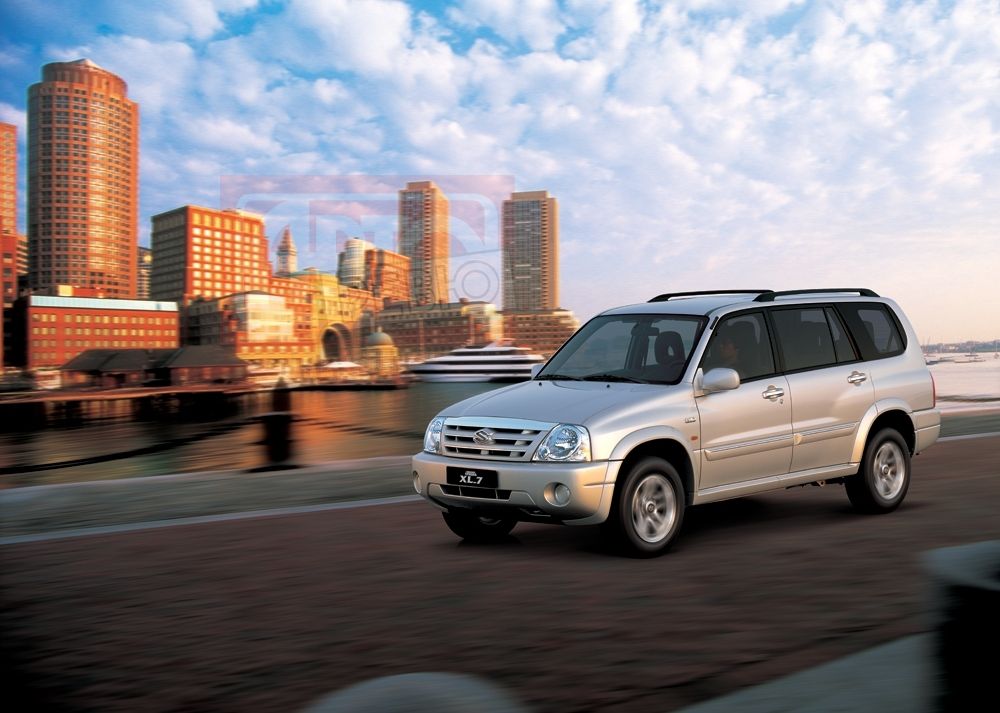 |
| Opel Antara | Suzuki Grand Vitara XL7 |
But what about those who find the off-road capability of "soft-roaders" insufficient? There is a choice: with about $40,000, you can choose from at least five body-on-frame SUVs with a transfer case and low range. These include the old Suzuki Grand Vitara XL7 (2.7 L, 184 hp, from $33,600), which is about to be replaced by a new model, the Kia Sorento with a six-cylinder 2.5 L turbodiesel (170 hp, from $35,910 for a manual and from $38,210 for an automatic), the SsangYong Rexton (220-hp inline six-cylinder 3.2 L, from $42,220), and even the Chevrolet TrailBlazer (4.2 L, 295 hp, from $39,900). Incidentally, the transmissions of the last three vehicles are similar — permanent drive to the rear wheels and a front axle that is either automatically or manually engaged via a multi-plate clutch.
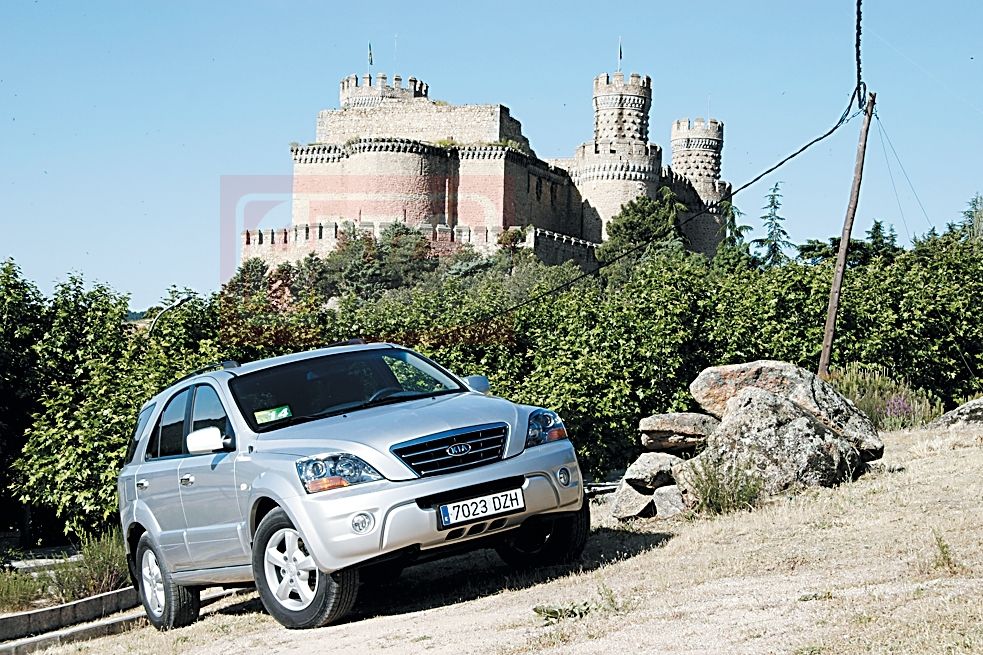 | 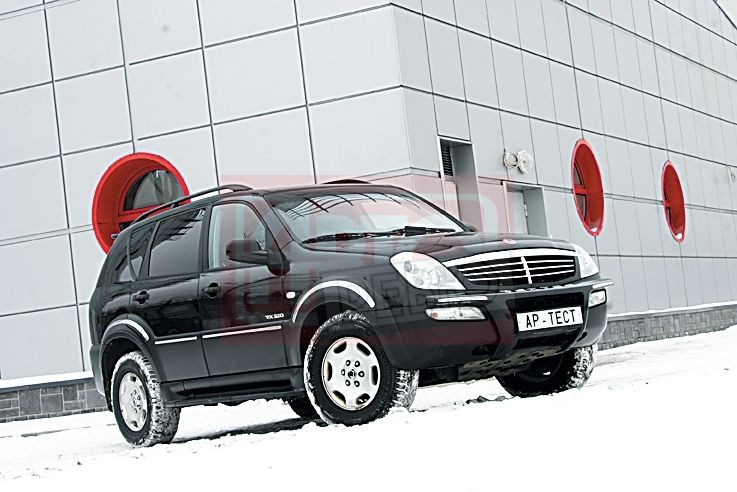 |
| Kia Sorento | SsangYong Rexton |
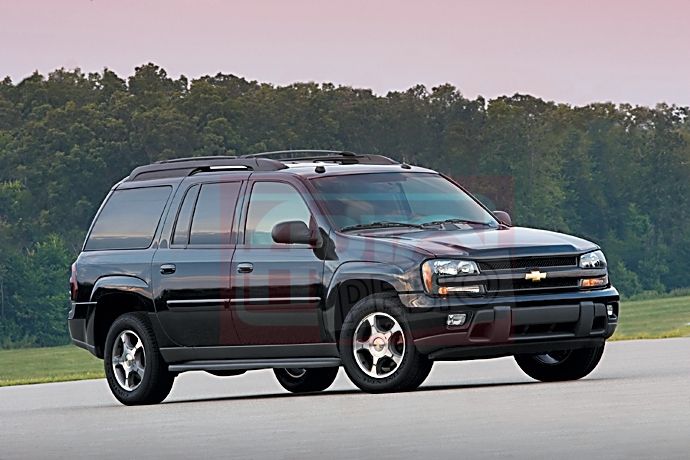 | 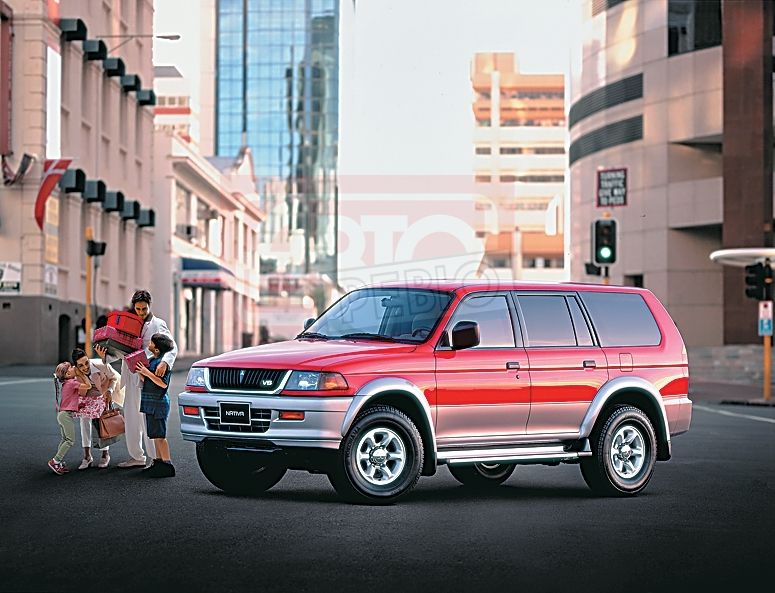 |
| Chevrolet TrailBlazer | Mitsubishi Pajero Sport |
In this lineup, there is also a full-fledged off-roader — the Mitsubishi Pajero Sport. It offers an optional rear self-locking differential. The base version with a 100-hp 2.5 TD diesel engine and manual gearbox starts at $29,350, while the version with a 170-hp 3.0 L petrol V6 starts at $37,130.