

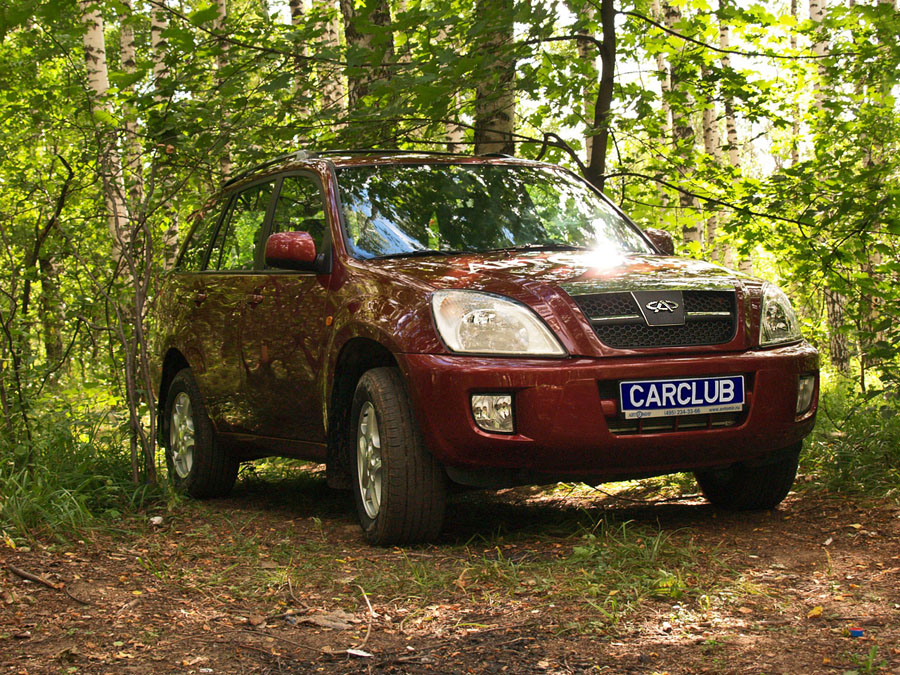
 The appearance of the Chery Tiggo unmistakably references the Toyota RAV4, while the front end was styled after the Honda CR-V.Comments (4)
When you first encounter the Chery Tiggo on the road, the thought comes to mind that it is a hybrid of the Honda CR-V and Toyota RAV4. But once you lift the hood, you discover a 2.4-liter engine that is clearly related to Mitsubishi units. It is precisely this kind of "hodgepodge" that we decided to take for a spin as part of the test.
In marketing, there is an unwritten rule: the price is determined not by how much production costs, but by how valuable the product is to the buyer and how much they are willing to pay. In the world of cars, the ability to drive has long ceased to be the main argument. People choose a car based on image, service quality, off-road capability, and trim level. Hence the prices, which sometimes look rather strange. For example, it is already customary that any crossover, even if it is front-wheel drive and built on a golf-class platform, costs more than a D-class sedan. It is believed that a higher seating position provides a better view, confidence on slippery roads, and protection in a collision, which justifies the premium.
The customer, as we know, is always right, and if they are willing to shell out more than $27,000 for a soft-roader—well, that is their choice. But the market is constantly shaken up by "profitable alternatives." Nissan sells the Qashqai from $23,000, but for that money you get a maximally stripped-down version: front-wheel drive, a 1.6-liter engine, and a minimum of options. Against this backdrop, the more spacious Chinese Chery Tiggo for $16,499, with air conditioning and a 130-horsepower 2.4-liter engine, looks like a very tempting offer. Let's figure out whether it really is.
Our attitude towards cars from China is twofold. On the one hand, there is cheapness; on the other, doubts about safety and reliability. Moreover, spare parts from the Middle Kingdom do not arrive as consistently as the cars themselves, and the quality of service leaves much to be desired: savings are visible in everything, from open-air sales to warranty repairs. To cut the price even further, the Chery Tiggo, like the Amulet hatchback, is assembled using the screwdriver method at the Avtotor plant in Kaliningrad, which helps significantly save on customs duties.
Now about the appearance. The Chery Tiggo is clearly inspired by Japanese soft-roaders: the body silhouette is unmistakably recognizable as RAV4-like, and the front end, apparently to avoid claims, was made in the style of Honda—with a car from the nineties serving as the model to emulate. Nevertheless, the Tiggo looks rather cute: nothing ultra-modern or flashy, which is perhaps even good for a car that aims at the masses, especially in the provinces.
Inside, everything is even simpler. The gray plastic is hard and soulless, the dashboard is boring, although the fit of parts pleasantly surprises—everything is even and neat. A bit of color is added by the blue inserts on the seats and doors; otherwise, the cabin would be utterly dreary. In the center of the console, a large 2DIN head unit with a big display showing huge numbers takes pride of place. In size, the screen could rival a small TV, but it only shows the selected radio frequency, and even that glares—both day and night. In sunny weather, you have to switch stations almost blindly. The front seats are soft but shapeless—after a long trip, your back gets tired, and thoughts of buying orthopedic pads or at least a lumbar cushion come to mind.
Rear passengers are luckier: the bench is split into two parts, and the backrest angle adjusts over a wide range. A third person will, of course, be a bit cramped here, but two will sit quite comfortably—there is enough space both in length and height, and the side visibility is good. What else is needed for family trips to the dacha or on vacation? The trunk, of course! And here the Tiggo does not disappoint. The spare wheel hangs on the tailgate, so the floor is lowered as much as possible. There are pockets for small items on the rear seat backs and in the side niches, and the jack is hidden under the floor—everything is thought out and convenient. The only thing missing is a door that opens towards the sidewalk rather than the road. But this is a common ailment of all Japanese-origin cars, which are structurally designed for left-hand traffic. Although the Chinese should have taken this into account—they are hardly planning to export their cars to Japan.
On asphalt, the crossover turned out to be simple and predictable. Front-wheel drive weighs noticeably less than all-wheel drive, so with the 2.4-liter engine, the Tiggo moves briskly. Do not be scared by the modest 130 horses: thanks to the large displacement, the engine, related to Mitsubishi units, has excellent torque, and the response to the gas pedal is quick. The result is a rather lively little engine that initially rumbles bassy but transitions to a squeal and howl as revs rise. Gear changes are not the crispest, but the Tiggo drives cheerfully and spiritedly. The engine easily revs to 6500 rpm and allows you to overtake heavy Toyota RAV4s and other renowned all-wheel-drive crossovers without any trouble—a sort of small but mighty Jackie Chan, tossing rivals aside.
On the highway, the Chery accelerates to 170 km/h without much effort—how accurate the speedometer is, one can only guess, but controlling the Tiggo at speed turned out to be quite comfortable: the car does not get thrown into ruts. If the body were a bit stiffer and the steering reactions more precise, one could talk about a claim to the title of "driver's car." But braking from high speed is not very convenient: the pedal effort builds unevenly, the Tiggo noticeably dives, and the front wheels on cheap Chinese tires lock up early, accompanied by a piercing squeal. In corners, the tires also start squealing long before the car actually deviates from the trajectory. At the same time, the Tiggo remains fully under the driver's control and never scares with the prospect of a rollover. So in bends, you can have fun and tease owners of more expensive and prestigious cars.
If you ease off the gas and imagine yourself as a model family man taking relatives to the dacha, the Tiggo is quite convincing in that role as well. The suspension honestly reports minor joints, but it is energy-intensive and allows you to easily fly over speed bumps. The only thing that may irritate passengers is the increased noise level penetrating the cabin from both the engine and the wheel arches.
It seems Chery manages to live up to the name Tiggo, which can be loosely translated as "Tiger Cub": not yet an adult Tiger, but already with fangs and ready to show the elders what it can do. But it was unlucky with its "relatives"—the younger Chery Amulet turned out to be a complete failure, failing crash tests and behaving dangerously on the road even in standard modes. The Tiggo, on the other hand, is much better balanced: it is pleasant to drive every day, and you can confidently head out of town—alone or in company. And as for the lack of all-wheel drive, it is not really needed: to reach a clearing in the forest, ground clearance and short overhangs are usually enough. It is unclear how the Tiger Cub will behave in a crash test, but let us not dwell on the sad—thoughts, as we know, materialize...
Author: Leonid Pavlov