
Chery Amulet
Engine: 1.6 8V, SQR 480
Displacement: 1596 cc
Max torque: 132 Nm/4000 rpm
Max power: 94 hp/5500 rpm
Top speed: 172 km/h
Transmission: Manual
Acceleration 0-100 km/h: 11.5 sec.
Dimensions: Length — 4393 mm, Width — 1682 mm, Height — 1424 mm, Ground clearance — 170 mm
Curb weight: 1100 kg
Tire size: 185/60 R14
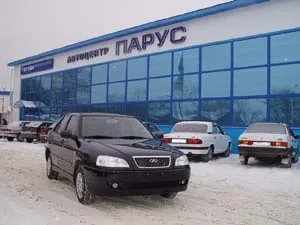
The Chery Amulet traces its lineage back to March 1991, when the SEAT Toledo was unveiled to the world. The Spanish model was based on the Volkswagen Golf platform, and its design was crafted by ItalDesign. In Europe, such a car cost from 16 to 23 thousand dollars depending on equipment. By 1999, the first-generation Toledo was discontinued, but it was produced not only in Spain but also in Mexico. It was the Mexican plant that was bought in 1997 by the little-known Chinese company Chery Automobile Co. Ltd. Since 1999, the model got a second life under the name Chery Qiyun.
Today, Chery is one of the flagships of the Chinese auto industry, producing several families, but the basis of the program still consists of variations on the theme of that very Toledo. Over seven years, the car has changed several names, undergone modernizations, but has not fundamentally changed either externally or technically. There is demand for it both in China, where it works as a taxi, and abroad. A fresh version is supplied to Russia — the Chery Amulet, known at home as the Chery A15. Prices here range from 10.99 to 12.49 thousand dollars.
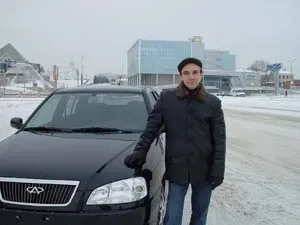
Marat. Designer of the newspaper «Autoclub-Kazan». Personal car VAZ 2109.
I participated in a test drive for the first time, so I was a bit nervous. Previously, I had only seen this car briefly, and I was used to the idea that you need to get accustomed to a new car. As it turned out, I worried in vain. The car turned out to be so friendly that I got behind the wheel and immediately drove around the city without any adaptation. Plus, this car is a direct competitor to our «Zhiguli», and I wanted to compare them in real conditions.
I'll start with the inspection — outside and inside. The design is not a masterpiece, but it exists. The build quality of the body is also up to par: seams are even, gaps are small, and the paint looks reliable. The trunk lid surprised me: on the sedan, it opens like a hatchback. The answer was found inside — the trunk itself. Its volume is simply huge; otherwise, you wouldn't be able to reach the rear seats. At the same time, rear passengers also have enough space.
There is one flaw in the design — the rear wheel arch looks unfinished, as if some part is missing. The black color suits the car, adding solidity, while a light color, on the contrary, makes it look light and swift.

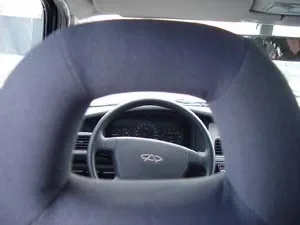
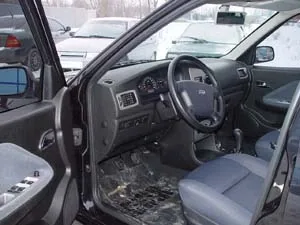
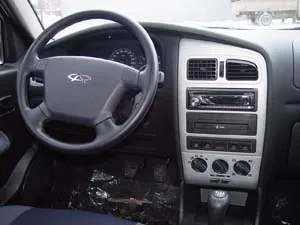
Inside, everything is quite decent for its class. The plastic is not perfect everywhere, but the parts are fitted tightly. However, something rattled while driving — the four of us never figured out what it was. Maybe the boxes in the trunk? The plastic steering wheel looks toy-like; it could use a cover. But these are trifles — overall, the cabin is cozy and inviting. We didn't check the steering wheel adjustment, taking the manager's word that it exists. The seats are ordinary but hold well and are comfortable. The gearshift lever was a bit confusing: gears engage too easily, with no feel of a neutral position, as if it's loose. But this didn't affect control — I never made a mistake. The heater works great and blows exactly where needed. We didn't test the air conditioning — not the season.
On the road, I liked the car right away. The engine is lively, pulls well, and revs up quickly. Perhaps even too quickly. On first gear, you need to work the clutch very carefully — it seems designed for wheelspin. But you can confidently start in second. With a sharp press on the gas, the car noticeably lunges forward. The power reserve is decent. The engine sounds quiet and pleasant, with a slight whistle — but that's probably a matter of taste.
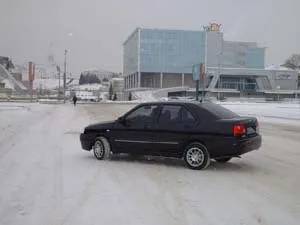
The power steering gives freedom: you can turn the wheel with one hand when maneuvering, and in calm city driving, it's almost unnoticeable. The brakes are concerning — too soft and vague. The car brakes well, but you feel it not through your foot but by external signs. During hard braking, the ABS strongly kicks back into the pedal, but I wouldn't give it up — it's good when the wheels don't lock and the car maintains its course. Stability is important, and here it's excellent. Even on snow and slush, you can drive confidently if you don't exceed reasonable speed. And speed builds up quickly and is almost unnoticeable.
I didn't delve deeply into the suspension — I'm not picky, and I didn't notice much difference. Bumps are felt; I wouldn't drive over them at high speed. The stiff suspension is probably needed for stability, which is justified given such acceleration. But good sound insulation maintains comfort.
In the end, I think this car will pose serious competition to domestic manufacturers, especially if they set up service, maintenance, and spare parts supply.
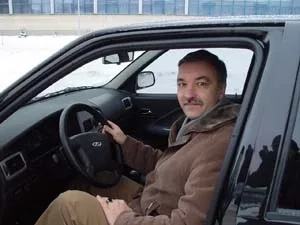
Vadim. Driving experience — 9 years.
In Kazan, I sometimes see the Seat Toledo (Seat is part of the Volkswagen group), which looks very similar to the Chery Amulet. But appearance is just the beginning of the acquaintance. The first pleasant surprise is that the sedan turned out to be a liftback! The trunk volume in this configuration is enviable. And if you fold down the rear seats — it's a dream. However, the cabin isn't very spacious in width: only two people are comfortable in the back, but knees don't touch the front seatbacks. The best place is the front seat: plenty of room, excellent visibility, and a comfortable armrest. Another plus is that the stock radio plays very decently, which is rare: usually, factory speakers are mediocre. There's a slight squeak from the panels, but (as owners of domestic cars know) this is dealt with quickly and cheaply — Kazan has plenty of specialized services.
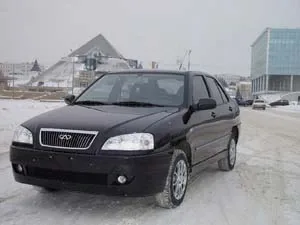
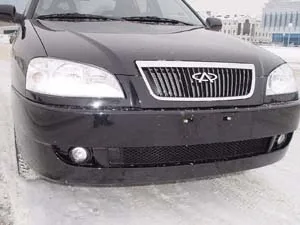
Now about the main thing — how the car behaves on the road. The suspension is tuned quite stiffly, and all irregularities, whether potholes or bumps, are felt through the back and the whole body. But this stiffness has an obvious plus: the car handles confidently, body roll in corners is minimal, and the trajectory remains predictable. A huge step forward compared to the VAZ is the presence of ABS. Online, debates constantly flare up about whether this system is needed at all. The essence of the opponents' arguments is that, having switched from a «classic» to a foreign car, they realized that moving in a skid with locked wheels allows faster cornering or turning around. The answer here is always the same: if you're a racer — welcome to a closed track. But on public roads, the main thing is safety: yours, your family's, pedestrians', and other drivers'. And considering that ABS not only allows maneuvering while braking but also shortens the braking distance, there's nothing to argue about. Of course, the system on the Amulet is of an older generation: unlike modern multi-channel ones, it makes a loud rattling noise and noticeably kicks back into the brake pedal when activated. But it performs its function flawlessly: with the steering wheel straight, the car doesn't veer forward or sideways. The power steering is also not the newest design — in sandy or snowy ruts, it's hard to tell the position of the wheels. However, to be fair, many electric power steering systems, for example on Toyotas, do the same. But the most impressive thing is the engine. It seems nothing special — a regular 1.6 with eight valves. Well, slightly tuned, producing 87 hp (the «ten» with 1.6 16V has 89 hp). But how it drives! It's a hurricane! From an intersection, you can easily «beat» almost any car. By the way, at first, we all, out of habit, spun the wheels on first gear — you can feel there's plenty of torque here. I deliberately tried to start in second gear, the so-called winter mode. Usually, in such cases, the algorithm is: press the clutch, engage second, rev a bit, and smoothly release the clutch. But on the Amulet, you can start «truck-style»: just engage second — and go. While driving, there's an incredible lightness: the response to the gas is instant, acceleration is swift. Moreover, in fifth gear at 60 km/h, the car drives very confidently and readily accelerates when pressing the gas. The only drawback in the context of dynamic driving is the too-long throws of the gearshift lever; on truly sporty cars, they are much shorter and clearer. By the way, the 8-valve engine on the Amulet has several more advantages over the 16-valve: reliability, ease of repair, and durability.
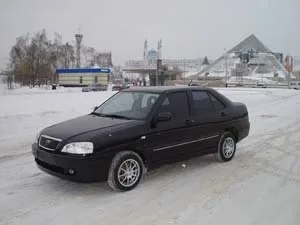
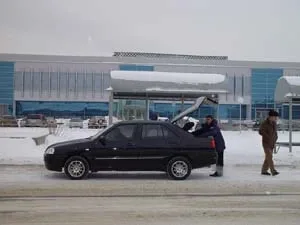
I tried to at least roughly compare prices for the Amulet and the «ten». The simplest trim with power steering and air conditioning at the «Parus» dealership sells for $8,995 (71,955 UAH). The «ten» with power steering already costs more. And if you add air conditioning to it, that's another $1,000.
And here is the main question: who is that very potential buyer of the Amulet? First of all, it's young people. They will surely like the torquey engine and excellent handling. And if you also choose black color, do stylish tinting (not 75% and not 100%) and light exterior tuning — the car will look very nice. Secondly, these are people of middle and older generation who are tired of driving the same VAZs for decades. They should appreciate both the spacious trunk, and the factory air conditioner, and ABS.

Alfred. Driving experience — 11 years.
This car has already changed since its appearance on our roads. We are talking about the interior. The first batches came with an ugly light interior, which also emitted a terrible unpleasant smell. Now the Amulet is equipped with a dark interior: it looks more noble, much more practical, and that sharp persistent smell is gone! Everyone has long known that Chinese cars have a so-called "Western trace" in their lineage. The Amulet did not escape this: the car is based on the Seat Toledo of the early 90s. It's funny that angular shapes are in fashion again, so today the car looks quite relevant. It has a rather interesting appearance, a pleasant "face", calm lines. It is assembled solidly: even gaps, good paintwork. A decent lineage inspires respect and trust, and the engine made under a Mitsubishi license is also a big plus. Well, and of course, the price! It is quite competitive. Let's see what the manufacturer offers for our 315 thousand rubles. For comparison, let's take the most expensive production domestic car — the "ten" with power steering for about 282 thousand rubles. Let's say we install an air conditioner on it, which will add another 25–30 thousand rubles to the price. This is already approximately the price of the Amulet, but do not forget that it also has ABS, which also costs money. A similarly priced Accent will be without ABS. The same picture with the Lanos. It turns out that for a comparable amount, the Amulet is better equipped than all of them. So, let's go!
This time I settled into the front passenger seat like a boss to feel the plastic, smell it, listen. What can I say: sitting is comfortable, only you sit a bit high — the visor of my baseball cap constantly caught on the sun visor. In short, the front passenger sits almost under the ceiling. This seating position is to the liking of beginners who need to see the hood. The seats are adjusted simply: the backrest angle of the front passenger seat is changed with the left hand, and the driver's with the right. This is more convenient than reaching between the seat and the side pillar. The seat moves forward and backward like in most cars — using a handle. The adjustment range is large, so even a very tall person can get comfortable. Moving to the driver's seat, I involuntarily noted how easily the doors close. You just need to pull — and it slams shut by itself. I won't say that it makes a rich, dull, and pleasant sound, but I can't call it "tin can" either.
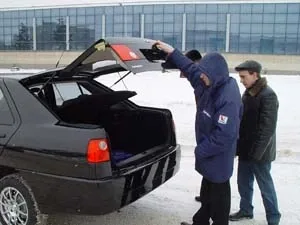
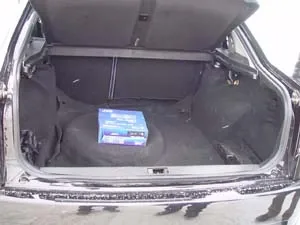
In motion, the car turned out to be creaky: the main sounds come from the front panel — audibly somewhere in the area of the glove box and from somewhere in the center. The shelf sings along from behind. Yes, exactly the shelf: despite the clearly sedan-like body, the Amulet is a liftback (see photo). The suspension handles potholes more stiffly than bumps and wavy road sections. This behavior hints at good handling, but personally, at that moment I didn't delve into it.
Out of habit, it's hard to get the car moving without wheelspin even on bare asphalt. So I, driving around the city, turned onto second gear at an intersection and lightly pressed the gas — and immediately caught treacherous wheelspin, even though the car was already moving at 30–35 km/h. So what kind of beast is under the hood? According to the characteristics, nothing outstanding, but why it pulls so hard is unclear. It feels like it doesn't need first gear at all. The car easily starts in second even with a full cabin of passengers. Credit where due: the engine accelerates the car quite briskly, and this was a surprise for me. But the steering wheel is very light, and it remains so at 40 km/h and at 80 km/h. There is no heaviness, and therefore little feedback. Although on snow-dusted surface, the connection with the road is felt better than on clean asphalt, but still not enough. There are also complaints about the brakes. They are very soft, and it's unclear when they start to engage and whether braking happens at all. It feels like the brakes are not bled — there is no usual firmness. ABS works in the old way: vibration of the pedal is felt under the foot. I tried to brake hard "to the floor" from 80 km/h and couldn't make the car lose its course, which can't be said about Vadim. He managed it on about the tenth try. But nevertheless, ABS works predictably and, in my opinion, quite correctly. The gearbox is simply excellent: shifts are precise, it's hard to miss or confuse gears. I dare to suggest that the gearbox is either licensed or just well copied. What else was there... Oh yes, I remembered! I wanted to switch the heater mode, direct warm air to the feet — and couldn't. From the driver's seat, the controls for the air conditioner, air duct modes of the heater, and fan speed are poorly readable. They are located so low that they are almost invisible; it will take getting used to switching them by touch. Our test car had a JVC head unit paired with the stock six-speaker audio system. We decided to evaluate the sound quality of such a combination. And you know — it's quite good, no worse than many stock systems from various manufacturers. Although this is of secondary importance to the car, still.
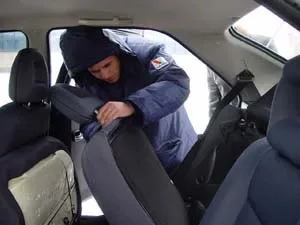
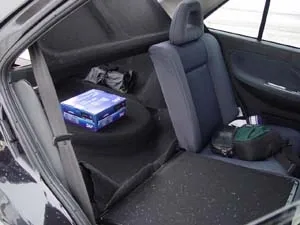
Summing up, I can state: now I understand why there are more and more of these cars on our streets. It wins with its price and quite realistically competes with the domestic auto industry. No offense, but hardly anyone will switch to it from a Mitsubishi or Toyota voluntarily, but people from "our" cars have already started to move.