

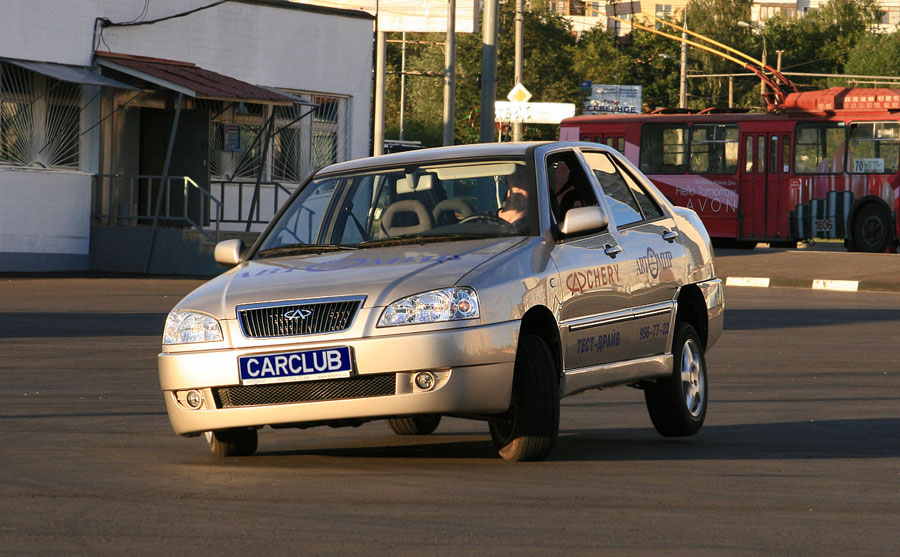
 Chery Amulet is a semi-licensed copy of the first-generation Seat Toledo, model year 1991, which in turn traces its lineage to the VW Golf II.Comments (24)
I admit honestly: the results of the Chery Amulet crash test, recently conducted by experts from Autoreview, just won't leave my head. How did it happen that a car, which German engineers worked on, albeit almost three decades ago, fell apart like a house of cards in the crash test, showing results even worse than those of our domestic Zhiguli, whose age has long exceeded forty years?
After all, millions of drivers are considering the Amulet, constantly tormented by the question: should they take the latest generation Lada or prefer an inexpensive foreign car that already has air conditioning in the base, and for the same money?
When Chinese manufacturers began their expansion with unlicensed copies of Japanese pickups, it immediately became obvious: in the segment of affordable SUVs, UAZ would have a hard time. But pushing aside AvtoVAZ is a much more serious task. Tolyatti has modern equipment, models have been produced for years, and their cost has been minimized. Even if the Chinese managed to make a similar car slightly cheaper, all the benefits would be eaten up by customs duties. Moreover, there is practically no free niche left between expensive Ladas and budget Koreans. However, the Chinese found a loophole here too: having agreed with the Kaliningrad Avtotor, they organized screwdriver assembly in a special economic zone, thus bypassing customs barriers. As a result, prices for their cars turned out to be even lower than for domestic ones, and at the same time, the base version already has air conditioning, which cannot be found on Ladas even for an extra charge.
But here's the problem: in their quest to save money, the Chinese seem to have forgotten such elementary things as safety. This was confirmed by the Autoreview crash test. We, of course, did not plan to smash the Amulet against a wall, but we decided to take it for a test drive to understand how the "Chinese" would behave in more gentle conditions — if, of course, it is possible to avoid hard obstacles.
The idea of avoiding obstacles seems sound, but for the Amulet it turned out to be an impossible task. It seems that in the pursuit of a low price, the Chinese forgot not only about safety but also about handling. You only need to turn the steering wheel slightly from the zero position, and the car first reacts with deep body rolls. The Amulet turns only after a second's pause, when the front suspension has already fully taken up the roll. Both outside and inside, this looks frightening. The driver feels that the car is obeying not him, but some Chinese gods. Passersby see the rear wheel lifting off the ground and hear the terrible screech of the front wheel catching on the fender. Good thing the tires are relatively wide — if they were narrower, the Amulet could scrape the asphalt with its front bumper or even roll over. And this is despite the fact that the maneuvers in the photo were performed at a speed of only 30–40 km/h. What will happen if you have to avoid an obstacle faster or in a loaded car? Usually, large rolls and sluggish handling are compensated by a soft ride, but this rule does not work here: the body shudders on asphalt joints, and after hitting a speed bump, you just want to get out and count the wheels.
I carefully press the clutch, find first gear on the second try, and, gradually adding gas, pull away. It seems to have worked. But the acoustic accompaniment surprised me: from under the hood comes a howl that turbo engines usually make, although there is no supercharger on the Chery at all. At the same time, the 1.6-liter engine honestly delivers the stated 94 hp and responds to the gas pedal without the slightest delay — unlike modern engines strangled by Euro-4 standards. The close gear ratios of the gearbox also add drive. At 120 km/h in fifth gear, the tachometer needle goes beyond 4000 rpm, and the hum begins to press heavily on the ears. If you muster up the courage, the Amulet can accelerate to 160 km/h, but the feeling is worse than that of a kamikaze — at least he had the ability to control the rocket until the very collision, but here keeping the "Chinese" under control is almost impossible.
The brakes match the handling. Deceleration begins only at the very end of the pedal travel, when the thought already flashes through your head that they decided to save on them too. If you press the brake for a long time and with all your might, you can wait for the ABS to activate, but it works unconvincingly — even on dry asphalt, the car skids slightly. Interesting, what will happen in winter on snow?
As for the design and quality of the interior trim, everything is clear here: the Chery Amulet is a semi-licensed copy of the first-generation Seat Toledo from 1991, which, in turn, traces its lineage to the VW Golf II. There are almost no original Toledos left in Russia now, so there is nothing to confuse the Amulet with. But if you still compare the copy with the original, there will be a minimum of differences. First of all, new optics with polycarbonate diffusers and slightly rounded bumpers. There is nothing for the eye to catch on... Although wait, what about the "Chinese" rear? You can't immediately tell: is it a sedan or an elongated hatchback? Car history experts will recall that the Toledo was exactly a hatchback, and the Amulet continues this tradition. The huge rear door opens access to a very spacious trunk. But here's the problem: meticulous Germans long ago calculated that a tire puncture in Germany happens on average once every 12 years, so there is no point in carrying a full-size spare — you can get by with a narrow space-saver, which saves useful volume. In China, as in Russia, roads, alas, are not so optimistic, and we prefer a full-fledged wheel. The Chinese found a non-trivial solution: they placed the full-size wheel in a shallow stamping and covered it with carpet. As a result, a protrusion about 10 cm high formed in the center of the trunk, which significantly complicates loading things, especially large ones.
The windshield is located too close, the radio is simple, the steering wheel adjusts only for height, and the boring instrument panel glows dimly. In terms of the quality of trim materials, the Amulet is inferior even to domestic cars. And here the cherished AC button, which our cars lack so much, comes to mind. Here, perhaps, for the first time in the entire test, the Korean pulls ahead. The air conditioner really works, copes even with 30-degree heat, and almost does not affect dynamics.
It turns out that for $8,999 — that's exactly how much the base Chery Amulet costs — dealers offer a mobile air conditioner. The tested example with music, central locking with remote control, alloy wheels, power windows, and two front airbags is priced at $10,899. Those who want to save on their own safety can take the version without airbags and ABS for $9,999.
The price is certainly attractive, and many of our compatriots have already bitten: in the first half of the year, 18,558 Chery cars were sold, and most of them are Amulets. The aggressive pricing policy of the Chinese allowed them to take 12th place in the ranking of foreign car sales, confidently pushing aside Honda, Volkswagen, Skoda, and others. How justified the choice of an air conditioner on wheels instead of a normal car is — everyone decides for themselves, and it's not just about passive safety, but also about the overall quality of the car. Personally, I would rather vote with my ruble for a slightly more expensive, albeit less powerful, Renault Logan or Chevrolet Aveo: taking a car loan for the missing amount is not a problem, but health and nerves, alas, cannot be bought.
Text: Leonid Pavlov.