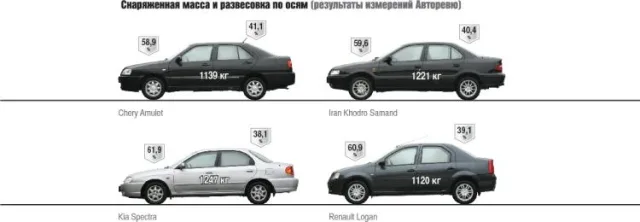
Iranian sedans Iran Khodro Samand, known to us as heirs of the Peugeot 405, reach the Russian market across three borders. And they are brought in large quantities. In the first half of the year, 1,384 units were sold, and in the following three months — already 1,643! Not surprising: a spacious and well-equipped car with a 1.8-liter engine (100 hp) is priced at $13,300, and in the base trim with the same engine — only $10,950. If the Iranian expansion does not slow down, Samand may soon overtake the Russia-assembled Kia Spectra (11,241 units in six months) or even Renault Logan (21,115)! Chery Amulet is also gaining popularity — a Chinese hatchback disguised as a sedan: 2,580 cars sold in the last quarter versus 1,529 in the first six months. And again the key argument is price: $9,000 for the base version.
The customer is always right? We know many cases where this rule does not work. Therefore, we gathered all four cars in fairly well-equipped trims (each over $12,000) and headed to the test site. All cars except Kia were equipped with manual transmissions. But, looking ahead, we note: it was not this that determined the final ranking.
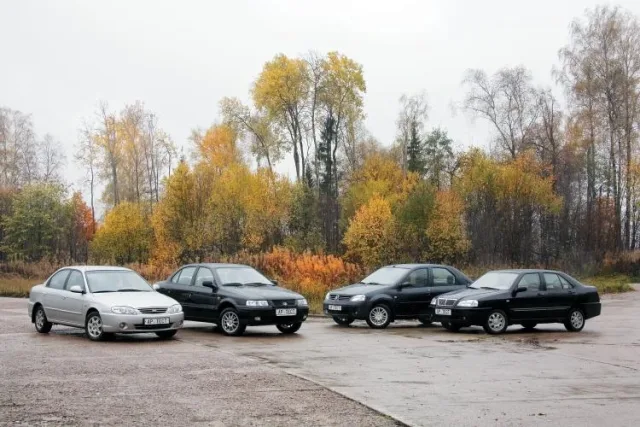
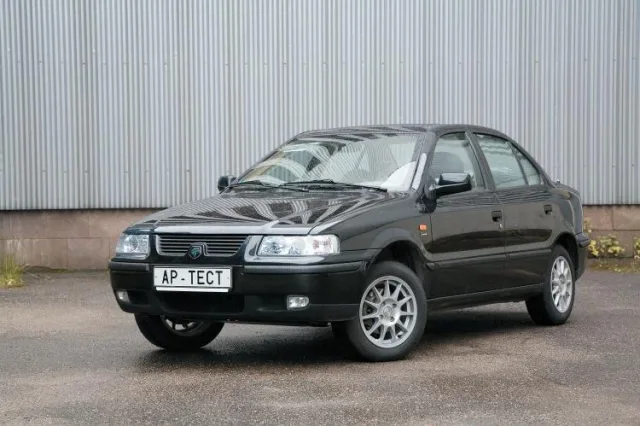
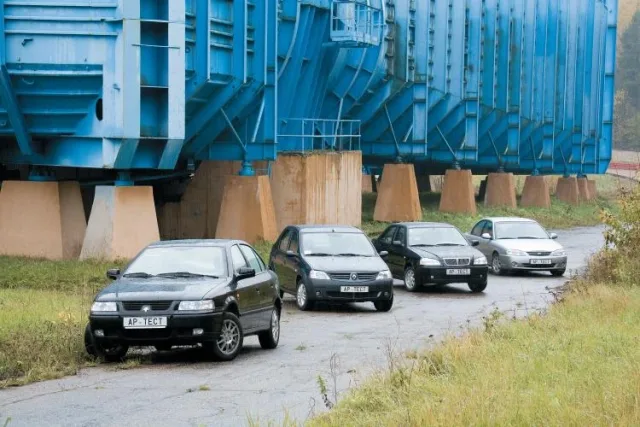
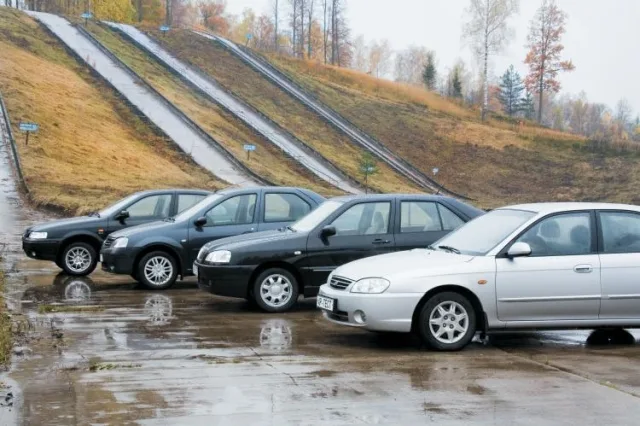
In Russia, sedans are still held in high regard, even if they are small: solidity must be visible! And in this sense, the black Iran Khodro Samand on alloy wheels looks the most representative. Refined lines, a strict look like an old Passat, no provincial tinsel. The coal-black Chery Amulet is slightly less harmonious but does not repel the eye — an unauthorized copy of the 1991 Seat Toledo. And the angular Renault Logan in a "graphite" shade no longer seems so rustic. But the grayish rounded Spectra looks quite ordinary — even in this, frankly, not the most refined company.
Where does a family sedan begin? With the trunk! The Samand has the same "correct" and as spacious a trunk as the Logan. But loading the "Iranian" is more convenient: the opening is wider. One problem: the button on the key fob works intermittently, and if you open the trunk from the cabin, the lock responds only after holding the button for about twenty seconds. With the Renault it is simpler: insert the key into the trunk lock, turn it — and the lid opens. Under the flat floors of both trunks are full-size spare wheels and tools. If only the seatbacks folded properly, not just a small ski hatch... So it is more convenient to transport lining from the construction market in the Chery — after all, it is a hatchback. But the spare wheel there protrudes from its niche, and the light upholstery is better covered with something. Still, the "Chinese" is more practical than the Samand and Logan with their tightly bolted seatbacks. The 2:3 split rear seatback of the Spectra, although it folds, creates a very low opening. And the trunk itself is noticeably smaller than competitors', and loading it is inconvenient due to the narrow opening and protruding bumper.
 |  |
| Iran Khodro Samand Quality upholstery and almost flat walls | Renault Logan Protruding springs and hinges are compensated by the greatest width |
 |  |
| Chery Amulet The protruding full-size spare wheel interferes | Kia Spectra The opening is "squeezed" by slanted taillights |
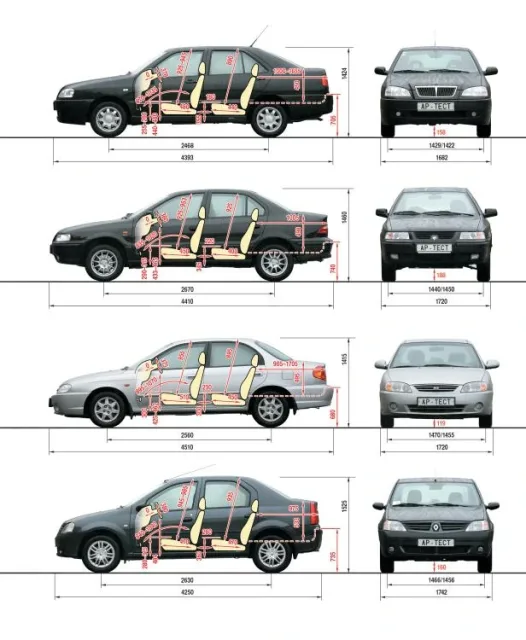
In terms of rear seat space, the Samand and Logan will give a head start to cars of a higher class. No need to duck your head, knees do not touch even the front seats pushed all the way back, and a third passenger can easily endure a thousand-kilometer journey. Moreover, in the Renault it will be even slightly more spacious, and there is nothing surprising about that. In terms of overall dimensions, the Logan, belonging to class B, has almost caught up with a fifteen-year-old class D car, which once included the Peugeot 405! The "Iranian", however, wins over the Renault in coziness (the seat is softer, the armrests are more comfortable), but loses in ease of entry: the opening is smaller, and opening the door from inside is hindered by the handles moved far back.
 |  |
| Iran Khodro Samand Only a tiny hatch in the seatback | Renault Logan The seatback can be removed by unscrewing two bolts |
 |  |
| Chery Amulet Unrivaled — a hatchback! | Kia Spectra The seatback folds, opening a narrow passage |
The Kia Spectra and Chery Amulet are more cramped. And if two people can still sit comfortably in the back, three is like in an overcrowded commuter train. The rear bench of the Chery especially contributes to the "elbow feeling": passengers sit "overlapping".
And what about the driver?
In the Samand, he is not well off due to the uncomfortable backrest of the soft seat, and the fact that its tilt is adjusted by an electric drive does not improve the mood. The backrest presses just below the shoulder blades, not providing proper support to the body — the lumbar adjustment is useless. The hand is scratched by the flash on the knob of the stiff and long-throw gear lever. There are no complaints about the pedals, and the rough steering wheel is not bad, but it adjusts in height in a very limited range. One can put up with such rudiments as the "slider" climate control and the horn button on the end of the turn signal stalk. But with the pretentious "wood" coated inserts combined with poorly fitted plastic... Never!
 |  |
| At first glance, the Samand interior makes a good impression. But the quality of Iranian plastic is little better than that of Chery | Antediluvian climate control inherited from the Peugeot 405. Under the Alpine CD receiver is a Russian-speaking onboard computer with a "blind" display |
 | |
| Rear passengers have air ducts and an ashtray | Emergency trunk release is a handle from... the trunk. Access to it is only through the long-item hatch, and you have to feel for it |
The interior of the Logan cannot even be called an interior. A barracks-like setting. But this does not prevent praising the comfortable, moderately firm seat and the pleasant-to-touch, grippy steering wheel. And if you close your eyes, it turns out that in terms of tactile-muscular sensations, the well-equipped Logan surpasses all test participants: the handles and buttons click softly and informatively, and their materials do not scream so desperately about "low-budget" as in the Spectra, Amulet, and Samand. Among the inconveniences, we note only the low-located heater control handles and the lack of steering column adjustment.
 |  |
| The Samand's glove box is small, but there are two slots for 0.33-liter cans | The power package control panel is at the bottom of the door |
 | |
| The seatback tilt is adjusted by a servo drive, the seat height by a pull-out handle... | ...and lumbar support by a knob |
In the light interior of the Chinese copy of the old Toledo, there may be more optimism, but everything is crossed out by the terrible build quality and a terrible phenolic smell. And ergonomics are far from ideal. The symbols on the heater handles are completely unclear — you have to control the climate by trial and error. You have to reach for the gear lever. The huge steering wheel with a thin and slippery rim, although adjustable in height, not everyone can find a comfortable position — the soft "plush" seat with a pushing backrest cannot be moved far back.
The Kia's interior is truly depressing: gray plastic and dreary dashboard shapes. Driving becomes a chore also because of the heavily reclined seat cushion and a large steering wheel with a thin rim. It's gratifying that there are no problems with the pedals — there are only two of them here.
 |  |
| Iran Khodro Samand In the Samand, the rear offers space and comfort by "budget" standards | Renault Logan The flat and hard bench of the Logan easily accommodates three... |
 |  |
| Chery Amulet | Kia Spectra |
| ...but only two people, and not the tallest ones, can sit comfortably in the Amulet and Spectra | |
We have no complaints about the visibility of all cars, except for the Logan: the exterior mirrors are too small.
For an exemplary "family man," maximum dynamics are not so important — you just need to keep up with city traffic, confidently overtake on the highway, and stand in traffic jams without stress. The Logan 1.6 handles these tasks best of all. The engine is sufficient both in the city and on the highway. The gearbox works precisely, the clutch is clear, and responses to the gas pedal are predictable. Even though the Logan is inferior to the Samand with its larger engine in peak dynamics, dosing acceleration in the Renault is more pleasant.
 |  |
| Samand: the light interior would look better without the "wooden" panels | Logan's cabin: modest and comfortable, except for the heater controls |
The Samand is also good: the engine pulls confidently across the entire range from 1000 to 6000 rpm. But in traffic jams, the "cotton" clutch and delayed responses to the gas are annoying. Plus, the vibrations of the power unit during shifts, which even reach the steering wheel, are irritating.
The Chery and Kia lag behind. The "Chinese" simply lacks power: after 4000 rpm, the engine revs with obvious reluctance. But at low revs, it pulls briskly and responds adequately to the gas — calm drivers will be satisfied. The Spectra suffers not only from the sluggish engine. The outdated "automatic" also contributes: jerks during shifts, huge pauses during overtaking, unpredictability. Even in exhausting Moscow traffic jams, the Logan's "manual" seemed better to us than such an "automatic."
 |  |
| Iran Khodro Samand | Renault Logan |
 |  |
| Chery Amulet | Kia Spectra |
| The best seats with good lateral support are in the Renault. The Kia's decent seat is spoiled by the heavily reclined cushion. The Chery and Samand seats feature a "pushing" backrest and lack of support in corners | |
The Logan also brakes best of all: excellent feedback, impressive deceleration, and reliable ABS operation. Due to the poor grip of the tires, the Amulet slows down a bit worse. The Kia Spectra is inferior to both — the pedal effort is vague. But the Samand is even worse: to get the ABS to activate, you have to press the brake with all your might. Even during normal braking, the pedal effort increases disproportionately to the deceleration.
 |  |
| Iran Khodro Samand | Renault Logan |
 |  |
| Chery Amulet | Kia Spectra |
| The Samand's instruments are simple and concise, but spoiled by unpleasant blue backlighting. The Amulet's scales are also poorly lit — in a poisonous green. In the Spectra, additional markings in miles hinder quick perception of information. Against this background, the simple scales of the Logan are perceived best of all | |
But in terms of handling, the Samand is the benchmark for the other three participants. The behavior is reliable and predictable. This is exactly what a family sedan should be! Even the increased ground clearance could not spoil the excellent kinematics of the Peugeot 405 suspension, which the Iranians inherited. The Samand confidently holds the straight line, almost ignoring ruts and other irregularities of Russian roads. Responses to steering inputs are precise, stable, and calm. And — unexpectedly high reserve in terms of ultimate capabilities. If an obstacle suddenly appears on the road, even an inexperienced driver will most likely cope with the Samand.
 |  |
| Iran Khodro Samand | Renault Logan |
 |  |
| Chery Amulet | Kia Spectra |
| The Renault's gearbox works best: short throws, precise engagement. The long-throw lever of the Chery requires reaching far forward, and shifts in the Samand are accompanied by terrible vibrations of the power unit. The Kia's "automatic" selector can be moved from "park" without pressing the brake — there is no lock | |
Against this background, even the recognized "good student" Logan fades. On a high-speed straight, it requires noticeably more steering corrections, but the excellent steering feedback helps. The Logan obediently enters an arc and clearly tracks the trajectory, but in high-speed corners there is not enough self-centering action, and when lifting off the gas, the Logan too readily goes into a slide. This also happens during sharp avoidance maneuvers: you need to stay alert!
A sedate driver will surely like the American "straight-line" nature of the Spectra. The Kia calmly, even arrogantly, responds to steering inputs, showing considerable understeer. But once on an arc, it holds it well. Only the diagonal rocking on asphalt waves is annoying. Against the background of general sluggishness of reactions, the lack of self-centering force no longer seems serious. On a high-speed straight, the Spectra goes calmly, unambiguously responding to steering actions during lane changes. Such a character could be called bland but reliable, if not for one circumstance: dodging a suddenly appearing obstacle on a slippery road will not be easy.
 |  |
| From the inside, the Amulet would look like a Seat — if not for the typically Chinese build quality and archaic light control switches | The gray existence in the Spectra cannot be brightened even by the convenient climate control knobs and logically placed buttons |
The Chery's responses to steering are an unpleasant mix of high sensitivity and low precision. Just accelerate to at least 100 km/h — and the car starts wandering left and right, reacting sharply to steering corrections. Irregularities also knock the Amulet off its intended course. In corners — strong diagonal rocking and trajectory deviations. The lack of self-centering action, combined with a tendency to oversteer and delays in responding to steering inputs, does not let you relax for a minute.
An interesting detail: last time we tested the Amulet (AR No. 2, 2006), it held up quite well. But after we visited the Chery factory and tried a freshly assembled car at the Chinese test track (AR No. 13—14, 2006), it seemed as if the car had been swapped: at any sharp turn of the steering wheel, it tended to go into a skid. And now — the same story! During the "moose test," none of the five drivers managed to keep the Amulet on the intended path!
 |  |
| Samand behaves confidently and predictably at any speed: it's no wonder it has Peugeot chassis underneath! | But the overseas relaxation of the Spectra during sharp lane changes won't appeal to everyone |
 |  |
| Chery Amulet — this is huge body roll and a dangerous tendency to skid | Logan on dry asphalt is simple and understandable |
The Samand's suspension handles both long and short road undulations decently. It smooths out minor and medium surface imperfections without unnecessary noise. True, on potholes nearly a third of the wheel deep, the Iranian steed starts to "buck." The acoustics are also in order: the engine is heard modestly, the tires are surprisingly quiet, and the wind starts whistling only after 120 km/h.
Logan lagged slightly in this component — vibration loading takes its toll: on minor irregularities, a slight trembling is transmitted to both the steering wheel and the seat. Road undulations are also felt more acutely. However, Logan is a good fellow: any surprises of our roads are nothing to it, and the energy intensity of the suspension is simply incredible! But sound insulation is a weak point. The main source of noise is the mournful howl of the engine, and on rough asphalt, the tires join in.
| Amulet: the multi-colored trims on the door handles and the panel under the steering wheel fell off right during the test. And after an overnight stay in pouring rain, a huge puddle gathered under the driver's feet | |
The Kia Spectra is both noisier and more loose. The rocking on waves is compounded by shaking on harsh bumps. Kia silently swallows only minor road imperfections. In the sound chaos, the engine stands out, which whines not only during acceleration but also at steady speeds. In the background — the whistle of mirrors, the hum of tires, and the clatter of stones on the underbody.
But even the Kia against the Chery is just a quiet one. The engine roars desperately, and to this is added a whistle — as if a hole had formed in the intake tract. The tires hum so loudly that your ears get plugged. Stones drum on bare metal. Even the suspension, giving the driver a good kick on every bump, considers it its duty to add a control blow to the ears. On waves, the body rocks heavily. And the odometer shows only 2500 km…
Time to sum up. The Iranian version of the famous Peugeot 405 is largely successful, but there is no balance in it. Problems with brakes and ergonomics, multiplied by poor build quality, outweigh even the excellent handling and comfort. One joy — the car speaks Russian, and without an accent. You turn off the engine with the low beams on — and you hear: "Turn off the headlights." You start off with the door open: "The door is open." And if the handbrake is engaged, a piece of advice follows: "Check the brake band!" Cute. But nothing more.
 |  |
| The Chinese 1.6-liter engine only comes alive at low revs | The 8-valve Peugeot 1.8 engine briskly pulls the Samand across the entire rev range |
 |  |
| The only 16-valve engine in this test, the Kia's, is rich in horsepower only on paper | Modest 90 hp and 128 Nm accelerate the light Logan quite well |
As in previous Autoreview tests, Logan did not win with a clear advantage. In the summer comparison a year ago (AR No. 13—14, 2005), it lost ten points to the Hyundai Accent and Renault Symbol sedans, which did not participate in the current test due to their modest size. In winter (AR No. 2, 2006), it lost to the Amulet — that "Chinese" was both better assembled (or specially finished for the test?) and handled more reliably. Now Logan and Samand have scored the same number of points. But Logan's main advantage is that it has no serious flaws in any discipline — it is the most balanced car in the quartet. And if you consider the cost of maintenance and the development of the service network, the pragmatist's choice is the Renault Logan.
The weak consumer properties and low build quality of the Chery are in no way justified by the low price. Although the top version can hardly be called affordable. So the strict exterior is just a semblance of solidity.
Despite losing on expert assessments and having the highest price, we do not consider the Kia an outsider. If only because the creators took care of safety: only the Spectra, even in base trim, has two airbags and Isofix anchors on the rear seats. In the near future, we plan to check how they work…
"Horse Breeders"
Iran Khodro is Iran's largest automobile concern, founded in 1962. It accounts for about 70% of all cars produced in the country. The production base consists of licensed Peugeot passenger cars, Mercedes buses, and Hyundai vehicles. This year, a total of about 550,000 cars are planned to be produced. Exports go to the Caspian region countries, including Turkmenistan and Azerbaijan.
Among the passenger models are various variations on the theme of the Peugeot 405 (RD and Pars), Peugeot 206 sedans and hatchbacks, the Paykan pickup, and the "independent" Samand — this sedan based on the Peugeot 405 went on the assembly line at the Tehran plant in 2000.
In Russia, Iran Khodro is betting on the Samand, although the Pars is also supplied in small volumes. Recently, it was also agreed that the Iranian Peugeot 206 Sedan will be sold through official Peugeot dealers.
The Iran Khodro dealer network in Russia has 22 showrooms, of which only two are in Moscow. Next year, the Iranians intend to open centers in 50 of Russia's largest cities.
Who's from Where
The Iran Khodro Samand is the only "real" foreign car in this test that is brought to Russia from abroad. In July of this year, the Iranians launched semi-knocked-down ("screwdriver") assembly at the Union plant in Belarus (where Ford Escort and Transit were previously made). But so far, only cars from Iran are supplied to Russia, since Belarusian Samands would incur the same customs duties (plus the cost of delivering car kits). To "bypass" them, the Belarusians would need to weld and paint bodies themselves, and with current production volumes (6,000 cars per year), this is unprofitable.
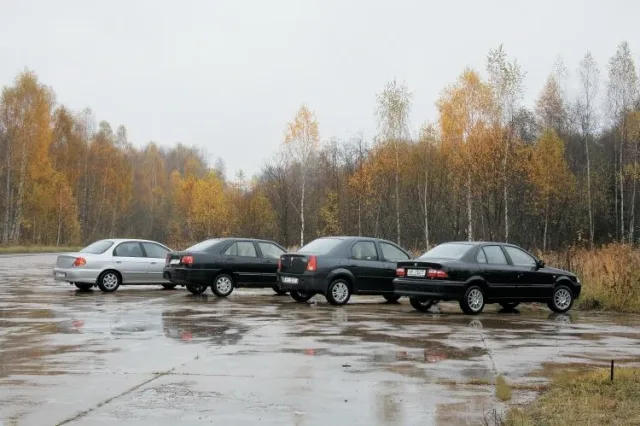
The Chery Amulet began to be assembled using the same "screwdriver" method at the Kaliningrad Avtotor, and official supplies of cars from China ceased. Our test involved one of the few Amulets still assembled in China. Over the next year, Avtotor plans to establish body production, which will allow increasing capacity from the current thousand to 25,000 cars per year and reducing prices.
The Renault Logan and Kia Spectra are produced in a full production cycle — at the Avtoframos (Moscow) and Izh-Avto (Izhevsk) enterprises. Production is expanding in line with demand. This year, it is planned to produce 60,000 Renault Logan sedans and 33,000 Kia Spectras, and next year — 80,000 and 45,000, respectively.
Why Do Ratings Change?
As we have said more than once, expert ratings of the same models can change from test to test. First of all, this is influenced by the "weighted average" level of qualities set by the participants of a particular test and their configurations.
For example, compared to the winter tests (AR No. 2, 2006), the Chery Amulet and Renault Logan "swapped places." Why? In the previous test, there was a Logan 1.4 in a modest configuration, and in the current one — a well-equipped car with a more powerful 1.6-liter engine.
Design scores increased by five points thanks to beautiful 15-inch alloy wheels (last time they were steel 14-inch). The Amulet lost the same number of points for a sloppily assembled interior — such a mess was not present on the previous car.
When we compared the cars last time, the Amulet looked quite nimble, but now it clearly loses to the Samand in acceleration dynamics — again minus five points. But the Logan with the 1.6-liter engine gained twenty points in this component.
The wider tires also made themselves known: Logan's braking performance was rated ten points higher, and handling five points higher. The Amulet, on the other hand, lost ten points in handling — this particular example turned out to be quite unlucky.
We also slightly revised our approach to comfort assessment. The maximum for ride smoothness was reduced by ten points, but the ceiling for acoustic comfort was raised by the same amount. Naturally, the final figures were adjusted accordingly.
Previously, when evaluating the rear row, we primarily looked at the comfort of two passengers. Now, for budget sedans, overall passenger capacity turned out to be more important. The overall context also played a role. Therefore, Renault lost five points, and Chery lost all fifteen. However, Logan added five points for the absolutely flat trunk floor, which we underestimated last time.
In the end: Renault gained an additional forty points thanks to its rich equipment, while Chery lost forty-five — due to unstable and very low build quality, which also affected the car's behavior.
An interesting detail: despite the changed criteria and different lineup, the Kia Spectra scored the same 685 points as two years ago.
| Expert assessments from Autoreview | |||||
| Evaluated parameters | Max. score | Cars | |||
| Chery Amulet | Iran Khodro Samand | Kia Spectra | Renault Logan | ||
| Design | 160 | 110 | 120 | 100 | 115 |
| Exterior | 80 | 55 | 60 | 50 | 60 |
| Interior | 80 | 55 | 60 | 50 | 55 |
| Ergonomics | 160 | 120 | 120 | 120 | 125 |
| Driver's workplace | 80 | 50 | 50 | 50 | 60 |
| Visibility | 80 | 70 | 70 | 70 | 65 |
| Dynamics | 280 | 195 | 215 | 190 | 240 |
| Acceleration dynamics | 90 | 60 | 70 | 55 | 75 |
| Braking dynamics | 100 | 80 | 65 | 75 | 90 |
| Handling | 90 | 55 | 80 | 60 | 75 |
| Ride comfort | 200 | 120 | 160 | 135 | 145 |
| Ride smoothness, vibration protection | 70 | 50 | 65 | 55 | 60 |
| Acoustic comfort | 70 | 30 | 50 | 40 | 45 |
| Climate control | 60 | 40 | 45 | 40 | 40 |
| Interior comfort | 200 | 150 | 135 | 140 | 125 |
| Passenger seats | 80 | 50 | 65 | 55 | 65 |
| Trunk | 70 | 55 | 60 | 55 | 60 |
| Interior transformation | 50 | 45 | 10 | 30 | 0 |
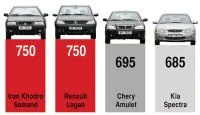
| Total score | 1000 | 695 | 750 | 685 | 750 |
Final assessments from Autoreview
Autoreview readers' forecast
Before this test, we asked website visitors which car from the four they would choose for themselves.
The votes were distributed as follows:
Renault Logan 45.82%
Kia Spectra 39.35%
Iran Khodro Samand 12.34%
Chery Amulet 2.48%
A total of 6970 people voted
"Moose test"
This time, the "moose test" was conducted on wet asphalt — autumn made itself known. Therefore, we did not measure the maximum maneuver speed. But it was interesting to check whether an average driver could avoid an unexpected obstacle at 65 km/h. As usual, each of the five volunteers was given one attempt. It's clear that on a wet road, tires matter a lot. But who, if not the manufacturer, chooses them for their car?
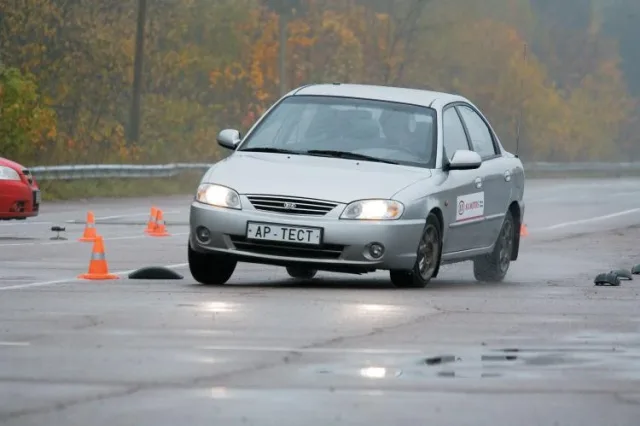
The most obedient turned out to be the Samand. During a sharp maneuver, it clearly follows the steering wheel, without the slightest hint of understeer or oversteer. Only one driver out of five miscalculated the trajectory and hit a cone.
After the docile Samand, the other cars showed themselves quite differently. Even the familiar and understandable on dry asphalt Logan began to "kick" — it has a pronounced tendency to oversteer. Only one person managed to handle the Renault on the wet road. The rest struggled to hold the sliding rear axle and sometimes flew out of the corridor — straight into an imaginary ditch.

But the Kia and Chery turned out to be even more difficult on wet surfaces. Nobody managed to avoid the "moose"! The Spectra mostly went straight, barely responding to steering wheel turns, while the Amulet behaved absolutely unpredictably — sometimes the front axle understeered, sometimes the rear oversteered. Slippery tires and terrible steering feedback led to deep and unexpected slides. One of the drivers of the Chery Amulet was "spun out" so much that the car calmed down only after the fourth oscillation. This is a reminder once again: on a wet road, you need to be especially careful. Otherwise, you'll remember the saying that the miser pays twice.
| "Moose test" on the first attempt at 65 km/h* | |
| Car | Maneuver completed |
| Chery Amulet | 0 drivers out of 5 |
| Iran Khodro Samand | 4 drivers out of 5 |
| Kia Spectra | 0 drivers out of 5 |
| Renault Logan | 1 driver out of 5 |
| * Five drivers participated in the tests | |