
 Comments
  In the world automotive history, there are few cars, even priced at around a hundred thousand dollars, that have managed to create their own image, supported later by both engineers and designers. Cadillac Escalade may not top this honorable list, but it certainly makes the top ten. That's why this "stormtrooper" is so often found in the garages of luxurious villas on the California coast. The list of celebrities who have chosen this five-meter brutal giant could go on for a long time, but here are just a few names from the Escalade's "hall of fame": Puff Daddy, Mariah Carrey, Eminem, 50cent. And the fact that mostly Rap and R'n'B stars are gathered here is no coincidence – it's that established "style." The Escalade glides leisurely along the road, powerful "beats" blare from its speakers for all to hear, and stylish guys and girls in furs sit in the cabin. The gleam of gold and diamonds, breaking through the thick smoke of expensive Cuban cigars. And this monster's movements are unhurried: there's no need to rush – the owner has already achieved everything, now his task is to enjoy the ride and catch the admiring glances of passersby.
We, however, will try to step away from show business and see what the Caddy really is, especially in the version adapted for the European, and primarily the Russian market. After all, once you encounter such a giant on the narrow streets of Paris or Rome, you might not sleep for a long time afterwards. But in Russia, the Escalade looks quite organic: gasoline is still inexpensive, and no one has yet been held accountable for parking on the curb.
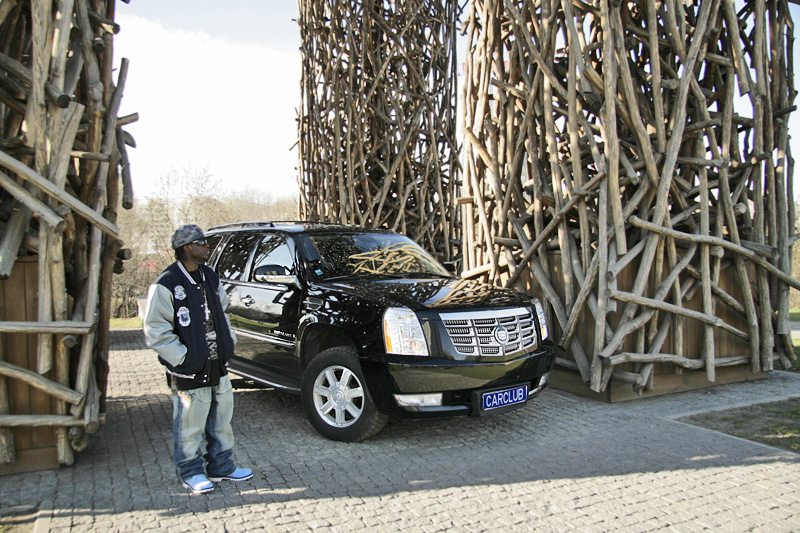
Upon closer acquaintance, the Cadillac Escalade doesn't seem as harsh as it appears from afar. The vertical "skyscraper" headlights are unlikely to leave anyone indifferent, nor are the LED taillights. However, the window line turned out to be quite plastic, not drawn with a ruler, like the Hummer or the previous Chevrolet Tahoe, with which the Caddy shares a common ladder frame and chassis. The final point on the question of brutality is made by the chrome check: the Caddy has it in abundance, meaning a washed car will always shine and attract attention – it simply won't go unnoticed on the road.
The interior is a collection of quotes that could be called plagiarism if it weren't for the work of General Motors, which, when creating each new model, seems to simply mix available ingredients in different proportions. Then, depending on the resulting "cocktail," the car is assigned a name and brand.
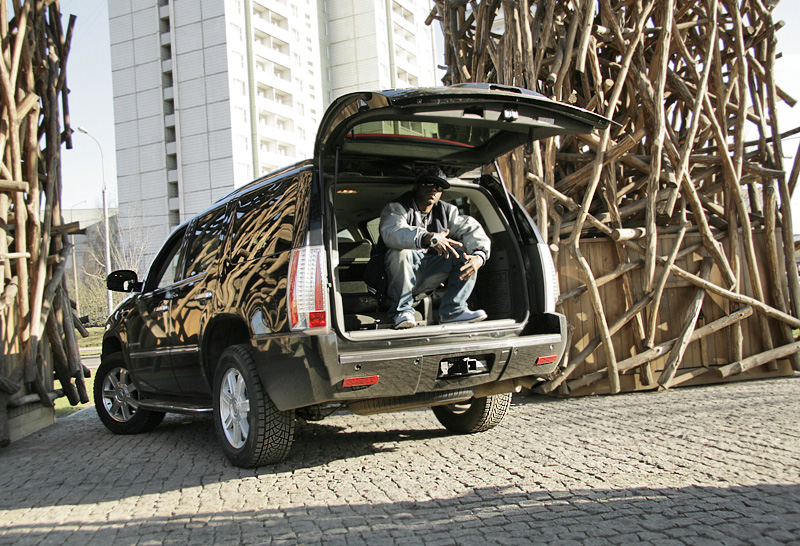
Only the instrument panel with white optitronic backlighting and blue-violet ray-like needles looks truly original. The steering column switches migrated here from the Hummer, and the steering wheel, despite wood inserts around the entire rim, clearly echoes the Chevrolet Captiva. And the center console seems to have moved unchanged from passenger Cadillacs and looks too modest against the abundance of "wooden" trim and the huge center box. But this is only the base version – there are Escalade versions with a large color display, navigation, and rearview camera. We had to make do with just parking sensors. Without them, it's impossible: a passenger car, or even a couple of Daewoo Matiz, can easily hide behind the towering rear. A pleasant surprise was that the wide leather seats have some lateral support, and the box between the front seats can serve as a child seat or storage for anything. The rear sofa is completely flat – it can accommodate three or even four people, and if desired, you can even spend the night there. The third row is not as spacious, but you can sit there quite tolerably.
The 6.2-liter engine, despite its American roots and impressive displacement, is quite modern. Even though there are only a couple of valves per cylinder, the engine is entirely aluminum, and lightweight pistons and connecting rods allow it to rev freely up to almost 6000 rpm. And what a sound at low revs – real America, the Wild West! True, as revs rise, it turns into a simple roar. The power of 409 "horses" is quite good. For comparison: the 6.0-liter Hummer produces only 325 hp. Although at the court tuning studio AMG at Mercedes-Benz, they extract a hundred more "horses" from a similar displacement. Paired with the engine is a new 6-speed automatic that shifts gears smoothly and quickly, and also has a manual mode. But how to use it if the gear selector is on the steering column? Paddle shifters? No, GM engineers went a different, more original way – on the massive mode selection lever, right near the steering wheel, there is a small rocker switch that handles shifting. It's clear that you'll rarely need to use it – the engine's torque is always sufficient, and in automatic mode the gearbox works promptly. But if you want to play around, the function is always at hand.
The Escalade reaches the maximum 170 km/h without batting an eye. Acceleration starts smoothly and very confidently. According to our stopwatch, the first "hundred" is reached, as stated by the manufacturer, in 6.5 seconds. The pace doesn't drop further, and then acceleration suddenly cuts off – the limiter kicks in. It would seem the speed isn't that high, but the car for some reason stopped accelerating. And only by glancing at the speedometer and seeing 180 km/h do you realize the true dynamics of the Caddy.
Moreover, 170 km/h (according to factory data, the limiter activates at this mark) is not so much a limit as a cruising speed for the Escalade. That is, when hitting the limiter, the SUV strains neither itself nor the driver. At this pace, it can go for as long as desired. Fuel consumption turned out to be quite acceptable for a 6.2-liter engine and a huge body: with cruise control set at maximum speed, it stays around 22 liters per "hundred." And compared to its closest relative, the Hummer H2, the Escalade has almost a double advantage. The "Hammer's" appetite already exceeds 35 liters per 100 km at 150 km/h... That's what thoughtful aerodynamics mean for such a large car as the Cadillac. However, mass cannot be hidden anywhere, so with every acceleration, the fuel gauge needle noticeably creeps toward zero. During active city driving, consumption doesn't drop below 25 liters per hundred.
At the end of the test, we considered testing the Escalade off-road, but changed our minds in time. The huge mass and large overhangs almost guarantee that on the first serious bump, the Cadillac will start catching its bumpers, and if it gets stuck, then "it's no easy task – dragging a hippopotamus out of the swamp"! And it's unlikely any Escalade owner would risk taking this off-road limousine into the mud – it wasn't created for that. Although its close kinship with the Hummer H2 leaves some hope, the Caddy lacks off-road features like low-range gearing or differential locks – here there's only permanent all-wheel drive and an electronic traction control system that will help when tackling curbs or on snow. But it's better not to get into diagonal wheel hanging – electronics in such situations usually don't save.
Overall, the Escalade is indeed a very unusual car. Its charismatic appearance speaks for itself. If you like American gigantism and aren't bothered by increased fuel consumption and a maximum of 170 km/h, while many European SUVs confidently exceed 200 km/h, then the Cadillac is an excellent choice. It successfully combines comfort and handling. And for conquering swamps, the twin brother Hummer H2 or in a pinch, the UAZ Patriot would be better suited. The price of around a hundred thousand dollars seems quite justified for such an interesting and powerful car – any European analogue of comparable power would cost more...
Text: Leonid Pavlov, Dmitry Malygin. Photo: Dmitry Malygin.