
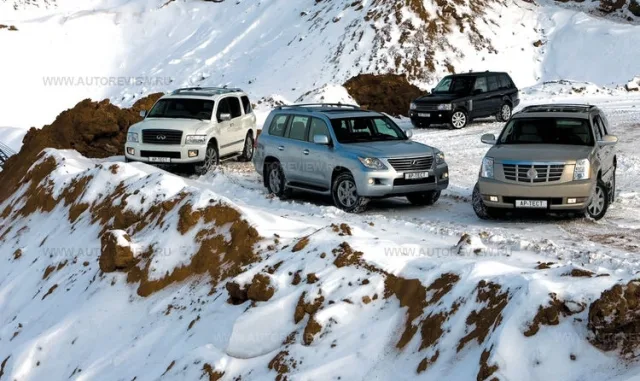
The main thing is not to give in to this European melancholy. CO₂, greenhouse effect, global warming... You start thinking about it — and now you feel awkward that under the hood there's a powerful and voracious engine. So let's agree right away: talk about reducing emissions is nothing more than the machinations of world imperialism, dreaming of bringing our oil and gas power to its knees. It won't work! We have our own pride. And here's the proof: the fresh Lexus LX 570, Cadillac Escalade, Infiniti QX56, and Range Rover 4.2 Supercharged. This is not a modest Mazda zoom-zoom, this is a real zoom-in! From bumper to bumper — no less than five meters, curb weight — over two and a half tons, total price — half a million dollars... Our, Russian scale!
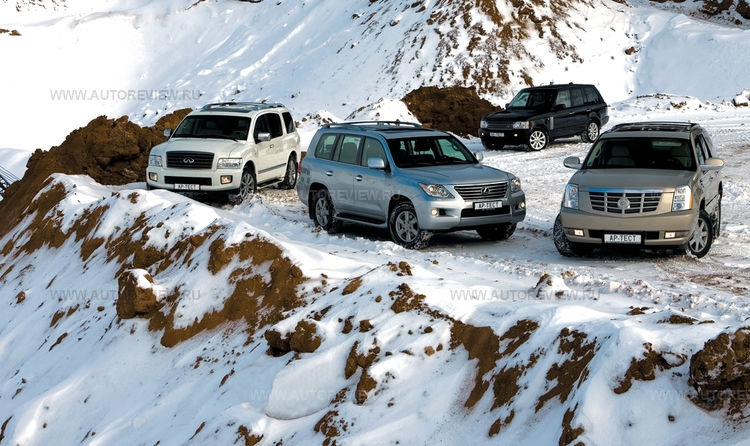
What's missing here? Perhaps only the Mercedes GL. But it, as luck would have it, didn't make it to the Daimler AG press fleet by the appointed date, so we'll console ourselves with the fact that our readers have already seen this SUV, as well as other "alternative" options — the Audi Q7 and Porsche Cayenne (see AR No. 10, 2007). The Range Rover is also familiar. However, for the first time we got our hands on the updated version with the most powerful engine in the lineup — a supercharged V8 of Jaguar origin producing 396 hp.
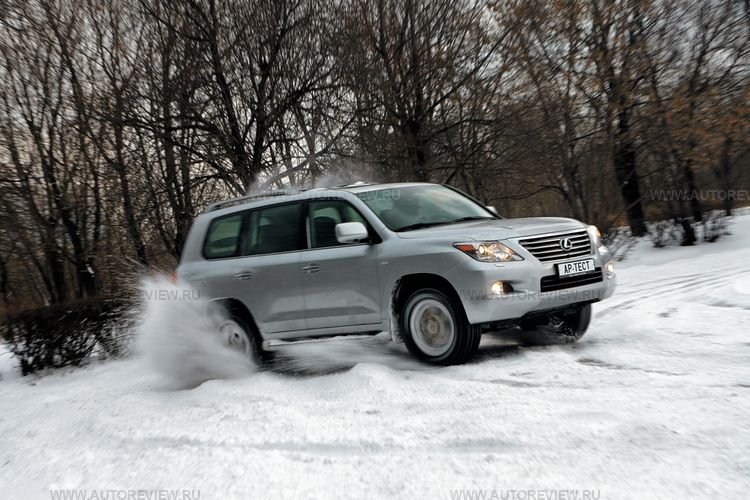
The Lexus gets rear-wheel-drive manners thanks to an asymmetric Torsen center differential that sends torque in a 2:3 ratio favoring the rear axle
And the Cadillac Escalade — a luxurious relative of the Chevrolet Tahoe and GMC Yukon — is even more powerful: 403 hp.
The Infiniti QX56 (5.6 L, 325 hp), built on the F-Alfa frame shared with Nissan's giants Armada and Titan, doesn't win with power but with size: it's the longest and widest of the four! The model has been in production for four years, but for Russia it's a new arrival: official sales started only a few months ago.
| Cadillac Escalade | Infiniti QX56 |
 |  |
| Lexus LX 570 | Range Rover |
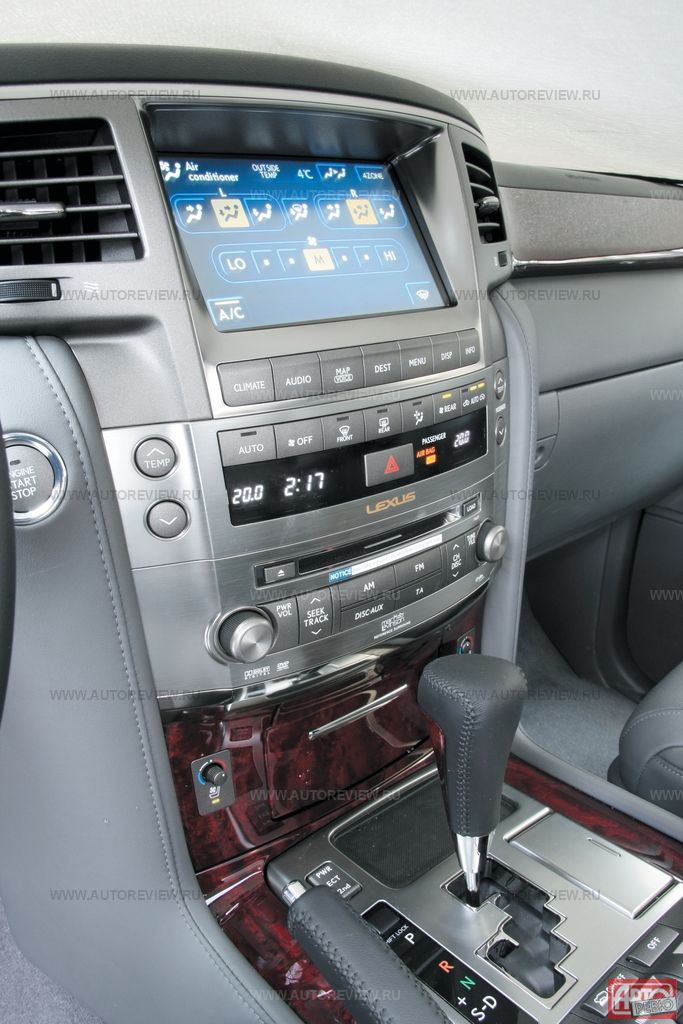 | 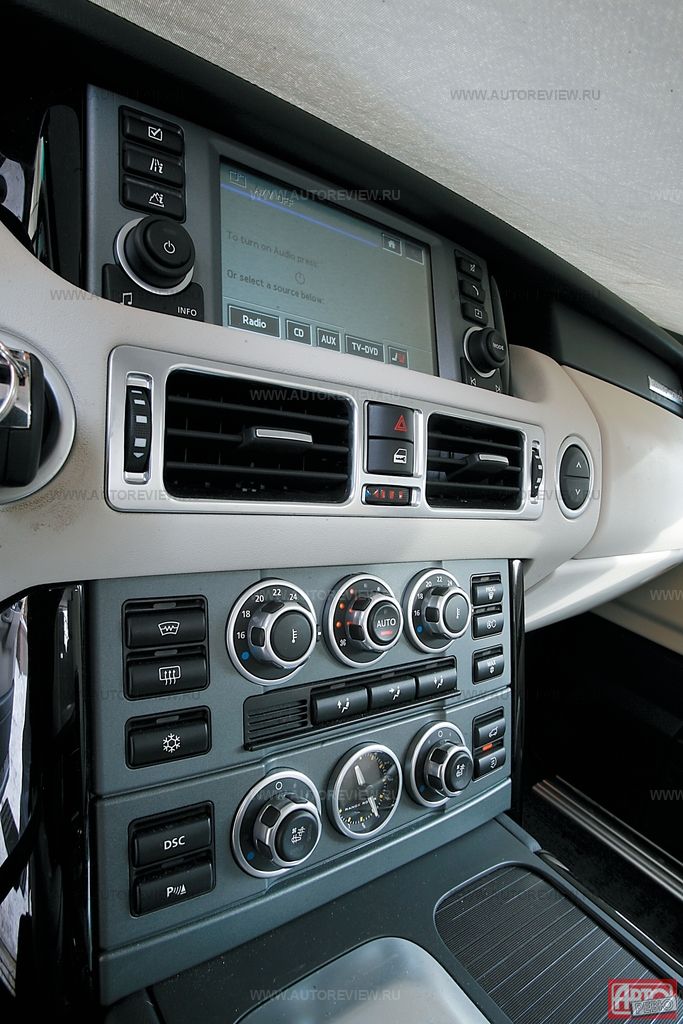 |
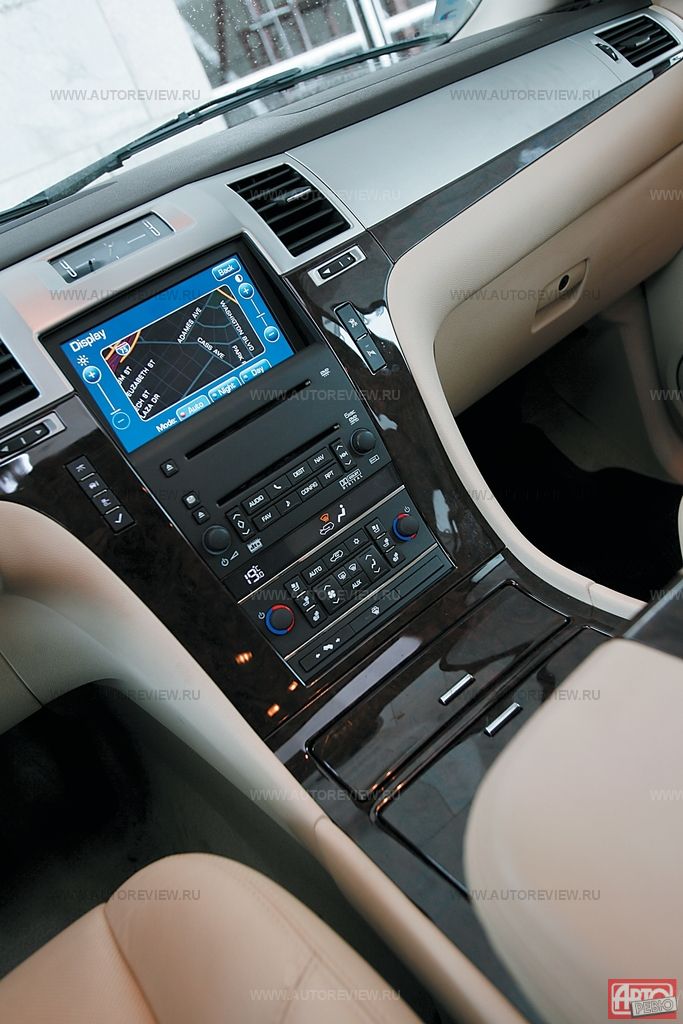
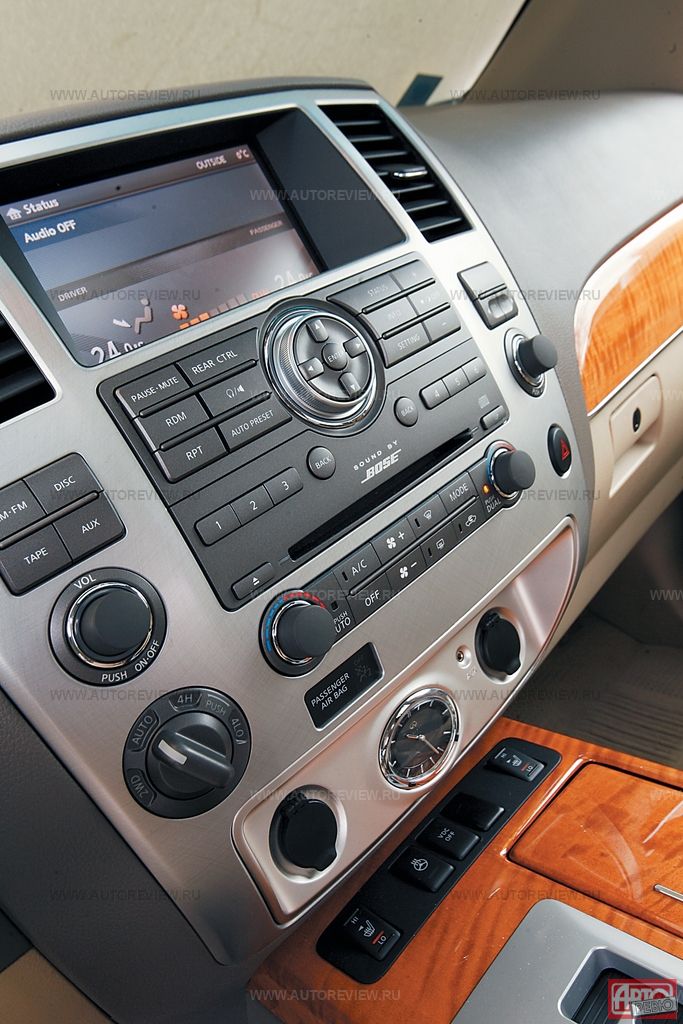
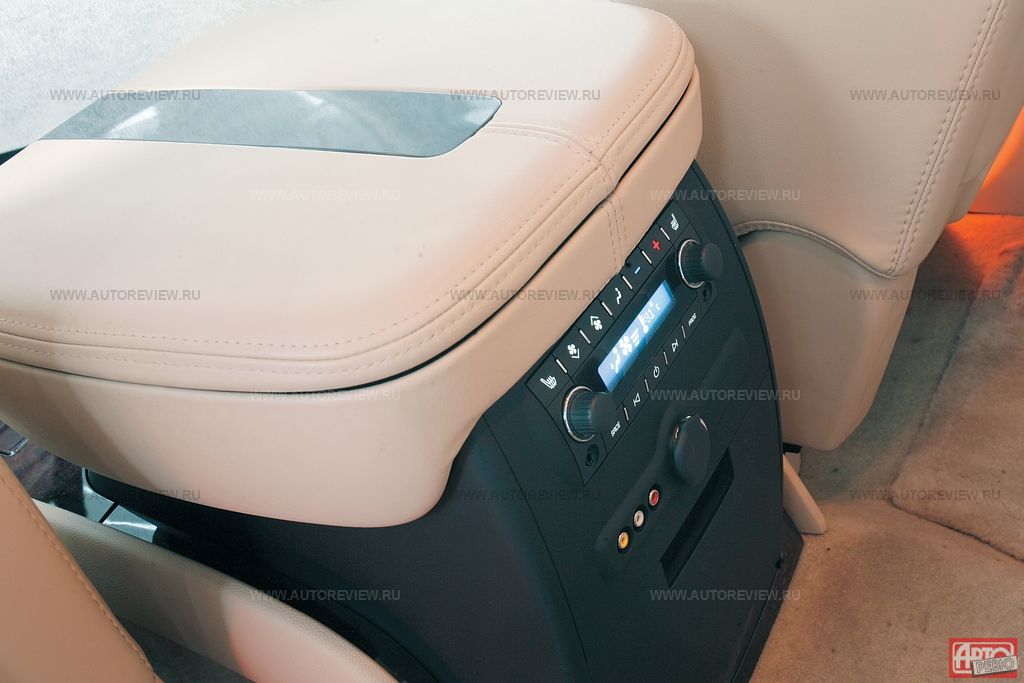
| It's easiest to set a comfortable temperature in the Range Rover: the Cadillac confuses with its button logic, and in the Lexus, the intensity and direction of airflow are changed only via the touchscreen. But the Lexus and Infiniti allow you to control the second-row climate from the driver's seat | |
The freshest is the Lexus LX 570, essentially a Toyota Land Cruiser 200 in rich clothing. The engine is more powerful — 5.7 V8 (367 hp), plus hydropneumatic suspension and "semi-circular" view cameras. And externally, the Lexus is the same Land Cruiser, but with a clever face in the spirit of the flagship LS sedan.
And only the Range Rover doesn't resemble anything — it's on its own. Classic! Despite being the only SUV in the quartet with a unibody construction.
| Cadillac Escalade | Infiniti QX56 |
 |  |
| Lexus LX 570 | Range Rover |
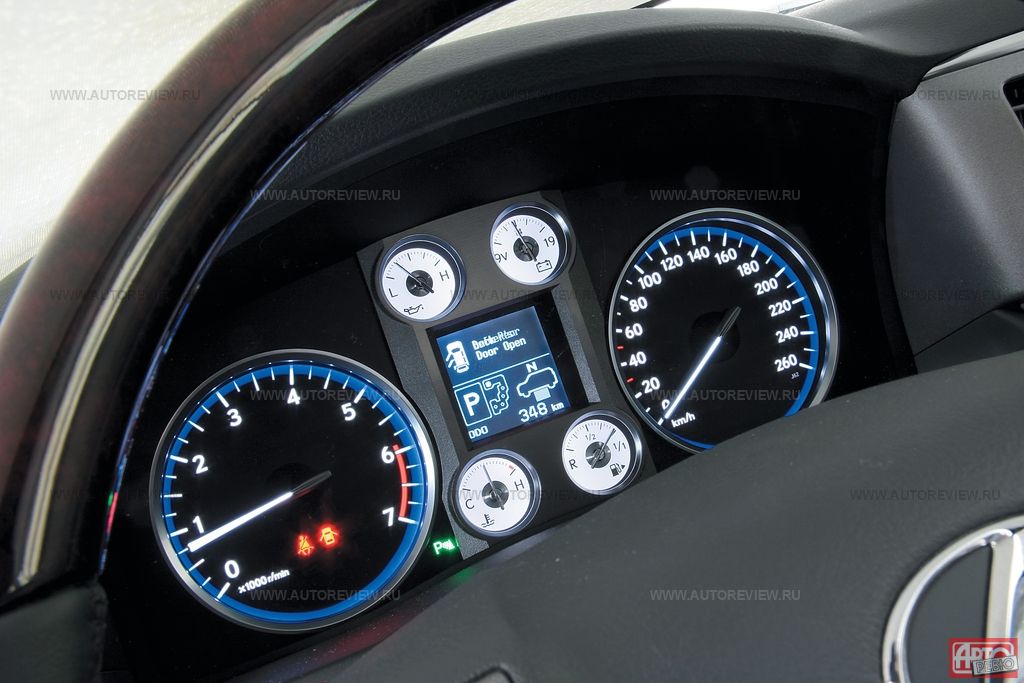 | 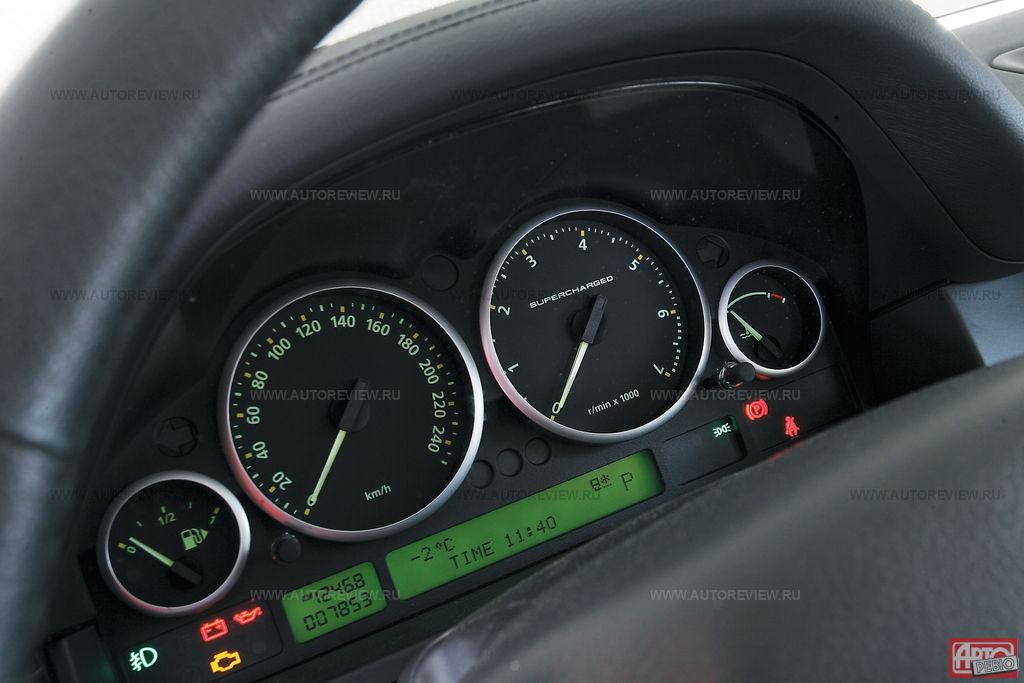 |
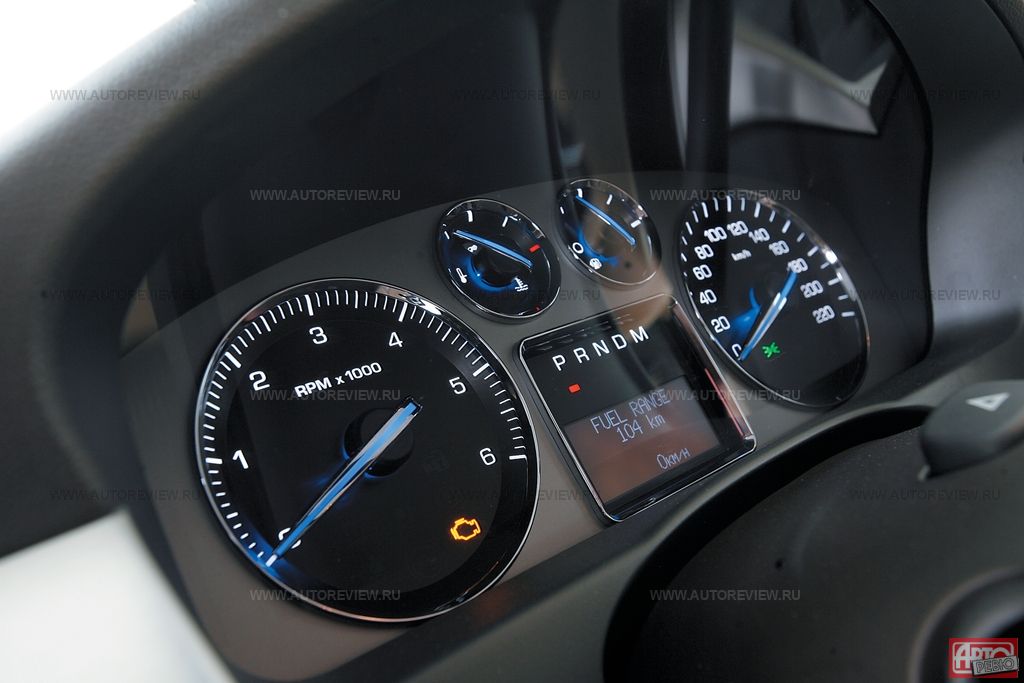
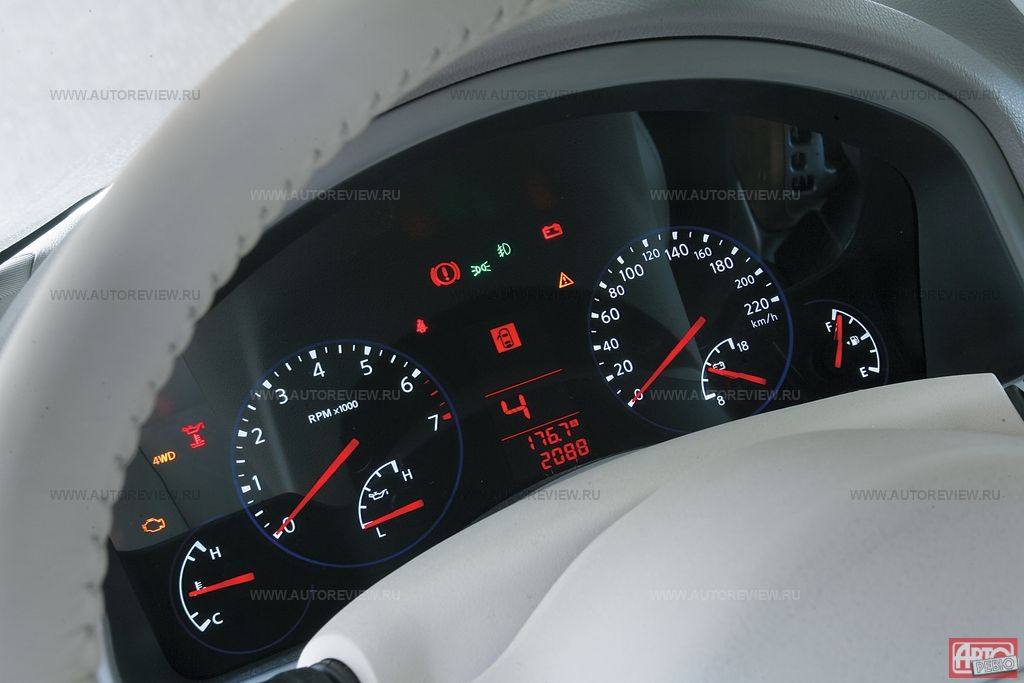
| The Lexus instruments were liked the most. But in the Range Rover, information is read the worst: the scales are small, the numbers are "inverted." For solidity, the Lexus and Infiniti instrument clusters additionally show network voltage and oil pressure | |
Getting into the Range Rover without a running board isn't very convenient, but behind the wheel it's the best of all: visibility is excellent, the seat is wonderful, and thanks to the low floor, it can be lowered almost to "car-like" levels.
In the Cadillac, the seating position is also decent geometrically, but the seat is somewhat formless, the steering column noticeably changes angle when rocking on a small lever, and the lack of steering wheel reach adjustment isn't saved even by "moving" pedals with a large height difference between the gas and brake.
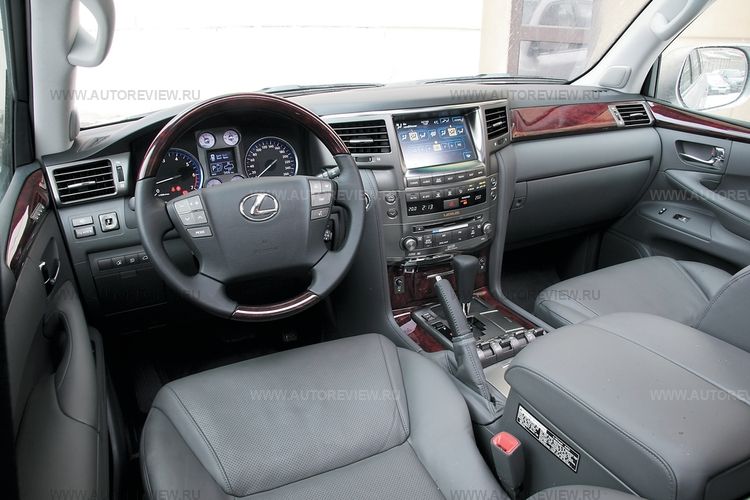
The Lexus cabin pleases with finish quality, although there's perhaps an excess of silvered plastic
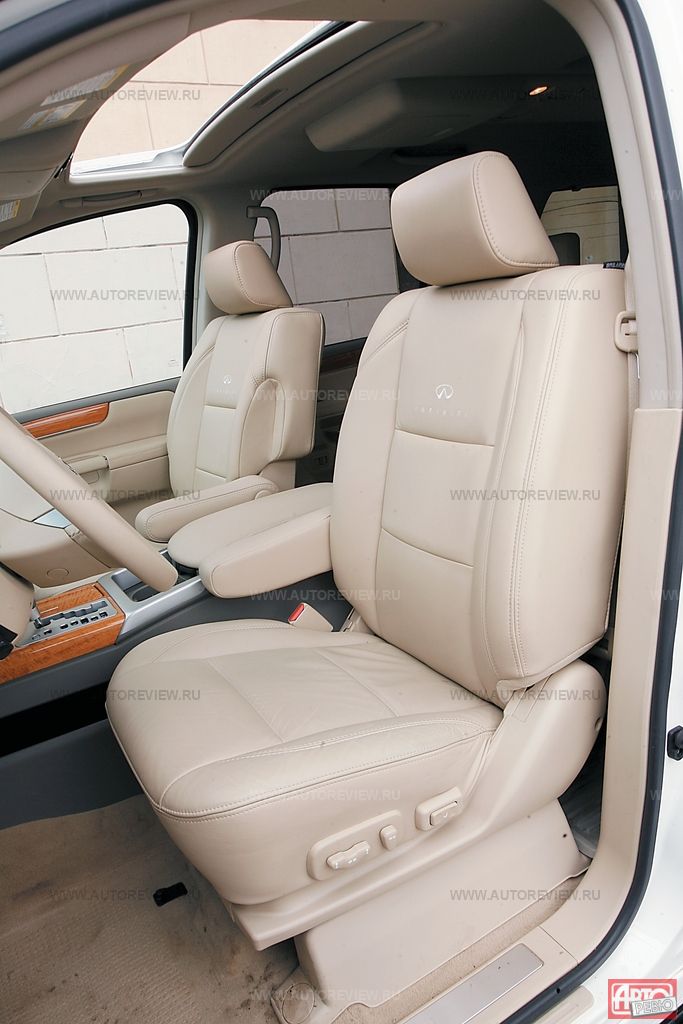
Everything said also applies to the Infiniti, but the seat here is more contoured, with "grippier" leather upholstery.
Unlike competitors, the Infiniti feels huge inside: you look at the center console as if through a magnifying glass. Zoom in! True, because of this, you can barely reach the radio frequency knob on the right, so it's better to delegate station searching to a passenger.
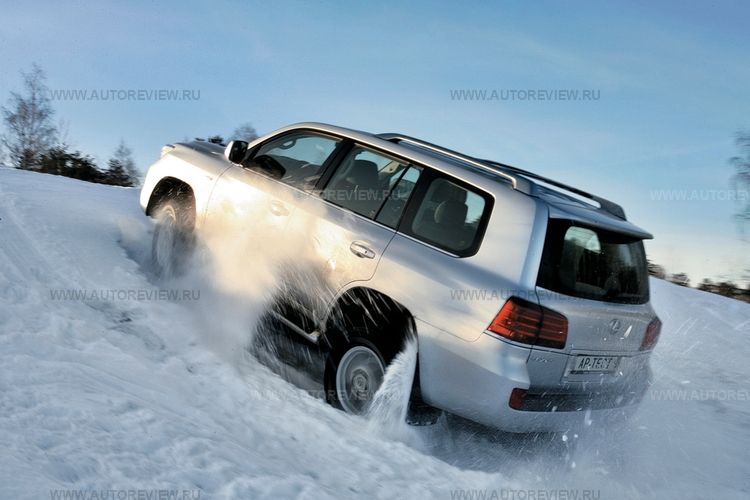
The adjustable suspension with wide limits gives the Lexus excellent geometric off-road capability
In the Lexus LX 570, both the running board and the high door opening help you get in — it couldn't be simpler! The seating is high and no less comfortable than in the Infiniti, although the seatback lacks contouring. But the main inconvenience, as in the Land Cruiser, is controlling the climate control via the touchscreen: without entering the menu, you can only change the temperature.
The Lexus accelerates powerfully — hold on! On slippery surfaces, you have to steer to avoid provoking a skid, and only on asphalt, after pressing the damped accelerator, do you get pure acceleration. Gear changes are imperceptible and infrequent: for example, in second gear you can reach 120 km/h. Delays and slight jerks are noticeable only on downshifts.
| Cadillac Escalade | Infiniti QX56 |
 |  |
| Lexus LX 570 | Range Rover |
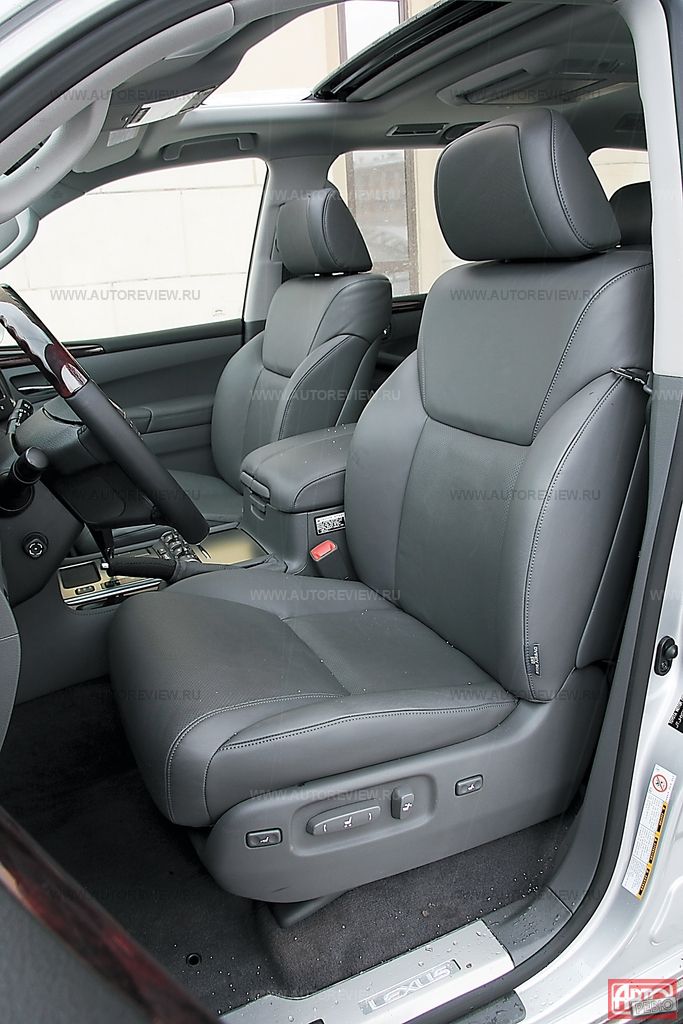 | 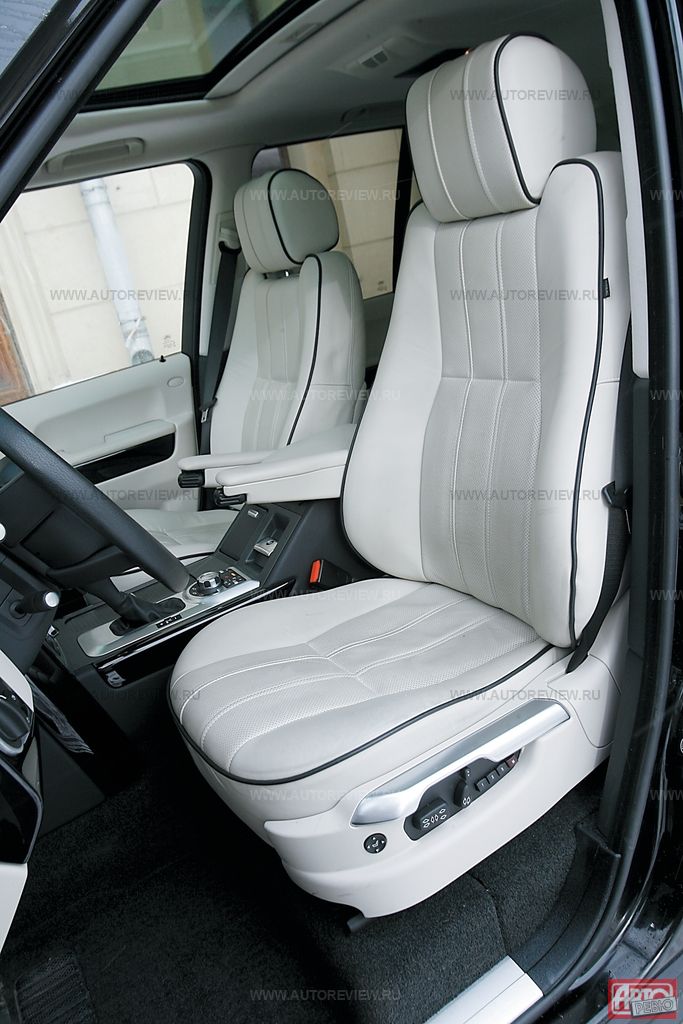 |
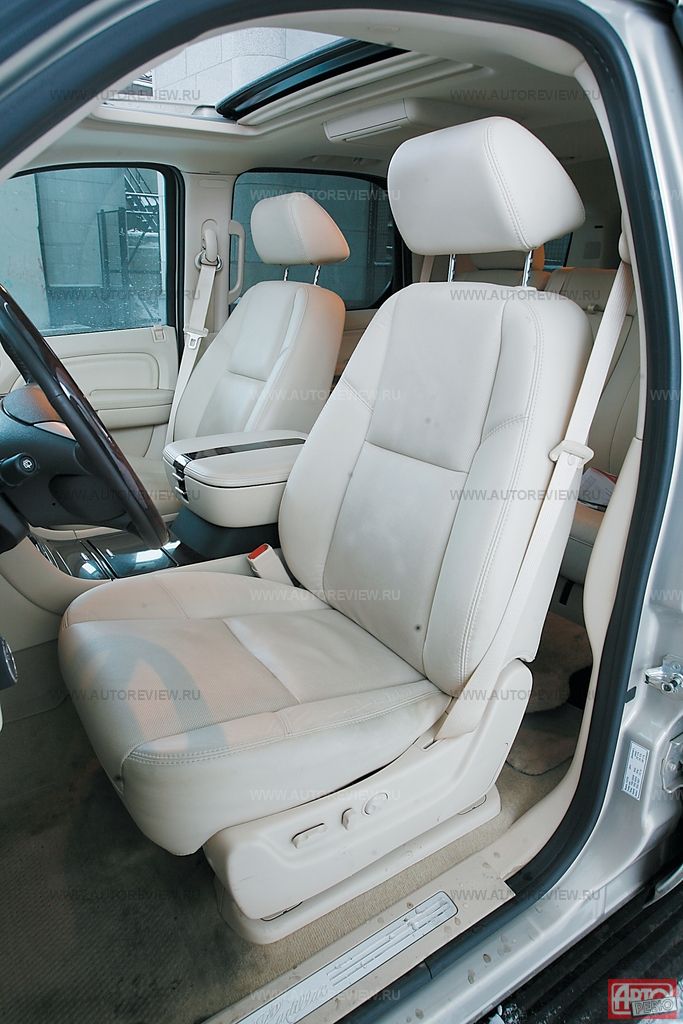
| The best seats are in the Range Rover. The Lexus and Infiniti seats are less contoured but still more comfortable than the amorphous and slippery Cadillac seats | |
And what if you want to be quick? The "automatic's" sport mode allows revving the engine to 6000 rpm versus 5700 rpm in D mode, it holds the previous gear longer, and when you release the gas, the gearbox shifts only one step up and waits for the next press. The same effect can be achieved with the Power button on the center tunnel. And to prevent unauthorized upshifts, the "manual" mode helps.
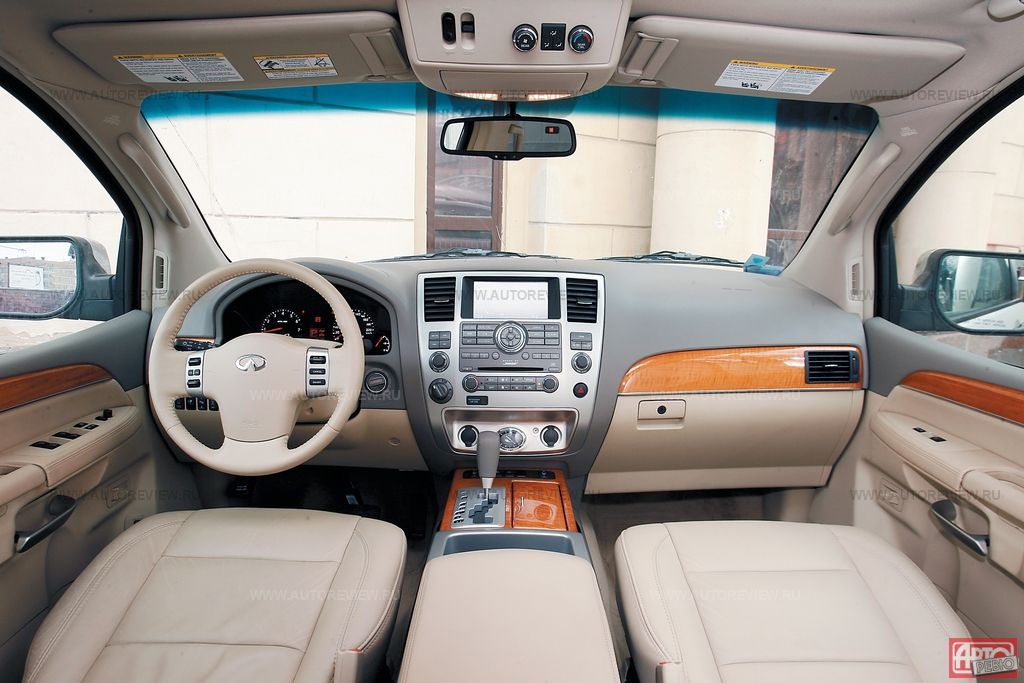 | |
| In the Infiniti, buttons to the left of the steering wheel can raise the tailgate, move the pedal assembly, and slightly open the rear quarter windows | The Infiniti amazes with space: the driver can barely reach the buttons on the "passenger" half of the center console! |
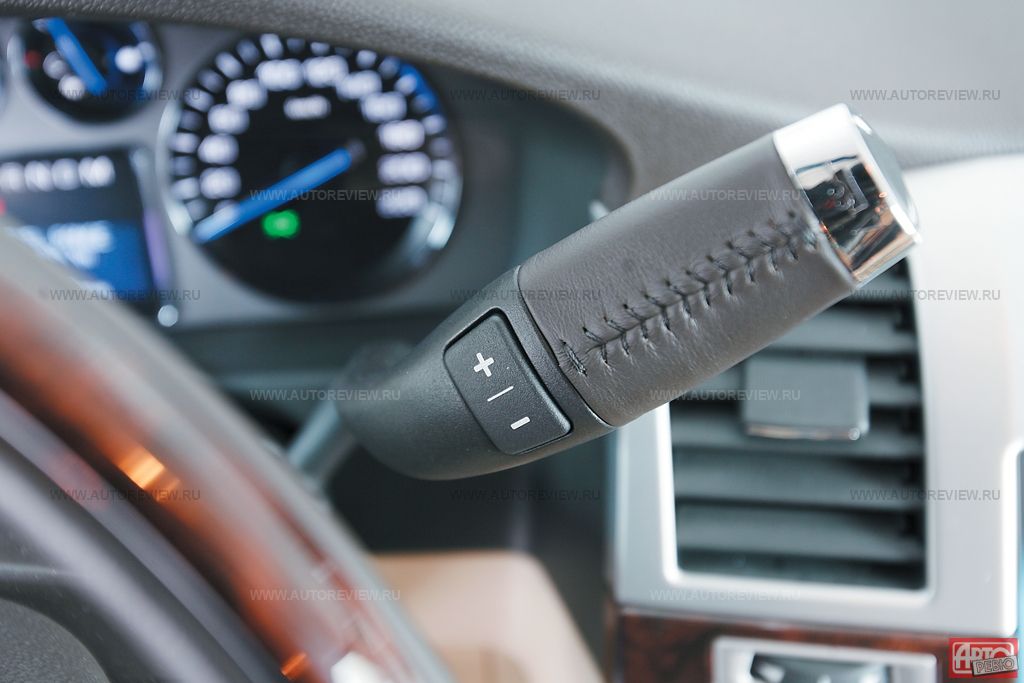
Just press the Cadillac's accelerator harder, and the image of a good-natured cartoon beast disappears without a trace. Instead, a real element awakens, which picks you up and carries you forward to the sounds of the multi-liter engine. But taming this power isn't easy: the unhurried "automatic" and the slow response to the gas pedal get in the way, which is especially annoying in city traffic jams. Even in free-flowing traffic, the gearbox doesn't please with smoothness or logic. Manual mode doesn't save either — the pleasure of engine braking is crossed out by an inconvenient small button on the steering column selector that clicks like a toy.
The Range Rover, which is only slightly less powerful than the Cadillac, was let down by its accelerator pedal calibration. You press the gas, it sinks halfway, and there's no response. You have to press even harder, and this repeats with every acceleration. It's a shame, because there's plenty of power in reserve, and the gearbox works surprisingly smoothly.
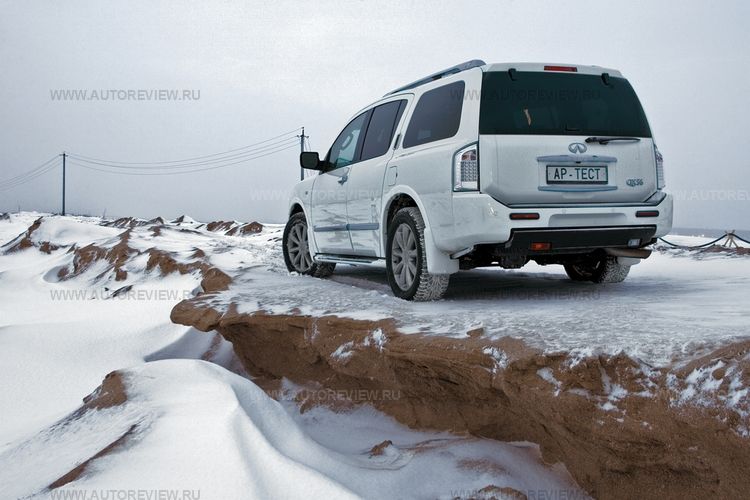
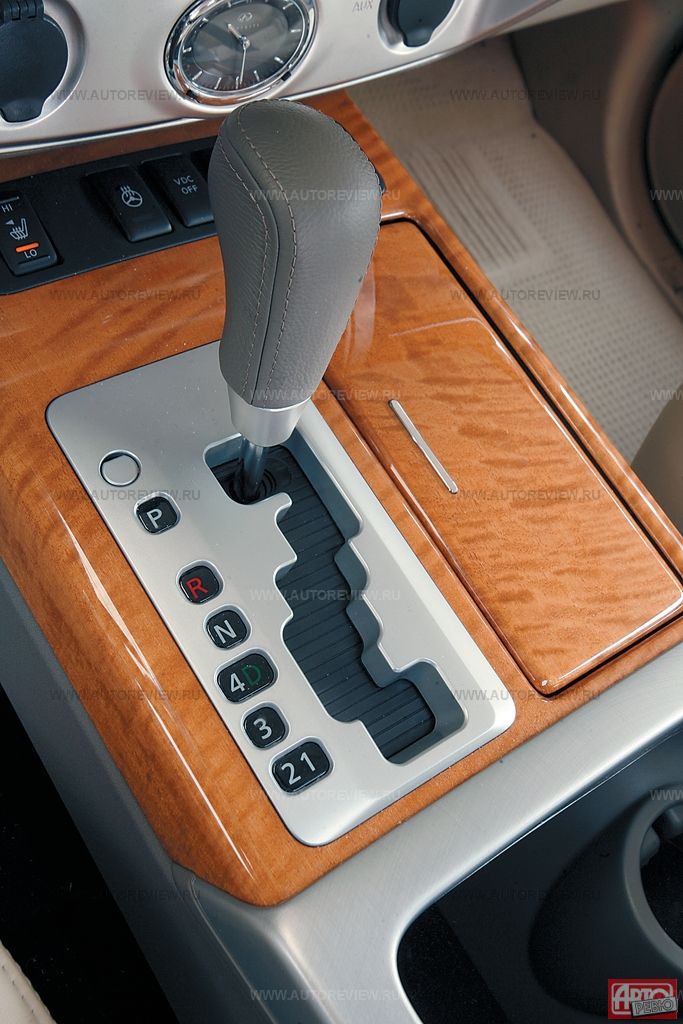
The Infiniti QX56 presents a completely different picture. It has the most modest engine of the four — a 325-horsepower V8, though the word "modest" sounds strange for such a unit — but the accelerator is perfectly tuned. The five-speed automatic has neither sport nor manual mode, but we never regretted that: in regular Drive, shifts are quick, smooth, and predictable. Every acceleration is pure pleasure.
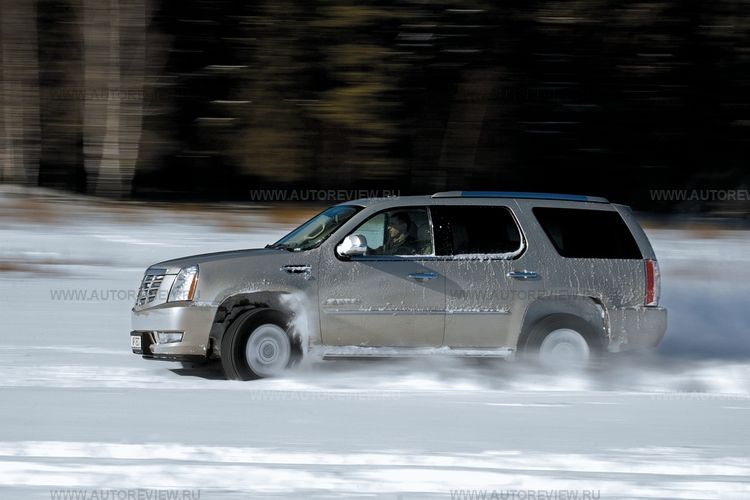
The Cadillac Escalade enters corners extremely reluctantly
Overall, it's the Infiniti that seems the most "driver-oriented" car in this quartet. Of course, it's far from car-like steering response and steering feel, but... This behemoth confidently holds a high-speed straight and handles arcs well, barely deviating from the intended path. And if something goes wrong, a strict stability control system stands guard, quelling a skid right after a brief drift, without waiting for driver input.
| Cadillac Escalade | Infiniti QX56 |
 |  |
| Lexus LX 570 | Range Rover |
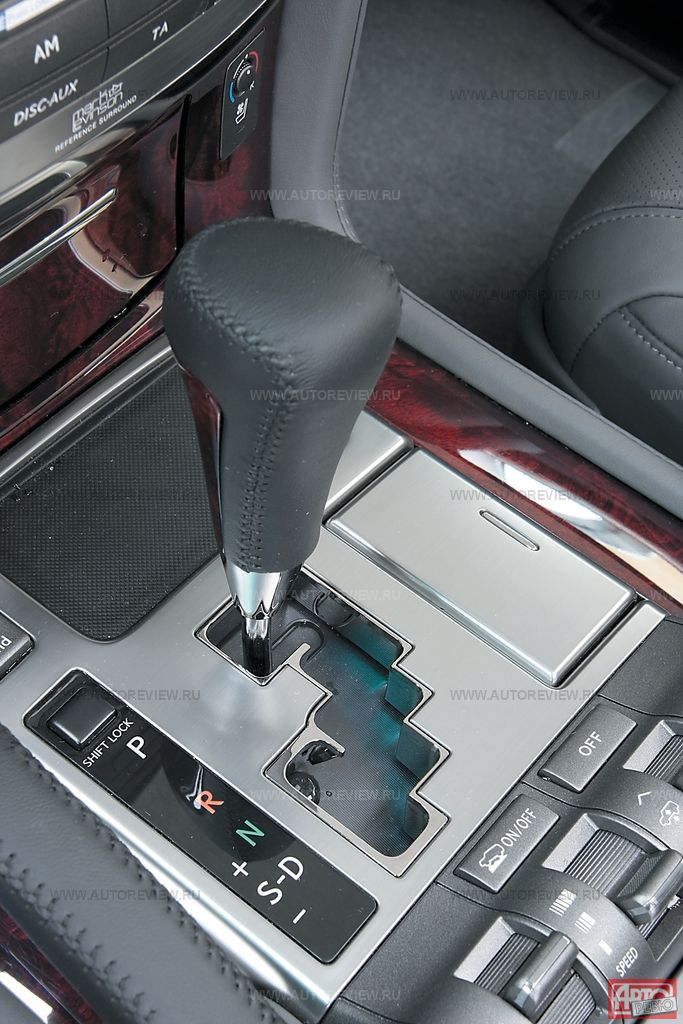 | 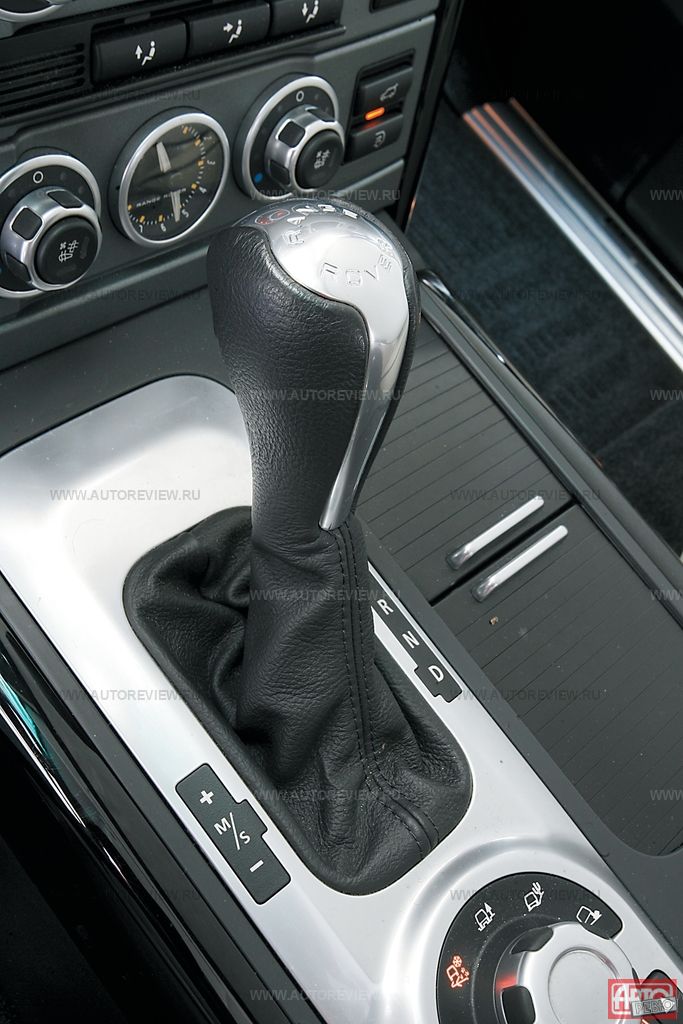 |
| The Cadillac's six-speed automatic is the most sluggish and unpredictable. Instead of awkwardly clicking the toy-like "manual" mode button on the steering column selector, it's better to simply limit gear changes — as the quick and responsive Infiniti gearbox allows. The Range Rover's automatic also shifts precisely, quickly, and smoothly, but the Lexus gearbox is even better | |
The Lexus LX 570 doesn't hold a straight line; it rather adheres to it. Steering responses aren't as sharp, and the low steering sensitivity forces you to watch the road with doubled attention — no sudden obstacles allowed! The Lexus enters corners reluctantly — the front axle pushes, sometimes even triggering the stability control (incidentally, only the Lexus's system also combats understeer). And when the arc is finally taken, the car rocks and wanders a bit. We tried playing with the hydropneumatic suspension settings, but even in Sport mode, the Lexus remains lazier than the "passive" Infiniti.
| Cadillac Escalade | Infiniti QX56 |
 | |
| Lexus LX 570 | Range Rover |
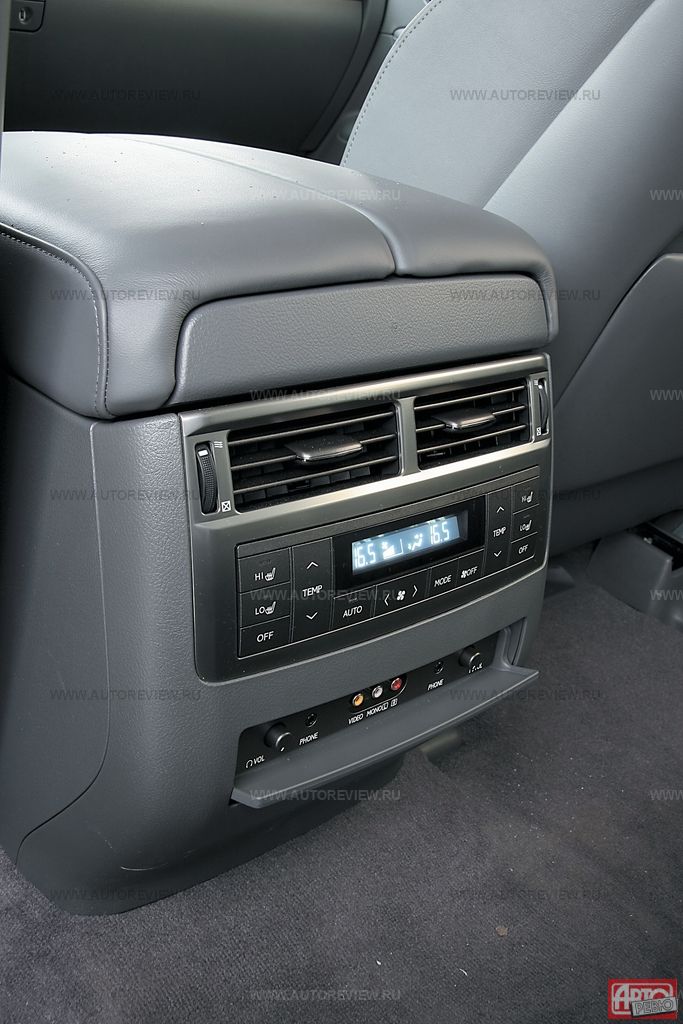 | 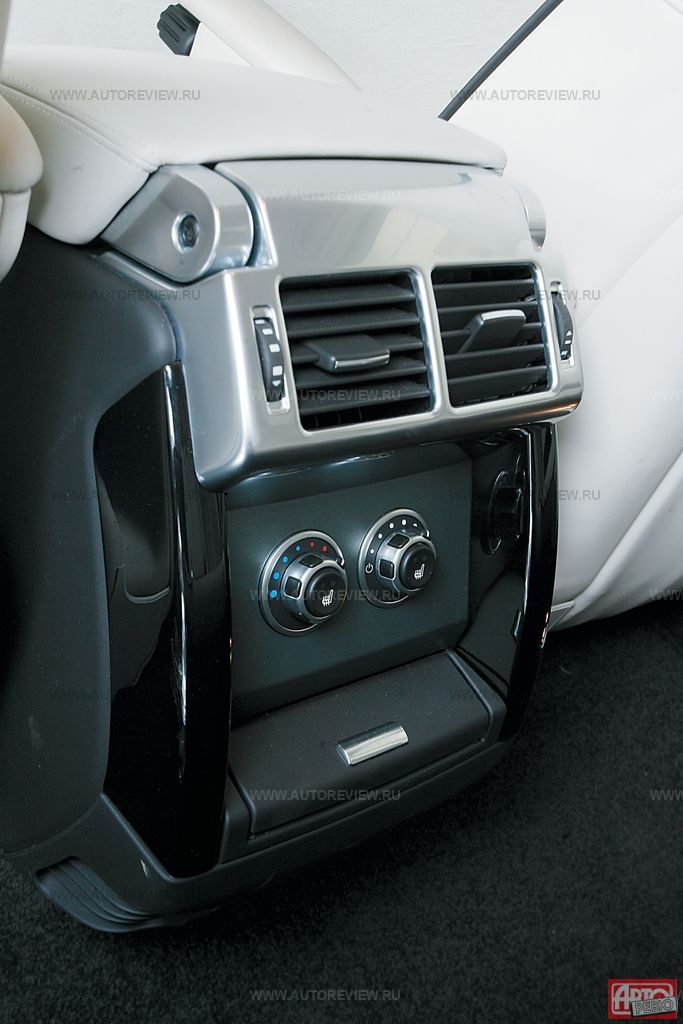 |
| In the Infiniti, the rear climate control unit is located on the ceiling, while in the other SUVs it's between the front seats. But only the Lexus has separate rear climate zones, and only the Range Rover requires "manual" adjustment of airflow directions: even the rear climate control itself is an option for it | |
However, the Lexus's handling shortcomings are just the tip of the iceberg compared to the Cadillac's neglected garden. This car is so engrossed in straight-line driving that it only responds adequately to slow steering inputs — as if to say, don't bother me, I'm busy! More abrupt inputs are useless: there's still no response, and feedback disappears. On uneven corners, the Cadillac rocks and strays off course. And if you spot a corner too late, then... It's better to just drive past. Otherwise — a long understeer, and then, if there's enough road surface, an oversteer that the stability control will have to battle. The slower you steer, the farther you'll go.
| Infiniti QX56 | |
 | |
| Lexus LX 570 | |
 | |
| Cadillac Escalade | Range Rover |
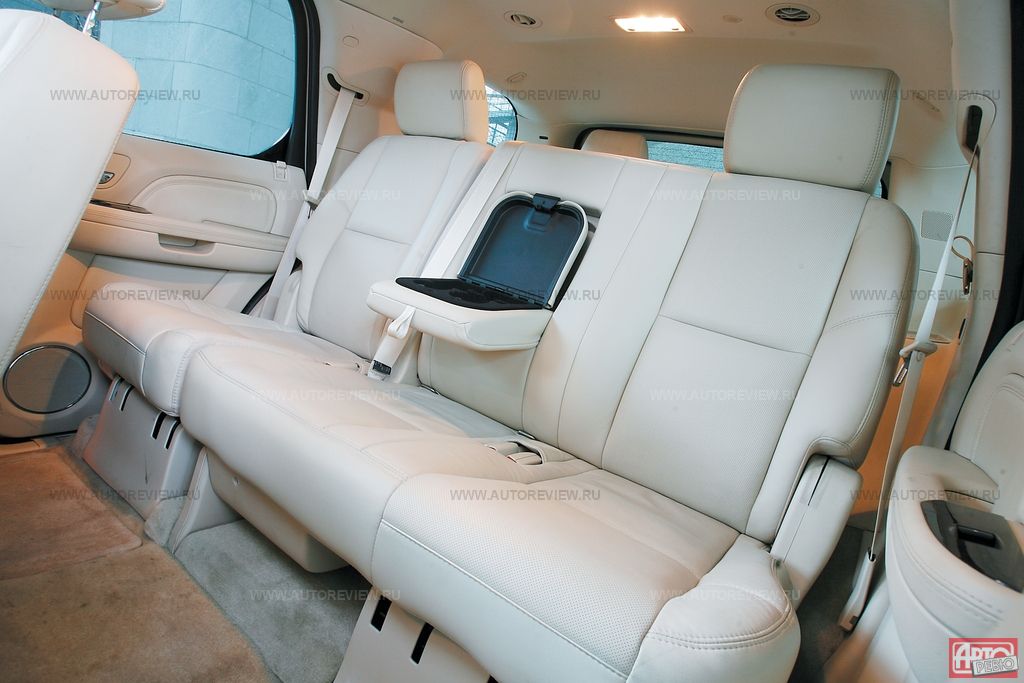 | 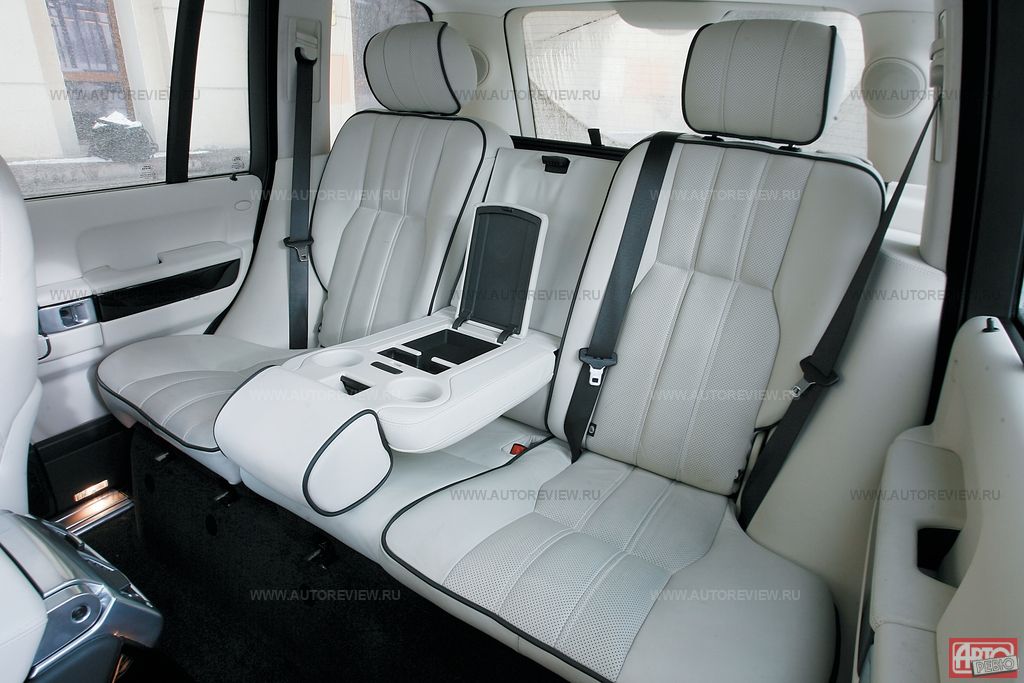 |
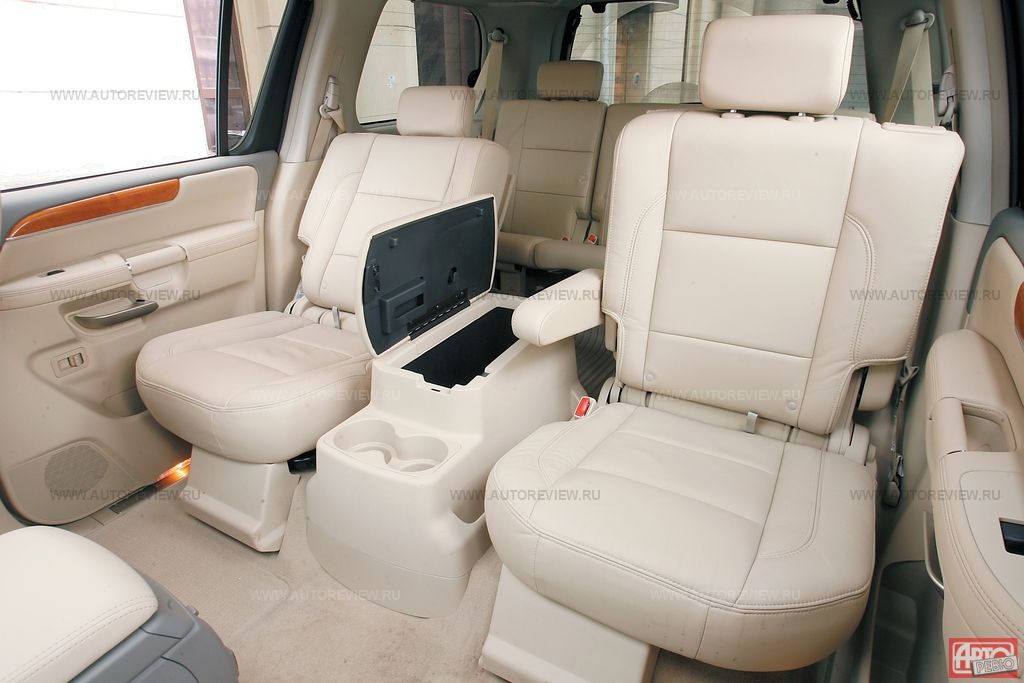
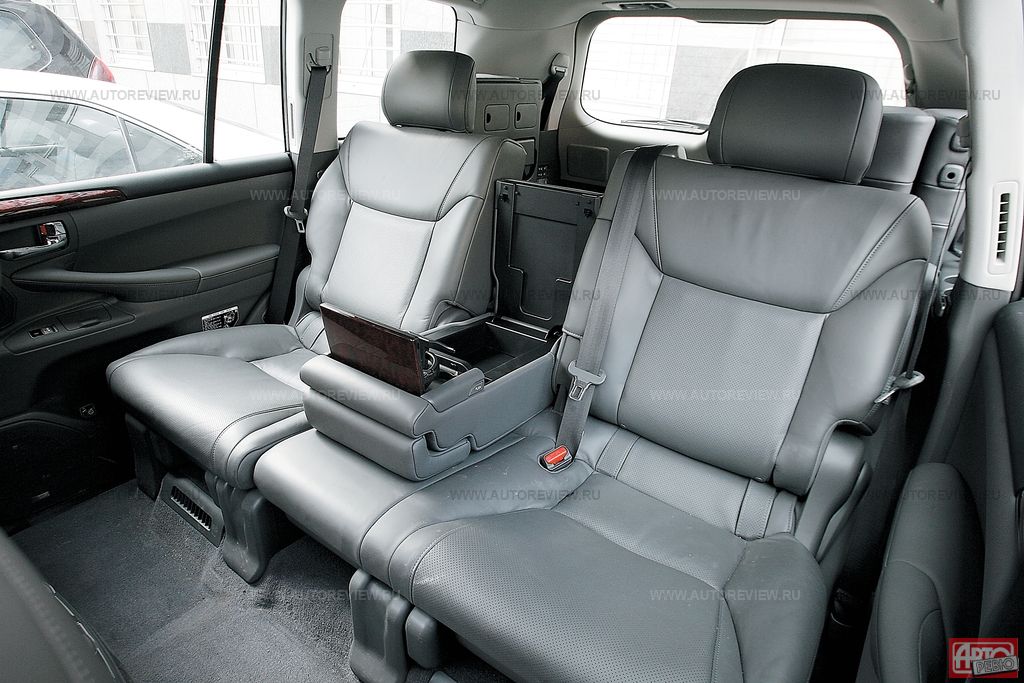
| The Infiniti's rear seats are unrivaled: the backrests recline, and there's a good half-meter from knees to the front seat! The Lexus has less space, but its middle bench can be moved forward and backward in sections; however, the Cadillac, which lacks only an adjustable backrest and legroom when seated, is more spacious. The Range Rover is good for three, but the door opening and its angle are a bit small. All four cars have heated seats, and passengers have screens for watching DVDs (standard only on the Infiniti), with the Range Rover also available with a TV tuner | |
The Range Rover holds a straight line well, but during smooth lane changes, feedback completely disappears. If the driver, expecting a response, keeps turning the wheel, the car first leans, then changes course, taking an increasingly tighter line. However, in sharp corners, it handles the arc surprisingly accurately. Still, when encountering a suddenly appearing "moose," it's better not to try to swerve around it but simply brake. And here the Range Rover is the best: deceleration is precisely dosed, not so much by pedal travel as by pedal pressure. The Cadillac's brakes are less precise, while the Lexus and Infiniti disappointed with "spongy" brake feel, though this hardly hinders controlling deceleration.
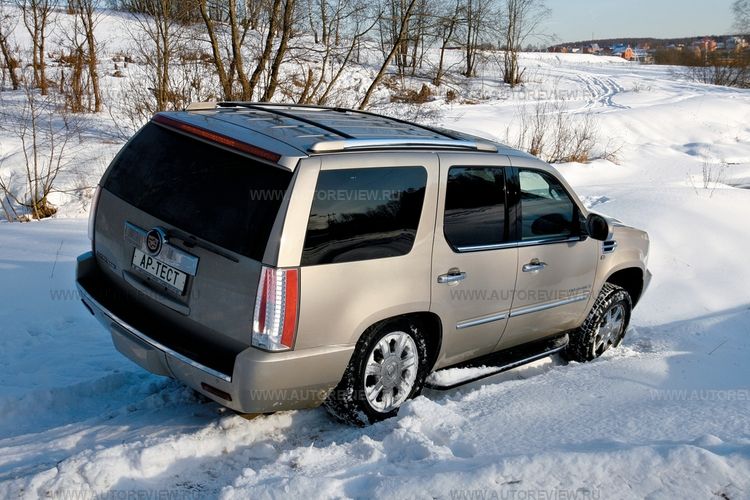
Under the periodically falling-out cover in the rear bumper is a tow eye for a 3.5-ton trailer
The Range Rover also pleased with ride comfort: the air suspension ignores minor imperfections and swallows large ones with such confidence that you want to charge ahead regardless of the road.
The Lexus, even in Comfort mode of its hydropneumatic suspension, constantly shudders, and Sport mode only worsens the situation.
The Cadillac and Infiniti have "passive" suspensions. But while the Cadillac yields to the Lexus on minor bumps, the Infiniti only copes with waves, thoroughly reporting all other imperfections to the occupants.
In short, on rough terrain, the Range Rover proved best. And what if there's no road at all?
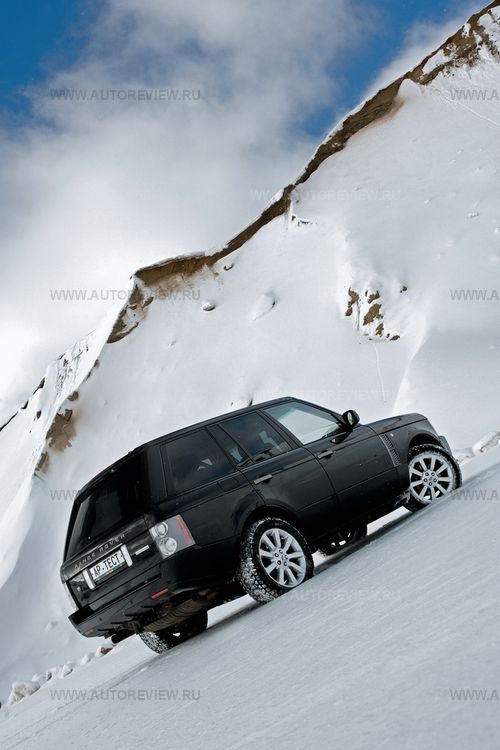
The updated Range Rover was the last of the British off-roaders to receive the proprietary Terrain Response system — not only with its advantages but also with all its quirks. For example, in "Snow" mode, the electronics fiercely "strangle" the engine — and the Range gets stuck precisely in snow. There are two ways out. Either disable the stability control, or, better, switch to "Sand" mode, where the engine is allowed to rev quickly up to 5000 rpm (rather than slowly to 3000 rpm as in "Snow" mode), and select gears manually — in the low range, the gearbox holds gears firmly.
Now even the steepest slopes don't look intimidating! The Range Rover's geometry is in perfect order: short overhangs, a flat underbody, and simply enormous suspension travel. The car is more likely to roll over than to hang a wheel in the air. But you shouldn't relax: on a steep climb, the Terrain Response system may suddenly ask for a "reboot" — you'll have to stall the engine and restart it. And if you spin for a long time in a deep rut, the electronics will first threaten to deflate the air suspension, and then actually do it.
| Cadillac Escalade | Infiniti QX56 |
 |  |
| Lexus LX 570 | Range Rover |
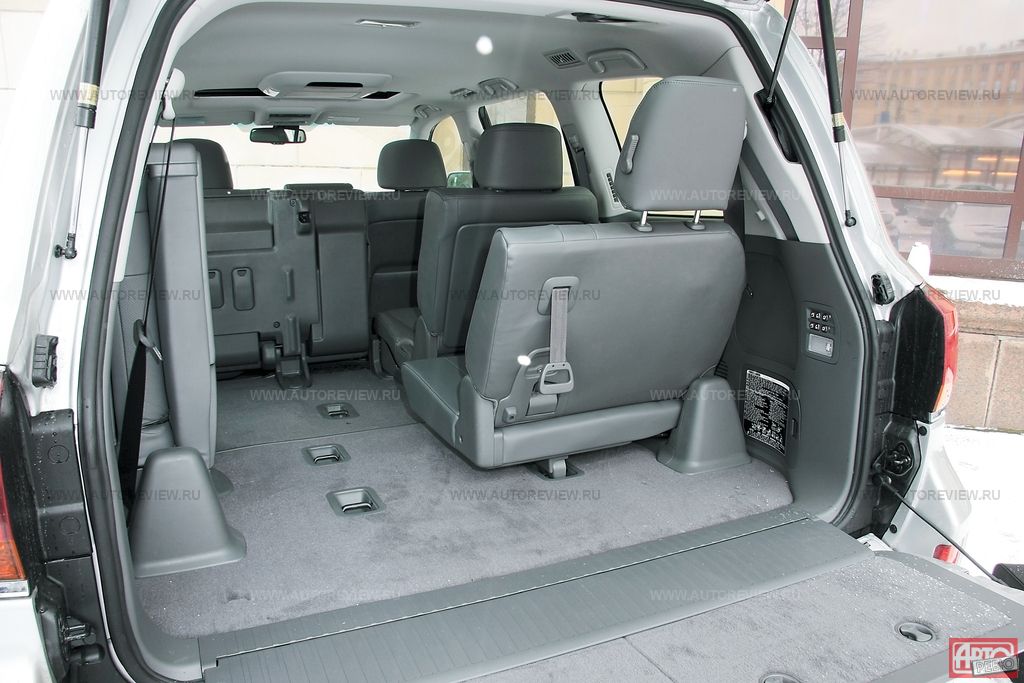 |  |
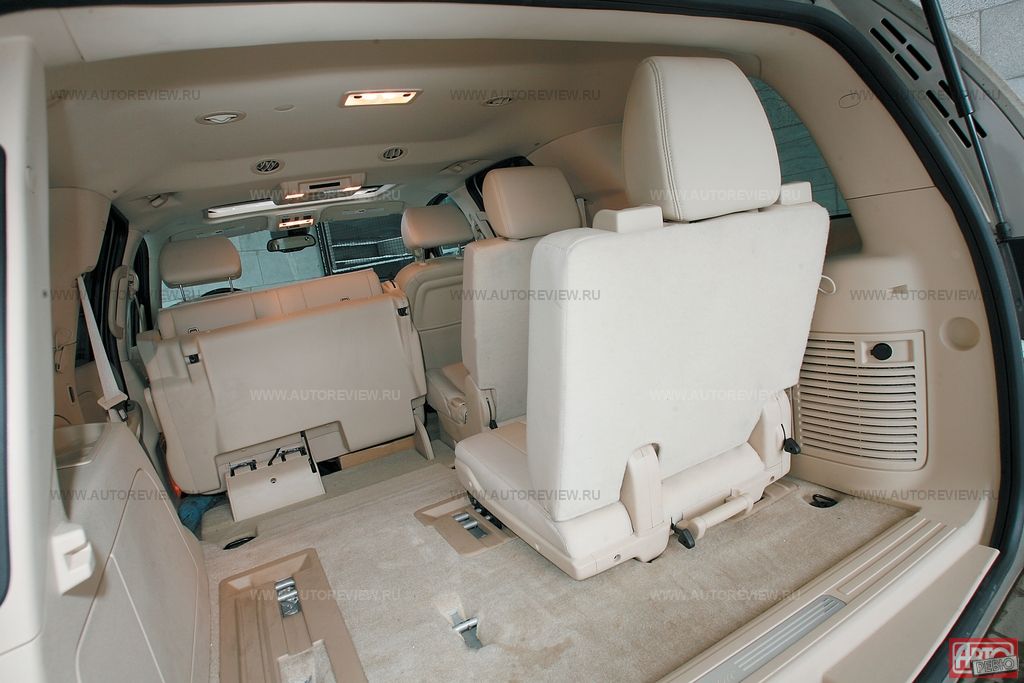
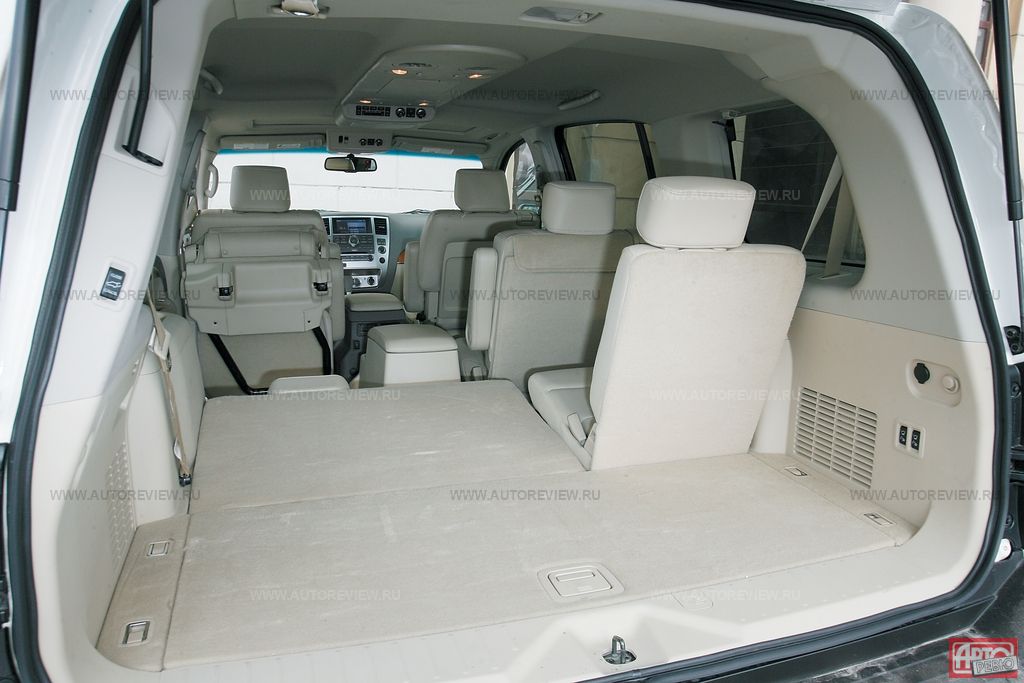
| In terms of trunk volume and ease of interior transformation, the Infiniti leads, although its tailgate does not rise high — only 175 cm. In the Range Rover, without the third row, the cargo area is very spacious, and it also has the most hidden niches, with the fifth door rising to 190 cm. In the Lexus, the trunk space is eaten up by the folded third-row seats on the sides. In the Cadillac, you have to choose: either put up with a small compartment or remove the "cargo" seats from the car. However, in the Cadillac and Infiniti, you can toss small bags directly through the window, while the split doors of the Lexus and Range Rover make it hard to reach the far corners | |
The Lexus's geometry is spoiled by the massive rear axle differential. But the electronics work more usefully here: when the "center" is locked, stability control turns off automatically, and in low range the ABS algorithm changes — at low speeds it disengages, allowing quick braking on loose surfaces. Plus, there's Crawl Control, familiar from the Land Cruiser: you can creep at a constant speed of 1, 3, or 5 km/h in any direction. Additional cameras at the front and on the right side also help. But the standard Dunlop Grandtrek tires spoil everything: if the Lexus briskly plows through snowdrifts on the move, once stopped, it cannot even reverse out of its own tracks. In this exercise, victory went to the Range Rover.
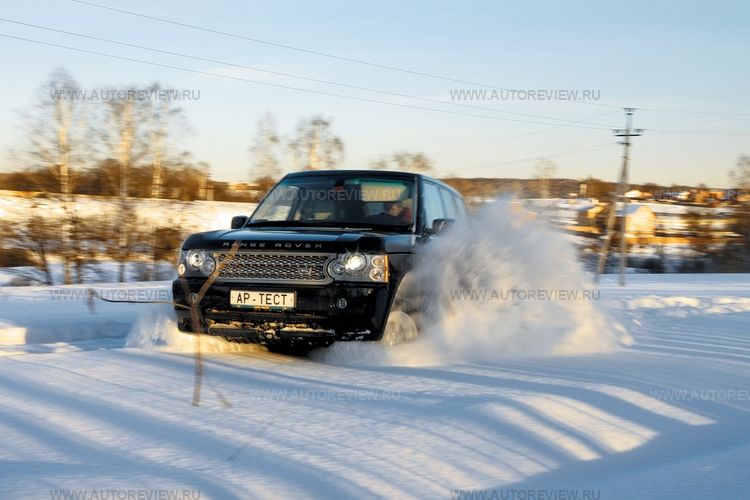
With suitable tires, the Range Rover confidently crosses virgin snow — though for this, it's better to switch Terrain Response to "Sand" mode
And what about the Cadillac and Infiniti?
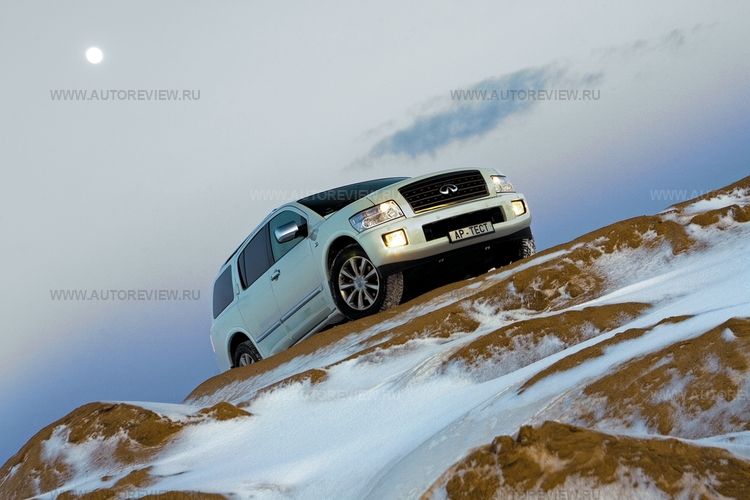
Their element is "shallow water" due to non-adjustable suspensions and long overhangs. With the front axle engaged and low range in the transfer case, the Infiniti briskly slides through virgin snow, but on the first incline it scrapes its belly. Besides weak geometry, the overly responsive gas pedal also hinders progress — the wheels either stay still or immediately dig in. In the Cadillac, the main limiter is the front bumper-snowplow: if not for it, even without low range, on Bridgestone Blizzak tires, the car would have climbed noticeably further.
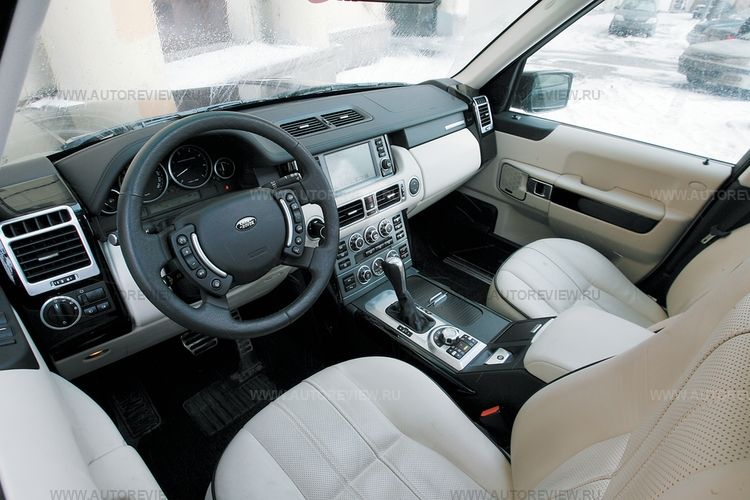
In the updated Range Rover, the conventional handbrake was replaced with a button for the electromechanical brake, a Terrain Response selector appeared nearby, the ignition switch moved from the tunnel to the steering column, and there are now two glove boxes
If we were choosing a car for carefree trips into nature, we would settle on the Range Rover: excellent off-road capability and enviable ride smoothness. But a car costing over $130,000 should also hold the road more confidently on asphalt — at least at the level of the "first new" Range Rover, which was tuned by BMW specialists.
| Cadillac Escalade | Infiniti QX56 |
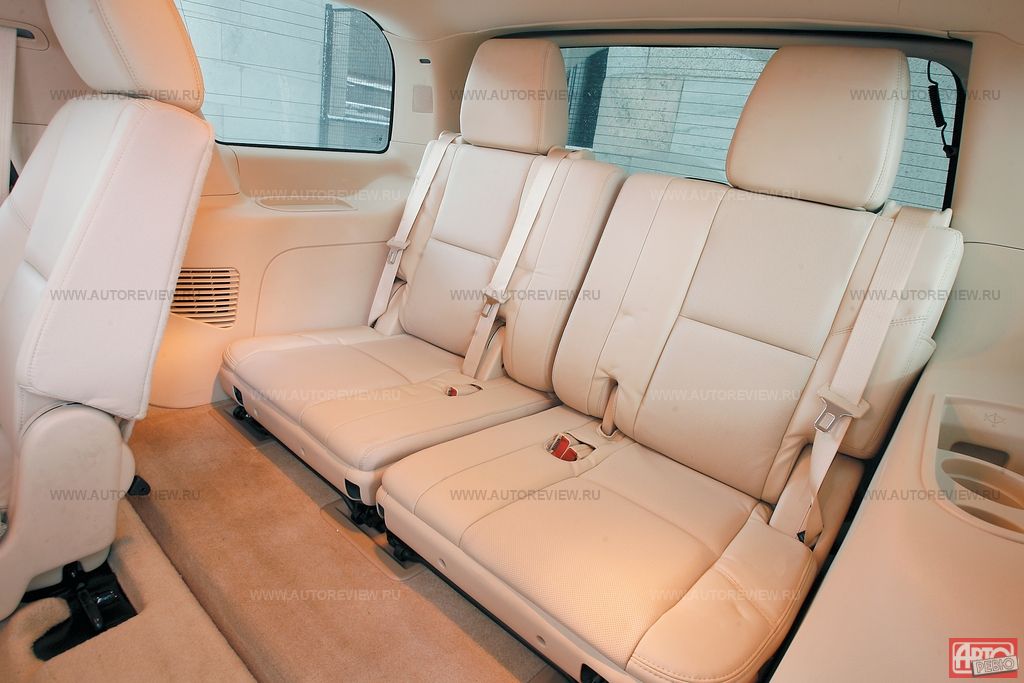 | 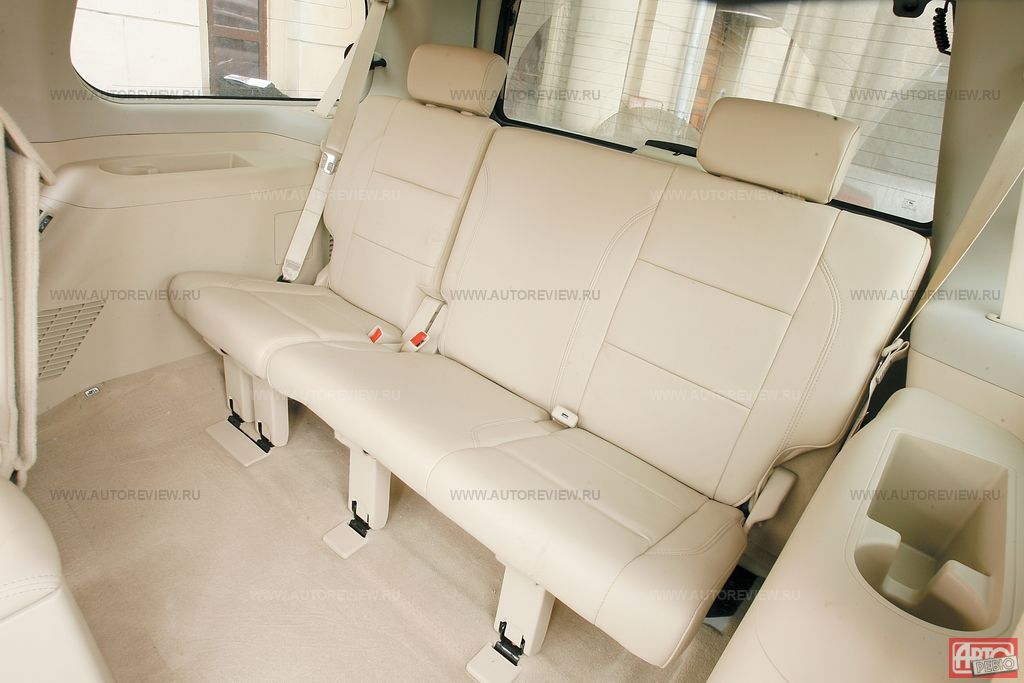 |
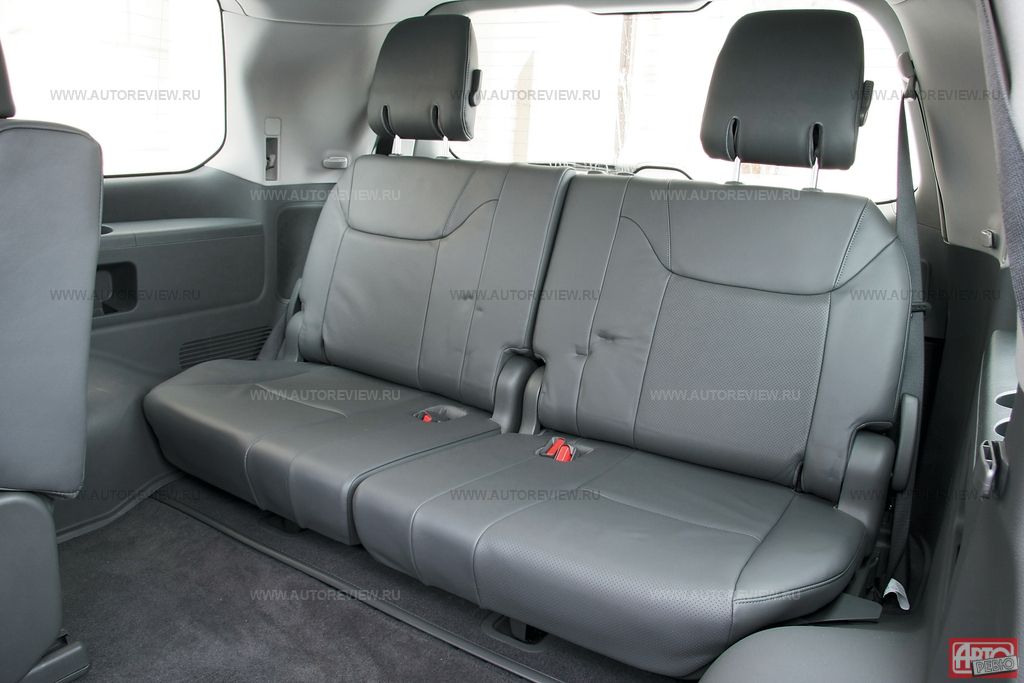
| Lexus LX 570 | The most spacious seats in the "gallery" are in the Infiniti: even three people can fit there comfortably. In the Lexus, access to the third row opens with one press, but it's still inconvenient to get to the seats, and the seats themselves are cramped. The Cadillac's third row is even less hospitable — the cushion is low, and there's a solid wall of second-row seatbacks in front of your eyes. The Range Rover has no third row at all |
 |
Interestingly, about seven years ago, the British didn't even consider the then-Lexus LX 470 a competitor: they said the only car comparable to ours in on-road manners was the Mercedes S-Class. Since then, already under Ford's wing, the Range Rover has been updated several times, gradually changing... And the Lexus has become completely different.
| Cadillac Escalade | Infiniti QX56 |
 |  |
| Lexus LX 570 | Range Rover |
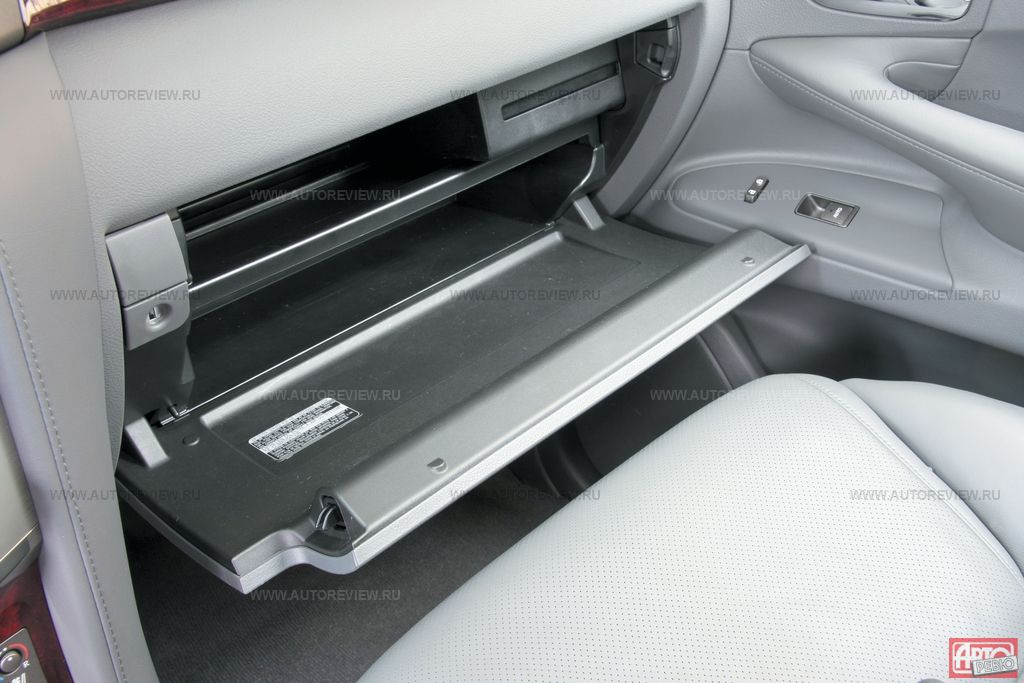 | 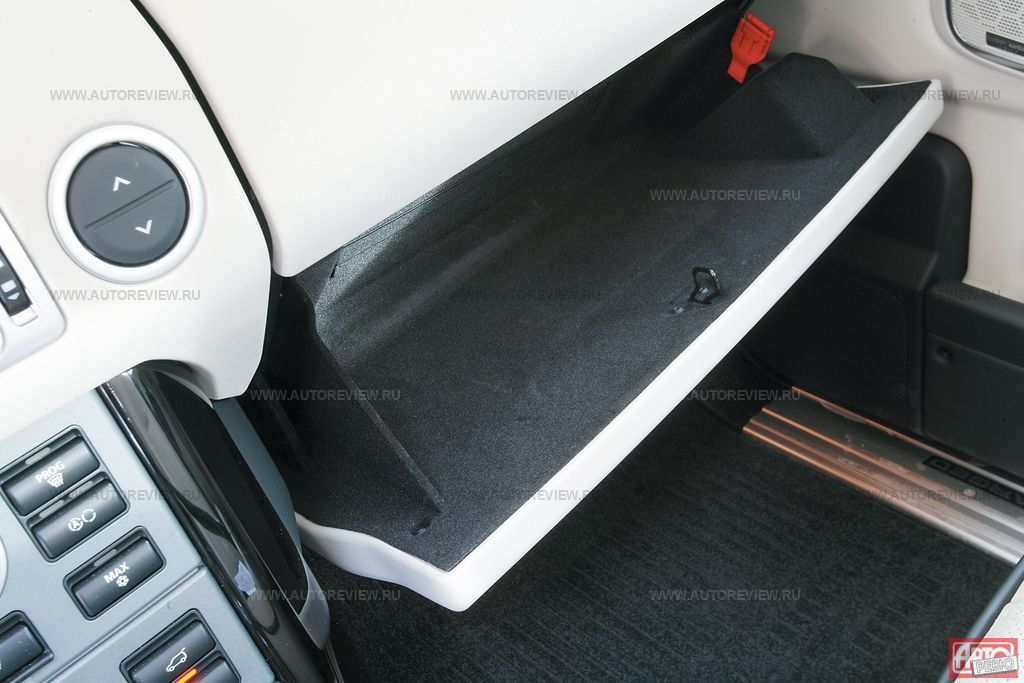 |
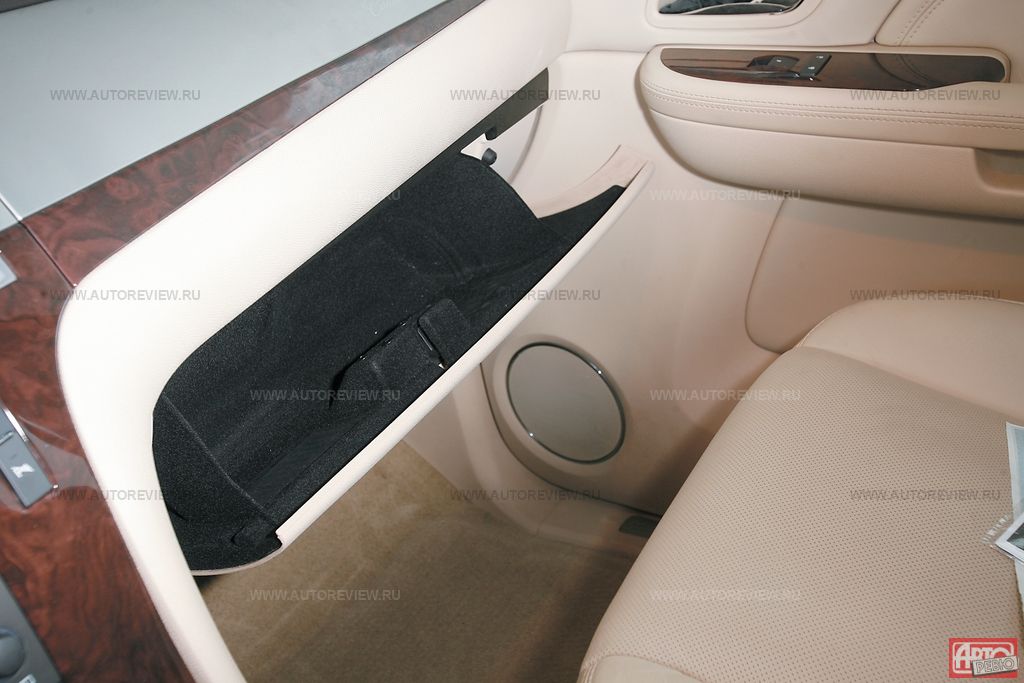
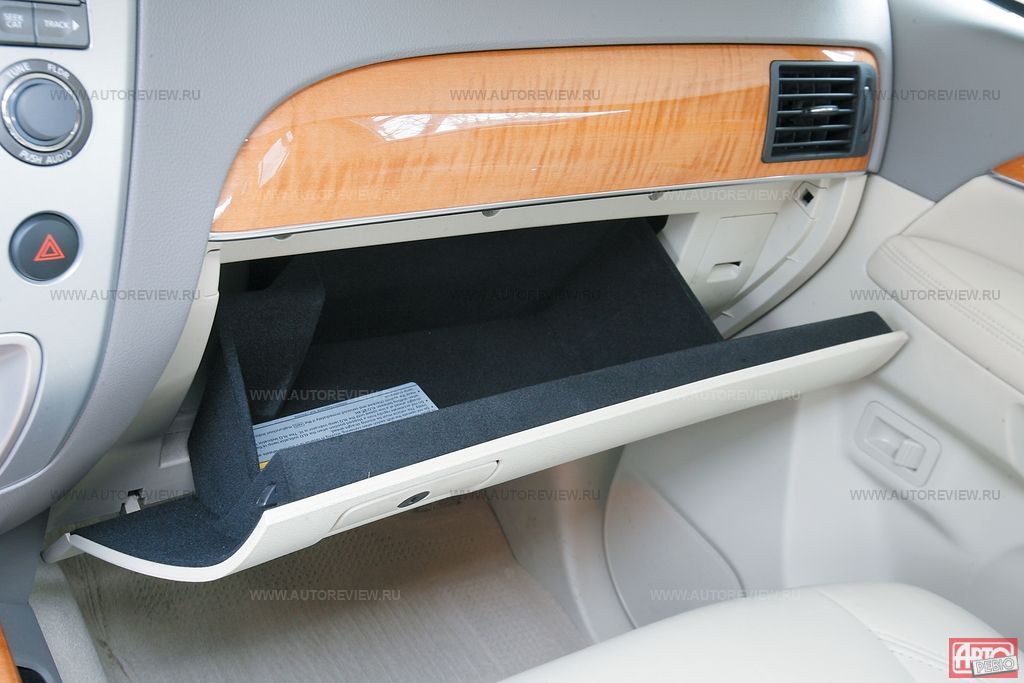
| The most compartments for small items are in the Range Rover's two "glove boxes," while the Lexus's narrow two-tier box is inconvenient to use | |
It is the Lexus LX 570 that we would call a car for all occasions. It holds the road confidently on asphalt, and with proper tires, it won't let you down off-road either. The price is steep — from $144,960. But which competitor can offer such a combination of equipment (four-zone climate control, "semi-circular" view cameras) and driving qualities? Perhaps the Mercedes GL 500, but it costs even more — from $151,110.
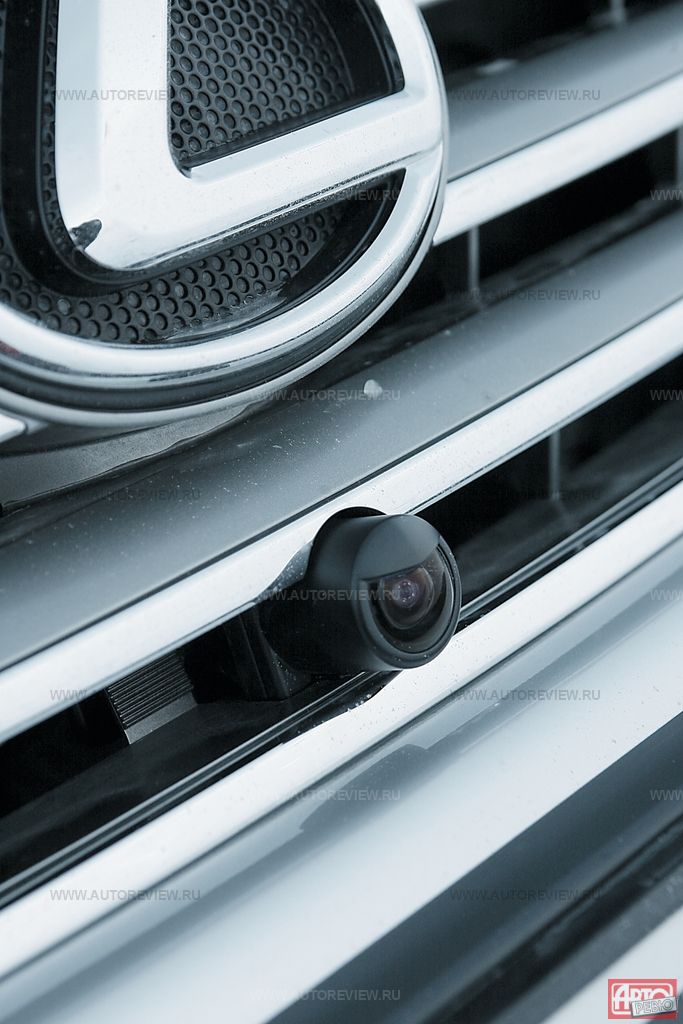 | 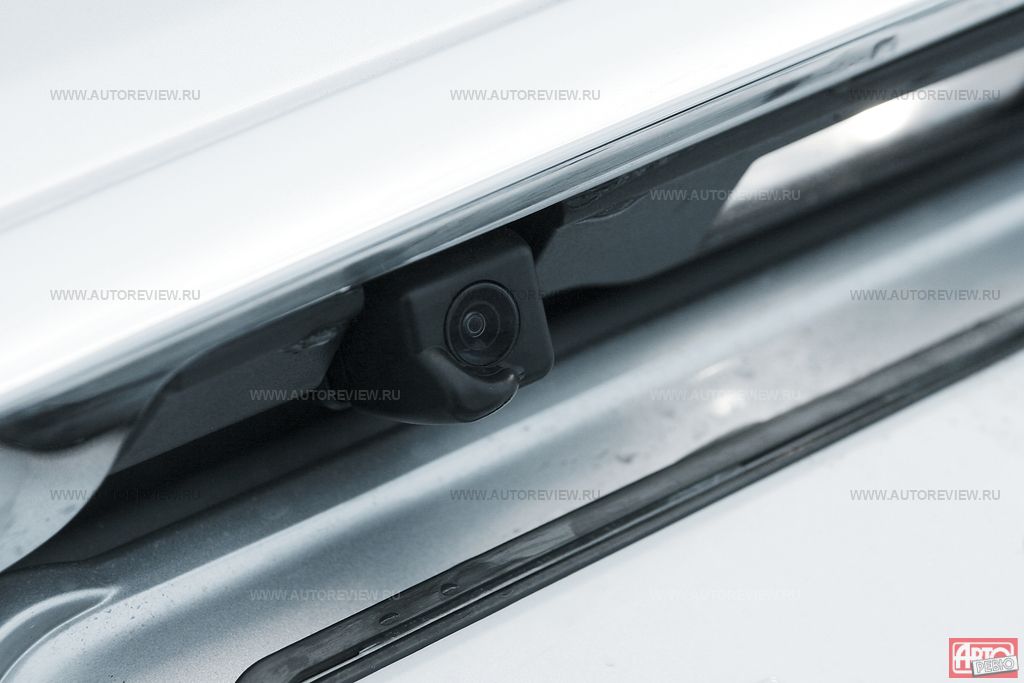 | |
| Only the Cadillac lacks a rear-view camera. The Lexus has three — on the radiator grille, under the right mirror, and above the license plate. Off-road and when parking, this is an excellent helper! | ||
If you mostly drive on asphalt, the best option is the Infiniti QX56. The most "driver-oriented" SUV in this quartet, with the most spacious cabin — and, if you will, the most affordable: from $104,580.
The Cadillac is for those who love American cars. Just the column-mounted gear selector paddle is worth it! And the design? And the engine?
In short, zoom in! And about ecology, the greenhouse effect, a sense of proportion, and a sense of guilt — we'll talk some other time.
| Specifications | ||||
| Parameters | Vehicles | |||
| Cadillac Escalade | Infiniti QX56 | Lexus LX 570 | Range Rover 4.2 Supercharged | |
| Body type | 5-door wagon | 5-door wagon | 5-door wagon | 5-door wagon |
| Number of seats | 8 | 7 | 8 | 5 |
| Trunk volume, l (SAE) | 478–3084* | 642–3429* | 259–2934* | 535–2099* |
| Curb weight, kg | 2609 | 2675 | 2660 | 2687 |
| Gross weight, kg | 3221 | 3310 | 3300 | 3100 |
| Engine | petrol, distributed injection | petrol, distributed injection | petrol, distributed injection | petrol, distributed injection, mechanical supercharger |
| Location | front, longitudinal | front, longitudinal | front, longitudinal | front, longitudinal |
| Number and arrangement of cylinders | 8, V-shaped | 8, V-shaped | 8, V-shaped | 8, V-shaped |
| Displacement, cm³ | 6162 | 5551 | 5663 | 4197 |
| Cylinder bore/piston stroke, mm | 103.3/92.0 | 98.0/92.0 | 94.0/102.0 | 86.0/90.3 |
| Compression ratio | 10.5:1 | 9.8:1 | 10.2:1 | 9.1:1 |
| Number of valves | 16 | 32 | 32 | 32 |
| Max. power, hp/kW/rpm | 403/296/5700 | 325/239/5200 | 367/270/5600 | 396/291/5750 |
| Max. torque, Nm/rpm | 565/4300 | 533/3400 | 530/3200 | 560/3500 |
| Transmission | automatic, 6-speed | automatic, 5-speed | automatic, 6-speed | automatic, 6-speed |
| Gear ratios | ||||
| I | 4.03 | 3.83 | 3.33 | 4.17 |
| II | 2.36 | 2.37 | 1.96 | 2.34 |
| III | 1.52 | 1.52 | 1.35 | 1.52 |
| IV | 1.15 | 1.00 | 1.00 | 1.14 |
| V | 0.85 | 0.83 | 0.73 | 0.87 |
| VI | 0.67 | — | 0.59 | 0.69 |
| Reverse | 3.06 | 2.61 | 3.06 | 3.40 |
| Final drive | 3.42 | 3.36 | 3.91 | 3.73 |
| Low range | — | 2.59 | 2.62 | 2.93 |
| Drive | permanent all-wheel, asymmetric center differential | all-wheel, front axle engaged via multi-disc clutch | permanent all-wheel, asymmetric Torsen center differential | permanent all-wheel, symmetric center differential |
| Front suspension | independent, coil spring, double wishbone | independent, coil spring, double wishbone | independent, hydropneumatic, coil spring, double wishbone | independent, air, McPherson |
| Rear suspension | dependent, coil spring, trailing arms, Panhard rod | independent, air, double wishbone | dependent, hydropneumatic, coil spring, trailing arms, Panhard rod | independent, air, double wishbone |
| Brakes | disc, ventilated | disc, ventilated | disc, ventilated | disc, ventilated |
| Tires | 265/65 R18 | 275/60 R20 | 285/65 R18 | 255/55 R20 |
| Maximum speed, km/h | 170 | 203 | 220** | 210 |
| Acceleration time 0–100 km/h, s | 6.8 | 7.8 | 7.5 | 7.5 |
| Fuel consumption, l/100 km | ||||
| Urban cycle | 23.0 | 21.9 | n.a.*** | 22.4 |
| Extra-urban cycle | 12.3 | 11.5 | n.a.*** | 12.2 |
| Combined cycle | 16.2 | 15.3 | n.a.*** | 16.0 |
| CO₂ emissions, g/km, combined cycle | 383 | 354 | 361 | 376 |
| Fuel tank capacity, l | 98 | 105 | 93 | 105 |
| Fuel | petrol AI-92–95 | petrol AI-95 | petrol AI-95–98 | petrol AI-95 |
| * With folded second (Range Rover) and third row seats — up to ceiling | ||||
| ** Electronically limited | ||||
| *** N.a. — not available | ||||
| Equipment of cars participating in the tests | ||||
| Equipment | Models | |||
| Cadillac Escalade | Infiniti QX56 | Lexus LX 570 | Range Rover 4.2 Supercharged | |
| Cost of the initial version, RUB./$* | 2596950/109120 | 2489000/104580 | 3450000/144960 | 3350000/140760 |
| Front airbags | + | + | + | + |
| Side airbags | – | + | + | + |
| Side airbags for rear row | – | – | + | – |
| Driver's knee airbag | – | – | + | + |
| Front passenger's knee airbag | – | – | + | – |
| Inflatable curtains | + | + | + | +***** |
| ABS | + | + | + | + |
| Stability control system | + | + | + | + |
| Hill descent assist | – | – | + | + |
| Adaptive suspension with electronics | – | – | + | + |
| Adjustable suspension | – | – | + | + |
| Power steering | + | + | + | + |
| Automatic transmission | + | + | + | + |
| Multi-function steering wheel | + | + | + | + |
| All-wheel drive | + | + | + | + |
| Tilt-adjustable steering column | + | + | +** | +** |
| Telescoping steering column | – | – | +** | +** |
| Leather-wrapped steering wheel | + | + | + | + |
| Wood-trimmed steering wheel | + | – | + | – |
| Heated steering wheel | + | + | – | + |
| Heated windshield | – | – | +*** | + |
| Power-adjustable front seats | + | + | + | + |
| Power-extending front seat cushions | – | – | + | – |
| Driver's seat memory | + | – | + | + |
| Power-adjustable rear seats along the cabin | – | – | + | – |
| Heated front seats | + | + | + | + |
| Heated rear seats | + | + | + | + |
| Ventilated front seats | P | – | + | O |
| Auto-dimming interior mirror | + | + | + | + |
| Built-in phone | – | – | + | – |
| Central locking with remote control | + | + | + | + |
| Keyless entry | – | + | + | – |
| Climate control | + | + | + | + |
| Three-zone climate control | + | + | – | O |
| Four-zone climate control | – | – | + | – |
| Power-adjustable and heated side mirrors | + | + | + | + |
| Power-folding side mirrors | + | + | + | + |
| Power windows | + | + | + | + |
| Folding rear row | +** | + | + | + |
| Reclining rear seat backs | – | + | + | – |
| Pass-through for long items | – | + | + | – |
| Rear center armrest | + | + | + | + |
| Folding third row | + | + | + | – |
| CD stereo | + | + | + | + |
| CD changer | + | – | + | + |
| DVD player | + | + | + | O |
| TV tuner | – | – | – | + |
| Additional screen for rear passengers | P | + | P | O**** |
| Rearview camera | – | + | + | + |
| Engine start button | – | – | + | – |
| Power-adjustable pedals | + | + | – | – |
| Light sensor | + | + | + | + |
| Rain sensor | + | – | + | + |
| Tire pressure monitoring | – | – | – | O |
| On-board computer | + | + | + | + |
| Navigation system | P | – | + | + |
| Cruise control | + | + | + | + |
| Power sunroof | O | + | + | + |
| Front parking sensors | – | + | + | + |
| Rear parking sensors | + | + | + | + |
| Leather upholstery | + | + | + | + |
| Leather-wrapped dashboard | – | – | – | |
| Wood trim in cabin | + | + | + | – |
| Remote trunk lock | + | + | + | + |
| Power tailgate | + | + | + | – |
| Remote fuel filler flap lock | – | – | + | – |
| Xenon low beam headlights | – | – | + | + |
| Bi-xenon headlights | – | – | + | – |
| Adaptive low beam headlights | – | – | – | + |
| Fog lights | + | + | + | + |
| Headlight washers | – | + | + | + |
| Alloy wheels | + | + | + | + |
| Full-size spare tire | + | + | + | + |
| Metal engine protection | – | – | + | + |
| Metallic paint | + | + | + | – |
| Tires | Bridgestone Blizzak DM-Z 3 275/60 R18 | Nokian Hakkapeliitta Sport utility 5 275/55 R20 | Dunlop Grandtrek 285/60 R18 | Dunlop Grandtrek SJ 5 265/50 R20 |
| Price of the tested car, RUB./$ | 2901020/121890 | 2489000/104580 | 3570000/150000 | 3663000/153910 |
| * At the exchange rate of $1=23.8 RUB. (+) Equipment of the base version | ||||
| ** Power drive | ||||
| (–) Not available in the base version | ||||
| *** Wiper rest zone | ||||
| (O) Options installed on the cars participating in the test | ||||
| **** Two monitors in the front headrests | ||||
| (P) Equipment included in the package of the tested car | ||||
| ***** Four inflatable "tubes" for front and rear occupants | ||||
Autoreview readers' forecast
Before the start of this test, we asked visitors to our website www.autoreview.ru to answer the question: "Which of the cars participating in the next Autoreview test would you choose?"
Here is how the votes were distributed:
Lexus LX 570 41.14%
Range Rover 39.48%
Infiniti QX56 11.50%
Autoreview expert assessments
Autoreview Expert Ratings Parameters Assessed Max. Score Cars Why? Cadillac Escalade Infiniti QX56 Lexus LX 570 Range Rover Ergonomics 180 140 150 160 160 Range Rover wins due to its comfortable driver's seat, Lexus — for excellent visibility. Cadillac can boast neither, and Infiniti remains at an average level. Driver's workplace 90 70 75 75 80 Visibility 90 70 75 85 80 Dynamics 360 277 292 297 287 Cadillac is the fastest, but the most pleasant to control is the torque of the weakest Infiniti. Lexus and Infiniti disappointed with "spongy" brake pedals. On asphalt, Infiniti is unrivaled, and off-road, Range Rover reigns. Lexus was let down by "slippery" standard tires. Acceleration dynamics 90 77 77 79 69 Braking dynamics 100 85 80 80 90 Handling 90 65 75 70 55 Off-road 80 50 60 68 73 Ride Comfort 240 193 180 213 202 Range Rover stands out for its best ride smoothness, Lexus — for cabin quietness and four-zone climate control. Infiniti is both noisy and bumpy. Cadillac is average in comfort. Ride smoothness, vibration protection 90 70 65 75 80 Acoustic comfort 80 60 55 70 65 Microclimate 70 63 60 68 57 Cabin Comfort 220 158 206 176 157 The Infiniti cabin is the largest and most comfortable. It also has the most spacious trunk and the best transformation. The third row of seats is standard on all vehicles except the Range Rover, for which it is not available even for an extra charge. Passenger seats 100 70 94 83 69 Trunk 70 60 65 55 60 Cabin transformation 50 28 47 38 28 Total Score 1000 768 828 846 806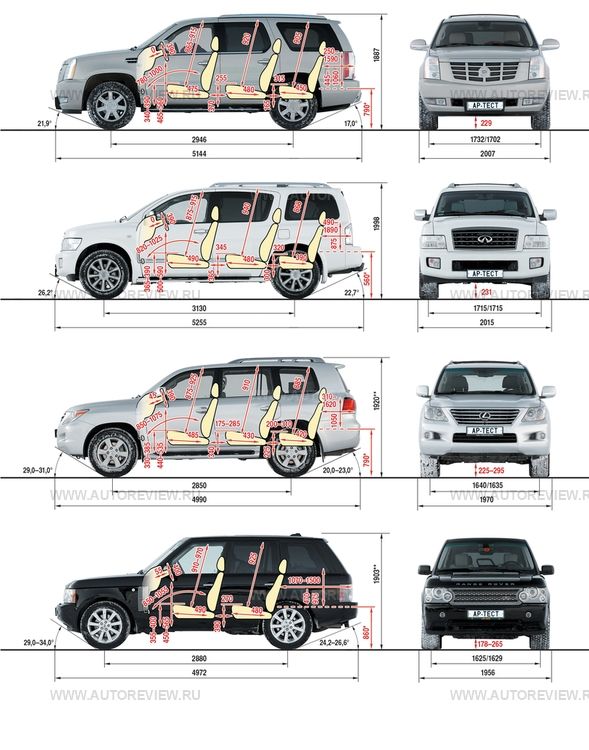
Black indicates manufacturer data, red — Autoreview measurement results
* Loading height (for Lexus and Range Rover — in standard suspension position)
** In standard suspension position
Are They Safe?
All four SUVs already come standard with ABS, stability control, and Isofix anchors for child seats. However, each has its own set of airbags. The Cadillac has four: two front and two curtain airbags. The Infiniti QX56 is additionally equipped with front side airbags, while the Range Rover received four inflatable "tubes" instead of two long curtains. But the Lexus LX 570 stands out the most: ten airbags, including "knee" airbags for front occupants and side airbags for second-row passengers.
According to EuroNCAP methodology, only the Range Rover has undergone crash tests, earning four out of five stars — hindered by the hazardous front panel and high seatbelt loads on the "driver's" chest. The SUV withstood side impacts excellently, but pedestrian protection was rated only one star out of four possible.
The Cadillac Escalade and Infiniti QX56 were tested according to the U.S. National Highway Traffic Safety Administration (NHTSA) methodology. The Cadillac received five stars across all metrics, while the Infiniti only underwent a frontal crash test: five stars for driver protection and four for passenger protection. The estimated rollover probability: 22% for the Cadillac Escalade and 21% for the Infiniti QX56.
The main hero of our test, the Lexus LX 570, has not yet undergone independent crash tests.
Cadillac Escalade* ★★★★★ Driver protection in frontal impact 5 stars Passenger protection in frontal impact 5 stars Driver protection in side impact 5 stars Rear passenger protection in side impact 5 stars Rollover rating 3 stars Curb weight 2393 kg * Tests conducted according to NHTSA methodologyInfiniti QX56* Driver protection in frontal impact 5 stars Passenger protection in frontal impact 4 stars Driver protection in side impact — Rear passenger protection in side impact — Rollover rating 3 stars Curb weight 2512 kg * Tests conducted according to NHTSA methodology
Range Rover* ★★★★
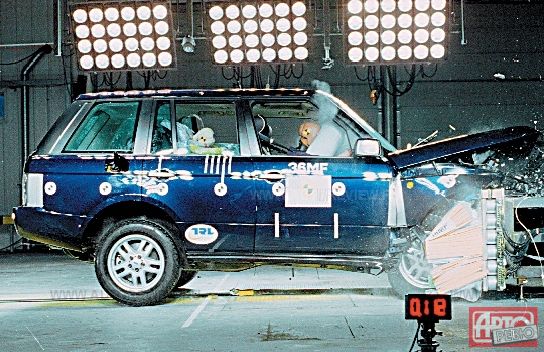 Overall rating 30 points
Frontal crash test 12 (75%)
Side crash tests 18 (100%)
SBR** 0
Child occupant protection —
Pedestrian protection 2 (6%)
Curb weight 2540 kg
* Tests conducted according to EuroNCAP methodology
** Presence of seatbelt reminder system
Overall rating 30 points
Frontal crash test 12 (75%)
Side crash tests 18 (100%)
SBR** 0
Child occupant protection —
Pedestrian protection 2 (6%)
Curb weight 2540 kg
* Tests conducted according to EuroNCAP methodology
** Presence of seatbelt reminder system
Visibility
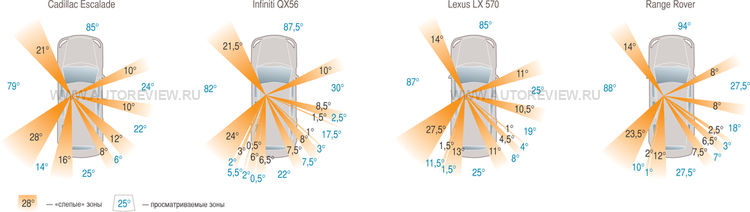
The best visibility is in the Lexus: not too wide front pillars, excellent mirrors, and "semi-circular" view cameras. The Range Rover driver sees slightly less, but the rear wiper with a top-mounted arm allows just-scraped dirt to flow down onto the cleaned glass. Infiniti's visibility is spoiled by the narrowed rear window opening, and in the Cadillac, massive front pillars combined with a high and far-forward lower edge of the windshield also interfere.
Cadillac Escalade Infiniti QX56 Lexus LX 570 Range RoverVehicle Total viewing angle, deg. Total "blind" zone angle, deg. Cadillac Escalade 255 105 Infiniti QX56 262 98 Lexus LX 570 269 94 Range Rover 276 84
What the Transmission Allows
Andrey MOROZOV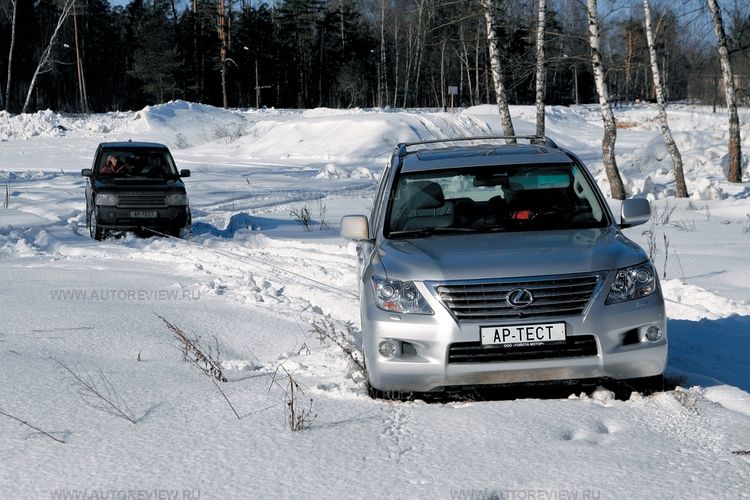
No, it's not the Lexus pulling the Range, but quite the opposite — the "slippery" standard tires of the Lexus (Dunlop Grandtrek) do not allow deviating from the beaten track
In the updated Range Rover, the Terrain Response function is activated by a dial located on the center console. The system offers five programs adapted to different surface types: it adjusts the accelerator pedal response, changes the logic of traction control electronics, manages the air suspension, activates the HDC descent assist, and continuously redistributes torque between the axles and rear wheels through locks. The low-range gear here is very torquey — with a ratio of 2.93:1, and it can be engaged up to 40 km/h and disengaged up to 60 km/h. The color screen in the cabin displays how Terrain Response affects the differentials and also shows the current front wheel steering angle. Ground clearance varies from 178 to 265 mm.
Cadillac Escalade Infiniti QX56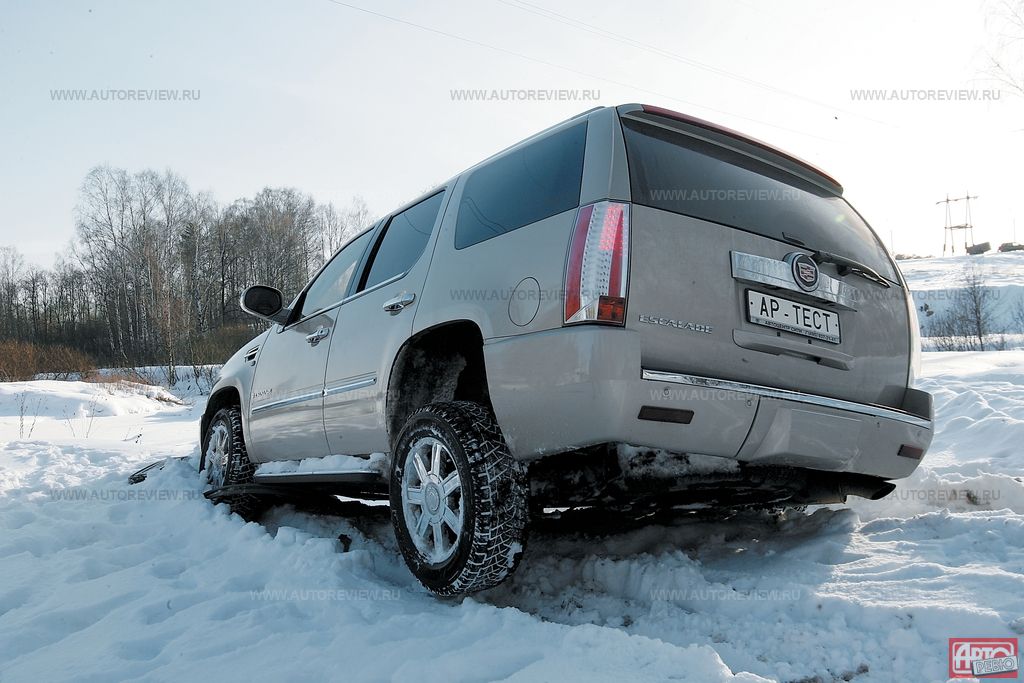
 Lexus LX 570 Range Rover
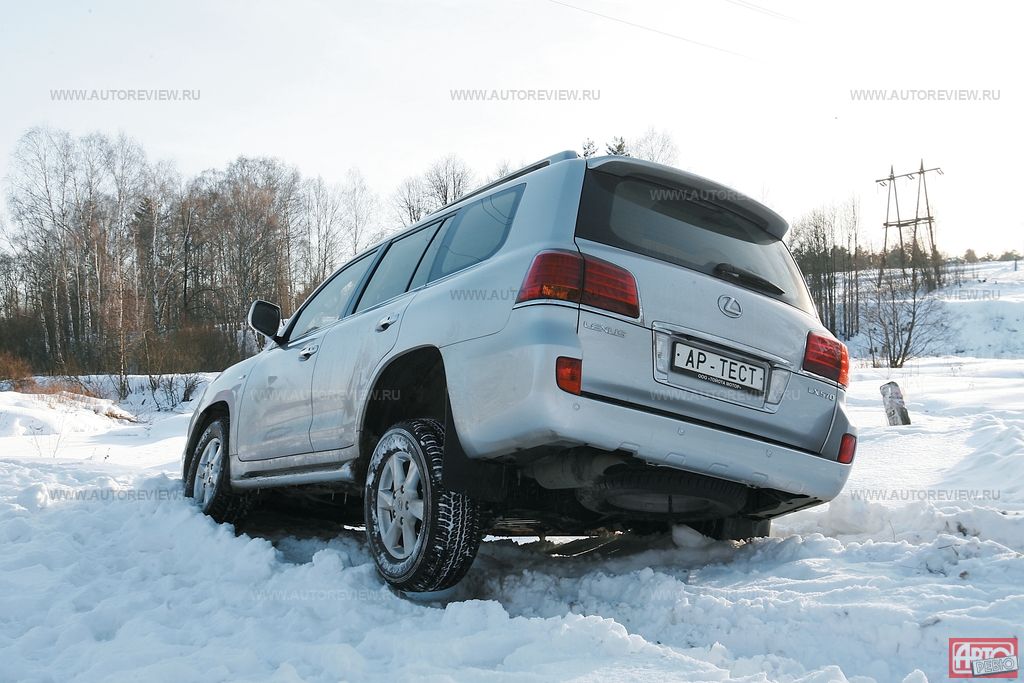
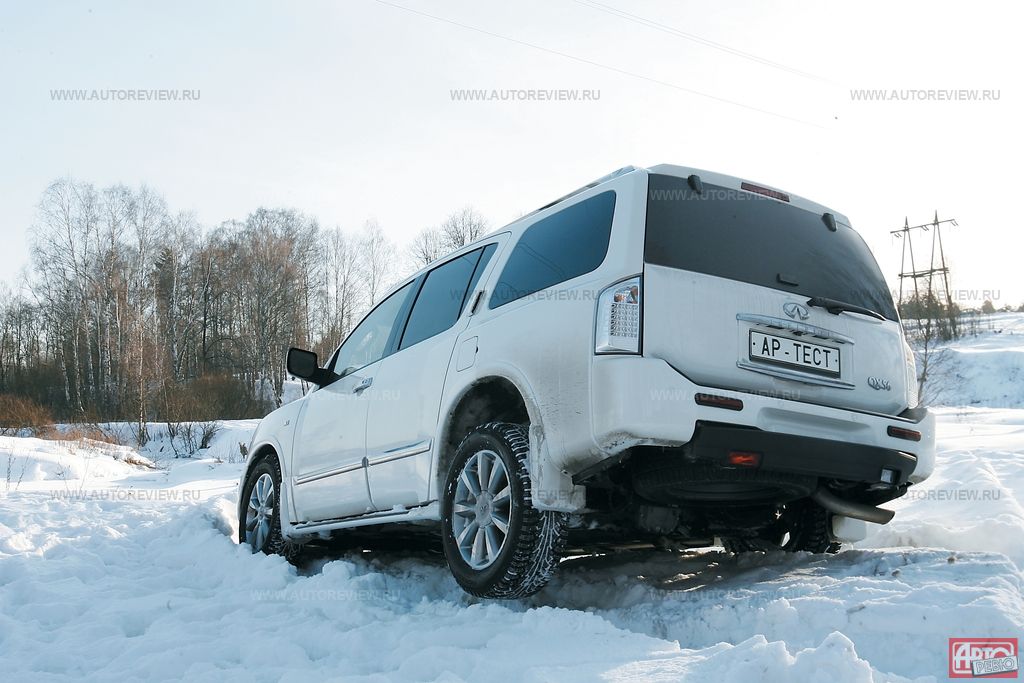
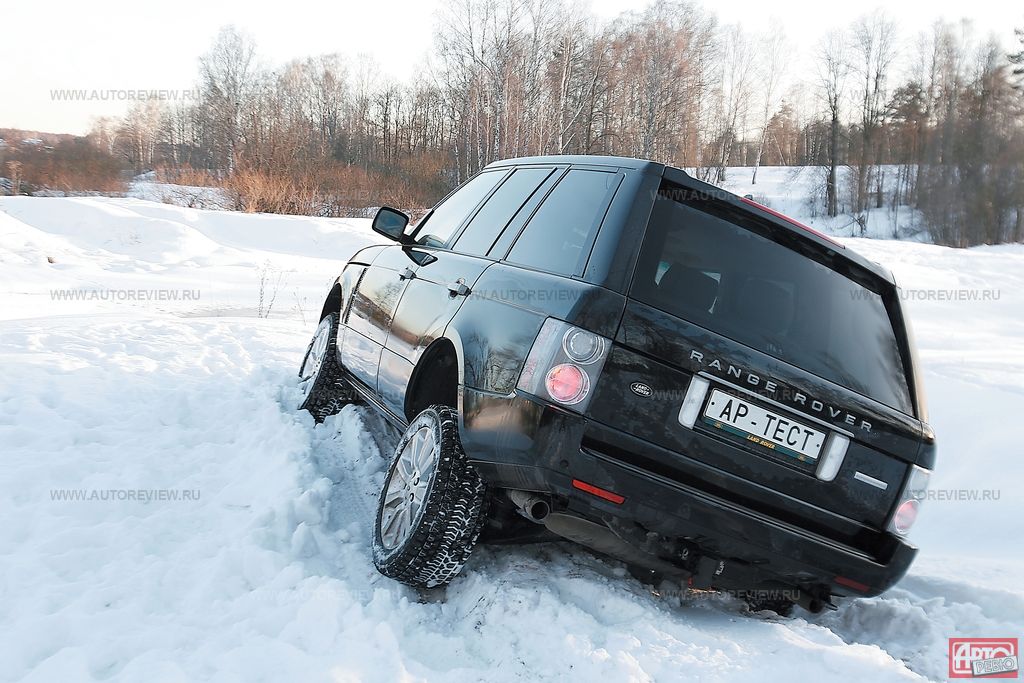 Maximum suspension travel is demonstrated by the Lexus and Range Rover. The Cadillac also did not disappoint, but the Infiniti with its modest travel feels uncertain on serious off-road: when descending a small hill, we almost tore off the rear bumper — fortunately, it was possible to put it back in place with one movement of the hand. Another danger for the Infiniti's rear is the cable that catches on the tow hook, hidden high up
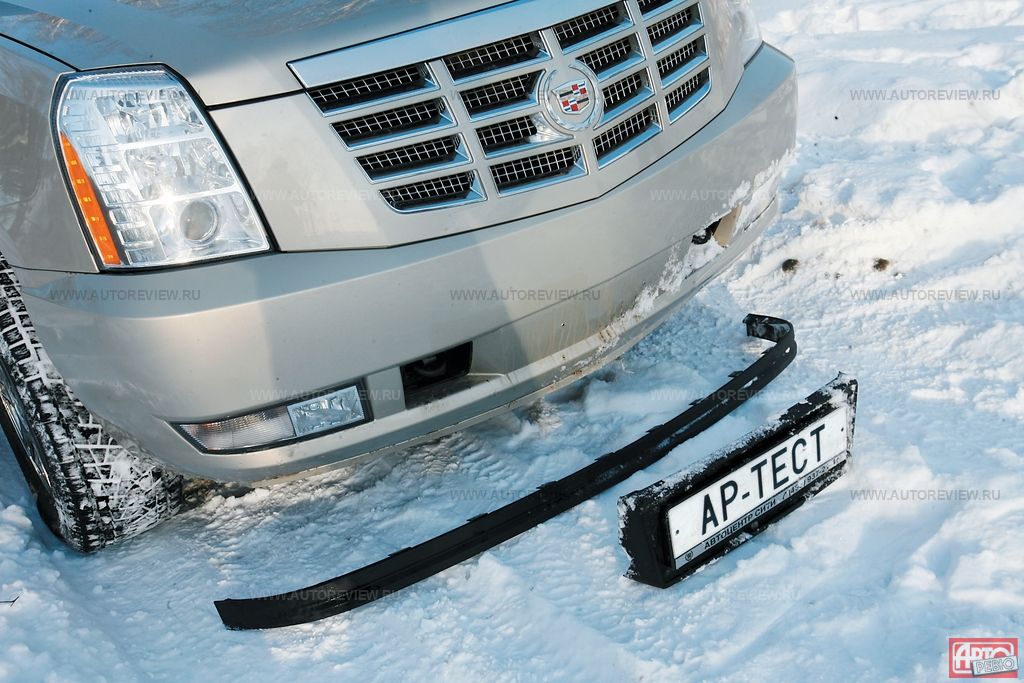 When the Cadillac hit a snowdrift, it immediately lost both the lower part of the bumper and the license plate
In the Lexus LX 570, all-wheel drive is permanent: it is based on a Torsen center differential, which in standard conditions sends 40% of the torque to the front axle and 60% to the rear. A button to the right of the steering column allows locking the center differential. However, there are no inter-wheel locks — their function is taken over by electronics. The low range (2.62:1) is engaged with a lever on the tunnel, but only at speeds not exceeding 5 km/h. If you engage the low range while stationary, the Crawl Control, familiar from the Land Cruiser, becomes available: the air suspension raises the body by 70 mm, and the driver only needs to select the speed — 1, 3, or 5 km/h — and take their feet off the pedals. The Lexus's ground clearance is adjustable from 225 to 295 mm.
When the Cadillac hit a snowdrift, it immediately lost both the lower part of the bumper and the license plate
In the Lexus LX 570, all-wheel drive is permanent: it is based on a Torsen center differential, which in standard conditions sends 40% of the torque to the front axle and 60% to the rear. A button to the right of the steering column allows locking the center differential. However, there are no inter-wheel locks — their function is taken over by electronics. The low range (2.62:1) is engaged with a lever on the tunnel, but only at speeds not exceeding 5 km/h. If you engage the low range while stationary, the Crawl Control, familiar from the Land Cruiser, becomes available: the air suspension raises the body by 70 mm, and the driver only needs to select the speed — 1, 3, or 5 km/h — and take their feet off the pedals. The Lexus's ground clearance is adjustable from 225 to 295 mm.
The Infiniti's transmission is simpler than that of the Lexus or Range Rover. There is no center differential here, and under normal conditions torque is transmitted only to the rear wheels. The driver can choose one of four modes: rear-wheel drive, automatic front-axle engagement, fully locked all-wheel drive, and the same but with a low range (2.59:1), which requires stopping to engage. The traction control system acts as inter-wheel locks. Ground clearance is 231 mm.
Infiniti QX56 Lexus LX 570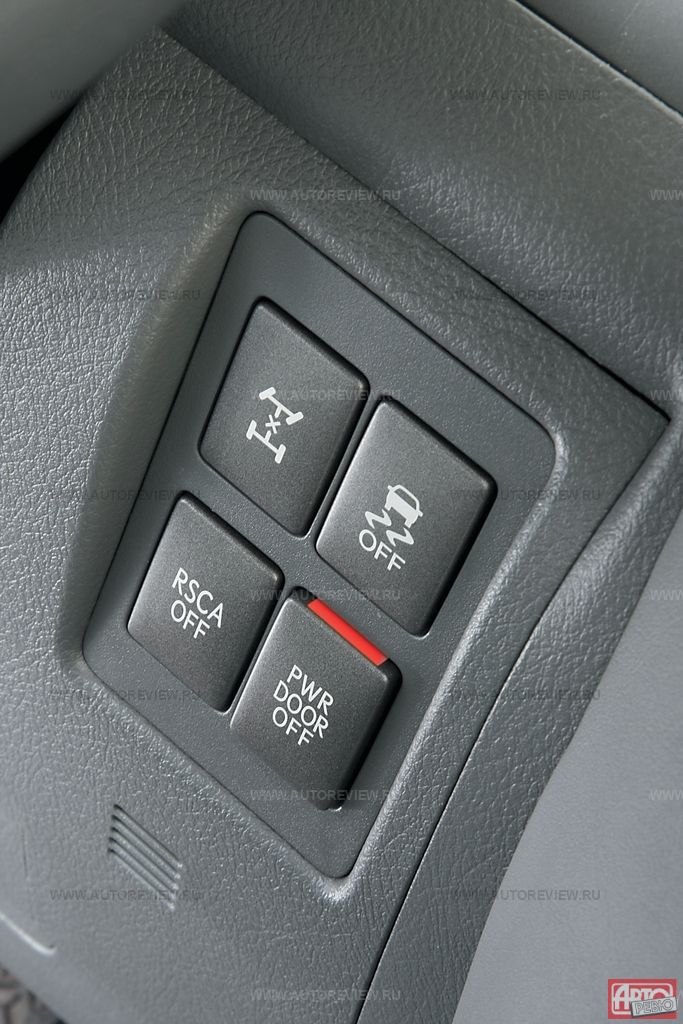 Lexus LX 570 Range Rover
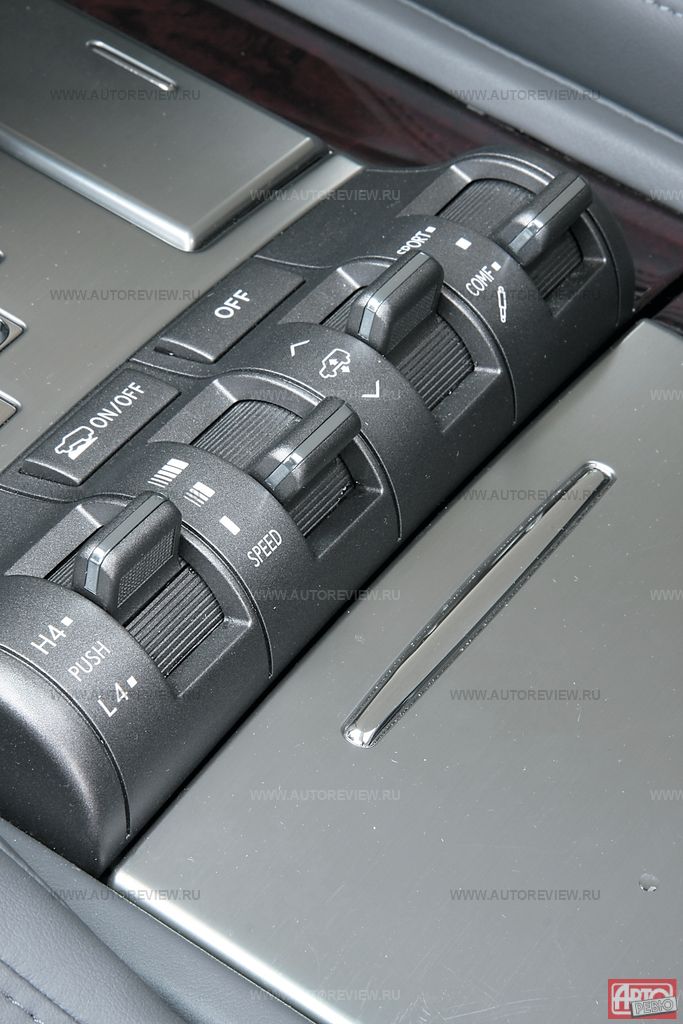
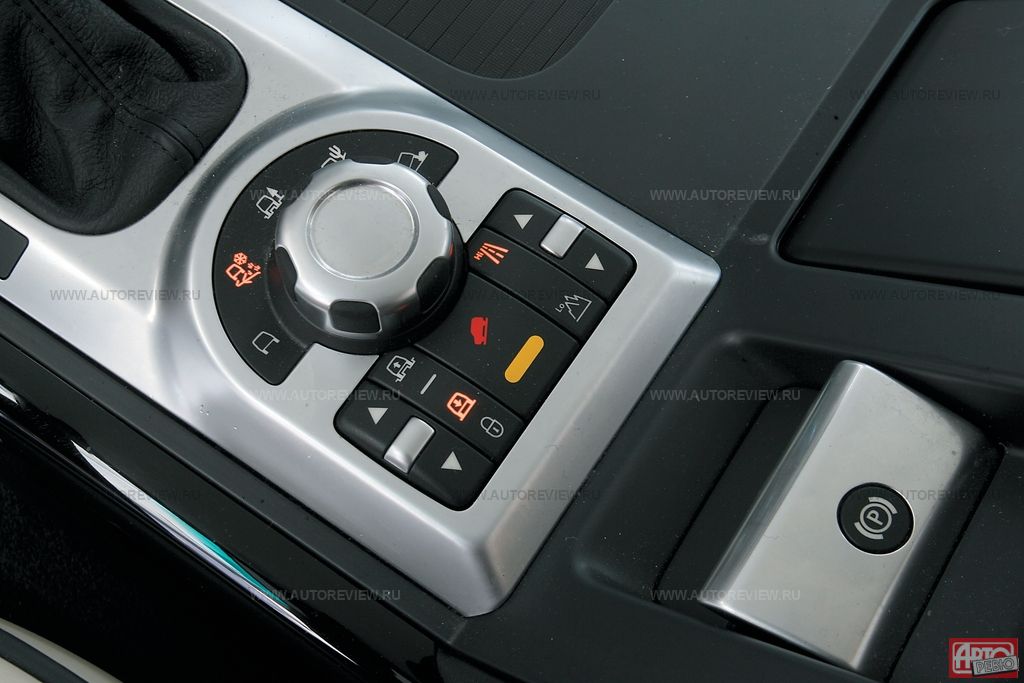 The Infiniti's all-wheel drive is controlled by a rotary knob on the center console. In the Lexus, the low range is engaged with a toggle switch on the tunnel, and the center lock is engaged with a button to the right of the steering wheel. The Range Rover's Terrain Response system selector allows only selecting the surface type
The Cadillac's all-wheel drive is not controlled by the driver in any way: it features an asymmetric center differential with a viscous coupling lock (38:62) and a self-locking rear differential. The transfer case is single-speed, without a low range. Ground clearance is 229 mm.
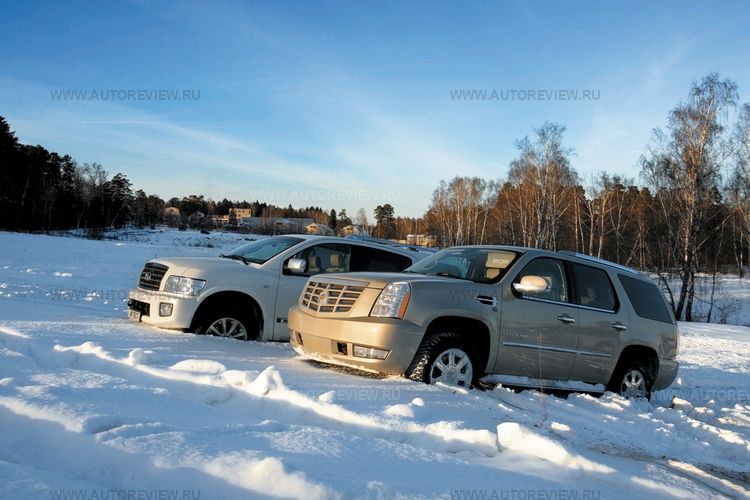
Despite having a low range, the Infiniti advanced off-road only slightly further than the Cadillac, which has no controllable off-road systems at all
Cabin warm-up speed
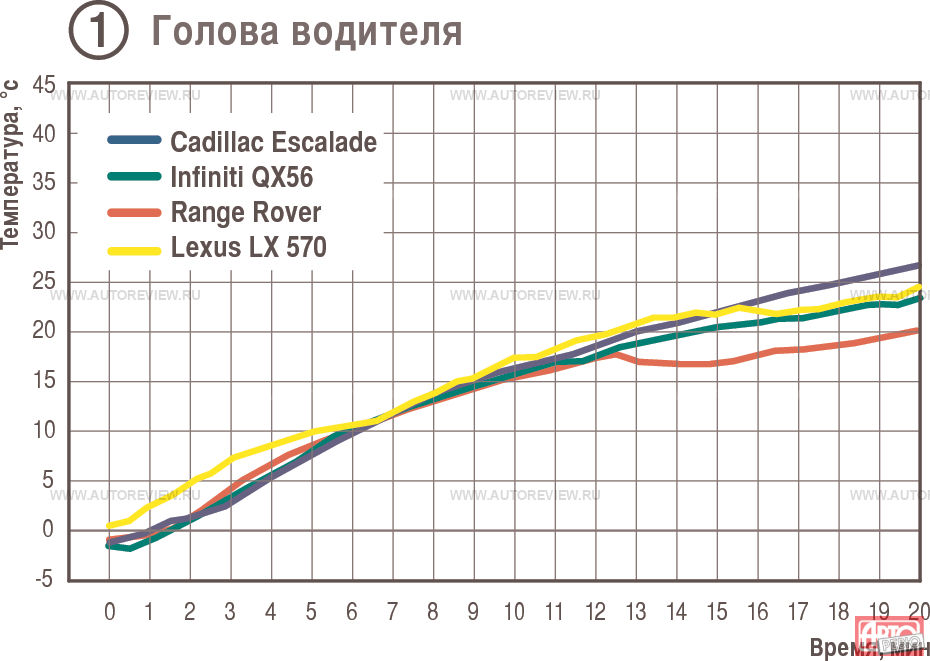
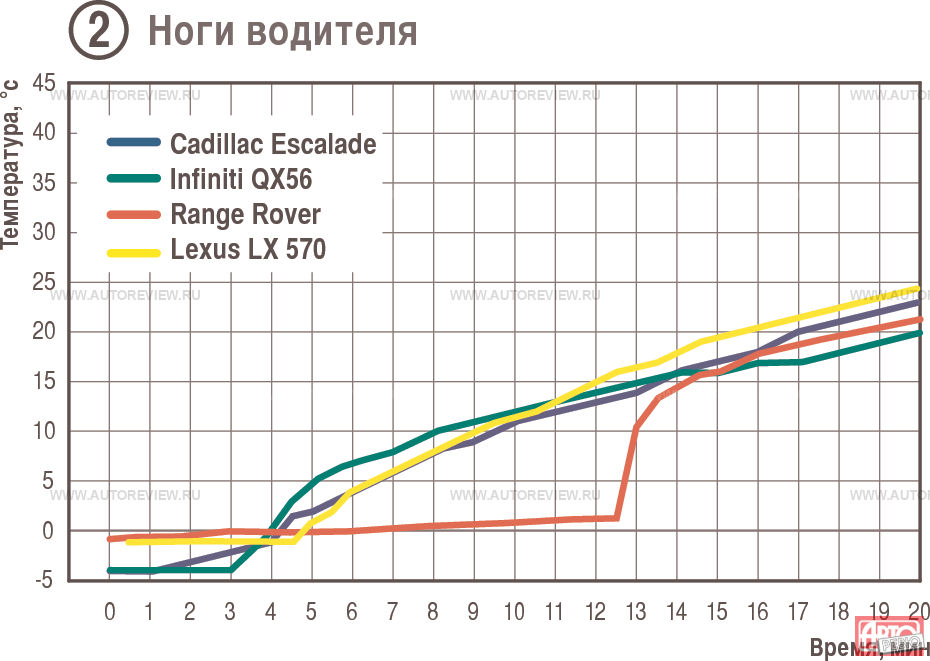
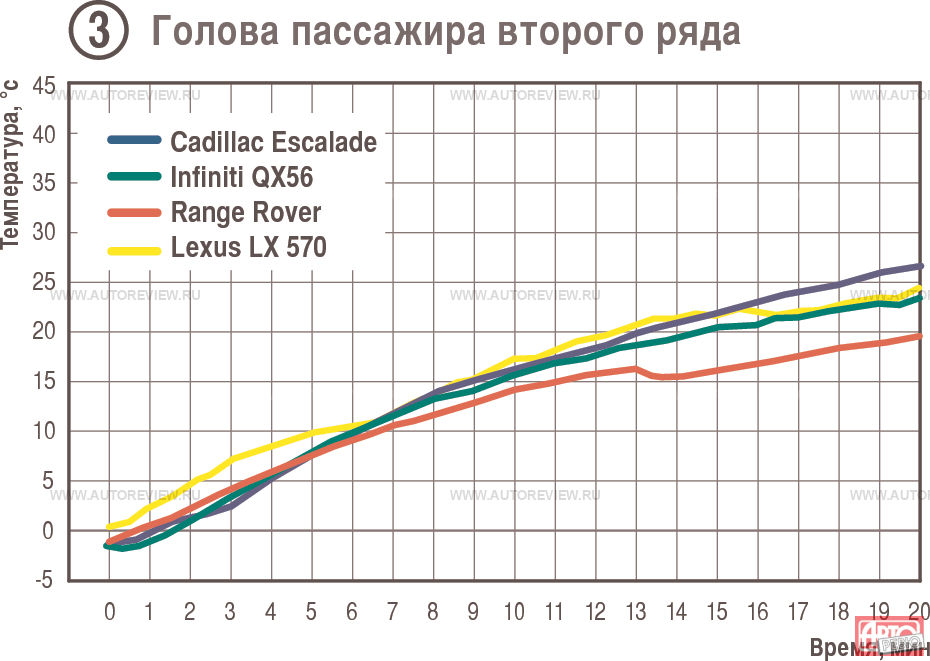
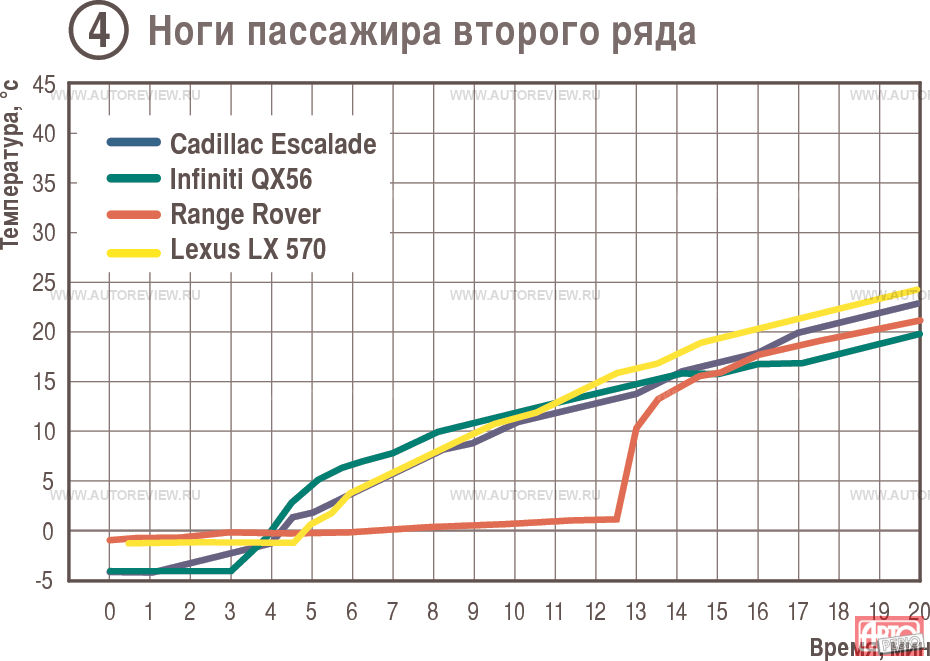
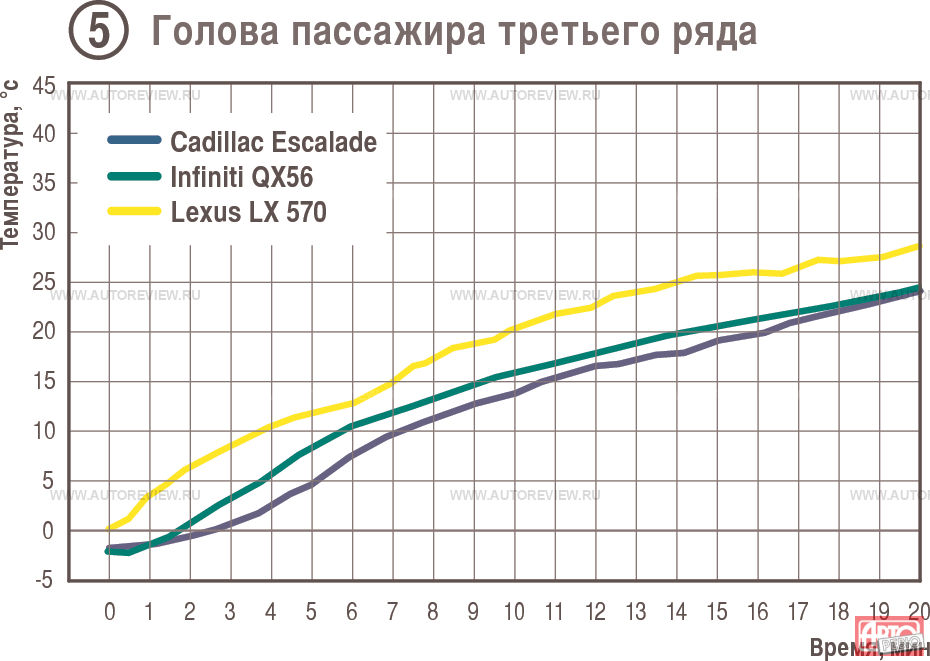
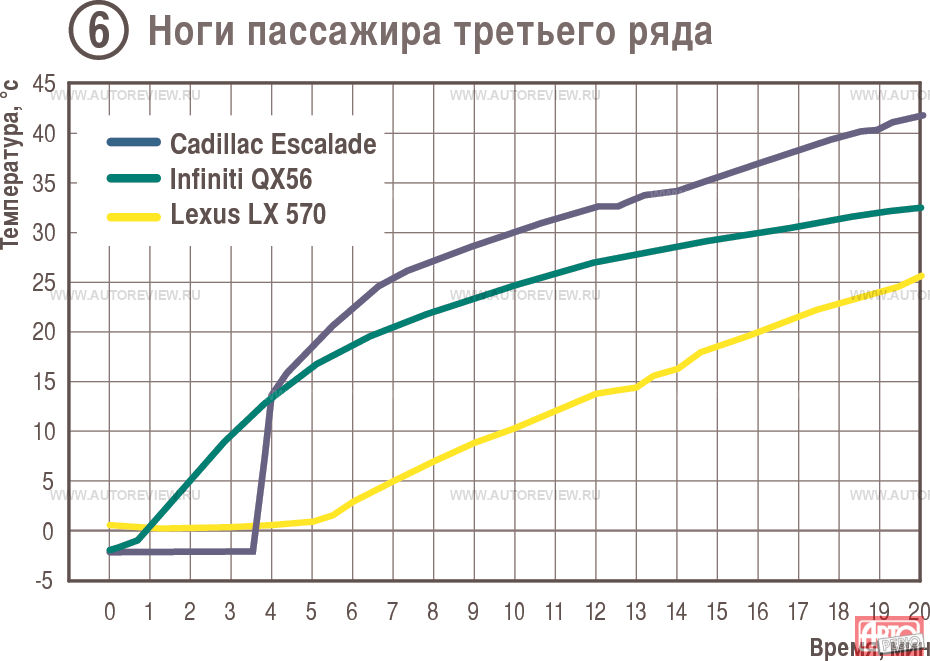
To evaluate the efficiency of the heaters, we placed sensors at six points in each cabin. The cars sat overnight in frost at –2°C, after which we started the engines, set the climate control systems (both front and rear) to Auto mode, opened all vents, set the maximum temperature, and monitored the readings of six thermocouples. As a result, all four SUVs handled the warm-up quite well, with the only weak spot being the footwell area in the Range Rover. As for third-row passengers, they are warmest in the Infiniti and Cadillac: in the Lexus, the head area warms up faster, but the feet remain cold noticeably longer
Prices and trim levels
Infiniti QX56 (5.6 L, 325 hp) is offered in only one, but well-equipped version: six airbags, three-zone climate control, power front seats, heated first and second-row seats, a DVD player with a ceiling screen for rear passengers, a light sensor, parking sensors, a sunroof, and a keyless entry system. The price is 2,489,000 rubles ($104,580*). There are no cars in stock, but the wait will be no longer than two months.
Warranty — three years or 100,000 km. Official Infiniti dealers — three in Moscow and St. Petersburg.
Cadillac Escalade (6.2 L, 403 hp) in the Base version costs slightly more — 2,596,950 rubles ($109,120). It also has three-zone climate control, but the rest of the equipment is more modest: four airbags, a CD/DVD/mp3 stereo, and rear parking sensors. The sunroof is not included in the base trim (it costs an additional 52,200 rubles), but there is a rain sensor and an adjustable pedal assembly. The Top version with navigation, a TV for rear passengers, and power-folding second-row seats will cost 2,848,820 rubles ($119,700). Dealers have cars in stock; orders take up to two months.
Warranty — three years or 100,000 km. Cadillac is sold by 26 dealers in 14 Russian cities.
Range Rover with the base 4.4 L gasoline engine (306 hp) costs exactly three million rubles ($126,050). The Vogue trim includes eight airbags, two-zone climate control, navigation, a rear-view camera, power front seats, a CD changer, a sunroof, light and rain sensors, bi-xenon headlights, and parking sensors. With the TDV8 turbodiesel (3.6 L, 271 hp), the price increases by 50,000 rubles, and the Supercharged version with a gasoline V8 (4.2 L, 396 hp) and heated all seats starts at 3,350,000 rubles ($140,760). For a DVD player for rear passengers and ventilated front seats in the Vogue SE version, you will have to pay an additional 260,000 rubles, and for three-zone climate control — 53,000 rubles. The car can be found at dealers, but an order will take three months to wait.
Warranty — three years or 100,000 km. Range Rover is sold by 34 dealers in 21 Russian cities.
Lexus LX 570 (5.7 L, 367 hp) in the Premium version surpasses all three rivals in terms of equipment: it has ten airbags, four-zone climate control, navigation, a rear-view camera, a DVD changer, xenon headlights, and ventilated front seats. The second and third-row seats fold and adjust electrically. For all this, they ask 3,450,000 rubles ($144,960*). If you take the Luxury version, which has a TV built into the ceiling in the rear, the price rises to 3,570,000 rubles ($150,000) — and even then it is 93,000 rubles cheaper than the Range Rover Supercharged with a similar set of options. There are so many people wanting to buy a new Lexus that the queue stretches for at least ten months.
The warranty on the car is three years or 100,000 kilometers. In Russia, the LX 570 is sold by 13 dealers, all concentrated in six cities.
* Dollar exchange rate — 23.8 rubles.
Cost of scheduled maintenance with consumables and parts, RUB Scheduled maintenance Vehicles Cadillac Escalade Infiniti QX56 Lexus LX 570 Range Rover Cost of standard hour 1620 2030 1930 2750 Mileage, km 10000 9400 11000 11850 — 12000 — — — 14000 20000 13700 20500 14550 — 24000 — — — 17100 30000 9400 13000 11850 — 36000 — — — 14000 40000 13700 33000 34100 — 48000 — — — 30000 50000 9400 11000 11850 — 60000 13700 22500 14550 14000 70000 9400 11000 11850 — 72000 — — — 17100 80000 13700 33000 42380 — 84000 — — — 14000 90000 9400 13000 11850 — 96000 — — — 30000 Total 101800 168000 164830 150200Approximate prices for parts at dealers in Moscow, RUB Parts Vehicles Cadillac Escalade Infiniti QX56 Lexus LX 570 Range Rover Oil filter 350 350 460 1180 Fuel filter 968 13000* 1359 1857 Air filter 1030 810 1002 2190 Cabin filter 1624 2455 1320 3054 Spark plug 713 565 537 674 Front brake pads 5700 6900 3900 11177 Rear brake pads 6610 6100 2900 3930 Front shock absorber 13830 3600 7774 52400** Rear shock absorber 23000 11140 1328 23354*** Front headlight 40000 45126 25200 50452 Rear taillight 35000 15865 5700 14703 Front fender 19000 22764 9790 30195 Front bumper 30000 29907 13700 31149 Hood 26535 34870 17600 66388 Windshield 20000 18337 16600 36014 * Complete with fuel pump ** Air spring strut complete with shock absorber *** Air spring complete with shock absorber
Alternative
When talking about powerful full-size SUVs, other options cannot be ignored.
First of all, this is the seven-seat Mercedes-Benz GL with permanent all-wheel drive. The model has been produced since 2006, and in Russia it already comes standard with the Off-Road Pro package, which includes a low-range gear and locking of the center and rear differentials. The GL 450 (4.7 L, 340 hp) costs from 3,236,400 rubles ($135,980*), and the GL 500 (5.5 L, 388 hp) — from 3,596,400 rubles ($151,110). The interior is spacious, off-road capabilities are excellent, but the car is not suited for fast driving on asphalt. Details — in AR No. 10, 2007.
The legendary Mercedes-Benz G-Class has been produced since 1979, and during this time it has been modernized more than once — the last time last year. True, in 2010 the veteran may be retired: new environmental standards and pedestrian safety requirements are to blame. For now, the G 500 (5.0 L, 296 hp) with a five-door body is sold in Russia from 3 million 672 thousand rubles ($154,290). Permanent all-wheel drive here is supplemented by a low-range gear and locking of all three differentials. On asphalt, the Gelandewagen holds uncertainly, and the interior is a bit cramped. But off-road it has no equal — a true king! Details — in AR No. 24, 2003.
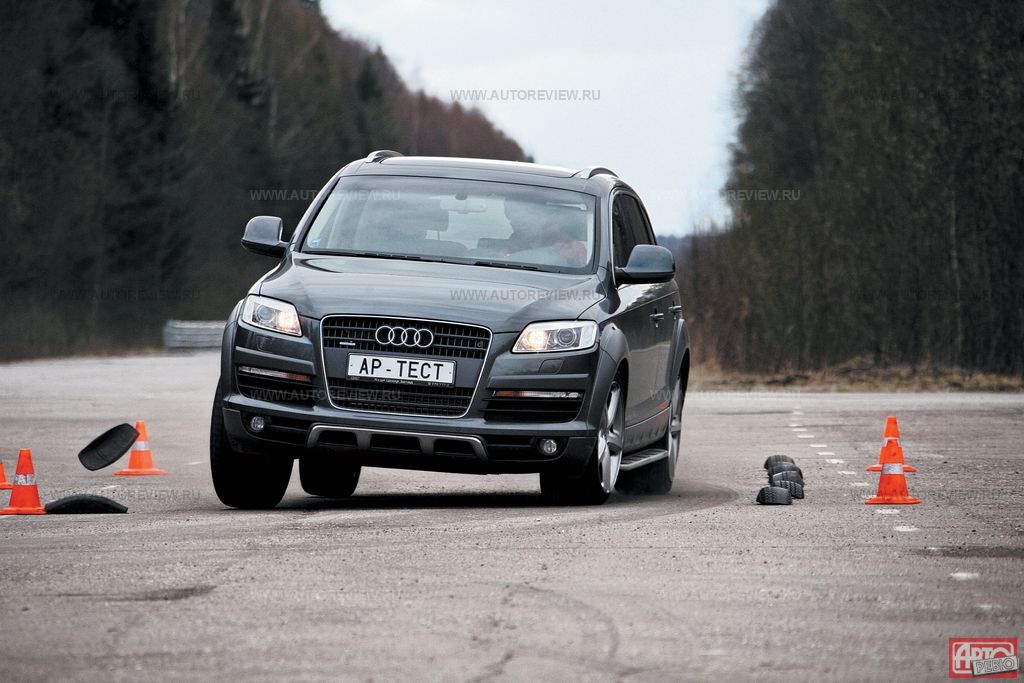
Mercedes-Benz GL Audi Q7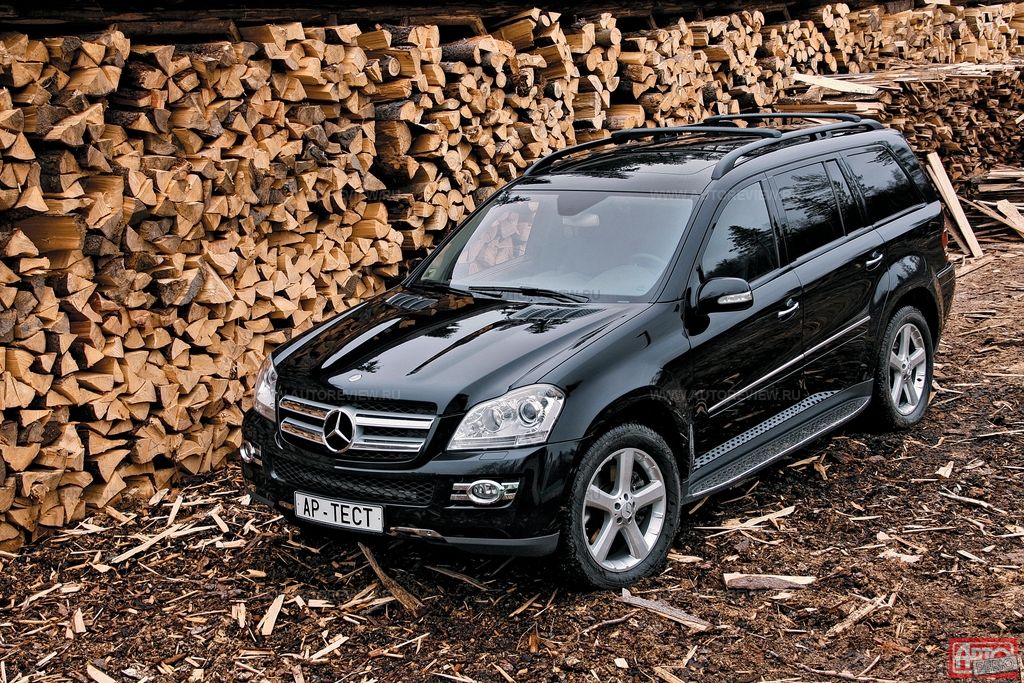
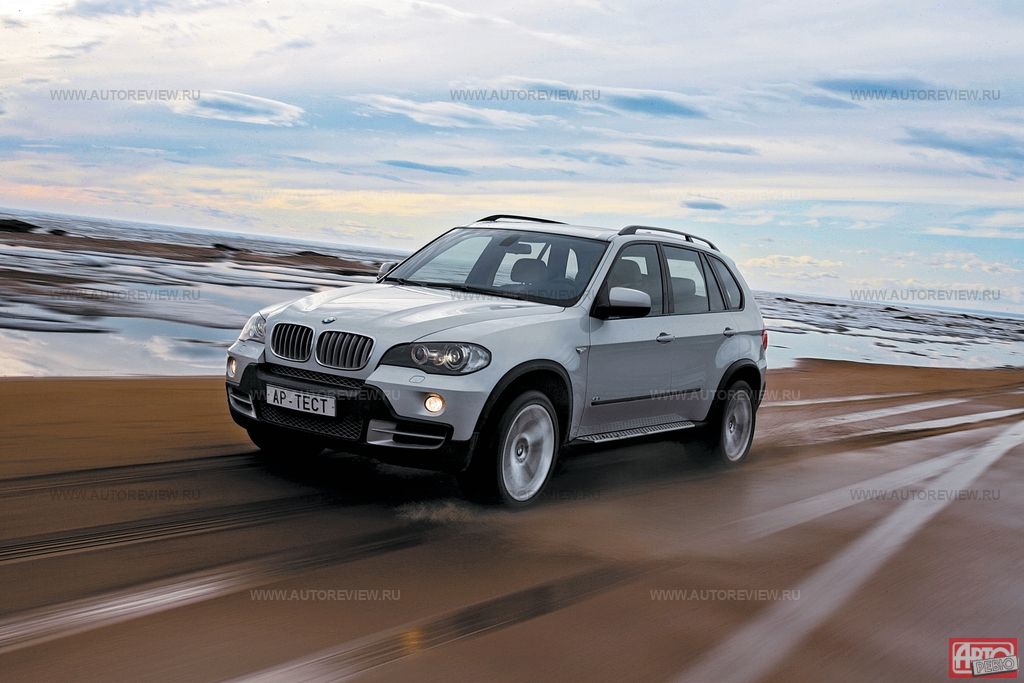
 Mercedes-Benz G500 BMW X5
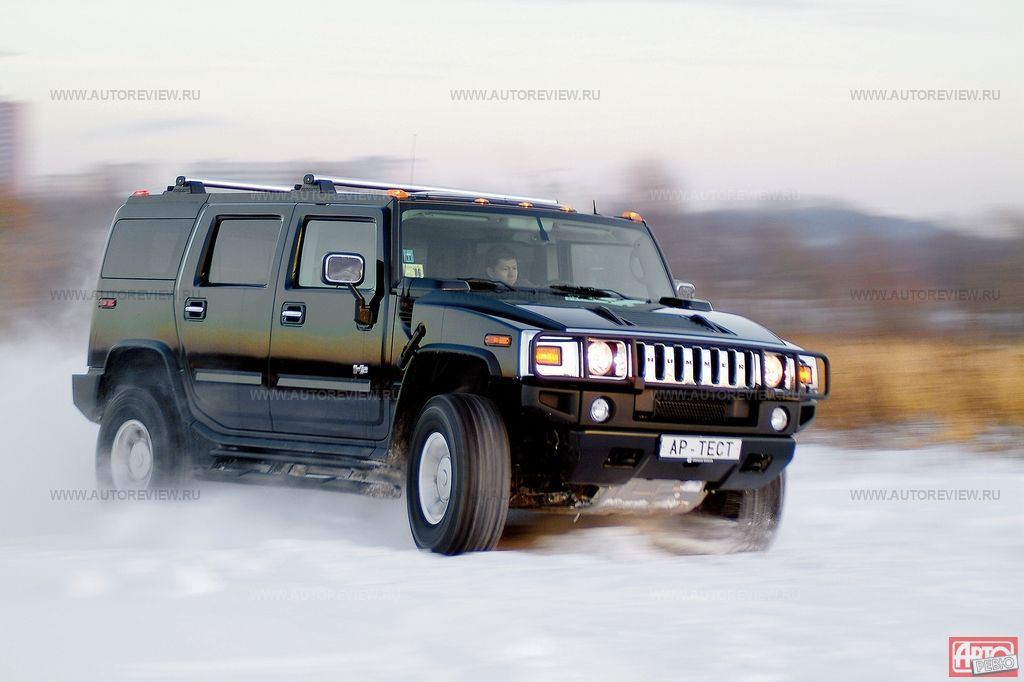
Hummer H2 (6.0 L, 325 hp) appeared in 2002, and since 2004 it has been assembled at the Kaliningrad Avtotor. Against the background of the Mercedes, the price of the base five-seat version looks very attractive — 2,347,720 rubles ($98,640). More expensive trim levels add a third row of seats and rear air suspension. Permanent all-wheel drive — with low-range gear and locking of the center and rear differentials. The Hummer has decent ride comfort, and it also feels confident off-road, but the uncomfortable interior and cheap plastic inside spoil the impression. Details — in AR No. 24, 2003 and AR No. 24, 2004.
The more compact Volkswagen Touareg with the unique W12 6.0 engine (450 hp) is priced at 3,486,810 rubles ($146,500). The model debuted in 2002 and underwent a facelift last year. The base permanent all-wheel drive is supplemented only by a center differential lock, but a rear differential lock can be ordered for an extra charge. Inside — comfort and excellent ergonomics. On asphalt and serious off-road, the Touareg behaves superbly, and the W12 version delights with thrilling dynamics. Details — in AR No. 22, 2005 and AR No. 4, 2008.
Built on the same platform, the Porsche Cayenne debuted in 2003 and was modernized three years later. The Porsche Cayenne S with a 4.8 engine (385 hp) costs at least 3 million 34 thousand rubles ($127,480). Of all the listed competitors, this is the only car that comes standard with a manual transmission — you have to pay extra for an automatic. The all-wheel drive transmission is the same as in the Touareg. The Cayenne is a fast and comfortable car with excellent off-road capabilities. Details — in AR No. 10, 2007.
Mercedes-Benz ML Volkswagen Touareg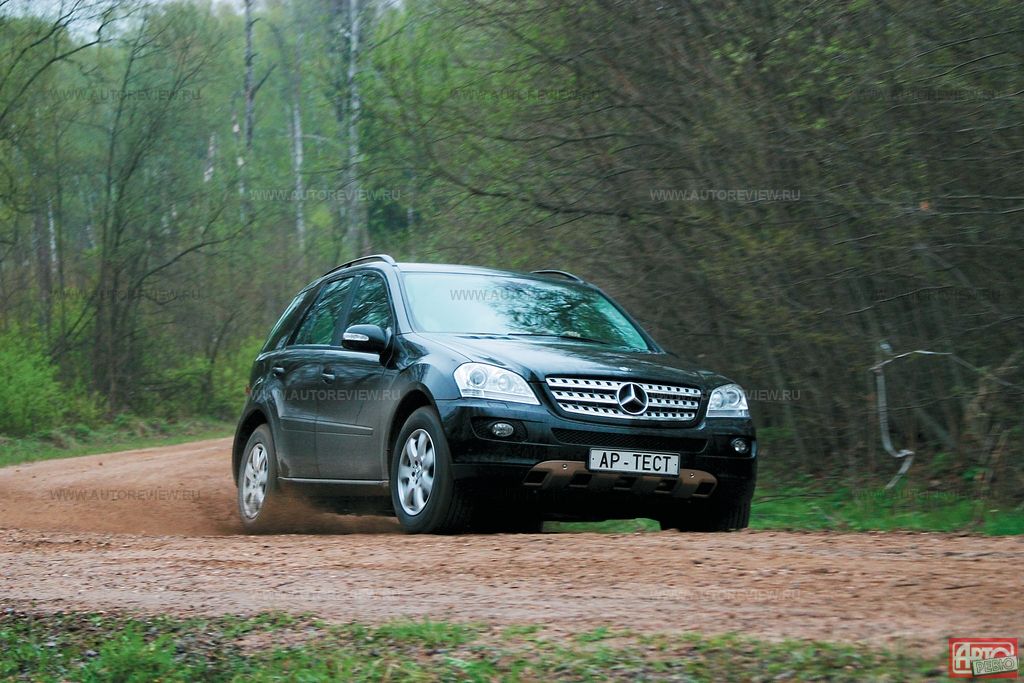 Hummer H2 Porsche Cayenne
We should not forget about the Mercedes-Benz ML, which has been produced since 2005. For the ML 500 version (5.0 L, 306 hp) you will have to pay from 2,876,400 rubles ($120,860). Drive — permanent all-wheel. Locks here are replaced by electronics, but the Off-Road Pro package with low-range gear and locking of two differentials is available for an additional fee. The main advantage is comfort. On asphalt, the car holds confidently, and with the Off-Road Pro package — also on rough terrain. Details — in AR No. 15, 2005 and AR No. 11, 2006.
BMW X5 appeared in 2006. The car with a 4.8 engine (355 hp) costs at least 2 million 988 thousand rubles ($125,550). The transmission uses a multi-disc clutch on the front wheels, and instead of locks — their electronic imitation. The BMW X5 interior is spacious and comfortable, and the crossover's driving characteristics are speed-oriented: the suspension is stiff. However, on difficult off-road, the car gives up. Details — in AR No. 10, 2007.
And finally, the Audi Q7, produced since 2005. The modification with a 4.2 FSI engine (350 hp) is estimated at 3 million 143 thousand rubles ($132,060). Permanent all-wheel drive with a Torsen center differential is intended more for "asphalt" torque distribution and improved handling than for increasing off-road capability. The Audi Q7 impresses with a spacious interior and ride comfort, but going off-road can turn into problems. Details — in AR No. 11, 2006 and AR No. 10, 2007.
* At the exchange rate of $1 = 23.8 rubles.
Reliability rating
Andrey MOROZOVIn the US, reliability statistics are regularly collected by the consulting firm J.D. Power and Associates: it surveys owners of three-year-old cars about problems over the last 12 months of operation. The latest survey, conducted from January to April last year, involved more than 53,000 Americans.
Owners of the Cadillac Escalade rated the reliability of their cars as mediocre: the only thing the Escalade received a "good" rating for was the reliability of the engine and transmission.
The main hero of the test, the Lexus LX 570, has just entered the market, so we provide data for its predecessor — the LX 470 model: a maximum five-star rating in three of four categories!
But the Range Rover was rated by Americans with a "two" — the same as the Nissan Armada SUV. What does Armada have to do with it? The fact is that the Infiniti QX56, which was not in the survey, is based on the Armada.
Interestingly, in addition to the rating of individual models, J.D. Power also maintains a brand rating, where Lexus has been leading for nine years in a row, while Range Rover remains among the "poor students".
Vehicles Overall reliability rating Reliability of engine and transmission Reliability of body and interior Additional equipment and accessories Lexus LX470 ★★★★★ ★★★★★ ★★★★★ ★★★★★ Cadillac Escalade ★★★ ★★★ ★★★ ★★★ Range Rover ★★ ★★ ★★ ★★ Nissan Armada ★★ ★★ ★★ ★★