
Brilliance M1. Chinese Emotions
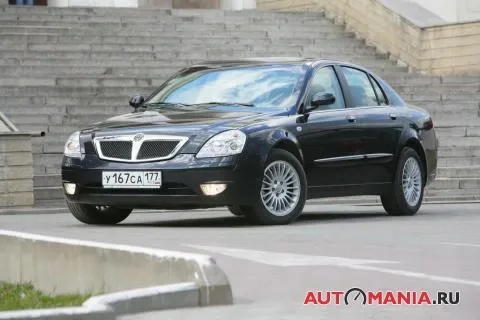
Chinese SUVs, compact cars, and mid-size sedans have long become a common sight in Russia. Now, manufacturers from the Middle Kingdom have decided to take a shot at the segment of executive cars. The Brilliance M1 model claims exactly this status.
Dreaming of a Mercedes S-Class or BMW 7-Series, but short of a hundred or two thousand euros? The Chinese auto industry is rushing to the rescue! For just $26,000, you become the happy owner of a Brilliance M1. Here, you have everything expected of a large executive sedan for transporting an important person in the back row. The body length is almost five meters. As for the exterior... Contrary to stereotypes about Chinese cars, the design is perfectly fine here. Both in profile and from the front, the car looks modern and, unlike many of its compatriots, has a quite recognizable individuality.
And this individuality is recognized precisely because the appearance painfully resembles a BMW of the previous generation. Yes, the shape of the headlights is slightly changed, and the radiator grille is different. But overall — the body proportions, the contours of the front fenders, the hood lines, the headlights — all of this unmistakably points to the German original. However, this is not bad: the Chinese "remix" on the Teutonic theme turned out quite well. The M1 did not lose face either from the front or the rear. The smooth contours of the rear, the design of the rear lights — it looks stylish, nothing to complain about. The Brilliance emblem also hints at a "creative reinterpretation of European heritage." The Chinese trident so resembles the Maserati badge that neighbors in the parking lot where the tested M1 spent nights seriously inquired about the "new Italian." My explanations usually met with a distrustful smirk — like, who are you trying to fool? — until the vehicle registration certificate came into play. By the way, there is a simpler way to convince skeptics of the car's Chinese origin: just invite them into the cabin. Once inside, you feel that incomparable, persistent aroma of plastic and phenol, which veterans of the Soviet auto industry reverently tell their grandchildren about. I wonder how much the maximum permissible concentration is exceeded? However, representatives of the company that provided the car claim that this nuance is only characteristic of the "pilot batch." Production cars should not have such a smell. We'll see...
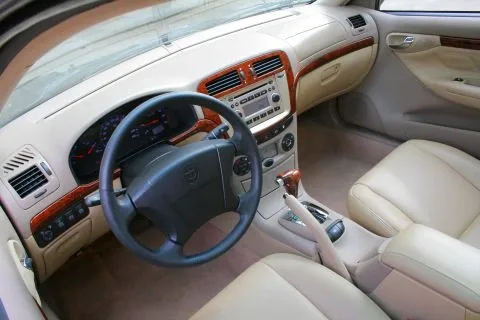
The interior is trimmed with cream leatherette, the quality of which, to put it mildly, leaves much to be desired. This splendor will obviously get dirty very quickly. The air conditioner here, as it turned out, is "standard Chinese." It feels like one small factory in the Middle Kingdom supplies "ACs" to the entire Chinese auto industry, at least the part that is delivered to Russia. The design of these units differs in different models, but the construction, apparently, is the same: getting normal cooling in the heat or heating in the cool from it is a great success. Both work at a C grade.
The driver's seat immediately makes it clear: the person behind the wheel is not the main character here. Seat adjustments are mechanical, and lateral support is completely absent. The steering wheel adjusts only by height — and thank you for that! The side mirrors, although equipped with electric adjustment and heating, are somewhat small (apparently, for the sake of design). The rearview mirror is also Lilliputian in size. Why so? The car is large, requires care when maneuvering, and visibility seems deliberately reduced! The sunroof operation also disappointed. It has no "tilt" position — only full sliding back to the desired distance. The jerks during the process resemble the movements of a poorly lubricated Terminator.
In the back seat, as befits cars of this class, three people can sit comfortably. But the folding center armrest hints: "very important persons" are entitled to more personal space. The complete absence of any adjustments for the rear seat was surprising. The fact that it cannot be transformed is understandable and not necessary, but additional conveniences for rear passengers would have been useful. It seems that the desire to stand out somehow against competitors pushed Chinese engineers to a strange, from a practical point of view, solution: the rear seat is removed literally with one hand movement. Why? Probably to transport "respected people" in stacks on the car floor. In this context, the presence of a completely immense trunk volume becomes understandable.
Between the front seats is the automatic transmission selector. The good old mushroom-shaped handle, no sequential modes... Under the hood of the M1 is a two-liter engine with 130 hp, produced in China under a Mitsubishi license. Fears that such a combination of engine and transmission would be too weak for a one-and-a-half-ton sedan were fully confirmed. The power reserve is practically absent. To confidently keep up with modern (and not so modern) foreign cars, you have to keep the gas pedal floored almost all the time. Because of this, the consumption of 92-octane gasoline clearly exceeds 15 liters per hundred. It's hard to say more precisely: the onboard computer cannot calculate these figures. In addition, the "automatic's" thoughtfulness periodically annoys. No sport modes, only limiting gears to second or third... In short, the "automatic" is from the last century. Although in practice, surrounding drivers treat the serious black "face" that slowly but surely approaches from behind with great respect. I really liked the power steering. To turn the deliberately not "sharp" steering wheel, a small but noticeable effort is required. You feel that you are holding the "wheel" of a car, not a joystick from a console. Thanks to this steering effort and the long wheelbase, the M1 turns into a real asphalt cruiser. Neither potholes, nor ruts, nor the removed top layer of asphalt — nothing can knock it off course: it goes like on rails.
Technical specifications
| Dimensions: | Brilliance M1 |
| Length (mm) | 4880 |
| Width (mm) | 1800 |
| Height (mm) | 1450 |
| Weight (kg) | 1420 |
| Engine displacement (cm3) | 1997 |
| Max. power (hp) | 129 |
| Avg. fuel consumption (l) | 7.6 |
| Tires | 195/65R15 |
| Price ($) | 25,600–26,600 |
"Autoguide" magazine, June 8, 2007, No. 19(19)
Source – www.automania.ru