Brillance M1. The "Diamond" Businessman
What does the situation in the D-segment on the Russian market look like today? There are no domestic models here, and none are expected in the foreseeable future (if we don't recall the ancient ZIM). Available models include the Toyota Camry, Volvo S60/80, BMW 5 Series, Audi A6, and three "Koreans": the Kia Opirus (loosely), Nissan Teana (known as Samsung in Korea), and Chevrolet Epica (also Korean by origin). Of course, you could add Mercedes, but that doesn't change the essence – the weather in this class is made by the listed cars.
No one expected big events, but they happened, and leading automotive publications in the country acknowledged this. The real sensation of the 2007 Geneva Motor Show was a car that made it to Russia. It's not hard to guess where it came from – from the East, from the most populous country in the world.
Here is the new member of the "business club" – Brillance with the flashy name "Diamond." It is ready to serve its owner, even if they have a personal driver, and it costs not 3,000,000 rubles, but only 445,000 for a manual and from 465,000 for an automatic. Is that a lot or a little – let's figure it out.
For that money, you get a lot of metal, a leather interior, spacious rear seats, a sunroof, climate control, an automatic transmission, and power windows. But you'll have to accept the lack of heated seats, only two airbags, and no onboard computer. On one hand, that's a minus – for a business class, such equipment isn't respectable. On the other hand, rear passengers are truly comfortable here, and driver comfort isn't the main thing in such a car.
The one-and-a-half-ton Chinese car is unlikely to please with its weak two-liter engine producing 122 horsepower. In its homeland, there's a version with a 2.4-liter engine (130 hp), but it's unlikely to appear here – at a price of $33,000, it won't withstand competition from the Japanese and Koreans.
The question of competition here is almost rhetorical and even a bit humorous. All the listed rivals (including the Koreans) noticeably surpass the Brillance in build quality, driving characteristics, and comfort. But the Chinese have a trump card – the M1 is the longest in the D-class. Not the tallest, but definitely the longest – 4,880 mm. True, in width it yields not only to the A6 or Epica but even to the Camry and S60. And with a licensed Mitsubishi engine of old design, its dynamics will be weak.
Before getting behind the wheel, I'll note one fact that seems almost fantastic but is absolutely real. After Geneva, the Brillance M1 became the first "Chinese" car actively sold in Europe, costing a hefty 22,000 euros. The plans are ambitious: about 1,500 cars per year in Europe and about 1,000 in Russia.
But the M1's prospects here look bleak, and these figures are clearly too optimistic. There are many reasons for skepticism – distrust of Chinese goods in general and cars in particular, issues with service, repairs, and spare parts (including body parts), warranty, and reliability not tested by time. Moreover, the Koreans have already been through this – the Chinese will have practically no secondary market. And for Russia, that's a serious argument: having bought a "Chinese" car for 27 thousand "greenbacks," in a year you'll have nowhere to put it if you're disappointed.
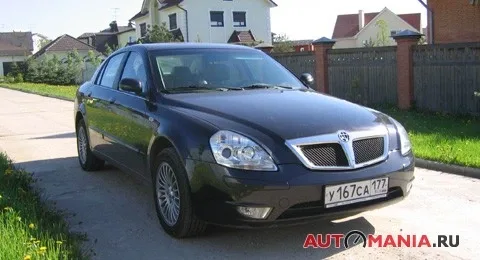
But that's all theory. Time to test it in practice. A huge black limousine (such a color adds pathos) with the bright name "Diamond" became mine for a week. First of all, like any driver, I started adjusting it to myself: mirrors, steering wheel, seat. It immediately catches the eye – the side mirrors are quite tiny, you need time to get used to them and be more careful when changing lanes. Seat adjustment is manual – you can live with that, you do it once. But with the steering wheel, the first surprise came, and not a pleasant one.
The steering wheel adjusts only by height, and even in the upper position, it hangs too low – about ten centimeters from your knees. And I'm far from a giant – 178 cm and slim.
The interior is cozy: beige leather is no worse than in "Beemers," "Audis," or "Mercs." It's pleasant that there's no smell. The pseudo-wood inserts on the console look much more elegant than in the new Toyota Camry, where they seem foreign. And with the onset of darkness, another detail reveals itself – the instrument panel backlighting in Volkswagen style (purple-red) and soft lighting at the feet when doors open. Not a novelty, but it looks solid. The exterior also pleases. According to dealers from "Atlant M-Asia," Giugiaro himself had a hand in the body design – he, along with Pininfarina, is considered as much a guru of car design as Dolce and Gabbana in fashion.
Some of my fellow journalists who have already driven the M1 wrote that it resembles a BMW. Allow me to disagree – here you can clearly feel Italian influence.
Perhaps Giugiaro, at the request of the Chinese, pulled unrealized sketches from the archives and made variations on the theme of the little-known Lancia Thema from the end of the last century (Lancia has never been popular in Russia, and the current Thesis is found in literally a couple of examples).
The rear of the "Diamond" – here the maestro definitely earned his fee. The rear part is not just beautiful and copies no one – it captivates with a combination of metal, glass, and chrome. Passersby and parking neighbors turn to look at it no less than at Jennifer Lopez's behind. Look at the photo – and you'll agree with me.
However, exterior, interior, and Italian charm are secondary, especially when it comes to a car with "made in China" on it. The main thing is how it drives and how reliable it is. In motion, the M1 (especially at speed) holds up well. But it's sluggish on acceleration, and at idle in traffic jams, the steering wheel nervously trembles for some reason. As for the small mirrors I worried about – they turned out to be very convenient: there are almost no blind spots, and you get used to them quickly. But the standard parking sensors work in a Chinese way – they beep when reversing and when there's an obstacle, and without one.
What I never got used to is the gas pedal. It's too stiff and reacts unpredictably. That the engine is weak and there won't be any kick-down is clear right away. But why by evening my right leg gets as tired as my left from the clutch on a manual, I still don't understand.
One Soviet party boss demanded from his drivers that the car not accelerate faster than 80 km/h and go smoothly. Had he lived to our days – the Brillance M1 would have been to his liking. How could they put only 122 horsepower under the hood with such dimensions and weight (even the old Opel Vectra, 300 kg lighter, had a 136 hp engine)? Forget about extremes – everything is smooth (remember the pedal), stately, and as a result – 16-17 seconds to 100 km/h. Like in a "Zhiguli," only more comfortable and pretentious.
The Chinese really tried with the logo. Curious people, looking at the emblem, took the car either for a small Maybach or an unknown Maserati. And indeed, it looks similar!
…It started raining, and new problems emerged. The headlights shine weakly, even the fog lights don't help. This is noticeable in the city, where lighting is already a problem. Also, the wipers cover too small an area for such a large windshield. As if they were attached at the last moment from another car.
What really pleased me was the climate control. Its only drawback is that it shamelessly overstates the outside temperature readings, apparently the sensor is mounted too close to the engine. But the air in the cabin cools instantly, and the airflow distribution is so well set up that you don't have to fear drafts and colds. On sunny days, another advantage emerged: there were practically no reflections on the windshield from the dashboard. As for the trunk – it fully corresponds to the business class, as do the folding rear seats, which also confirms its belonging to the D-segment.
Our car enthusiasts will surely be pleased that you can fill the 60-liter tank with 92-octane gasoline – most Mitsubishi engines are tuned for this fuel, and the new Galant is no exception. With an average consumption of 10-11 liters per hundred, the fuel savings are significant. We won't give exact figures – there's no onboard computer in the car, and the manufacturer's brochure indicates 7 liters, which is clearly far from reality even on the highway.
After a week of driving, we've taken a close look at the car and are ready to sum up.
The price of $26,650 for a Chinese buyer, even if it positions itself as luxury rather than business class, looks daunting. Yes, it's a solid "road cruiser" with its strengths, in some places surpassing rivals. On smooth asphalt, it's very comfortable, but the suspension breaks through where the road surface leaves much to be desired. In parking lots, it attracts glances, but in motion, it's a bit sluggish and becomes noisy after 120 km/h. Passengers are comfortable in it, but the driver – not so much. Overall, the car is good, but it's worth stopping by a Chevrolet dealer and seeing that for an additional three thousand dollars (which today is less than 75,000 rubles) you can get an Epica – also with leather, climate control, and heated seats. And in driving qualities, the Korean car is clearly better. Plus, it has a three-year warranty.
Both models share one problem: what to do with them in a couple of years when they get boring and you want a change.
Technical specifications:
| Dimensions (mm) |
4880x1800x1450 |
| Engine displacement (cm3) |
1997 |
| Maximum power (hp) |
129 |
| Curb weight (kg) |
1420 |
| Fuel consumption (l/100 km) |
7.6 (spec) |
| Tires |
195/65 R15 |
| Gasoline |
A-92 |
| Price (rub. base) |
445,000 |
Dmitry Shavyrin
Source — www.automania.ru
