
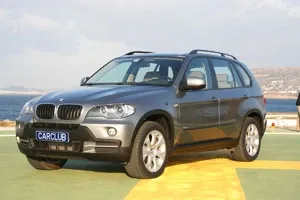
In 1999, BMW introduced the first X5 and effectively created a new class of vehicles. Externally, it was a typical SUV—tall body, large wheels—but the engineers focused on on-road behavior, which has always been the Bavarian brand's forte. The model's success was impressive: since its debut, 580,000 units have been sold, and about 70% of owners were already considering buying the next generation. In 2003, the lineup was expanded with the smaller X3, which sat one step below and filled its niche in Europe.
Now, following market demands, it was time for a generational change, and the introduction of the new flagship SUV from Bavaria took place in Greece. Judging by the first official photos, one might think the car had only been slightly updated, but in person it turned out to be a quirky combination of ideas from the X3 and the fifth-series wagon. The hood with its wavy contours is divided by four longitudinal ridges, and the imposing height of the front is visually masked by a massive insert of unpainted plastic that combines the fog lights and several chrome strips. The designers cleverly disguised the increased proportions and the huge trunk—the steeply raked tailgate and slightly convex glass hide the fact that the body has grown 187 mm in length.
Flagship status demands certain things, so the interior finish is impressive: soft plastics, pleasant-to-the-touch leather, and countless power adjustments—all of this is already the norm for BMW. The only thing that looks a bit odd is the monochrome climate control display, which sits next to the widescreen iDrive screen. Against that backdrop, the small screen seems archaic; it would have been more logical to display all climate information on the large screen and give the freed-up console space to a phone pocket or, at the very least, stylish analog clock. However, that's a matter of personal preference.
Interestingly, over the five years since the system appeared on the 'seven', the iDrive joystick has ceased to feel like something alien. After spending fifteen minutes getting acquainted with it, you start using the main functions almost blindly, although some options—such as fine-tuning the navigation or entering a phone number—still force you to take your eyes off the road. However, while driving, the head-up display is a great help: it shows speed and navigation prompts.
Perhaps the most unusual interior detail is the new automatic transmission selector. As before, it sits on the center tunnel, but now it looks more like a manual or robotic gearbox lever. The lever always stays in one position: you push it in the desired direction, and it returns on its own, while Park mode is engaged via a separate button on the end. Initially, confusion arises when starting off and parking, when frequent forward-reverse shifts are needed. But once moving, everything is familiar to those who have driven a BMW: pull the lever toward you, and the automatic switches to manual mode.
When creating the new SUV, the Bavarians clearly kept an eye on competitors and deliberated whether to make a compact five-seater or stretch the trunk and add a pair of seats, as in the Audi Q7 or Mercedes GL. In the end, they chose a compromise: the base X5 is designed for five adults, and for an extra charge, you can order two additional child seats. However, the manufacturer honestly warns that only passengers up to 150 centimeters tall are allowed to ride 'in the trunk'. Deciding to test this myself, I climbed in the back and confirmed: there's nothing for adults back there—your head hits the ceiling, and the middle seat can't even be returned to its original position because it presses against your knees. Though children aged seven to twelve would likely be comfortable. If there are no such passengers in the family, you can skip the folding seats and get a spacious compartment under the trunk floor. Incidentally, to save space and weight, the engineers removed the spare tire—instead, the car rides on puncture-proof Run-on-Flat tires. This luxury comes at a cost: such tires are on average 15–20% more expensive than regular ones, and comfort suffers—the stiff sidewalls faithfully transmit vibrations from minor road imperfections to the body. Second-row passengers get a spacious bench split into two unequal parts. Each half is adjustable and folds down for carrying long items. Optionally, the rear can be equipped with two-zone climate control and a DVD player with a nine-inch folding screen—though on the previous X5 it hung from the roof, now it has moved to the center tunnel, which seemed less convenient to me.
As expected, the main focus in the chassis tuning is on handling, but given that the primary sales market is the US, where women often drive such cars, the engineers had to combine sportiness with ease of driving and comfort. And surprisingly, the Bavarians pulled off this complex cocktail. The steering remains crystal clear and informative, with light effort—and you get the feeling you're sitting not in a huge SUV but in a compact sedan. Even city driving is enjoyable, and thanks to the Active Steering with variable ratio, you don't have to crank the wheel to large angles. But the X5 truly shines on a mountain serpentine. To understand the car's character, you don't need to push it to the limit. Even with the DSC stability control switched off, the SUV remains fully controllable.
After just a few kilometers of winding road, you find complete harmony with the car. With the electronics on, the X5 cuts power at any wheel slip, but even in this mode, you can drive quite quickly—the wide Continental tires have a huge grip reserve. If you want adrenaline, you can confidently press the DSC off button—driving without it isn't scary at all. It's quite difficult to provoke the X5 into a drift with excess torque: the xDrive transmission precisely distributes torque between the axles, preventing any excess from breaking loose. In standard mode, torque is split 40/60 in favor of the rear axle, but during wheel slip, the electronics can change this ratio. The SUV also steadfastly handles lifting off the throttle mid-corner—you can drive fast, safely, and completely without noticing system intervention. But if you provoke the car more seriously, the reaction is immediate—the X5 shows that drifting isn't alien to it either. A slight steering input at corner entry sends the SUV into a smooth, easily controlled slide. The transparent steering and long wheelbase make such maneuvers quite safe: if the car has turned to the desired angle and the driver suddenly panics, a slight turn of the wheel in the direction of the slide instantly stabilizes the vehicle. Moreover, if the angle was small, engine power isn't limited, and you can get back on the throttle before the corner ends. The X5's excellent balance is largely due to its ideal weight distribution—exactly 50% of the mass on each axle. To lower the center of gravity, the hood and under-hood components are made of aluminum, and the front fenders are plastic.
The three-liter turbodiesel with 272 hp won me over with its endless torque and smooth operation. Even at idle, there's no rattling or vibration in the cabin, and during acceleration, the diesel can give many rivals a run for their money. Of course, the 4.8-liter gasoline V8 is noticeably more powerful and surpasses the diesel in ultimate capabilities, but in relaxed driving, it's not as pleasant: in sixth gear, the mighty X5 accelerates reluctantly and demands a downshift, whereas the diesel pulls confidently from the very bottom. Of course, X5 buyers are unlikely to think about fuel economy, but given modern diesel technology, it turns out to be quite significant. On the same route, the difference in consumption between the gasoline and diesel versions was nearly twofold: the 355-hp gasoline engine averaged 20 liters per 100 km, while the diesel managed 12 liters. At the same time, the difference in lap times was small—the capabilities of both vehicles were far from fully utilized.
 The six-speed ZF automatic transmission, familiar from most six- and eight-cylinder BMW models, has undergone serious modernization. According to the engineers, it shifts twice as quickly, and in practice, this is indeed noticeable—perhaps it's one of the best automatics I've ever driven. In Drive mode, the gearbox is perfect for relaxed driving, and when the road turns into a serpentine with sharp bends, the sporty DS mode comes to the rescue. If you want to really let loose, manual mode is essential. The SUV brakes excellently with the engine, and combined with the responsive stability control, this provides a constant reserve of traction on all four wheels.
Summing up the X5 test, I'll say outright: the car turned out to be remarkably successful. No significant flaws come to mind that you could pick on. Although, wait—there is one drawback: the price. Official dealers haven't announced pricing yet, and deliveries won't start before March, but 'gray' sellers are already taking orders for 4.8-liter gasoline versions imported from the US. Prices start at $117,000, and top trims go for $130–150,000. That's noticeably more expensive than, say, the Audi Q7, but the car is also more refined and characterful.
Leonid Pavlov