
The Bavarians state without a shadow of doubt that the X3 is the world's only luxury compact SAV, that is, a "premium compact for active leisure." Apparently, they ignore the new Freelander from Land Rover on principle (the split between BMW and Rover Group was scandalous), and they probably consider Lexus and Infiniti crossovers not compact or refined enough. In that case, the real rivals are only the Audi Q5 and Mercedes MLK. But those won't appear until next year. And if there are no competitors, why do you need a facelift at all? That's how it's done. Three years on the assembly line is a perfectly sufficient term.
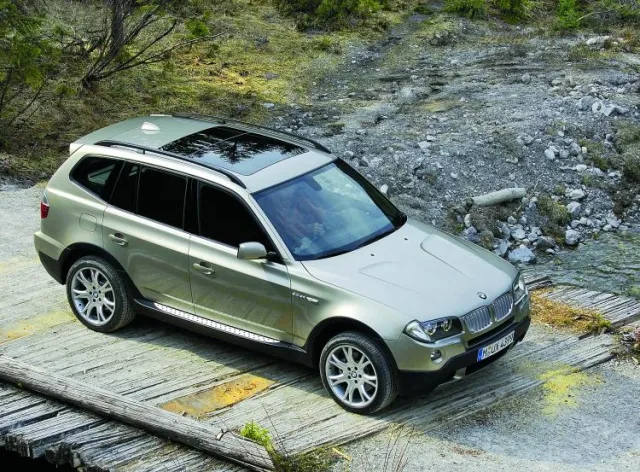
 Outside, the updated X3 has become a bit softer and more refined. LED optics appeared at the rear. The bumpers were changed slightly, and now most of them are painted in the body color. And the "facial expression" of the front has softened thanks to the enlarged "nostrils" of the radiator grille.
As a result, the facelifted X3 has become even more reminiscent of... the first-generation BMW X5. The Germans don't hide this: they were aiming for exactly that result. Previously, the X3 and X5 had to be separated into different niches, including through design, but now there's no such need — the new X5 will stand apart on its own anyway.
By the way, in Europe, 75% of BMW X3 buyers are fit men aged 35–45. But in Russia, they are about 40%. However, ladies will probably also like the X3's resemblance to the "masculine" X5.
Inside, the changes are in a sporty-noble spirit. Instead of the "off-road" steering wheel, there's a small three-spoke wheel with a very thick rim, on the front panel there are large wood or aluminum inserts, like in the Z4 coupe, and the doors now have proper pockets instead of the former "string bags." Not bad. But there's something strange with the ergonomics. It would be fine if only the steering wheel were "crooked," like on the Z4 Coupe (see AR No. 16, 2006), but the pedals are also shifted to the left, and the gear lever is moved back: to engage second gear, you have to noticeably bend your arm. And the right foot, even in a narrow shoe, keeps trying to get stuck between the brake pedal and the transmission tunnel.
 |  |
| The new BMW X5 can no longer be confused with the "younger" X3 — it has become even longer and more solid | BMW doesn't increase displacement, but raises specific output — for the new engine of the X3 3.0si version, it has reached 90 hp/l |
But these are trifles. The main thing is the new range of engines: from two-liter "fours" (gasoline and diesel) to a three-liter diesel with 286 hp. True, the latter won't be offered to Russian buyers due to the low quality of our diesel fuel. Instead, the less boosted old version with 218 hp will continue to be installed on "our" cars.
I, however, managed to drive the most market-demanded version near Munich — the BMW X3 3.0si with an inline gasoline "six" producing 272 hp.
Compared to its predecessor, this engine with a bimetallic cylinder block and Valvetronic system has become 41 hp more powerful. No matter how hard the Volkswagen Touareg V8 tried to escape from me, it failed on the autobahn — in the 160–200 km/h range, the dynamics of the BMW X3 3.0si are simply magnificent! But as soon as you turn onto the small roads of quiet German towns and villages, the dashing agility is gone: the engine doesn't shine with tractive effort. Below 2000 rpm, it frankly "sleeps," and when starting uphill, it even tends to stall.
 | |
| The xDrive system — drive to the front wheels is engaged by a clutch, the "preload" of which is controlled by a miniature electric motor via a worm gear and a rocker arm. Under normal conditions, torque is split 40:60 in favor of the rear wheels — the clutch operates with slip | The "X-third" should be driven in sports shoes: a regular boot can catch on the brake pedal even in a car with an "automatic" |
I never expected that the manual gearbox would please me least of all in a BMW. The lever travel is long, and it vibrates even at 3000 rpm, even at steady throttle. Maybe it's a defect of this particular example?
No — the "automatic," only the "automatic"! Smooth, timely shifts, absolutely transparent logic. The new torsional vibration damper, reinforced friction plates, increased speed of the hydraulic actuation — the new ZF automatic gearbox is magnificent. Except that in a sluggish traffic flow, the transmission's adaptability shows a downside: it "falls asleep," so before overtaking, to avoid an unpleasant delay, it's better to switch to Sport mode right away.
And what about the modernized all-wheel drive xDrive? I drive under the barrier of the Bundeswehr test site — and in front of me is a wide gravel road. Yes, you can have a great time here!
The new control algorithms, embedded in the ICM (Integrated Chassis Management) unit, manage torque distribution, brakes, and the engine. The electronics really work, and they work great. If a skid occurs, the ICM first tries to extinguish it by increasing torque on the front wheels, and if that's not enough, the system grinds the brakes and gently "strangles" the engine. Excellent! But how, on a BMW, and on a closed test site, can you not turn off the stability control? I press the DSC button for about five seconds — and the yellow icon lights up. Now the electronics still flexibly control the clutch for engaging drive to the front wheels, but it doesn't interfere with the brakes or the engine. Do what you want!
I want this. Acceleration. Rocking. First oscillation, second, third — "wagging the tail" in a rhythmic drift is as easy as pie! Time to turn around, and...
Instead of damping the oscillations with a smooth maneuver, I jerked the steering wheel sharper than needed. An unpredictable "whip" in the opposite direction, and the X3 drops its rear wheels into the ditch. I desperately turn the wheel, brake. ...Why did the military put a wooden post right here?
 |  |
| BMW has very serious plans for Dakar-2007 — Jutta Kleinschmidt herself will lead the X3 to the Pink Lake! | The interior has changed only slightly — for the better: leather inserts on the door trim and "wood" on the front panel |
Although the damage was limited to a broken mirror and a slightly dented door, it was terribly embarrassing.
Why the devil did I turn off the DSC...
And why, when sitting next to Julien Chicherit in the rally-raid X-raid BMW X3 CC, did I blurt out that I had also participated in rally-raids? Again the devil tempted me. After all, the young Frenchman finished ninth in the Dakar-2006 — in exactly such an "X-third," essentially turned into a sports prototype. And now Chicherit drove so fast along the off-road track that the car flew through the air more than it drove on the road! Monstrous impacts, barely any soul left in the body. But the suspension never "bottomed out" — it's, of course, racing here.
On the production BMW X3, the suspension is, of course, not so stiff, but it still shakes considerably. And although the springs on the updated car have become softer, to ensure quick responses to steering inputs, the designers "clamped" the shock absorbers. The BMW X3 handles superbly — both on a high-speed straight and in sharp corners. Juicy effort on the steering wheel, excellent reactions to its slightest deviation, exciting and reliable behavior on the arc... If only the steering "rack" were made "shorter," it would be ideal: after all, three and a half turns from lock to lock is a bit much even for a crossover.
The BMW X3 is good in every way! And it sells better and better here: 528 cars in the first half of 2006. No competitors? Don't say that. Formally, if we talk about price, they won't be only for the base versions with two-liter engines: the gasoline car costs $51,800, and the diesel one — $54,350. The 2.5si modification is priced at a minimum of $55,400. But as for the BMW X3 3.0si, even with a manual gearbox, a "bare" car costs as much as a well-equipped Lexus RX 350 — $60,000. And there's also the Subaru Tribeca and the Infiniti FX35... We'll need to compare. And it's not at all necessary to wait for the Audi Q5 and Mercedes MLK to appear.
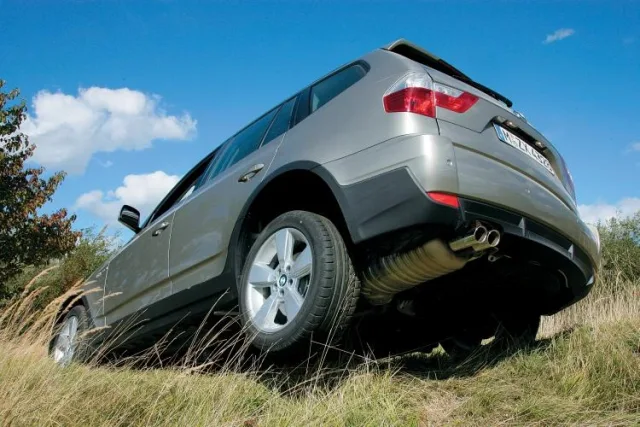
Don't expect off-road feats from the X3 — like all "crossover SUVs," it's only good on demo off-road
However, BMW is not sitting idle and is actively preparing to fight future direct competitors. Prototypes of the next-generation BMW X3 are already driving around the outskirts of Munich — so far, naturally, in camouflage. The car will go into series production in about two years. What will it be like? If we consider that a new three-liter twin-turbo engine, known from the BMW 335i coupe, should appear under the hood — it will certainly be even more "sporty-active"...
| Technical specifications (manufacturer data) | |||||
| Vehicle | BMW X3 | ||||
| Modification | 2.0i | 2.5si | 3.0si | 2.0d | 3.0d |
| Body type | 5-door wagon | ||||
| Number of seats | 5 | ||||
| Trunk volume, l | 480—1560 | ||||
| Curb weight, kg | 1655 | 1730 (1755)* | 1740 (1765) | 1745 | 1805 (1810) |
| Gross weight, kg | 2200 | 2260 (2300) | 2260 (2300) | 2265 | 2350 (2355) |
| Engine | petrol, with distributed injection | diesel, turbocharged | |||
| Location | front, longitudinal | ||||
| Number and arrangement of cylinders | 4, in-line | 6, in-line | 6, in-line | 4, in-line | 6, in-line |
| Displacement, cm3 | 1995 | 2497 | 2996 | 1995 | 2993 |
| Cylinder bore/piston stroke, mm | 84.0/90.0 | 82.0/78.8 | 85.0/88.0 | 84.0/90.0 | 84.0/90.0 |
| Compression ratio | 10.5:1 | 11.0:1 | 10.7:1 | 17.0:1 | 17.0:1 |
| Number of valves | 16 | 24 | 24 | 16 | 24 |
| Max. power, hp/kW/rpm | 150/110/6200 | 218/160/6500 | 272/200/6650 | 150/110/4000 | 218/160/4000 |
| Max. torque, Nm/rpm | 200/3750 | 250/2750—4250 | 315/2750 | 330/2000 | 500/1750—2750 |
| Transmission | manual, 6-speed | manual, 6-speed (automatic, 6-speed) | manual, 6-speed | manual, 6-speed (automatic, 6-speed) | |
| Drive | all-wheel, with automatically engaged front-wheel drive | ||||
| Front suspension | independent, coil spring, McPherson | ||||
| Rear suspension | independent, coil spring, multi-link | ||||
| Front brakes | disc, ventilated | ||||
| Rear brakes | disc, ventilated | ||||
| Tires | 215/60 R17 | 215/60 R17 | 235/55 R17 | 215/60 R17 | 235/55 R17 |
| Maximum speed, km/h | 198 | 221 (220) | 232 (228) | 198 | 210 (210) |
| Acceleration time 0—100 km/h, s | 11.5 | 8.5 (8.9) | 7.2 (7.5) | 10.2 | 7.4 (7.7) |
| Fuel consumption, l/100 km | |||||
| urban cycle | 13.1 | 13.7 (14.1) | 14.2 (14.3) | 9.6 | 10.3 (11.2) |
| extra-urban cycle | 7.1 | 7.7 (7.8) | 7.7 (8.0) | 5.9 | 6.5 (7.1) |
| combined cycle | 9.3 | 9.9 (10.1) | 10.1 (10.3) | 7.2 | 7.9 (8.6) |
| Fuel tank capacity, l | 67 | ||||
| Fuel | petrol AI-95—98 | diesel fuel | |||
| * In parentheses — data for vehicles with automatic transmission | |||||