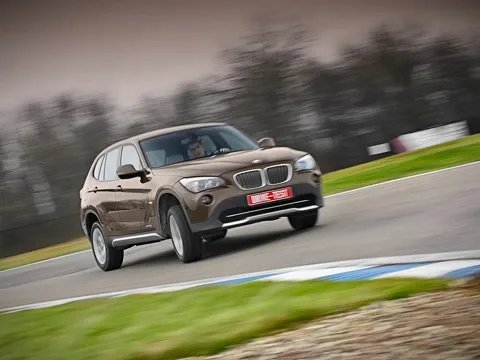
Each new lap further undermines my faith that the Bavarians didn't mix something up. Is it really 194 mm of ground clearance under me, with the "crossover" letter X adorning the rear? The steering responds to the slightest movement with surgical precision, the effort is crystal clear, the car's behavior is predictable, and the accelerator pedal reacts instantly. While driving on the correct trajectory, the chassis delights with predictable rotation, just by lifting off the throttle. And only during active throttle work do you realize that all-wheel drive is underfoot: instead of screwing into the corner and sliding into oversteer, the X1 begins to stubbornly slide toward the outer shoulder.
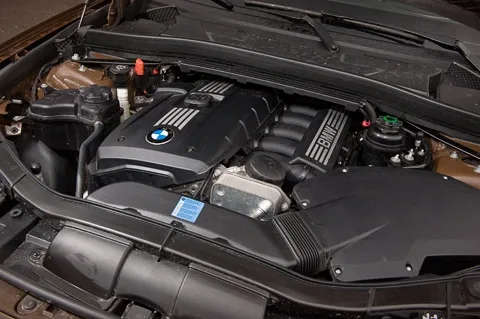
However, clean driving, without a hint of sliding, comes surprisingly easily to the BMW. Especially since under the hood of our example is the most powerful version, the xDrive28i. Here is the familiar inline three-liter petrol engine from other models, detuned to 258 hp. The "six" pulls with deliberate humming almost from idle, and the maximum 310 N•m is available already at 2600 rpm. Paired with it is an impeccable six-speed automatic that never misses a gear and seems to provoke you to drive faster. Acceleration to 100 km/h feels exactly as stated on paper — 6.8 seconds. But the most impressive is acceleration from 80 or 120 km/h. A wonderful engine!
Such brisk dynamics and a spirited nature — a description more fitting for some sports coupe than a crossover. And where are the body rolls, pitching, and other "crossover" habits? The "X first" has all of that, but in such microscopic doses that even the Audi A5 coupe would envy. We've already gotten used to the idea that an SUV twists and tries to lean over in corners, but we never expected that a BMW with the X prefix would outpace the Ingolstadt two-door on the track. In terms of asphalt behavior, none of the older brothers — neither X3 nor X5 — can compare with the X1. Except maybe the X6... And the most accurate comparison for this transitional "one" is with the third-series wagon.
In essence, that's what it is. Raised on longer and stiffer springs, with different front steering knuckles and different rear kinematics. Its own factory index E84 also means replacing the electromechanical power steering with an electro-hydraulic one. In our opinion, the steering has only become more informative because of this. Although the main goal of such modernization was to rid it of excessive vibration.
The wheelbase of the X1 and the "three" is identical — 2760 mm. At the same time, the crossover's length is even 73 mm shorter (4454). The X1's height is 1545 mm, which is 127 mm higher than the wagon, and its width is 1798 mm, 19 mm narrower. The curb weight is only 1685 kg — just 40 kg heavier than the all-wheel-drive wagon. A direct hit into the vacant premium niche of the segment where Tiguan and Qashqai reside. But the Audi Q5 and Infiniti EX are noticeably larger: on average seventeen centimeters longer and six to ten centimeters taller. Therefore, against their background, the X1 looks more frivolous.
The BMW crossover is not a rival to Audi and Infiniti. It's not just about the class, but also the sensations. In those cars, you feel more like you're in an SUV than a wagon. Here, it's the opposite. The proverb "sit high, see far" is not about the "X first." The seat is raised only one and a half centimeters higher than in the "three-touring." The seating is purely car-like, and the vestibular system almost doesn't need to adjust for height when perceiving lateral accelerations. There's no sense of a huge car at all. The seats with developed lateral support securely hold the body, preventing sliding on the leather upholstery.
Moreover, on the highway, the taller and heavier X1 behaves even slightly better than the regular "three." The main thing is that the crossover allows driving without unnecessary tension. It ignores ruts, holds the straight more confidently, and doesn't require constant steering correction at high speeds. There's less of that feeling of constant engagement that is characteristic of all BMWs. Excellent sound insulation also contributes.
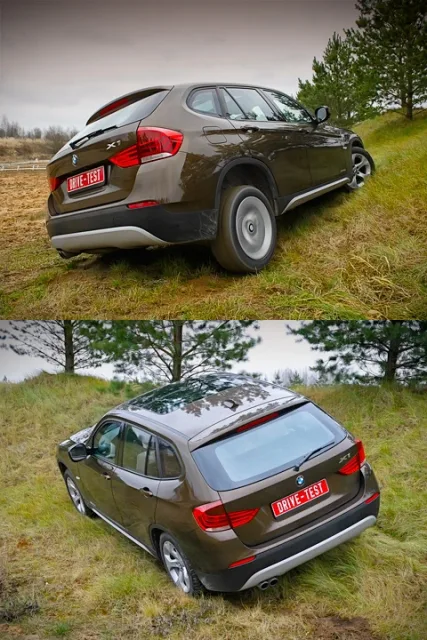
The worst situation is with ride smoothness. The X1 collects small irregularities faithfully, but on broken roads it shakes mercilessly. However, there's nothing to be surprised about: remember the BMW X3. And the almost 20 cm ground clearance shouldn't mislead. Look at the massive front overhang! The bumper with a metallic lip, like a shovel, scoops all the debris off-road right into the huge mouth. The suspension travel is car-like, and electronics can't overcome wheel articulation. There's no low-range gear. So most "sandboxes" will have to be taken at speed, crossing fingers and hoping the fancy body kit can handle it.
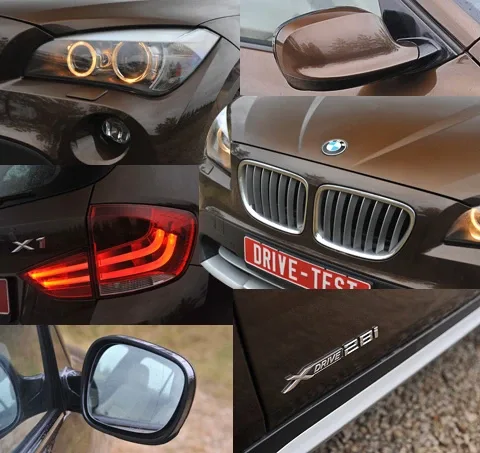
So, elevating the "X first" to the rank of saints and almighty would be a mistake. Although with its quirkiness, it could rival Egyptian deities. Those that had human bodies and animal heads. The BMW X1's image also seems composite. The large toothy jaws of the front and the sloping brow of the windshield, in our opinion, poorly combine with the low and somewhat unbalanced rear. Look from the front — a crossover, almost an SUV. Walk around to the back — no, it's still a wagon.
But such design is a necessary measure. Try to come up with something more harmonious that would neatly fit into the narrow niche of the model lineup. It wouldn't overshadow the existing "X three" and wouldn't harm the "three-touring." Here, you should blame not the designers' imagination, but the overly strict technical specification. Nothing else could have come out. How to put it more gently... an ugly handsome man?
But the paradox: it's precisely its strangeness that won over, for example, our correspondent Nastya Korolkova. "It's not like everyone else," she said and immediately sat down to calculate the test crossover in the BMW online configurator. Five minutes later, the delight turned to disappointment: from a car comparable to the Tiguan, Nastya expected a comparable price. But it turned out that the xDrive28i version in base at 1,799,000 rubles comes out too... basic. Leather interior, navigation, suitable body color, and sunroof raised the price to almost two and a half million. What can you buy for that money? Right: anything.
Therefore, the male half of our editorial team, under equal conditions, would choose instead of this "cocktail" — one-third sports car, one-third wagon, and one-third crossover — a pure product, for example, an all-wheel-drive third-series wagon. It's more attractive in appearance, and it doesn't need 194 mm of clearance to get rid of dirt on the wheels during diagonal articulation. But, if you believe Nastya, the BMW X1 crossover is one of a kind. And her opinion should be considered: it's precisely such cars that we will see on city streets perfectly clean and with the same girls behind the wheel. Those very ones who are right now sitting in the configurator and choosing interior trim to match the body color.
It's on them that the Bavarians will have an impact, talking about a revolutionary class of cars, reasoning about the "first of its kind," composing puzzles from model indices for them, and juggling technology names. The most curious thing is that BMW cannot be denied credit for cleverness. That is, "we understand," "you can't fool us," "the X1 is just a 'three' with increased clearance"... But the Germans so skillfully hid its essence in a new shell that it's already unclear whether it's worth disturbing it at all. The question is simple: how many Russians buy third-series wagons? And in a new guise?
Technical specifications
| Model | BMW X1 xDrive28i |
| Body |
| Body type | wagon |
| Number of doors/seats | 5/5 |
| Length, mm | 4454 |
| Width, mm | 1798 |
| Height, mm | 1545 |
| Wheelbase, mm | 2760 |
| Track front/rear, mm | 1500/1529 |
| Curb weight, kg | 1685 |
| Gross weight, kg | 2180 |
| Trunk volume, l | 420–1350 |
| Engine |
| Type | petrol |
| Location | front, longitudinal |
| Number and arrangement of cylinders | 6, in-line |
| Number of valves | 24 |
| Displacement, cm3 | 2996 |
| Max power, hp/rpm | 258/6600 |
| Max torque, N•m/rpm | 310/2600 |
| Transmission |
| Gearbox | automatic, six-speed |
| Drive | all-wheel, with multi-disc clutch in front wheel drive |
| Chassis |
| Front suspension | independent, spring, McPherson |
| Rear suspension | independent, spring, multi-link |
| Front brakes | disc, ventilated |
| Rear brakes | disc, ventilated |
| Tires | 225/50 R17 |
| Ground clearance, mm | 194 |
| Performance characteristics |
| Maximum speed, km/h | 205* |
| Acceleration time 0-100 km/h, s | 6.8 |
| Fuel consumption, l/100 km |
| — urban cycle | 13.0 |
| — extra-urban cycle | 7.3 |
| — combined cycle | 9.4 |
| Toxicity standard | Euro-5 |
| Fuel tank capacity, l | 63 |
| Fuel | AI-92-98 |
*electronically limited
Prices and configurations
Base configuration - Front airbags
- Side airbags
- Rear side airbags
- Inflatable curtains
- Isofix child seat anchors
- ABS
- Dynamic stability control
- Hill start assist
- Traction control
- Front fog lights
- Automatic transmission
- Brake pad wear indicator
- On-board computer
- Air conditioning
- Heated and power-adjustable rearview mirrors
- Heated windshield washer nozzles
- Fabric upholstery
- Leather-wrapped steering wheel
- BMW satellite anti-theft system
- Alloy wheels (R17)
- Runflat tires
Additional equipment of the test car - X-Line styling package
- Adaptive cruise control
- Bi-xenon headlights
- Adaptive headlights
- Rain sensor
- Light sensor
- Dual-zone climate control
- Rear parking sensors
- Rearview camera
- Nevada leather interior trim
- Multifunction sports leather steering wheel
- Front seats with power adjustment
- Driver's seat memory
- Electrochromic rearview mirror
- Navigation system
- Harman/Kardon audio system
- CD changer
- Integrated Bluetooth hands-free system
- External multimedia device connections
- Panoramic glass roof
- Metallic paint
Base price — 1,799,000
Price of the tested car — 2,753,615Technology
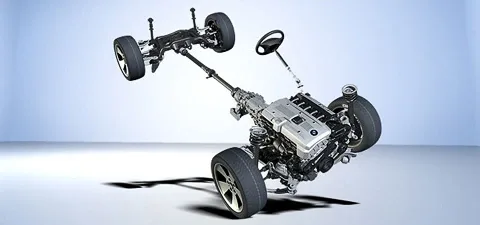
The inline six-cylinder petrol engine with a displacement of 3.0 liters and 258 hp (310 N•m) is one of the variations of the well-known N52 engine with the second-generation Valvetronic throttleless mixture formation system. The engine debuted back in 2004 on the BMW 630i coupe and was subsequently available in one form or another for every BMW model. In Europe, the latest three-liter naturally aspirated engines are equipped with direct fuel injection, while engines for Russia still use port injection. Without the ability to run on lean mixtures, but less demanding on fuel quality.
By default, the BMW X1 with the xDrive system is a rear-wheel-drive vehicle. The front axle is engaged by a multi-plate clutch on command from the electronics. When pulling away, the clutch locks, providing more dynamic acceleration, but if the wheels are slightly turned at start and the driver does not press the accelerator pedal hard, the clutch disengages.
During driving, the degree of locking constantly changes depending on driving conditions: vehicle speed, steering angle, lateral accelerations, and commands from the stability control system. This operating scheme is also known from other all-wheel-drive BMW models, but in the X1, the clutch is integrated into a new and lighter transfer case.
Interestingly, a rear-wheel-drive version will also be available to Europeans, while only xDrive versions are brought to Russia.
Safety
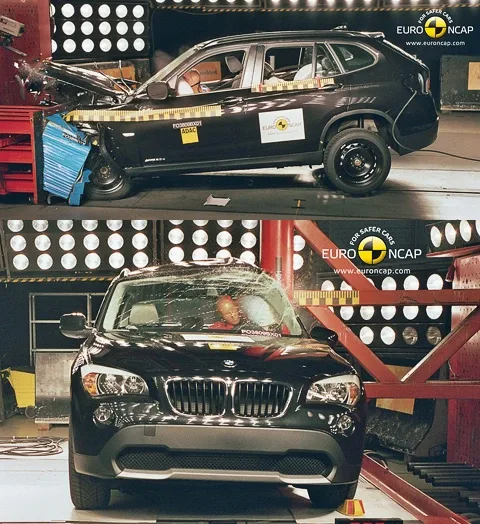
In Euro NCAP tests, the X1 earned the maximum — five stars. Protection for front occupants is 87%, and for children — 86%. The X1 is also quite friendly to pedestrians — a 63% protection level. Experts criticized the Bavarians for the high probability of chest injury to passengers in a side impact, and neck injuries to front occupants in a rear-end collision.
Design
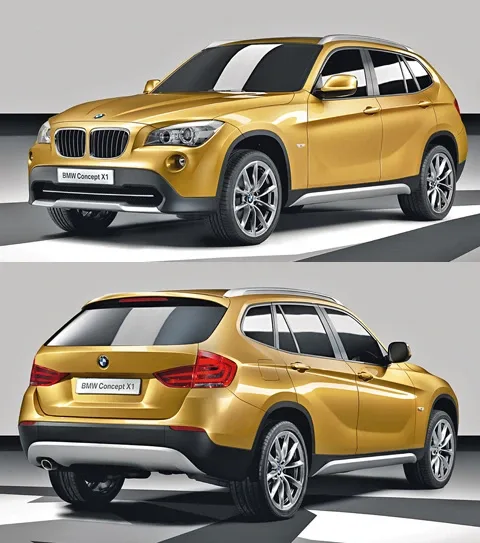
Rumors about the appearance of the smallest BMW crossover circulated for several years. But the debut of the conceptual prototype took place in the fall of 2008 at the Paris Motor Show. The debut, it must be said, was strange: after the press days, the car was removed from the exhibition, and the general public never saw it. However, the production version differs little from the concept.
Behind the scenes
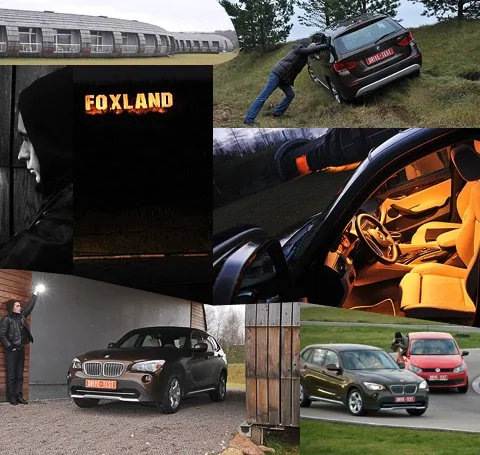
The test of the X1 coincided with the testing of two Polo hatchbacks, so the Bavarian crossover did not take its angelic eyes off them and followed the little ones closely: from the sports-shooting complex "Fox Hole" we liked to the karting track "Mayak" friendly to us and back.
And again, it would be a sin not to use a reader's photo who spied on our work.
By the way, some of our fellow journalists apparently believed in the off-road talent of the X1 — the car came to us with traces of violence. It was, apparently, submerged in such swamps, the mud from which is washed off along with the paint. We polished the car twice before shooting, but it only helped partially.