
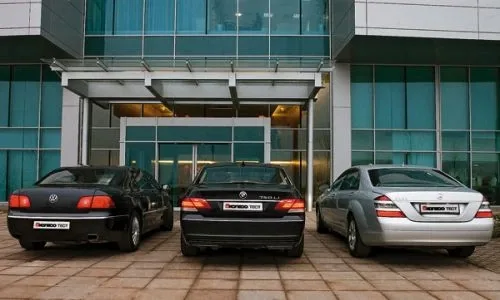
In business-class cars, it would seem that everything should be perfect. But even those who are ready to pay $100,000 for a car have a hard time. We asked Nikita Isaev — the author of a letter to our editorial office — to compare the Mercedes-Benz S 350 (W221), BMW 740Li, and Volkswagen Phaeton 4.2 Long. He had to choose a car for everyday business trips.
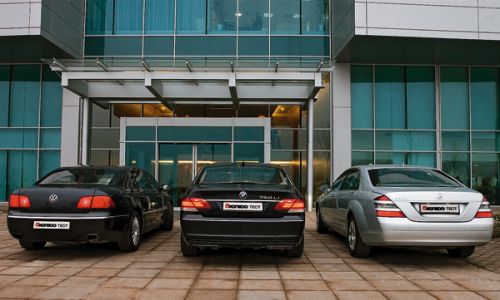
Mercedes-Benz S 350L vs Volkswagen Phaeton 4.2 Long vs BMW 740Li
© Photo: Sergey Krestov, 5 Koleso
In my opinion, in a car of this level, comfort for rear passengers is of primary importance. Driving qualities, of course, also matter, but they are more of interest to the driver. Design is no less important, and it should emphasize the owner's status. I think BMW and Mercedes-Benz handle this best. Everyone knows how much respect these limousines command on the road.
The "Seven" has changed after the restyling, and, to give credit, for the better. It began to look even more aggressive and solid. The design, which five years ago was criticized by everyone who could, is now perceived as a benchmark. Noticing the "angel eyes" in the rearview mirror, you involuntarily want to give way and let this car pass.
But the new S-class, unlike the seventh series, has changed radically. The 221st body successfully combines the impressiveness of the 140th and the elegance of the 220th. I especially like the silhouette. From some angles, the wheel arches and the edge that connects them along the side stand out effectively. In addition, the Mercedes has a very successful mirror shape, giving the car a sense of swiftness, and the rear lights remind of its kinship with the luxurious Maybach. The long version looks more harmonious than the regular one, although this is my subjective opinion.
I don't want to say that the Volkswagen Phaeton is less impressive. Its design is in a classic, even conservative style, which suits the executive class perfectly. But there is one nuance: it will take a long time before something changes in the minds of wealthy people. For many, Volkswagen still remains a "people's car." And the huge VW emblems on the radiator grille and trunk lid remind of this once again.
To be fair, it is worth noting that inside the Phaeton everything is made of high-quality materials, with excellent design and thoughtful ergonomics. I really liked the solid front panel, finished in dark marble, which hides the ventilation deflectors. When the airflow is turned "up," the panel automatically opens the air ducts. It looks beautiful and unusual. The metal inserts on the gearshift lever and armrests are also tastefully done.
The center console reminded me of Saab in some ways. Perhaps the similarity is given by the abundance of buttons and controls. Frequently used functions are placed on separate keys, while everything else is hidden in the multimedia menu. Although there is no selector like iDrive, managing the functions is no more difficult, and perhaps even simpler. Overall, the interior leaves a very pleasant impression. Moreover, the cabin here is the most spacious: there is plenty of legroom in the back, and the seat backs are adjustable.
But the sound insulation of the Phaeton disappointed me. Both road and aerodynamic noises are audible in the cabin. After 100 km/h, they become intrusive. For cheap cars, this is forgivable, but for a car worth a hundred thousand — hardly. However, it brakes better than all: an excellent braking system with an informative pedal.
In the BMW cabin, the materials are almost perfect — expensive leather, a successful combination of shades and textures. On the beautiful front panel, there are many handles, buttons, and controls, all in a unified style. The main thing is not to get confused in this abundance. When you sit behind the wheel of the "Seven" yourself, it seems that the car cares about you too much. Sometimes it starts to annoy.
The Bavarian's seats turned out to be the best in terms of the number of adjustments and profile. True, the control buttons are located on the armrest, and there are so many of them that they are not very convenient to use. The small items box in the front armrest is also not impressive in terms of convenience: its lid consists of two opening flaps. Beautiful, but impractical. I don't know why, but inside the "Seven" I feel uncomfortable. Apparently, it's a matter of taste.
But driving is undoubtedly BMW's trump card. A pleasant elastic steering wheel, clear responses to the pedals, and incredible gearshift speed. The car forces the driver to constantly stay on edge. Behind the wheel of this car, it is hard to drive calmly — you want to be mischievous and squeeze everything out of the engine, but the one sitting in the back is unlikely to like it. The suspension can be called quite stiff. Moreover, passengers experience discomfort during sharp acceleration and braking. Personally, I usually ride in the back, so BMW is not my choice.
Mercedes is the complete opposite. Any shortcoming in road behavior here is explained by a compromise in favor of comfort. The soft suspension does not notice a single bump. The gearbox shifts so smoothly that it will not disturb the passenger. In other words, there is absolutely no desire to drive recklessly here.
Among the unusual solutions, it is worth noting the speedometer, which is "drawn" on a liquid crystal instrument panel. Any information is displayed on this screen, including data from night vision devices. And one more important detail: the executive-class car has spoken Russian! All menus in the Command system are now in Russian. A small thing, but nice. The radio tuning is also original: on the central display, during station search, a slider moves, like on old radios.
Technical characteristics of Mercedes-Benz S 350L // VW Phaeton 4.2 Long // BMW 750Li
Curb weight, kg — 1925 // 2232 // 1925
Gross weight, kg — 2525 // 2750 // 2100
Dimensions, mm:
— length — 5206 // 5175 // 5180
— width — 1871 // 1903 // 1900
— height — 1473 // 1450 // 1480
Wheelbase, mm — 3165 // 3001 // 3130
Maximum speed, km/h — 250
Acceleration time to 100 km/h, s — 7.2 // 6.9 // 6.0
Control fuel consumption, l/100 km:
— urban cycle — 14.5 // 18.9 // 16.9
— suburban — 7.7 // 9.8 // 8.3
— combined — 10.1 // 13.1 // 11.5
Engine: with fuel injection;
— type — 6-cylinder, 24-valve // 8-cylinder, 32-valve // 8-cylinder, 32-valve.
— displacement, cm3 — 3498 // 4172 // 4799
— power, hp at rpm — 272/6000 // 335/6500 // 367/6300
— torque, Nm at rpm — 350/2400 // 430/3500 // 490/3400
Transmission — 7-speed automatic // 5-speed automatic // 6-speed automatic
Tire size — 235/55R17 // 235/55R17 // 245/55WR17
Wheel suspension:
— front — independent, on pneumatic elements of McPherson type
— rear — independent, on pneumatic elements
Brakes (front/rear) — disc, ventilated/disc
Steering — rack and pinion, with power steering
Price — from 89,000 euros // from $92,000 // from $104,900.
Advantages and disadvantages
Mercedes-Benz S 350
+ Smooth ride, Russified Command system.
— Brakes, gearbox operation.
VW Phaeton 4.2 Long
+ Interior, brakes, smooth ride.
— Sound insulation, trim materials.
BMW 740Li
+ Handling, seats.
— Too stiff suspension, iDrive control.
WHO WON?
Each car is good in its own way. The Phaeton will suit someone who looks at the essence of things and does not pay attention to brands. Despite its apparent simplicity, it has its advantages: original interior solutions and space on the rear sofa. BMW is created for those who are not limited to trips in the back seat.
This car can deliver real driving pleasure. True, the driver-oriented chassis setup may not please the main passenger.
And Mercedes-Benz, as always, is designed for the most serious and businesslike people. Here, the main thing is the peace and comfort of the one sitting in the back. Although the driver is also fine here. Do you know how a Mercedes owner differs from a BMW owner? BMW is a car for those who are in a hurry, and Mercedes is for those who have already succeeded. At the disposal of the "successful" is a wonderful office on wheels. So my choice is Mercedes.
May 2, 2006
Author: Nikita Isaev
© 5 Koleso