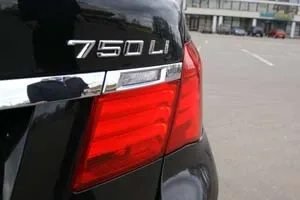
BMW 750 Li
BMW 7 Series Sedan
Engine — 4.4 liters
Peak output — 407 hp at 5500 rpm
Torque — 600 Nm from 1750 rpm
Top speed — 250 km/h
Sprint to 100 km/h — 5.3 seconds
Fuel consumption:
city — 16.4 L
highway — 8.5 L
combined — 11.4 L
6-speed automatic
rear-wheel drive
Curb weight — 2055 kg
Length — 5212 mm
Width — 1902 mm
Height — 1478 mm
Ground clearance — 144 mm
Tires 245/55R18 (winter)
Price — $178,876 (UAH 1,431,000), starting — $135,902 (UAH 1,087,209)
Equipment:
Automatic ride height adjustment, Dakota leather upholstery, satellite alarm, navigation, TV tuner, Hi-Fi Professional audio system, 6-DVD changer, door soft-close, three video cameras, two air conditioners, full electric package, four-zone climate control, parking sensors, cruise control, head-up display, power trunk closer, power sunroof, iDrive, 10.2-inch display, infrared night vision camera, lane departure warning system, auxiliary heater
Service intervals:
every 25,000 km
Each service will cost 12,000–15,000 rubles
Warranty — 2 years without mileage limit
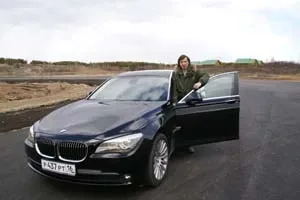
Alfred Mardanov, “Avtoclub-Kazan”
Involuntarily, the phrase from a famous movie comes to mind: “BMW 7 Series is a cool car!” But saying that about the new “Seven” means saying practically nothing. The creation of Bavarian engineers categorically does not fit into the short definition of “cool car.” Honestly, it even fits into the concept of “automobile” with a stretch. I would call this car transport from the future — and here it is, that future, already materializing right before our eyes in the form of the BMW 750i with its innovative solutions. Take, for example, the system that captures kinetic energy during braking and directs it to recharge the battery. No, no, we are not talking about a hybrid — under the hood is the most ordinary BMW gasoline engine with 407 horsepower.
To increase engine output during acceleration, the alternator is switched off, and all onboard electrics are powered by the battery, which then needs to be recharged. How pleasant it is to realize that this car remains one hundred percent BMW. It is tuned, as befits any BMW, for dynamics, handling, and drive. I have always admired BMW's ability to create cars that combine the incompatible. Judge for yourself: a representative-class sedan is sharpened for active driving, and this is not marketing promises but reality. Although the engineers did make a compromise by providing different tuning modes for both the engine and the chassis. I am talking about four comprehensive modes: “Comfort,” “Normal,” “Sport,” and “Sport Plus” (and the engine and suspension can be configured separately).
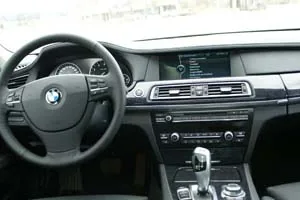
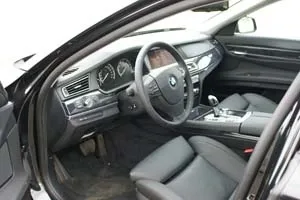
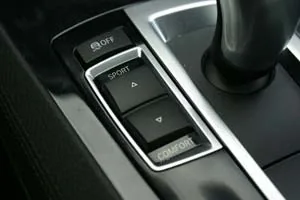
In “Comfort,” the suspension becomes noticeably softer, and on wavy sections due to the long wheelbase, the car begins to rock in the longitudinal plane. In “Normal” mode, the car adapts to the road condition and driving style, independently “figuring out” the settings. In “Sport,” the suspension noticeably firms up and stiffens, the engine more readily holds high revs, and the gearbox is in no hurry to shift up, allowing the engine to rev to the red zone. “Sport Plus” is the same, but additionally, the stability control systems are completely disabled. This is what I especially value BMW for — honest disabling allows you to truly feel the car. With most manufacturers, deactivation of such systems happens delicately, only pushing back the activation threshold. By the way, due to the confusion in the names of stability systems among different brands that perform the same function, this button has now received a new unified graphic designation, according to updated norms.
The list of options for this car stretched to no less than five pages! You understand, even a simple listing would take a lot of time and space. And to figure out all this stuff, you either need to take special courses or increase the crew to two people.
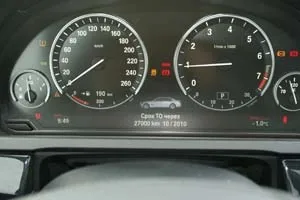
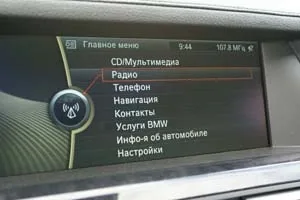
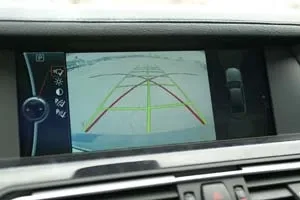
One driver controls the car, the other controls its functions. The paper instruction manual in thickness would resemble a volume of Marx, so the engineers simply loaded it into the onboard computer — fortunately, it understands Russian, which is very pleasant. In addition to the CD, above the glove box there is a six-disc DVD changer, and there is also a TV tuner. You won’t surprise anyone with the usual rear-view and surround-view cameras hidden in the bumper sides, but they are convenient to use. You can “stick your nose out” and look around the corner to see what is happening on the road. The infrared night vision camera helps distinguish pedestrians in the dark, caring for their safety. The satellite anti-theft system reliably guards your BMW, and NAVITEL navigation with 3D mode is not yet working at full capacity — Kazan will fully connect to it in the fall. Then the all-wheel-drive xDrive version will also appear.
The projection of speed, navigation prompts, and service icons onto the windshield is an amazing thing: everything is perfectly readable and does not distract from the road at all. And in the case of this car, keeping an eye on the road is not at all superfluous. When I drove around the city, I was really afraid to press the gas. The car takes off at the speed of sound (the claimed 5.3 seconds to 100 km/h), you don’t have time to look back — it’s already 120, and the pedal is only pressed halfway. I think it is unnecessary to talk about BMW ergonomics — it is ideal, except for the small side mirrors. When changing lanes, I felt discomfort due to the blind spot. But such a “little thing” as the extendable cushion that increases the width of the seat allows you to feel like in a home armchair — and you don’t want to leave it at all.
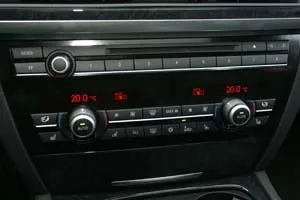
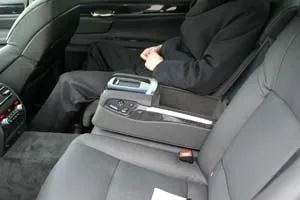
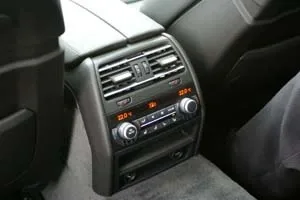
This also applies to rear passengers, even to a greater extent. For them, a separate air conditioner with an ionizer is provided, which destroys bacteria inside the system, and does not ionize the air, as one might assume. Thanks to two air conditioners, the cabin cools down in a matter of seconds. A convenient table-armrest with seat position control keys, huge space, and comfort make the trip truly pleasant. Although I cannot forgive the car for not finding a place for a jacuzzi even in the list of additional options.

Marat Makhmutov, “Kazan School of Higher Driving Skills”
In February of this year, on our site, the ice specially prepared at the beginning of winter for emergency driving courses was just beginning to give way to dry pavement with a high coefficient of friction. It was then that I first got acquainted with the BMW 750 Li. The most vivid impression from that short acquaintance was the tendency of the Bavarian sedan, with stability control disabled and careless handling of the steering wheel and gas, to instantly spin on slippery surfaces — the “culprit” being rear-wheel drive and the colossal torque of the powerful engine. The peak power of the gasoline V8 with Twin Turbo double turbocharging is 300 kW, or 407 hp.
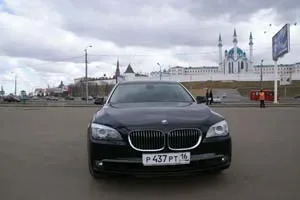
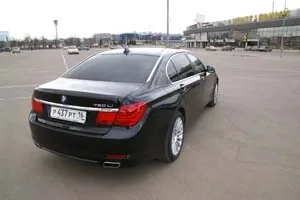
I got to deal with the long-wheelbase “Seven” in detail already in more favorable conditions — the snow had melted, and the roads finally freed from spring mud. The new generation of the Bavarian flagship, the fifth in a row, received the factory index F01, while its predecessor in the fourth generation was designated E66. Along with the new designation, Munich decided to abandon Chris Bangle’s bold design solutions — they were not to everyone’s taste. I myself am among those who, having sold my “Five” in the 39-series body, never came to terms with the aesthetics of the E60. But the most fundamental step was made in the chassis: instead of the traditional McPherson struts at the front, there are now double wishbones. The last time such a scheme was found on a BMW was in 1965, so the new here is indeed well-forgotten old.
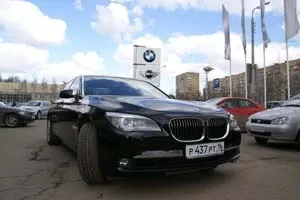
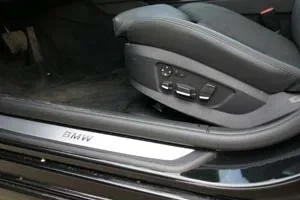
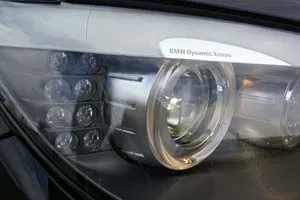
As for the interior, its description fits into one word — luxury. Everywhere is high-quality “Dakota” leather: on the steering wheel, dashboard, seats, and the front seats are equipped with electric drives and memory settings. On the door cards and in pockets — artificial leather, which in texture is almost indistinguishable from natural. Dark wood inserts on the doors and panel, electric sunshades on the rear windows, sunroof — the list of options for the test car was almost exhaustive. Here you have four-zone climate control, satellite navigation, speed projection on the windshield, cameras at the rear and sides, and the Integrated Chassis Management system responsible for unified suspension control.
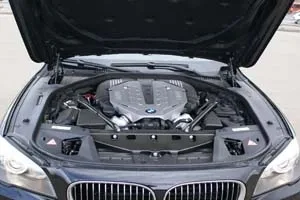
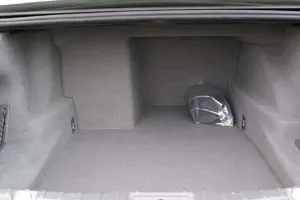
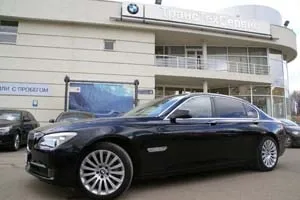
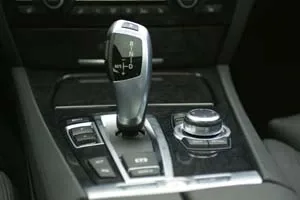
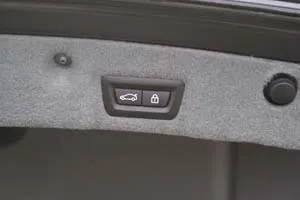
A solid black sedan, 5 meters 21 centimeters long, looked a bit out of place on the training ground, so it was decided to move the test route to a suburban racing circuit. Especially since the tires on this "seven" were non-studded — cars with studs are simply not allowed on the track to avoid damaging the expensive surface. We settle into the cabin and immediately discover a pleasant detail: you don't need to wait for the door lock to click shut — soft-close mechanisms will do it for you. A similar mechanism is provided for the trunk as well. The selector of the six-speed automatic, almost like the joystick familiar from the X5, is moved to "D," and we're off. With a smooth press of the gas pedal, the V8 reveals itself unexpectedly softly: the heavy and sizable car accelerates without the slightest strain, as the peak torque of 600 Nm is available from 1750 to 4500 rpm.
But if you press the accelerator more sharply, the long-wheelbase BMW literally shoots forward. The claimed 5.3 seconds to 100 km/h are not empty words. And this is despite the fact that in front of us is not a sports car, but a luxury limousine! By the way, about the engine: despite the 750 designation, the displacement here is not five liters, but 4395 cubic centimeters. The twin-turbo allows this V8 to produce power comparable to a naturally aspirated five-liter, hence the discrepancy in numbers. But this scheme, according to the manufacturer, also provides fuel savings: in the city cycle, 16.3 liters per 100 km is claimed. If this is true, then the manufacturers with the blue-and-white propeller can only be applauded — after all, 15 liters for gasoline cars with 2–2.5 liter engines and an automatic is not uncommon. The suspension in "Sport" mode was quite comfortable in the city, but switching the electronically controlled dampers to "Comfort" with the button to the left of the automatic transmission selector allowed us to completely forget about our road irregularities. The extended wheelbase of 3210 millimeters also contributes.
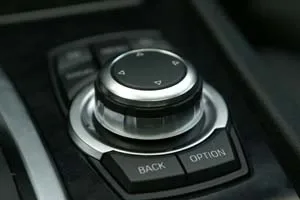
On the suburban highway, I managed to be both a front passenger and behind the wheel. Sitting on the right, I tried to explore the capabilities of iDrive — there's a wealth of information there. Satellite navigation (though, unfortunately, it didn't have maps of Kazan), diagnostics of component status, a car manual, radio settings, and many system settings... It seems that mastering all this will take time comparable to the full ownership period of such a car. The passenger seat, as it turned out, can also be adjusted from the rear row — buttons are provided for this. Not surprising: such cars are usually driven by hired drivers, while the boss himself sits in the back on the right. The front seat is apparently for security. The rear seats here have both heating and ventilation, as well as a separate climate control.
Expectations from the driver's seat were fully justified. The engine, the responsive floor-mounted gas pedal, the comfortable multifunction steering wheel — everything is in place. Overtaking slow trucks and other slow-moving vehicles is done playfully, with the noble roar of eight cylinders and a beautifully tuned exhaust note. The head-up display projecting speed onto the windshield proved very useful — no need to glance at the speedometer, which is especially important at high speeds. On one section of the track, the needle reached 221 km/h, and believe me, at that moment you definitely don't want to look at the instruments again. At the same time, the "seven" was absolutely stable, without any deviations from course and without requiring steering corrections, confidently gripping the road with 245/50 R18 tires.
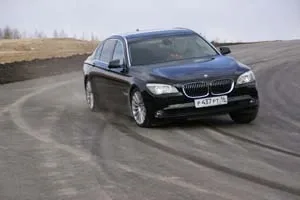
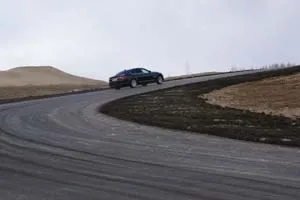
Finally, we reached the racing circuit. How will our subject behave on the 3.5-kilometer track with variable profile and many turns? On the track, the BMW holds up excellently, confidently tracing arcs despite its executive character. But once you exceed the grip limit, the electronics instantly and rather roughly intervene, reining in a driver who's gotten too carried away. However, if you turn off the stability control, the limousine turns into a drift machine! Press the gas a bit harder in a corner — and over 400 horsepower swing the car sideways across the road, reminiscent of ice racing in February. The seatbelts meanwhile hold everyone firmly in their seats and only release on straights. How about timing a lap?

We start the timer. Full throttle — and after the wheels have covered more than half a lap, the car bounces over a barely noticeable bump on the exit of a corner, and the engine suddenly loses power. We have to stop. We turn off the engine, start it again — everything works. We try again. And again, at the same spot, the engine refuses to work. This is already an alarming symptom. It seems it's time to end the extreme driving and return to a measured, dignified pace. However, there's nothing particularly surprising here: this car is not a sports car; its task is to comfortably transport its owner. And it does this perfectly, and for the executive class, it has retained a sporting streak, inherent to one degree or another in all Bavarian cars. But the price of almost five and a half million rubles is already a serious filter separating those who want such a car from those who can afford it. However, the powers that be have their own ideas about economics.