
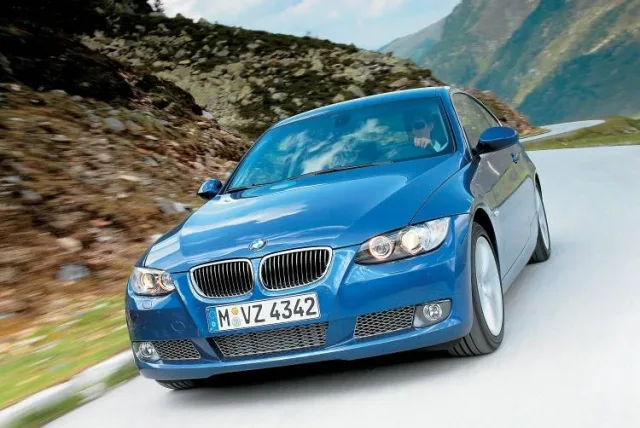
After all this, people definitely cannot be trusted. How many times have we been told: turbocharging is not for Bavarians, they will remain faithful to naturally aspirated high-revving engines until the end of time... But then how do we explain the playful whistling of two turbos under the elegant hood of the new BMW 335i coupe?
Don't trust anyone. No one.
On the other hand, if it weren't for this whistle, you'd never suspect the inline six of being a turbocharged unit. And does it really matter what methods the Munich demiurges use to reach their peaks?
In ancient Greek, the word "demiurge" before Plato meant ordinary craftsmen—those who make useful things for people: weavers or potters. Only after Plato did the demiurge become the Creator, building his own universe.
BMW engineers are demiurges in both senses. Craftsmen? Undoubtedly. They simply make cars. But at the same time, they are Creators. The best engine, the best chassis—only they can do this. Even the best British cars—the new Mini, Rover 75, or Rolls-Royce Phantom—were born not in Britain but in Munich.
The same goes for design... Under the leadership of Christopher Bangle, the Bavarians have excelled in what is commonly called product design. The new third-series coupe is a prime example of this approach. The car is beautiful primarily as an object of design creativity. How lines intertwine, how edges and smooth curves harmonize—in that style that on the BMW X Coupe concept of 2001 bore the poetic name flame surfacing, "flame surfaces"...
 |  |  |
| The interior differs from other third-series cars in trim details—for example, metallized inserts with a "grey chrome" finish | The "automatic" gears can be changed using two-arm paddles on the steering wheel—like on the discontinued unsuccessful SMG "robots" | The seats are magnificent, the driving position is exemplary |
So aren't the Bavarians demiurges? They created their own design universe—and experiment in it with delight. But these experiments increasingly make one look back with longing at the old "threes," "fives," and "sevens." Maybe because for their creators they were primarily cars, and only then abstract objects of "product design"?
Yes, the new coupe is infinitely far from its direct ancestors—the two-door E21 or E30 of the seventies and eighties. In those days, the third-series coupe differed from the sedan only in the number of doors. The E36 coupe of the nineties already had a slightly different silhouette. And only the two-door E46 "threes" of 1999 marked the beginning of a new canon—not sharing a single exterior panel with the sedans.
The E92 series is the culmination of this process. Although the E92 coupe is entirely based on the E90 sedan and differs from it neither in wheelbase nor chassis design—the car looks completely different. It is 60 mm longer thanks to a more extended trunk, and the rear lights—praise the demiurges!—are done in a completely different way, in the style of the refreshed "seven." Moreover, the tail lights in them are long horizontal strips of red LEDs. Very striking! And the "corona rings" built into the uneven round headlights glow even during the day—for extra safety.
 | ||
| At the back—two full-fledged cozy berths | The "arms" of the automatic seatbelt feeder hide in the pillars |
For the person behind the wheel, there is nothing unfamiliar in the interior of the new car—everything is like in the sedan. But at the back—two cozy berths with a box-armrest separating them. It's not cramped at all—this is a full-fledged four-seater, no worse than the sixth series. And in some ways even better! After all, the "sixes" don't have automatic seatbelt delivery for front occupants, but the third-series two-doors do. You close the door, start the engine by pressing the start button—and a telescopic "arm" extends from the center pillar with a slight hum, delivering the belt strap. It holds it—and retracts back, pretending to be part of the chrome molding.
By the way, this "grey" chrome is made specifically for the interior of the third-series coupe.
And of course, for the coupe, the chassis components of the third-series sedans have been recalibrated: stiffer springs, shock absorbers, stabilizers, and silent blocks. Plus a 15 mm reduced ground clearance. The coupe body is stiffer than the sedan's, and the curb weight is even 10 kg less thanks to fenders made of new durable and heat-resistant plastic, which are attached to the metal before painting.
But the suspension arms, subframes, steering, transmission—everything remains unchanged. Moreover, for the coupe, as for the sedans and wagons, all-wheel drive xDrive is offered for an extra charge! Such luxury could be afforded by BMW third-series owners only in the second half of the eighties, when all-wheel-drive BMW 325iX could be bought in all three guises—with two, four, and five doors.
However, for the introduction in Austria, the Bavarians brought rear-wheel-drive coupes. But the most powerful—BMW 335i with the new three-liter bi-turbo engine.
So, after all, turbocharging...
Why did the Bavarians, who for so many years fervently professed the naturally aspirated faith, need it? After all, the naturally aspirated three-liter "six" on the BMW 330i develops 272 hp, and with two turbochargers and direct gasoline injection—306 hp. What's the point of having two power units so close in power?
— We have to move forward, — the people from BMW calmly explain. — Power is growing, and we are not going to abandon our inline sixes. Therefore, turbocharging is a logical step. Besides, it's not just about power. The torque of the 335i engine is 400 newton-meters! Appreciate how easy it is to manage the thrust...
Easy is not the word.
Even in a car with a manual gearbox, which has very, very "stretched" gears (on second, the BMW 335i reaches as much as 120 km/h!), the most natural of all American blondes can start without any problems. Third gear is like an "automatic." Without shifting, you can crawl like a snail, dropping the tachometer needle to 1000, and a few seconds later break every speed limit conceivable in Austria. And no turbo lag: the engine revs smoothly from idle to the maximum 7000 rpm.
What Bavarians—to take and make a turbo engine completely disguised as a naturally aspirated one! A turbo engine that is more powerful and "smoother" than all current analogues with direct injection, including the Audi 2.0 TFSI and Mazda 2.3 DISI engines! I think I know which power unit I will vote for in the three-liter class of the Engine of the Year competition...
But why did Munich return to turbocharging only now, more than 20 years after the last attempt—on the inline six of the BMW 745i of the E23 series from 1979?
— Back then, turbo technology was imperfect, — the Germans state their point of view. — We faced a lot of problems. Thirstiness, breakdowns...
Interestingly, enthusiasts of the brand are still delighted with the BMW 745i. Just read the internet forums, where you won't find a single bad word about the reliability of these cars. But the people at BMW, of course, know better.
— And only now have turbochargers appeared that suit us in all respects, — the Bavarians continue their explanations. — Besides, it's about the combination: turbocharging plus the latest generation direct gasoline injection system, without which we couldn't achieve such efficiency...
These are not empty words. The BMW 335i engine is interesting not only because each three cylinders are "fed" by its own small low-inertia turbocharger—Japanese, Hitachi brand, made with the latest heat-resistant materials. But also because the Germans managed to place both the direct injection nozzle and the spark plug in the center of the chamber.
It is in such nuances that the know-how lies. The fineness of the gasoline spray (at a pressure of about 180 bar), the shape of the "direct" cone that doesn't touch the cylinder walls, the duration and precision of dosing—using the latest piezoceramic valves... Everything is calculated so that the gasoline fully mixes with the air from both intake ports, ignites with 100% reliability from the spark that jumps in the plug with two clever side electrodes—and burns completely. In any mode, whether idle or fully open throttle.
True, the naturally aspirated three-liter BMW M3 engine back in 1992 developed 286 hp, and the 3.2-liter engine from 1996 already exceeded 100 hp/l in specific output. Without any turbocharging.
But the people at BMW don't mention torque for nothing. Squeezing as much as 400 newton-meters out of three liters without forced induction is impossible. And if the current naturally aspirated M engines pull properly only at high revs, the BMW 335i "gets on plane" at almost any rpm except idle. After all, the compact turbochargers start "blowing" their maximum allowable 0.6 atmospheres (limited by the wastegate) already at 1300 rpm!
It feels exactly like there's a V8 under the hood.
And yet, even with two turbos and intercoolers, the inline-six is 70 kg lighter than a V8. And it asks for less fuel.
And the sound! There's the signature smoothness of inline-sixes when revving, and a noble velvety exhaust note... But new notes are mixed into the familiar melody, ones BMW never had before. Not only does the BMW 335i loudly vent excess air through the blow-off valves when you lift off the throttle after hard acceleration. But if you drive steadily, keeping the tachometer needle around 4000 rpm, a barely perceptible vibrating pulsation comes from under the hood — as if two aircraft propellers were humming somewhere far away, slightly out of sync with each other. Could it be sound interference from the pair of turbochargers?
The twin-turbo six will remain the flagship engine of the coupe until the new BMW M3 with a V8 of around 400 hp arrives. Although 306 hp and a 0-100 km/h time of 5.5 seconds for the BMW 335i is already the level of dynamics of the M3 from ten years ago. And what would happen if you add a limited-slip differential and flash the engine with a chip tune?
The junior versions of the coupe are the BMW 325i (218 hp) and BMW 330i (272 hp). There are also diesel options — the BMW 330d (231 hp, 500 Nm) and the BMW 335d with a high-tech twin-turbo diesel producing 286 hp and a phenomenal 580 Nm! The BMW 335d with a manual gearbox shoots to 100 km/h in 6.1 seconds! True, the most powerful diesel is only available with a manual gearbox, and all-wheel drive is not offered for it.
Speaking of gearboxes. After testing the new E90 sedans, we unanimously noted that BMW's automatics had become worse. It turned out that the Germans, together with ZF specialists, were preparing a new generation of transmissions for release — they are still six-speed, but they respond to driver commands twice as fast. You're driving calmly in sixth, you sharply press the gas — and the gearbox instantly drops to second, in just a tenth of a second!
Manual shifting is convenient with two-arm paddles under the steering wheel — each of them works for both upshifts and downshifts. And thanks to the fact that the torque converter lockup only disengages when starting off and shifting, the new automatic gives an amazing feeling of a direct mechanical connection between the engine and the wheels.
Wizards, the Bavarians. Demiurges.
And about the chassis — not a single bad word!
For an extra charge, the two-door can be equipped with active steering, AS, Active Steering. With it, the car becomes incredibly convenient in the city — just 1.8 turns of the thick steering wheel from lock to lock. The only downside is less "transparent" feedback due to the additional reduction gear on the steering column. But on "threes" without AS, you can enter corners even with your eyes closed — the "steering feel" is ideal. But... Three turns of the steering wheel — in slow corners you'll have to shuffle steer. Here the Bavarian demiurges have something to work on.
The suspension noticeably shakes even on the rare joints of Austrian asphalt. Most likely, this stiffness on small seams is the merit of the "run-flat" tires, whose reinforced sidewalls allow driving on a flat tire. But as soon as you pick up speed, the stiffness disappears, the BMW literally flies over the road. I caught a slight rocking only once — when with two passengers I was throwing the coupe from one autobahn corner to another.
True, the speedometer then showed...
Well, I admit, I couldn't resist. But the Bavarians are also good — arranging a presentation of a car with the dynamics of an "M" car not in Germany or Portugal with its hooligan traditions, but in prim Austria, where everyone crawls even slower than the allowed 130 km/h! And how can you resist here, if the BMW 335i with incredible ease lays the speedometer needle on the limiter?
Except that the last 40 km/h of acceleration become a bit calmer. And I was so carried away watching the needle that I missed a policeman.
A striped Volkswagen Sharan with red stripes was standing on the roadside. The driver was reading a newspaper. But he surely has a radar. And I have 250 km/h!
Braking, I frantically ran through the scenarios in my head. First, the lights will flash in the mirror. Then they'll stop me, stun me with a fine with a bunch of zeros... Maybe even ban me from entering Austria.
Forgive me! I won't do it again! It was an accident — it's all BMW, they're to blame!
But the policeman didn't even raise his head: I whizzed past like a bullet. And at the next checkpoints (the same minivans stood every five kilometers) no one stopped me for some reason.
Glory to the Creators...
But the provocative essence of the BMW 335i is obvious. A car with power-to-weight ratio that only supercars had twenty years ago, yet incredibly easy to drive. The design is clearly made to be reflected in the windows of SoHo, Tverskaya, or Fifth Avenue. Glamorous luxury with racing content. A ripe apple on the automotive tree of knowledge.
Creating such a thing is possible not just for craftsmen — but for demiurges.
Geometric parameters
Length, mm — 4580
Width, mm — 1782
Height, mm — 1395
Wheelbase, mm — 2760
Track front/rear, mm — 1500/1513
Turning circle, m — 11.0
BMW Coupe third series* (manufacturer data)**
| BMW 325i | BMW 330i | BMW 335i | BMW 330d | BMW 335d | |
|---|---|---|---|---|---|
| Number of doors/seats | 2/4 | 2/4 | 2/4 | 2/4 | 2/4 |
| Engine | petrol, with distributed injection | petrol, with distributed injection | petrol, with direct injection, turbocharging and intercooler | diesel, | diesel, |
Here is the revised test drive text:
Turbocharging in BMW's history did not appear yesterday. Back in 1969, the racing BMW 2002ti with a 290-hp turbo engine won the European Cup in circuit racing. And in 1972, a turbo engine was installed on the BMW Turbo concept, on which designer Paul Bracq, who had just joined the company, worked. From 1973 to 1974, the BMW 2002 turbo two-door was produced — the 2.0-liter engine produced 170 hp, and this model became the first production car in Europe with turbocharging. Because the turbocharger was placed on the right at the bottom under the hood, the car lost its air conditioning and right-hand drive version.
The car's driving characteristics were excellent: it reached 100 km/h in 6.9 seconds, and the top speed was 211 km/h. However, the fuel crisis and a number of design flaws forced BMW to cease production of the turbo version ahead of schedule.
Then BMW turbo engines moved to racing tracks — in touring car championships and Formula 1. But in 1979, turbocharging unexpectedly returned to production models: the inline-six of 3.2 liters on the BMW 745i, thanks to a turbine, gained 36 hp and began to produce 252 hp. Acceleration to 100 km/h for such a "seven" took 7.9 seconds, top speed reached 227 km/h. Due to the unusual power unit and rich equipment, the BMW 745i of the E23 series was a rarity, almost an exclusive.
It was not without mention of Alpina. In 1978, it began small-scale production of the Alpina B7 Turbo based on the "five" E12 or the sixth series coupe E24. Under the hood was a three-liter "six" with a KKK turbocharger, developing 300 hp. And from 1989 to 1994, the Alpina B10 BiTurbo was assembled on the basis of the BMW 535i: a 3.4-liter engine with two Garrett T25 turbines — one for every three cylinders, like a modern twin-turbo engine — produced 360 hp and 520 Nm.
An interesting detail: all three production turbo engines of BMW are united by one parameter — the standard boost pressure of both the BMW 2002 turbo, the BMW 745i, and the current BMW 335i does not exceed 0.6 bar.
Coupe line
BMW positions the new coupe above sedans and station wagons — the two-door is presented as a more expensive and prestigious car. This is a classic "up-market" marketing technique, a game to increase the prestige of the third series coupe. When it comes to the pedigree of "threes" with a coupe body, the Bavarians without hesitation include both the luxurious pre-war BMW 327, and the eight-cylinder BMW 502 and 503, and even models of the sixth and eighth series!
But let's not forget: before the appearance of the first "three", it was the two-doors that were the smallest and most affordable in the BMW range. Therefore, the history of the current coupe is more correctly traced from the brand's firstborn — the licensed English Austin Seven, which was produced under the name Dixi 3/15 PS in Eisenach since 1928. Two doors, closed body, four seats... In 1932, the Dixi was redesigned into the BMW 3/20 — the car became larger and more powerful. And a year later, the first own BMW model 303 appeared, equipped with the first six-cylinder engine of 1.2 liters and 30 hp.
The next predecessor of the current "three" is more logical to consider not the BMW 327 (it was a real luxury coupe — refined and very expensive), but the BMW 321: a beautiful two-door with a swift silhouette. Many of these cars came to the Soviet Union after the war as trophies.
The first post-war compact two-door BMW, not counting the licensed Isetta motor scooter, is the rear-engined model 700, created by Giovanni Michelotti. However, the true ancestors of the two-door "three" were the "new class" cars that appeared in 1961 — these were affordable and compact representatives of the "02" series. The BMW 1602, 2002, 1802, and 1502 models, which came out one after another, were hugely successful and created the basis for the brand's reputation as a manufacturer of cars with excellent handling. And the BMW 2002 turbo of 1973–1974 is, in fact, the direct ancestor of today's BMW 335i!
 |
 |
|
| The BMW 700 (1959–1965) had a two-cylinder engine at the rear with a displacement of 700 cc, borrowed from a motorcycle — it produced 30 hp. The body was made load-bearing for the first time. Due to its similar layout and light weight (640 kg), the sporty modification of the "seven hundred" (40 hp) was dubbed "Carrera for the working class" | The first coupe of the "new class" BMW 2000 CS (1965–1970) stood out with its refined design: there was no central roof pillar (in fact, it was a hard-top), and at the rear there was a "Hofmeister kink". The two-liter "four" had a power of 100–120 hp, and the maximum speed reached 185 km/h | In 1966, based on the 1600 sedan, a two-door was made — it became the founder of the "02" series. The 1.6-liter engine (85 hp) accelerated the car to 166 km/h. In 1968, the BMW 2002 began to be equipped with a two-liter engine (100 hp), and in 1973–1974 the BMW 2002 turbo was produced |
In 1975, the third series officially took shape as a separate family — with the appearance of the two-door E21 series, whose indices began with the number 3. The design of the small "sharks" was worked on under the leadership of the then chief designer of BMW, the outstanding Frenchman Paul Bracq — it is to him that we owe the interior concept of the "cockpit" with a front panel turned towards the driver. This idea lasted on BMW until the "seven" by Christopher Bangle…
The next third series E30 (1982–1990) had not only two-doors — the "threes" were for the first time produced with four doors, as well as in station wagon and convertible bodies. And the all-wheel-drive two-door coupes BMW 325iX are the direct predecessors of today's coupes with xDrive all-wheel drive.
Finally, the two previous series E36 (1993–1998) and E46 (1998–2000) increasingly differed from their four-door siblings, and the current E92 coupe has finally moved up-market — "up the market". But the place of compact coupes will not remain empty — it will be taken by the two-door "one", which is expected in 2008.
 |
 |
 |
| The third series BMW with the E21 body (1975–1982) existed only as a two-door, and two years after its debut it received an inline six-cylinder engine. First — a two-liter carburetor (124 hp), then with fuel injection (2.3 L, 145 hp) | The "threes" of the E30 series were produced from 1982 to 1990. The photo shows the two-door BMW 325iX, which was produced from 1986: it is the first production BMW with all-wheel-drive transmission. The asymmetric center (37:63) and rear differentials were locked by built-in viscous couplings | Two-door BMWs with the E36 body (1993–1998) were positioned separately from sedans — the word Coupe appeared in their designation |
By the way, convertibles and "charged" BMW M3 are still made in the previous E46 body — until new cars built on the platform of the new E90 sedan arrive soon.
In Russia, coupes with the E92 body will go on sale from October of this year. Initially, only two versions are being introduced to the market. The "entry-level" BMW 325i coupe (from 45,900 euros) has practically not risen in price compared to the two-door BMW 325Ci of the previous generation, prices for the BMW 335i with a twin-turbo engine start from 54,900 euros. But two-doors of the third series are still significantly more expensive than sedans (for the price of a BMW 325i coupe you can get an all-wheel-drive BMW 330Xi sedan). Later, the BMW 330i coupe and all-wheel-drive versions will appear, which are 3,600 euros more expensive than rear-wheel-drive ones.
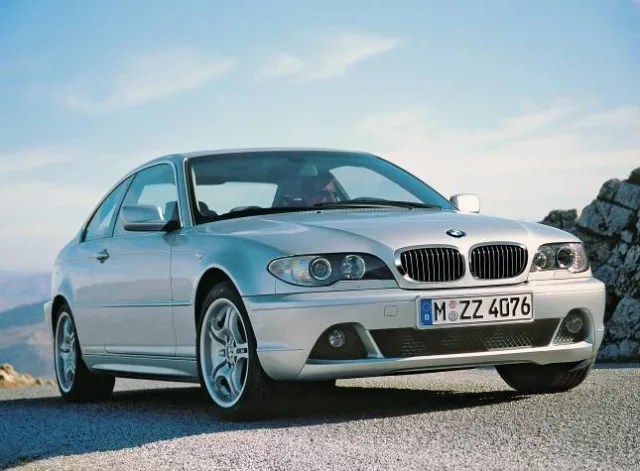
The "threes"-coupes of the previous generation (E46, 1998–2006) were for the first time equipped with diesel engines