

The new BMW 3 Series is positioned as a car with a pronounced sporty character, created not so much for race tracks as for driving pleasure. And the key role here is played by what is under the hood. With the base 318i engine, you will have to settle for just the striking looks and precise handling, while being lenient about acceleration dynamics. Our test drive was in the near-top 330XdA version — with a three-liter turbodiesel producing 231 hp, a six-speed automatic, and xDrive all-wheel drive.
On the outside, the 3 Series evokes associations with fencing. Sharp, swift body lines visually make the car slimmer, giving it a resemblance to a gymnast. The classic headlights with "glasses" for the parking lights boldly extend onto the fenders. However, the taillights, resembling butterfly wings, look controversial: their rounded shapes break away from the overall image created by sharp and dynamic lines. Perhaps that is why the rear lights on the 3 Series coupe are styled after the 7 Series sedan. 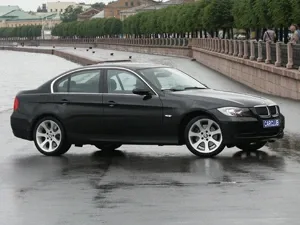
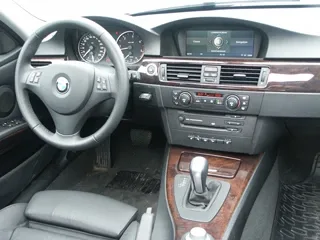
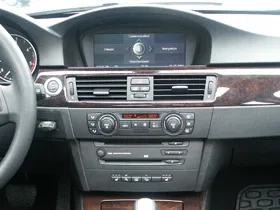
Getting behind the wheel, you immediately understand that this is a BMW — the feeling is like being in a car a class higher. The interior is trimmed with wood around the perimeter, the doors are leather, and all plastic elements are soft and pleasant to the touch. In the center of the dashboard is a widescreen color display for the iDrive system, through which the audio system, climate control, onboard computer, and other options are managed. You can also check the date of the next service and tire pressure there. Like the BMW 1 Series, the new 3 Series comes standard with Run-on-Flat tires, which are not afraid of punctures and allow you to drive up to 200 km (no faster than 80 km/h) even if the wheel is completely deflated. The abandonment of the spare wheel provided a large niche under the trunk floor and reduced the car's weight. But when choosing winter tires, you need to be careful: either buy special tires or constantly carry a spare that will take up almost the entire trunk. Its volume is 460 liters, but the layout is not the most convenient.
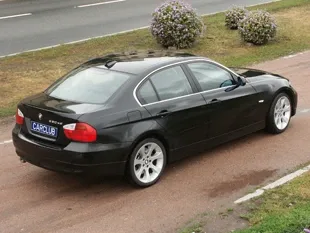 To get to know the car properly and check the efficiency of the modern turbodiesel, we set off on a Moscow — Saint Petersburg round trip. Diverse roads and long hours behind the wheel always help to better feel the car, especially a driver-focused one like the BMW 3 Series.
The sporty seating position with a high steering wheel immediately sets a fighting mood — as if you are sitting in a race car. At first, it is unusual, and you cannot lower the steering wheel — it blocks the instruments. But you quickly get used to it, and on a long journey the seating position turns out to be very comfortable. This is also thanks to the firm seats with developed lateral support and many electric adjustments. Once you set the seat to your liking, you can spend 8 hours behind the wheel without changing position — it is clear that the developers know a thing or two about long trips. On the 3 Series, you can easily cover several thousand kilometers, but only on good roads. The highway to St. Petersburg, unfortunately, cannot yet be classified as such.
On smooth surfaces, the 3 Series is magnificent. Precise steering responses and minimal body roll give an incredible sense of control, which sometimes borders on a feeling of impunity. Often you have to reduce speed in corners out of self-preservation, although the car is clearly capable of more. Wide tires help confidently hold the track, but transverse waves in the asphalt unsettle the sedan — the car gets thrown from lane to lane, forcing you to grip the steering wheel with both hands and watch the road closely. On large waves, the suspension lacks energy capacity. Small asphalt joints are swallowed without problems, but on serious potholes it breaks through — the impacts are so harsh that you want to stop and get out to check if the wheels are damaged. Moreover, this happens on relatively modest bumps found on any Russian road. On the way to St. Petersburg, the 3 Series transmitted five hard impacts to the body. Strange, because competitors on the same route never allowed themselves such behavior. In the city, bottoming out occurs when attacking a speed bump at about 40 km/h — this is also not the best result. 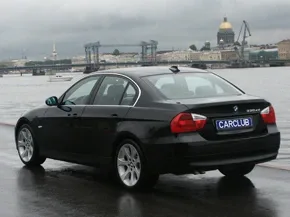
Probably, the three-liter turbodiesel and all-wheel drive are to blame, which significantly weigh down the car — versions with smaller engines are likely more compliant. One can only fear that the stiff suspension may quickly kill low-profile tires and 18-inch wheels.
But the engine simply conquered us. Confident thrust from the very bottom up to 2000 rpm grows into a real hurricane that throws the car forward until the tachometer needle reaches the maximum. The gears are selected so that the engine does not fall out of the turbo boost zone, and the peak torque of 500 Nm (almost like the BMW M5) is available in the range of 1750–3000 rpm. If the 3 Series were rear-wheel drive, the wheels would spin from any careless press on the gas, but xDrive transfers part of the torque to the front axle, and the sedan accelerates incredibly fast even in the rain. Wheelspin can only be achieved on dirt roads, but then the DSC III stability control system steps in, taming the engine.
If you start with the gas pedal pressed about halfway, the automatic works like a CVT on the first three gears. The engine hangs at 2500 rpm, and acceleration occurs due to the slipping of the torque converter — shift points are almost imperceptible. On higher gears, even in Drive mode, the automatic holds the selected gear both during acceleration and braking. The gearbox settings are so good that manual mode has become more of a game than a necessity. The automatic can be controlled only with the gas pedal, always achieving the desired acceleration.
 The characteristic diesel rattle is not heard in the cabin, and outside it can only be detected in a very quiet place. In a traffic jam with the window open, you more often hear the engines of neighboring cars than your own. At medium revs, the engine is audible in the cabin, but muffled, and it starts to draw attention only above 150 km/h. But the most discomfort comes not from the engine, but from the hum of tires on rough asphalt. It is unlikely that the Bavarians can be blamed for poor sound insulation — most likely, the stiff suspension components are to blame, transmitting small vibrations to the body. This is the price for sharp handling.
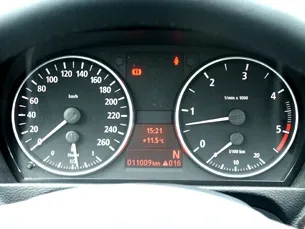
 On the Moscow — Saint Petersburg highway at a speed of 130–150 km/h, the onboard computer showed a fuel consumption of 7.2 liters per 100 km — and this is a car with a three-liter engine, an automatic, and all-wheel drive. Such a figure is unattainable for gasoline cars of a similar class and similar power. On the way back, when the speedometer needle regularly reached 170 and sometimes went beyond 200 km/h, consumption rose to 8.2 liters per hundred — also an outstanding result. In addition to low consumption, the diesel pleases with a large range. After refueling in Moscow, the next visit to a gas station can be planned already beyond St. Petersburg — a 63-liter tank on average lasts for 800 km.
However, despite all the advantages of the diesel, such cars have limited demand in our market. According to sales statistics, the affordable 3 Series with a two-liter gasoline engine and an automatic sell best — their prices start from €29,900. Enthusiasts choose versions with 2.5 or 3-liter engines, sometimes with all-wheel drive — from €38,000 to €46,000.
 The tested diesel sedan with a three-liter engine, an automatic, and xDrive all-wheel drive is the most expensive 3 Series. Its price is from €47,900, which is €2,300 more expensive than the similar version with a 3-liter gasoline engine (258 hp). So is it worth overpaying for the right to hear the characteristic diesel rattle?
According to official data, the diesel version 330XdA consumes 9.6 liters per hundred in the city cycle, while the gasoline 330X consumes all 13.9 liters. The difference is 4.3 liters per 100 kilometers, and considering that diesel fuel is cheaper than 95-octane gasoline, the savings amount to about 80 rubles on the same distance. It turns out that the extra payment of €2,300 (or 78 thousand rubles) will only pay off after 97 thousand kilometers of driving. At first glance, you will have to wait a long time, but if you remember that you will have to refuel less often, and the diesel's torque is distributed much more conveniently, the purchase no longer seems so reckless. Especially those who like to drive faster will appreciate it: in the sprint to a hundred, the diesel car pulls ahead by 0.2 seconds.
By the way, in addition to the three-liter turbodiesel, the BMW 3 Series lineup also includes a less powerful 320dA version with 163 horsepower. It is priced at €35,700 and, in my opinion, also deserves attention — especially given the average consumption of just 5.6 liters per hundred.
Leonid Pavlov