
About the Audi brand
Germany founded in 1909 Model range
General Information
Audi AG is a German manufacturer of passenger cars, part of the Volkswagen Group. The company's headquarters are located in Ingolstadt.
Corporate History
Audi was founded by August Horch in 1909. Its history is linked to the Horch company, which existed during the Third Reich. In 1899, Horch founded the company "Horch & Co." in Mannheim, which moved to Zwickau four years later.
In 1909, a new six-cylinder engine built by Horch proved unsuccessful and nearly led the company to bankruptcy. His partners expelled him from the firm, but he immediately founded a new one, also under the name Horch. His former partners sued, demanding a name change. By court decision, the new company could not use the name Horch, and August Horch translated it into Latin: the word "horch" (German for "listen") became "audi." Thus, in 1909, the Audi brand was born.
The first Audi-A car was released in 1910. In 1911, it was followed by the Audi-B model. Horch entered three such cars in June 1911 in the "Auto Alpenfahrt" race in the Austrian Alps, covering about 2500 km, which replaced the Prince Henry trials.
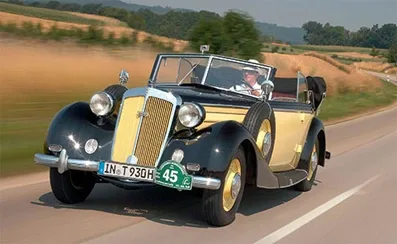
In 1912, the Audi-C appeared, the most famous model of that period. Its first samples passed the Alpine race test and showed good results, earning the C-series cars the nickname "Alpensieger" ("Conqueror of the Alps").
In the 1920s, Audi was on the verge of bankruptcy and was forced to merge with another firm. In 1928, the company was bought by German DKW, and its owner became Jørgen Skafte Rasmussen.
In 1932, the economic crisis led to the creation of the Auto Union concern, which included DKW, Wanderer, Horch, and Audi. The concern released two models with front-wheel drive and Wanderer engines. They sold well until the start of World War II.
After the war, Audi and other Auto Union partners were nationalized and turned into a division of the "Association of People's Enterprises for Automobile Production." In 1945, the DKW-F89 was released, a development of the 1939 F9 prototype. It was a front-wheel-drive car with a two-cylinder two-stroke engine producing 23 hp.
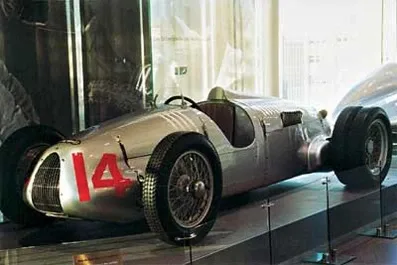
In 1949, Auto Union was reformed, attracting a majority stake from Mercedes-Benz. In 1958, Daimler-Benz AG acquired a controlling stake in Auto Union, but later sold it to Volkswagen. In 1965, after the controlling stake passed to Volkswagen, the name Audi came back into use. Soon, a new front-wheel-drive car was released, and by the end of 1968, Audi had returned to the market with a good model range and excellent sales. The emblem remained four rings, symbolizing the merger of four companies in 1932.
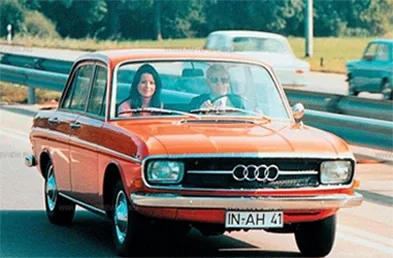
The "100" model, released in 1968, and its successors, including the Audi Quattro, featured a sporty profile and all-wheel drive — an innovation for the German auto industry.
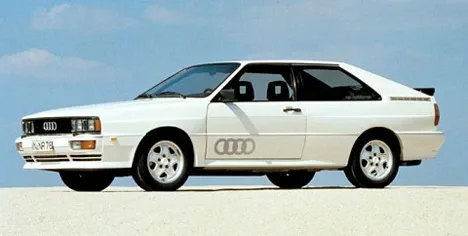
The 1980 Quattro model gave a powerful impetus to the industry's development and brought Audi (a subsidiary of Volkswagen) worldwide fame. It was a light, fast grand tourer with excellent stability, built for rallying. Competitors struggled to compete with this model, which performed successfully in several races.
In 1969, Volkswagen acquired Neckarsulmer Automobilwerke (NSU). The company name changed to Audi NSU Auto Union, and in the summer of 1985, back to Audi AG.
From 1970, mass exports of Audi to the USA began. Initially, these were the Super 90 and the new Audi 100. From 1973, they were joined by the Audi 80, which also existed in the US as a station wagon (effectively a VW Passat Variant with higher equipment). Later, models received their own designations on the American market. However, product liability issues from the mid-1980s led to a decline in Audi shipments to the US.
In 1980, the all-wheel-drive sports coupe attracted enormous attention at the Audi stand at the Geneva Motor Show. For the first time, such an all-wheel-drive concept, previously used only on trucks and SUVs, was offered on a passenger car. The idea arose in the winter of 1976/77 during tests of the VW Iltis off-road vehicle for the Bundeswehr: its excellent behavior on ice and snow inspired the implementation of all-wheel drive in the production Audi 80.
In 1982, the Audi 80 quattro began large-scale production of permanent all-wheel drive. Gradually, the quattro concept spread to other Audi models.
Based on the Audi 80, a sports coupe (Audi Coupe) was produced, debuting at the end of 1993. The cabriolet version was first presented in Geneva in 1991. This car was discontinued in mid-2000.
In December 1990, the new Audi 100 (internal designation C4) was introduced. For the first time in the company's history, it was offered with a six-cylinder V-engine. This compact and powerful unit was the shortest and lightest in its class.
The successor to the Audi 80 (1986–1994) was the Audi A4, first introduced in October 1994. In 2001, the A4 Avant station wagon and the A4 Cabrio coupe-cabriolet with a folding hardtop (like the Mercedes-Benz SLK) appeared.
The flagship of the model range, the Audi A8, was first shown in February 1994. The Audi A3, built on the Golf IV platform, was first shown in June 1996, and production began in 1997.
From the presentation of the conceptual Audi A2 in autumn 1997 to the start of series production (early 2000), just over two years passed. Thus, Audi gained a new family of European B-class cars.
The Audi S4/S4 Avant/RS4 is a high-performance sports modification of the Audi A4 with a 2.7-V6-Biturbo engine. It was first presented at the Frankfurt Motor Show in 1997.
The sports Audi TT in coupe body was first shown in Geneva in September 1998, and the roadster version in August 1999. The model prototype was presented in 1995 at the Frankfurt Motor Show.
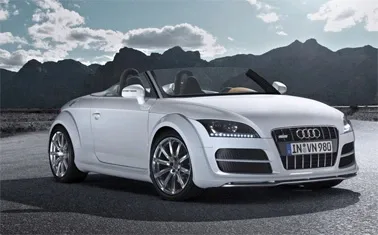
The Audi Allroad, an off-road vehicle based on the A6 Avant, was first introduced in February 2000.
In September 2005, at the Frankfurt International Motor Show, Audi AG presented the Audi Q7 hybrid SUV. Its uniqueness lies in two engines: a gasoline FSI V8 and an electric motor of the latest modification, increasing torque. Technical characteristics allowed fuel consumption to be reduced by an average of 13%.
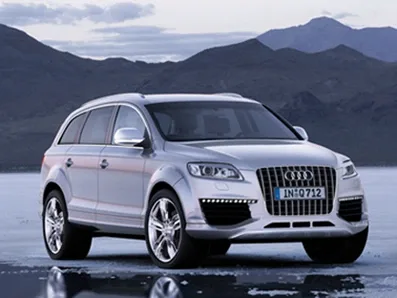
Today, Audi, as part of the Volkswagen Group, is experiencing a rapid rise thanks to new developments.
Audi in Ukraine
Since 1997, the official importer of Audi AG in Ukraine has been "VIPOS Automotive Group," supplying German premium cars.
"VIPOS Automotive Group" is a leader in the premium segment in terms of sales dynamics and dealer network development in the regions. The largest dealer network in the premium segment has been created, consisting of 15 Audi centers, which develops annually: new enterprises open, service quality improves. Service centers meet international Audi AG standards, built and equipped with advanced technologies.