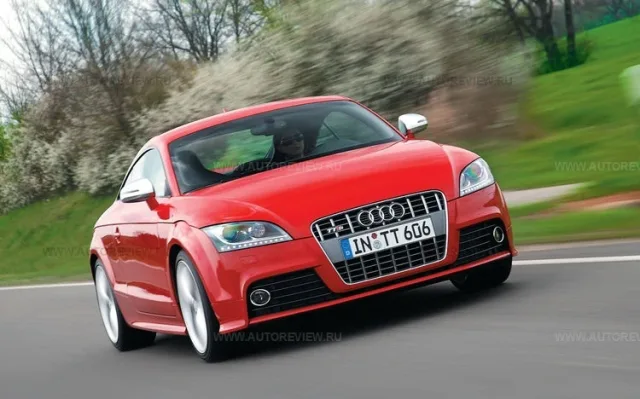
The letter "S" in Audi always means sport: we've already dealt with the S3 hot hatch, the more powerful S4 and S5, and the ten-cylinder S8 sedan. The next link in this chain is the Audi TTS coupe. Under the hood is a 272-horsepower turbo engine, the suspension is 10 mm lower, and the main question is how this version will surprise on German highways?
Navigation in the TTS shows that from Munich to the Nürburgring is about 560 km. Alas, even driving "at the limiter," I won't make it to the "Green Hell" and back — only six hours are allotted for getting acquainted with this coupe. A pity, because the Nordschleife is the ideal place for a real test of the TTS.
Under the rounded hood hide 272 horsepower, but this is not a naturally aspirated 3.2 "six," but a boosted 2.0 TFSI from the Audi S3 with turbocharging. Compared to the regular 200-horsepower version, the cylinder block, pistons, and connecting rods are reinforced, a cylinder head made of a stiffer alloy is installed, a fully aluminum intercooler radiator, a large turbocharger, and boost pressure has increased from 0.9 to 1.2 atmospheres. The claimed highway fuel consumption is only 6.5 l/100 km.
I got a TTS with a six-speed manual. The clutch pedal has a long travel, and the footrest for the left foot is positioned a bit high. Throttle response is calm, "civilian," and the sound is mundane. But already from 2500 rpm, powerful thrust appears, and revving to the cut-off at 7200 rpm presses you into the leather seat and causes a real rush of endorphins.
With the version on the S-Tronic preselective gearbox, driving is even more enjoyable. The seat moves back further, the left foot rests, and during sharp shifts at full throttle, short "pops" from the exhaust pleasantly caress the ear. With the manual, there was no such effect.
According to the specs, it's the S-Tronic that, thanks to shift speed, wins 0.2 seconds over the manual in the sprint to 100 km/h, although the gearbox adds 20 kg of weight.
The chassis has changed minimally: electronic Magnetic Ride dampers and springs shortened by 10 mm. Ride comfort for a sports coupe is excellent — the TTS softly absorbs bumps at joints and doesn't tire you with constant road surface feedback. But the handling surprised me.
I was circling the empty interchanges near Munich airport and couldn't understand: light understeer, followed by drift of all four wheels — that's how almost all all-wheel-drive Audis behave. The steering is light, almost without effort. From a car with the "S" letter, you expect something completely different!
Neither the front end lightened by 15 kg compared to the six-cylinder version, nor the recalibrated electric power steering changed the imperturbable character of the all-wheel-drive TT. The brakes are also almost standard — only pads made of a stiffer sports compound and additional openings in the bumper for cooling. Nevertheless, colleagues managed to overheat them even on flat Bavarian roads, as happened to us two years ago in Myachkovo.
However, for a couple of emergency brakings from Autobahn 250 km/h down to 80 km/h, the reserve is quite sufficient. And it's the Autobahn that is the native element of the TTS: on a straight line, it flies like an arrow!
However, German speed enthusiasts will surely also like the diesel Audi TT. This is another new product — coupes and roadsters can now be ordered with a new two-liter turbodiesel producing 170 horsepower. The Nürburgring is full of fans of diesel Golfs — exciting and economical: fuel consumption on a race track is three to four times lower than that of gasoline engines. The diesel TT doesn't feel slow: in the range of 1700–2500 rpm, torque reaches the same 350 Nm as the gasoline TTS. And although there are one and a half times fewer horsepower here, in corners, the all-wheel-drive diesel car with a manual goes no worse.
True, in drag races from traffic lights on dry asphalt, the turbodiesel loses even to the front-wheel-drive version with the 160-horsepower 1.8 TFSI engine: 7.6 seconds to 100 km/h versus 7.2. Both versions will be supplied to Russia. Prices are still kept secret, but the diesel will likely be more expensive, and the car with the "small" gasoline engine will be cheaper than the 2.0 TFSI version. Sales of diesel TTs start in November, but with the 1.8 TFSI, everything is foggy: neither an "automatic" nor a "robot" is provided for it. And that's a problem — of the 444 TTs sold in Russia in 2007, only 19 had a manual gearbox.
Details to the portrait: Audi TTS
Audi engineers claim that four exhaust pipes allow the turbo engine to "breathe" more freely than two on the Audi S3. Perhaps that's true, but the main question is whether it's worth overpaying for this version.
The Audi TTS can be purchased right now — the minimum price is 2 million 112 thousand rubles. For comparison: the BMW Z4 3.0si, which is not inferior in dynamics, will cost 376 thousand less, and the more aggressive Nissan 350Z with 300 horsepower — 362 thousand less. Even the regular Audi TT 3.2 is more attractive in price — the difference is 147 thousand rubles.
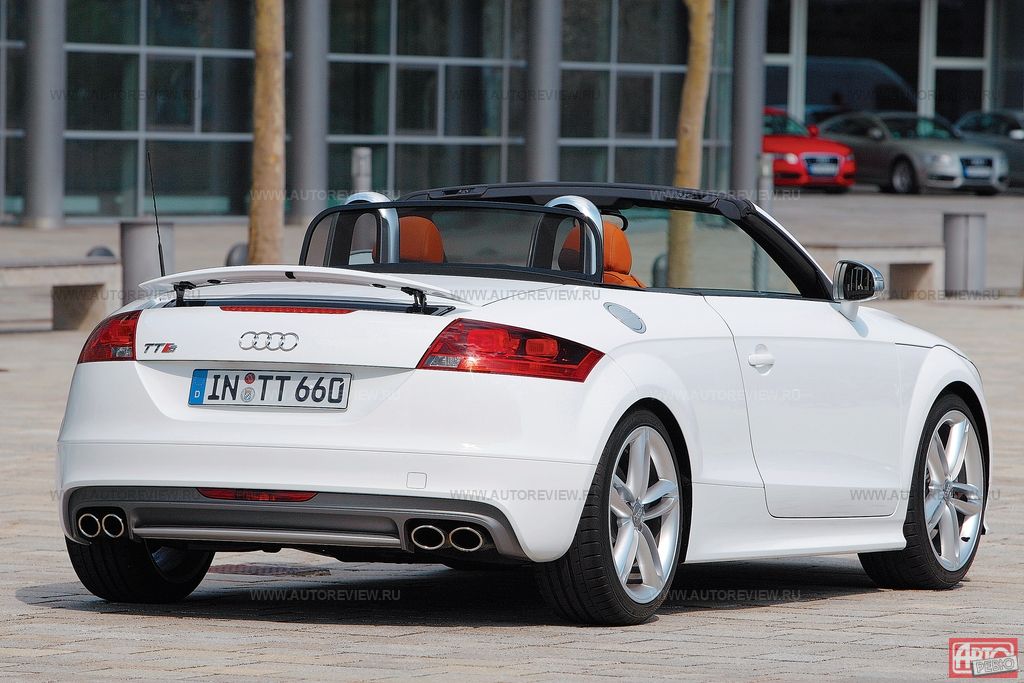
So what does the surcharge for the TTS give? Four exhaust pipes instead of two, a more expressive imitation diffuser in the rear bumper, and LED "garlands" — 12 lights under each headlight, like on the older R8 coupe. Not much for that kind of money.
 |
 |
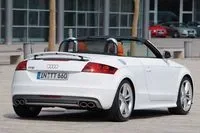 |
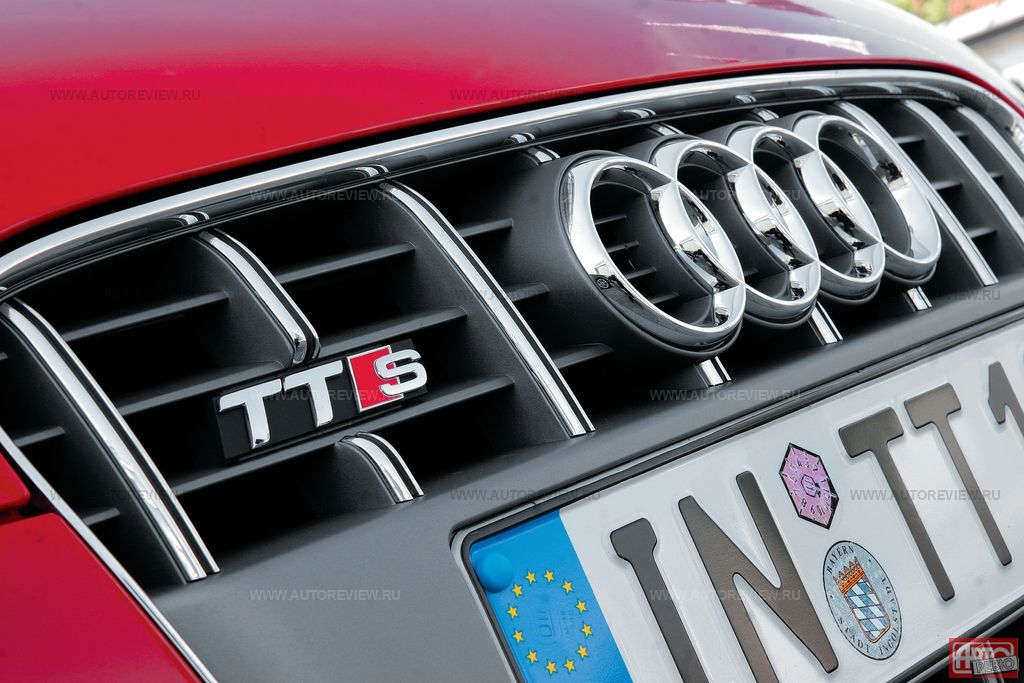
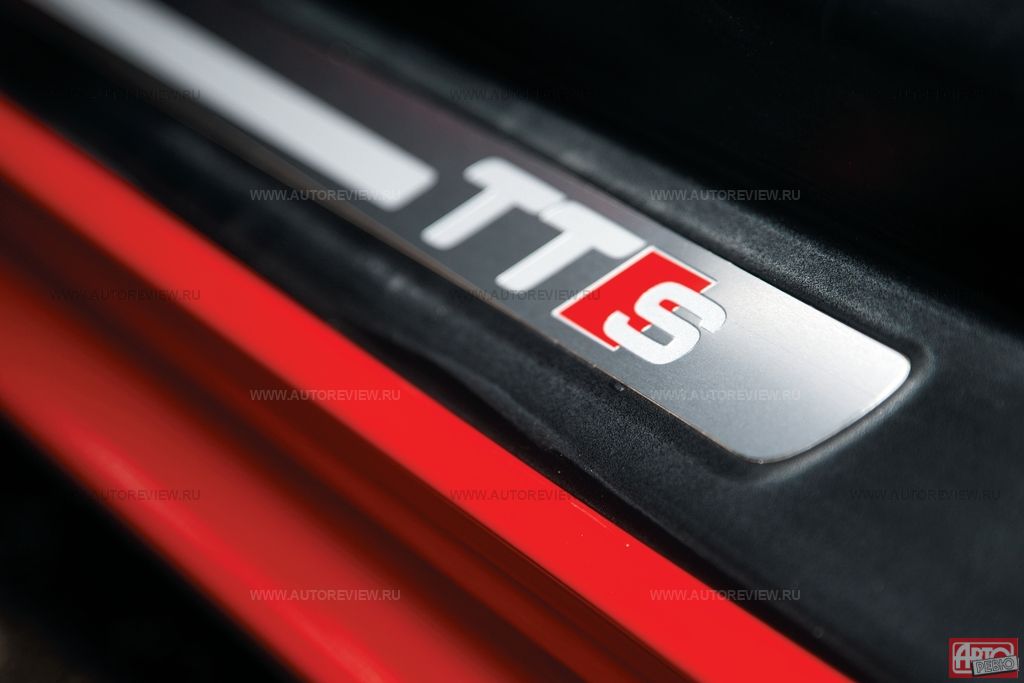
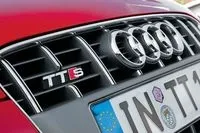
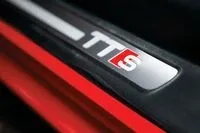
| TTS badges are everywhere — front, rear, on the dashboard, on the sills… |
The roadster is also available in the TTS version. But there's even less sport in this cruiser: it's 60 kg heavier than the coupe and behaves more relaxed on the road |
If the steering wheel of the TTS were heavier, and the engine more spirited and sonorous, one could understand the surcharge. But the Germans have saved the extreme tuning of the two-liter "turbo-four" to 300 hp for the TT RS version. That modification will also appear.
That's the one you need to take for a spin on the Nordschleife. Definitely.
Technical specifications
| Passport data |
| Parameters |
Vehicle |
| Audi TT |
| Modification |
TTS |
1.8 TFSI |
2.0 TDI |
| Body type |
3-door hatchback |
3-door hatchback |
3-door hatchback |
| Number of seats |
2+2 |
2+2 |
2+2 |
| Dimensions, mm |
|
| length |
4198 |
4178 |
4178 |
| width |
1842 |
1842 |
1842 |
| height |
1350 |
1352 |
1352 |
| wheelbase |
2468 |
2468 |
2468 |
| track front/rear |
1555/1546 |
1572/1558 |
1572/1558 |
| Trunk volume, l |
290/700* |
290/700* |
290/700* |
| Curb weight, kg |
1395 (1415)** |
1240 |
1370 |
| Gross weight, kg |
1795 (1815) |
1640 |
1770 |
| Drag coefficient Cd |
0.31 |
0.30 |
0.30 |
| Engine |
petrol, with direct fuel injection and turbocharging |
petrol, with direct fuel injection and turbocharging |
turbodiesel |
| Location |
front, transverse |
front, transverse |
front, transverse |
| Number and arrangement of cylinders |
4, in-line |
4, in-line |
4, in-line |
| Number of valves |
16 |
16 |
16 |
| Displacement, cc |
1984 |
1798 |
1968 |
| Cylinder bore/piston stroke, mm |
82.5/92.8 |
82.5/84.1 |
81.0/95.5 |
| Compression ratio |
9.8:1 |
9.6:1 |
16.5:1 |
| Max power, hp/kW/rpm |
272/200/6000 |
160/118/4500—6200 |
170/125/4200 |
| Max torque, Nm/rpm |
350/2500—5000 |
250/1500—4500 |
350/1750—2500 |
| Drive |
all-wheel, with Haldex coupling in rear axle drive |
front-wheel |
all-wheel, with Haldex coupling in rear axle drive |
| Gearbox |
6-speed, manual (6-speed, robotic) |
6-speed, manual |
6-speed, manual |
| Front suspension |
independent, coil spring, McPherson |
independent, coil spring, McPherson |
independent, coil spring, McPherson |
| Rear suspension |
independent, coil spring, multi-link |
independent, coil spring, multi-link |
independent, coil spring, multi-link |
| Front brakes/disc diameter, mm |
disc, ventilated/340 |
disc, ventilated/312 |
disc, ventilated/312 |
| Rear brakes/disc diameter, mm |
disc, ventilated/340 |
disc/286 |
disc/286 |
| Tires |
245/40 R18 |
225/55 R16 |
225/55 R16 |
| Maximum speed, km/h |
250*** (250***) |
226 |
226 |
| Acceleration time 0—100 km/h, s |
5.4 (5.2) |
7.2 |
7.5 |
| Fuel consumption, l/100 km |
|
|
|
| urban cycle |
10.9 (11.0) |
9.0 |
7.0 |
| extra-urban cycle |
6.3 (6.1) |
5.5 |
4.3 |
| combined cycle |
8.0 (7.9) |
6.7 |
5.3 |
| CO₂ emissions, g/km |
191 (188) |
158 |
139 |
| Fuel tank capacity, l |
60 |
55 |
60 |
| Fuel |
petrol AI-98 |
petrol AI-95 |
Diesel fuel Euro-4 |
| * With rear seats folded |
| ** Data in parentheses for version with S-Tronic robotic gearbox |
| *** Electronically limited |