
Audi TT. Predictable Extreme
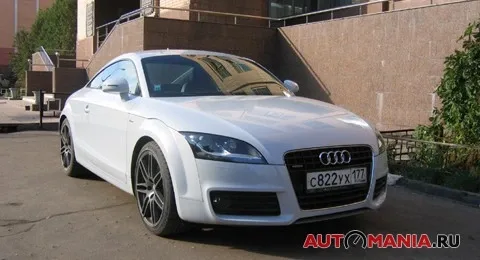
This car with its memorable appearance has an unusual history. Audi engineers created it as a youth coupe on the fourth-generation VW Golf platform (Audi is part of the VW Group). The first TT appeared with a 1.8-liter turbo engine — energetic and economical. It looked very impressive. But there were flaws in the chassis and aerodynamics. It was rumored that early examples even flipped over on German autobahns. I don't believe that — a car with such a body and all-wheel drive is as hard to roll over as, say, a Mini Cooper. And here's what's notable: today, even a five- or six-year-old TT 1.8 cannot be found on the secondary market for less than $30,000. And for 2.0-liter versions aged 3-4 years, they ask from $30,000 to $40,000. The car almost doesn't lose value — a very rare case.
The new TT 3.2 differs noticeably from the previous, pre-facelift cars. In 2005, the front and rear lights were updated. And in 2008, I got behind the wheel of essentially a different car. True, the price also changed — it increased by almost $30,000 and was no longer the same. But for those who truly understand what kind of car is in front of them, the price increase is absolutely justified.
The changes in the version we drove with colleagues three years ago primarily concern the interior. The steering wheel is now not round, but with a flattened bottom (see photo) — this is a new feature of all current Audis. The climate control knob and air flow adjustment keys have changed. Instead of four deflectors, there are now five (three in the center), and this has completely transformed the cabin ventilation. The seats with white stitching on the sides look more elegant and stylish. The radio control buttons have moved to the steering column. And, of course, a completely new center console with the Audi Symphoni radio, which is controlled not by a joystick, as in more expensive models of the brand, but by regular buttons. Which is logical, given the car's extreme nature.
You fall in love with the TT from the first second you get behind the wheel. The noble, soft voice of the engine captivates both the driver and passersby. And the driving process itself is just a fairy tale! The pickup after 4000 rpm is magnificent. The steering wheel, which seems stiff when parking, becomes absolutely adequate with speed. On any maneuvers up to 200 km/h, you perfectly read all the details of the road — the surface, its condition, the level of lateral G-forces. All information comes to the steering wheel in the form of filtered and softened vibrations — for your information. And nothing more. The engine's voice even at high revs doesn't irritate. Except perhaps passengers, who are unlikely to want to climb into the back seats at all.
I decided to check whether this car can be considered four-seater (as the manufacturer claims) on my own family. I got behind the wheel, my eldest daughter — as the tallest of our women — in the front passenger seat, and my wife with my youngest daughter squeezed in the back with difficulty. After the first bump, I was told that sitting in the back row is impossible — you hit your head on the roof. At the end of the very short trip, I was informed in the most decisive tone that they would never agree to repeat this ordeal in a half-bent state, with knees at chin level, for anything in the world. Only a person with an excellent sense of humor could call this car four-seater. The second row is pure decoration, not intended for passengers.
Let's return to the drive. The main trump card of the new TT is the DSG gearbox. This is a complex unit that has little in common with a "robot," a classic automatic, or a CVT. Simply put, it's an automated pseudo-manual with dual clutch. Servo drives engage the clutch and shift gears faster than even the most experienced driver could on a manual. Similar systems exist on BMW SMG, Alfa Romeo Selespeed, Mercedes Sequentronic, and Opel Easytronic. But DSG differs from all these "robots" in a major way.
The system uses two gearboxes at once. Each has its own clutch. One handles even gears, the other odd gears. That is, you have the unique ability to engage two gears simultaneously. How does this work? While you accelerate in first, the gears of second are already engaged, they also spin, but idle. When the computer decides it's time to shift (in Audi, this moment is called the kiss point), two hydraulic drives simultaneously release the first clutch and engage the second, passing the torque "from hand to hand" from first to second. It's like in a ski relay: at the baton handoff stage, athletes match speed, the transfer happens, one runs on, the other rests. The same picture repeats when second is engaged: the gearbox prepares third gear engagement in advance. And so on...
In "D" mode, shifts are so smooth and imperceptible that you can floor the gas without feeling any jerks or jolts. But as soon as you move the lever to "S" (Sport), the TT transforms. Just a moment ago, the car was driving in sixth with a pleasant bass rumble — and suddenly the gearbox instantly drops to second, and on each gear the tachometer holds the needle at 7000 rpm. When braking, the gearbox actively clicks down, accompanying the process with short but very effective rev-matching.
The faster and more aggressively you drive, the more adequate the DSG works. The gearbox constantly shuffles gears up and down, keeping revs around 5000. In short, a smarter gearbox than the one in the TT hasn't been invented yet. It will make the right decision before you even start thinking about it.
There is, however, one catch. The car, which feels great on high-speed highways, doesn't like traffic jams and traffic lights. The driver presses the gas and... until the clutch engages, until the engine revs up from the bottom, there won't be powerful acceleration. Half a second or more of starting sluggishness is guaranteed. However, Audi S-series and even the R8 (though there it's a "robot") also suffer from this. But if you're a fan of calm driving, you won't even notice it, and you're unlikely to find a better gearbox on any other car. Moreover, DSG's advantages include not only smoothness and dynamics, but also efficiency. In aggressive mode, the 1.5-ton coupe consumes 13.6 liters in the city (though of 98-octane gasoline) and about 10 liters on the highway. That's less than the classic version with the 1.8-liter engine.
The car has plenty of pluses. We've noted the main ones. But there are also minuses, unfortunately. Very small side mirrors (strangely, a drawback of all modern Audis). The front side pillars overhang the head, causing serious concerns in the event of a frontal impact. And finally, incorrect operation of the windshield washer: the left side window gets so dirty when the washer is working that you have to get out of the car to wipe it and ensure normal visibility on the left side in bad weather.
But all these little things are easily forgiven for the Audi TT — it looks so stunning. After all, true beauties must have small flaws.
Dmitry Shavyrin
Technical specifications:
| Dimensions (mm) | 4178 x 1842 x 1352 |
| Curb weight (kg) | 1505 |
| Gross weight (kg) | 1803 |
| Engine displacement (cm3) | 3189 |
| Power (hp) | 250 |
| Max torque (Nm/rpm) | 320/2500 |
| Acceleration 0-100 km/h (s) | 5.7 |
| Top speed (km/h) | 250 |
| Fuel tank capacity (l) | 60 |
| Tires | 255/135 ZR 19 |
| Fuel | A-98 |
| Price (RUB) | 1,800,000 |
We thank the "Audi Russia" representative office and personally Vagif Bikulov for providing the car for the test.
Source – AUTOMANIA.RU