
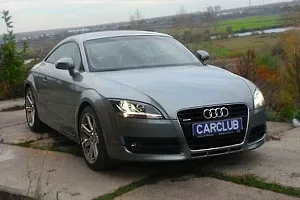
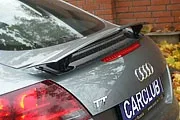
 When you look at the press photos of the new Audi TT, it doesn't grab you at first: the familiar features of the entire modern lineup, sleek surfaces, and the feeling that designers simply styled the car to match the general look. You expect some breakthrough, but you see yet another unification. But when I saw the car in person and spent two sleepless days with it, I had to admit I was wrong. Before me is one of the most attractive cars of recent years. If the TT used to be associated with feminine curves, now it's a truly masculine image. The new model has genuinely supercar-like proportions, unlike its predecessor. It's no surprise that at a gas station, a BMW 5 Series driver pestered me with questions: "How many horses under the hood? Probably a hundred in four seconds, right?" No, the performance is more modest—5.7 seconds to 100 km/h. And it's not a racing machine, and the badge on the grille isn't Ferrari or Porsche. But how beauty transforms people! Thank you, Walter de Silva, for keeping the bar high and knowing how to so effectively defy expectations.
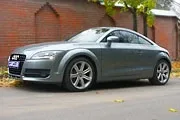
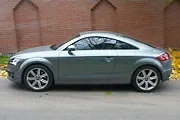
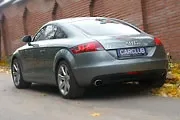
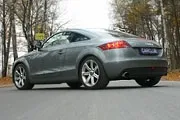
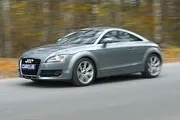
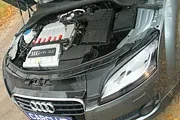
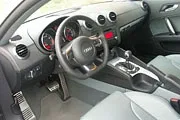
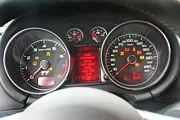
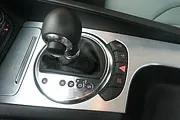
In city traffic, the new TT is a comfortable and cozy car with a moderately sharp steering and light handling. The feeling that you're actually driving, not stuck in a jam, only appears past 140 km/h. And the real fun begins after 180 km/h. Up to that mark, the speedometer needle flies in a matter of seconds. In principle, 250 "horses" on 1410 kg isn't that much, so the TT doesn't feel insanely fast. Smooth acceleration and the S-Tronic's desire to quickly engage sixth gear hint at a "touring" nature rather than sport. However, there's plenty of speed and drive here. On a straight, the TT is a bullet, and in corners—almost a kart. The stability control intervenes with a noticeable delay, designed for an active driver, and the "gearbox" does everything faster and calmer than a human. In manual mode, fourth gear reliably pulls to the desired 200 km/h, and the remaining two gears bring it to the top speed of 250 on the speedometer. But you'll likely feel uncomfortable: the body and suspension stiffness have increased compared to the predecessor, so on longitudinal waves or ruts, the car literally bounces, and in a corner, it tends to shift outward from the intended line. The suspension is clearly tuned for "autobahn-quality" asphalt, which we, unfortunately, have little of. Nevertheless, despite this, the TT remains very obedient and predictable. I've never experienced such G-forces as in this beauty: the sport seats mercilessly torment a weak body, reminding of the harsh superiority of German technology. And on transverse waves, the roof sadistically hits your head. The feeling is like a roller coaster. So be it, let the spine creak and the crown of the head be rubbed against the ceiling—it's worth the liters of adrenaline that the drive of the second-generation Audi TT pumps into your blood.
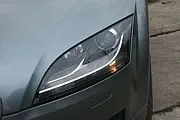
In the options list, there are Magnetic Ride dampers that stiffen the suspension in corners, adding stability and completely eliminating body roll. The technology, where magnetic particles are added to the damper fluid and controlled by a field, was invented by American Delphi many years ago. Until now, it was used on overseas SUVs, and the Germans decided to adapt it for a European sports coupe. However, despite the abundance of "high-tech" in all forms—bimetallic body, xenon, tire pressure sensors, which first appeared on the TT—Audi doesn't create the feeling of an "electronic sandwich."
Even the price of this beauty doesn't scare you—from $57,000 for a front-wheel-drive TT with a 200-hp turbo engine. The coupe with proprietary all-wheel drive and the 3.2 V6 engine (250 hp) costs from $70,000; add another $2,300 for the clever "gearbox," and you get a quite impressive sum comparable to the price of an Audi Q7 with a diesel engine of similar power, or $10,000 more than the 250-hp A3 3.2 V6 hatchback. But everything is known in comparison—Ferrari and Porsche, with which the TT is compared in looks, cost several times more.

Leonid Pavlov