
"A passenger without a steering wheel as a support bounces so much that a helmet is a must — head hits against the roof threaten a concussion. As for the driver, we recommend a corset: the impact load has to be absorbed by the abs and all the internal organs. You can't endure it for long. Wanted sportiness? You've got it! But this is no longer sport, but masochism." These are lines from our previous test of sports coupes (AR No. 16, 2006), and they referred to the new Audi TT: on any pothole or wave it seemed there was no suspension at all, like on a go-kart. For us, it was a shock. But, as it turned out, Ingolstadt was also puzzled! After the publication of the article "Temptation," it was translated into German and sent to Audi headquarters. The Germans reacted instantly: they contacted the Russian office and demanded that the "scandalous" car be sent to Germany for investigation. The car began to be prepared for shipment — and then it was discovered... that between the spring coils there were technological spacers protecting the suspension from compression during transport! Dealers were supposed to remove them during pre-delivery inspection but forgot. A silent scene. Curtain.
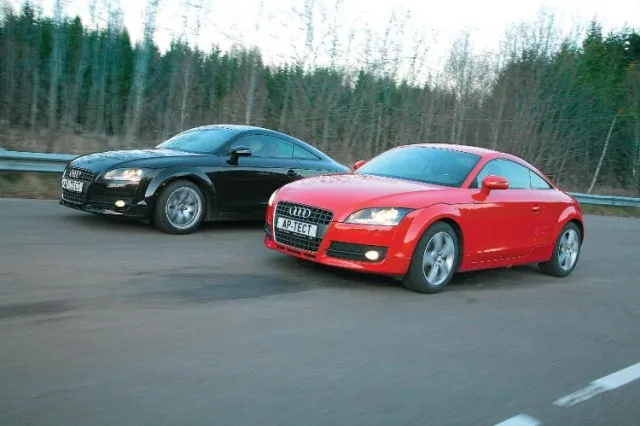
And now we have two Audi TT coupes for testing: one with a regular suspension, as in that very test, the second with optional Magnetic Ride. The main thing is that the spacers have been removed from both cars. We checked.
The day before, as in the Monte Carlo rally, we played "tire roulette": it snowed — will it melt? We decided to ask Audi representatives to switch both cars to winter non-studded tires and... We guessed wrong! At the test site, dry asphalt awaited us. To level out the difference in tires (one car had Bridgestone, the other Dunlop), we arranged a couple of pit stops to swap wheels, and all "scored" runs were conducted on the same tires — Dunlop Winter Sport 255/50 R17.
 |  |
| The suspension mode selection button for Magnetic Ride is to the left of the gear lever | |
What about handling? Last time, even with spacers, the car pleasantly surprised with a high limit of capabilities. In the "moose test," simulating an emergency lane change, the maximum speed of the "TT" was only slightly below the Porsche record: 82.6 km/h versus 83.2 km/h. Overall, we then recognized the TT's handling as not sporty, but very reliable and understandable. And now?
Even during active driving, the difference between the Magnetic Ride suspension and the regular one is small. In "sport" mode (activated by a button on the center tunnel), the magneto-rheological fluid dampers noticeably reduce body roll, and reactions become slightly sharper and more precise. Surface waves do not cause diagonal rocking or deviation from the trajectory. But even in "comfort" mode, the car does not suffer from dual reactions or rocking, although it responds to steering commands with less enthusiasm.
The Audi TT with "simple" dampers yields to its "magnetized" sister in composure: the car does not respond as clearly to steering inputs, perceives bumps slightly more sharply, and diagonal rocking in corners makes the car "wander" along the trajectory. But still, the handling is at a very high level — everything is clear, reliable, and simple! And the result of the "moose test" was even surprising: the maneuver in the TT with a regular suspension succeeded at a speed of 78 km/h. And that's on winter tires! Thanks to a favorable balance of front and rear tire slip angles, the car follows the trajectory precisely, without sliding, and so on up to limit speeds.
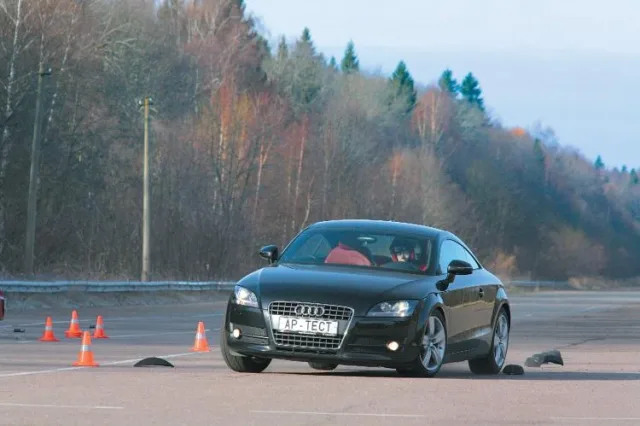
The coupe with Magnetic Ride suspension, regardless of the selected mode, turns out to be slightly slower in the "moose test" than the TT with a regular suspension
Interestingly, the coupe with "magnetic" dampers in "comfort" mode began to slide earlier, and a gradually progressing understeer took the car off the trajectory. When returning to its lane, this led to deep oversteer slides that neither the driver nor ESP could handle. As a result, the maximum speed in the "moose test" was only 75.9 km/h. When the "magnetic" dampers were switched to "sport" mode, the coupe held its course stability a bit longer, and the speed ceiling turned out to be slightly higher — 76.7 km/h.
It turns out that from a handling standpoint, the advantages of Magnetic Ride dampers over regular ones are purely "sensory." But overall, for handling, we give the same high rating as in the comparative test — 90 points out of 100.
And finally, the stumbling block — ride comfort.
 |
| The "sport" mode of the Magnetic Ride suspension is displayed on the instrument panel |
It's clear that comparing the Audi TT with spacers and without is like heaven and earth. The difference between the electronically controlled suspension and the regular one, though less noticeable, exists. The most pleasant ride is in the coupe with "magnetic" dampers in "comfort" mode. Even on a poor highway, the Magnetic Ride system successfully "rounds off" bumps, perfectly dampens waves, and only occasionally allows vibrations from unsprung masses and side-to-side rocking. And after 120 km/h, it seems the road levels out. Shocks from waves become unpleasant only after 160 km/h.
But in Sport mode, the "magnetic" dampers transmit all the cracks, seams, and potholes into the cabin, reacting more sharply to waves. There is noticeably less comfort, at any speed.
The Audi TT with regular dampers rides slightly stiffer than the Magnetic Ride system allows in "comfort" mode (small bumps are felt) and slightly smoother than in "sport" mode. But importantly, regardless of the "filling" of the dampers, comfort remains at a very decent level. And if we retroactively transfer our ratings of the "spacer-free" cars to the summer test, the Audi would likely be in a leading position in ride comfort — ahead of the BMW Z4 and Porsche Cayman S coupes and on par with the Nissan 350Z. But given the different tires and test conditions, such a "time travel" certainly does not claim to be correct. What can be stated with confidence is that the Audi TT is fully rehabilitated in terms of ride comfort. Naturally, with proper pre-delivery inspection, including the removal of technological spacers from the springs...
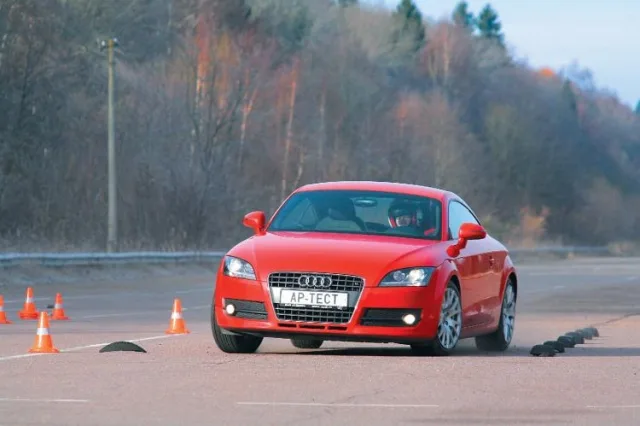
By feel, the coupe with regular dampers handles slightly less composed than the TT in "sport" mode of the "magnetic" suspension. But it maintains course stability a bit longer
Is it worth paying an extra $1950 for the Magnetic Ride system? In our view, this option is interesting in two cases — if you lack the comfort of a regular suspension or lack the feeling of sportiness. And precisely the feeling — faster, as our runs showed, you won't go with Magnetic Ride dampers.
Current Strength
At the heart of the Magnetic Ride system is a regular monotube damper. But it is filled not with ordinary oil, but with so-called magneto-rheological fluid — also oil, but with magnetic particles ranging from three to ten microns in size with a special coating that prevents them from sticking together. These particles occupy about a third of the fluid volume. An electromagnet is built into the damper piston, with current smoothly varied by a controller (wires run inside the rod). Under the influence of the magnetic field created by the coil, the particles align "in a row," increasing the oil viscosity in the piston orifice area. Since the degree of damping is determined only by the current strength, there are no conventional valves in the "magnetic" damper. Because of this, it operates more quietly: the flow of oil passing through the channels in the piston is laminar, not "ruffled" turbulent, as in traditional dampers.
 |  |
The Magnetic Ride system significantly outperforms conventional adjustable dampers with electromagnetic valves, such as those Monroe installs on the Volvo S60R, in response speed. If the "smart" Monroe struts respond in 10 milliseconds, the magnetic ones manage in 1 millisecond, while consuming no more than 20 watts each. The key difference in operating principle: in Monroe, the valve changes throughput in steps, while here the fluid viscosity transforms smoothly, depending on how the suspension moves, how fast the wheels rotate, what position the steering wheel is in, and even what the oil temperature is. Two main modes are provided — "comfort" and "sport." Engineers assure that they have solved the problem of overheating and wear, and promise a service life of no less than 300 thousand kilometers, although they do not give a separate warranty on these dampers.
Dampers, Jules Verne, and Rabinovich
The history of magneto-rheological shock absorbers began in 1998, but they debuted not in the suspension, but in the driver's seat of American trucks — to support the back. They were first integrated into the wheel suspension on the Cadillac Imaj concept, shown in Geneva in 2000. Two years later, such technology appeared on production cars, like the Cadillac Seville STS. Shock absorbers for both Cadillacs and the new Audi TT were developed by Delphi (a major supplier of components for General Motors) together with the American corporation Lord, which owns almost half of the US patents related to magneto-rheological fluid.
It all started with experiments by Yakov Aronovich Rabinovich, who conducted them back in the 40s. He was born in Kharkiv in 1910, then there was Siberia, China, and eventually the USA, where he became famous as Jacob Rabinow — the author of about three hundred patents. The inventor himself admitted that his path to engineering was prompted by childhood memories of mechanisms at his father's shoe factory and the novels of Jules Verne.
Rabinovich's career started in 1938 at the US National Bureau of Standards (now the NIST institute), where he rose to head of the "electromechanical artillery" department, and in 1954 he decided to work for himself. In 1968, he founded RABCO, which made tangential tonearms — the very ones that audiophiles remember from vinyl players. Later, the company was bought by Harman-Kardon, and Rabinovich himself returned to NIST and worked there until the end of his life. He passed away in 1999.
Among his inventions are a disk drive for computers (a distant ancestor of modern hard drives), a magneto-powder clutch used in the ECVT variator on the 1987 Subaru Justy, and, of course, that very magneto-rheological fluid. It, by the way, is also used to dampen vibrations of buildings in seismically hazardous zones. And if earlier a liter of such fluid cost $600, now the price has dropped tenfold — to $60.