
Friday evening. In a fresh Audi TT convertible, I approach the casino with dignity. Not some shabby gambling house, but the Grand Casino itself — the main one in Europe, in Monte Carlo!
The doorman gestures: they say, for you, monsieur, they've saved a parking spot… Wow, he immediately recognized me as a client. I raise my right hand: like, hello, old chap, but for this night I have other plans.
He nods — and immediately switches his attention to a blonde in a silver-blue Porsche 911 Cabrio. I go down to the sea and slowly roll along the embankment. The fact that the famous Grand Prix track runs right here doesn't impress me: on weekdays, and even in a convertible, it's better to drive calmly. Even if you're behind the wheel of a Ferrari Enzo, and next to you is a beauty. If you want adrenaline, go up to the mountains.
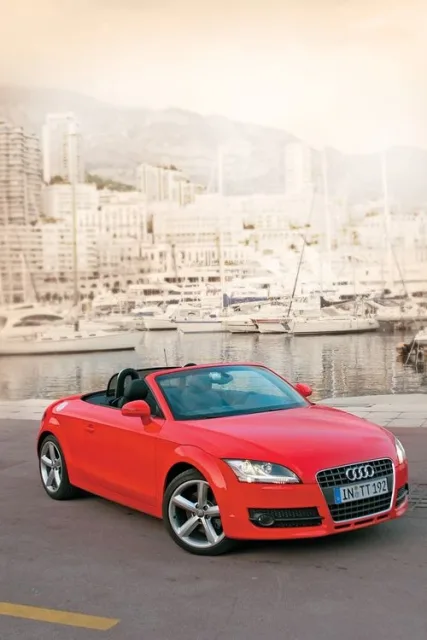
The main problem of all convertibles is body rigidity. If you remove the roof from a regular car, torsional resistance drops by about half. Take a shoebox, put the lid on — and try to twist it. Difficult? Now remove the lid — and repeat. Same with an open car. On uneven roads, unpleasant squeaks and vibrations appear, handling suffers… Therefore, serious manufacturers, when deciding on a convertible, first of all think about strengthening the body.
And the engineers of the Audi TT faced a more difficult task: to make a convertible that would almost not yield to the coupe in driving qualities. In essence, they had to design a new body. The sills are made of hardened aluminum profile with internal stiffening ribs, behind the seats there is a massive steel bulkhead from which roll bars emerge. A steel tube is built into the windshield frame — for protection during a rollover. As a result, having lost the metal roof, the Audi TT Roadster became… heavier by 35 kg! And this is an excellent result: the TT Roadster of the previous generation was heavier than the coupe by as much as 100 kg. The fact is that the body of the new roadster is 58% aluminum. Why not a hundred?
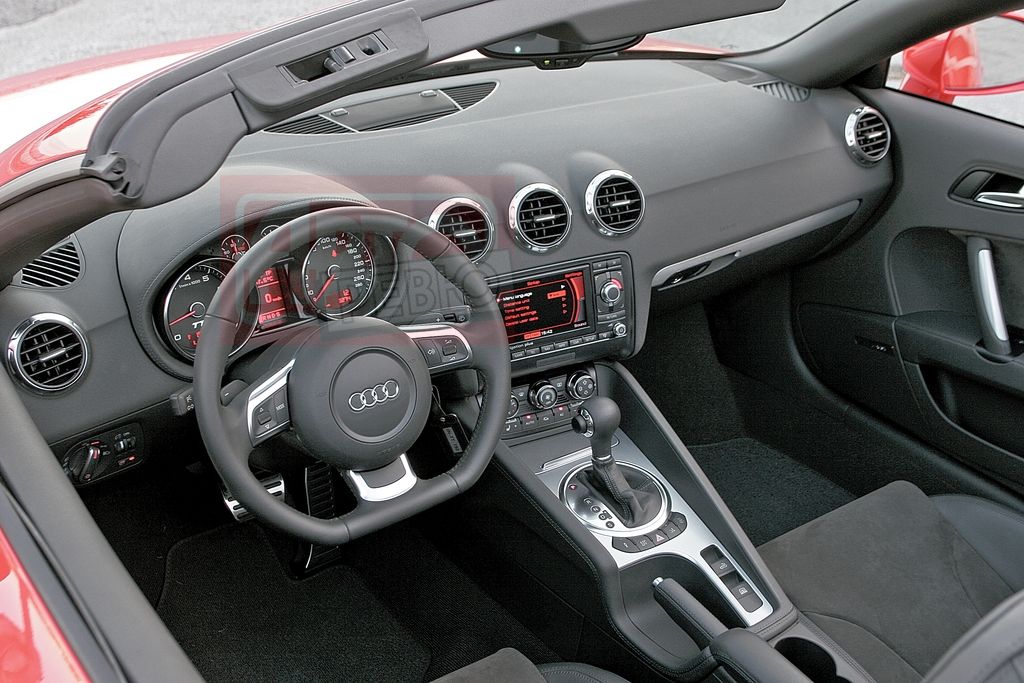 | 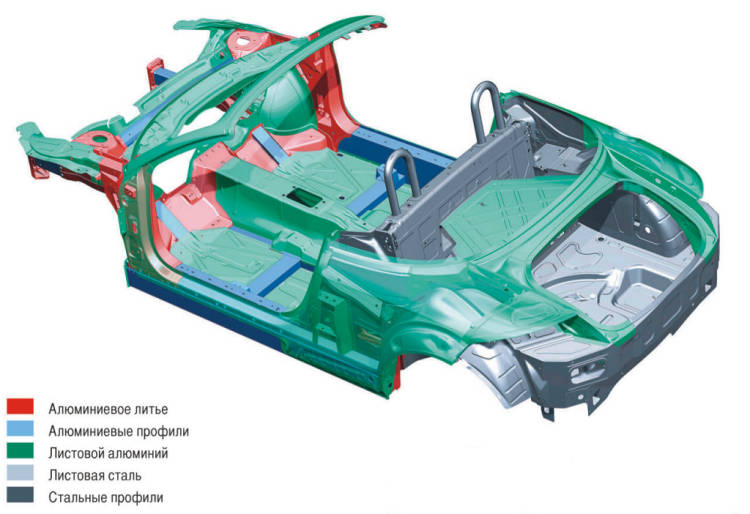 |
| The interior, like the coupe's, is stylish and functional | The roadster's body is 58% aluminum parts, and steel elements are concentrated in the rear for better weight distribution. Bolts and rivets are used to join aluminum and steel parts |
— Expensive, — explains Markus Swert from Audi's development department. — Moreover, the combination of steel and aluminum made it possible to achieve optimal weight distribution: steel at the rear, aluminum at the front.
If the body were entirely steel, it would weigh not 251, but 364 kg — 45% heavier! And torsional rigidity, according to Audi, has increased by 120% compared to the first-generation TT Roadster! They didn't give exact figures, but I found an archive of "Autoreview" for 1999: in issue 16 there was an article about the first-generation Audi TT Roadster, which indicated 10000 Nm/deg. It turns out that the torsional rigidity of the new roadster's body is 22000 Nm/deg. For an open car, this is simply a phenomenal figure! For comparison: the BMW Z4 roadster has 14500 Nm/deg.
Like BMW, Audi refused a rigid folding roof. Firstly, it would add about a hundred kilograms, which would also noticeably raise the center of gravity. Secondly, a rigid roof would spoil the excellent design. And finally, it would have to be hidden in the trunk, which already has little space — only 250 liters.
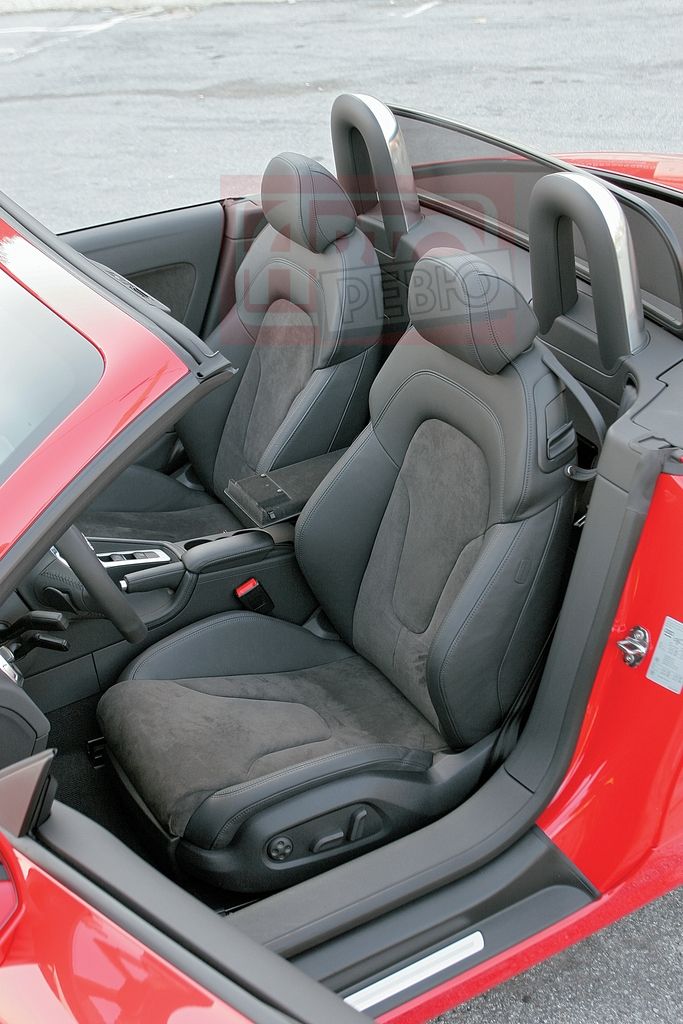 | 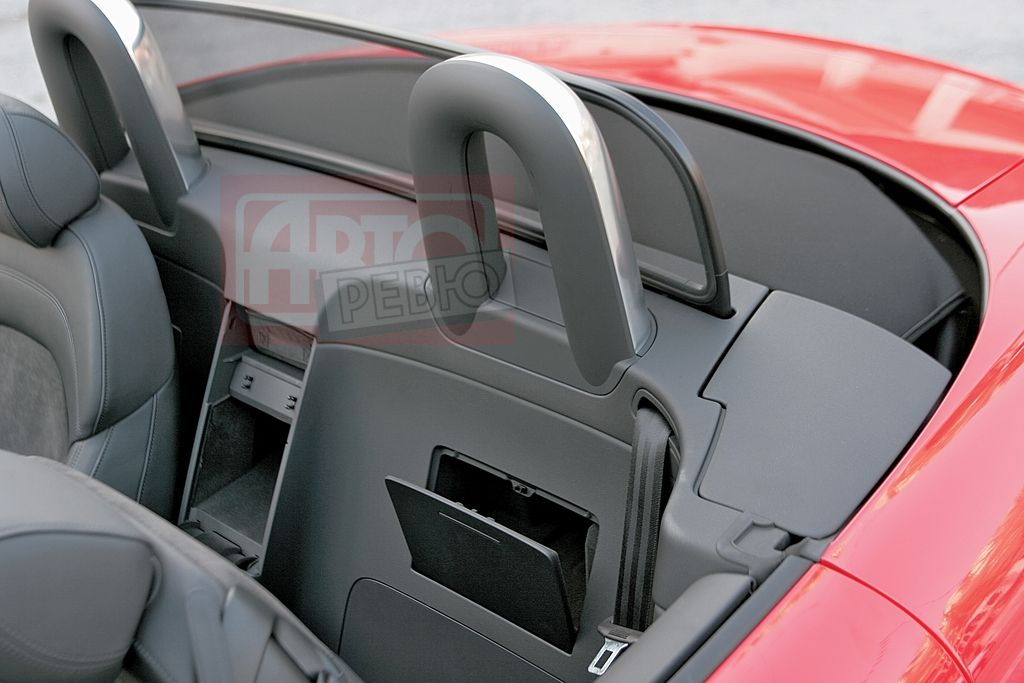 | |
| The 3.2 quattro version is equipped with seats upholstered in leather and Alcantara | There are additional "glove boxes" both under the seats and behind them | |
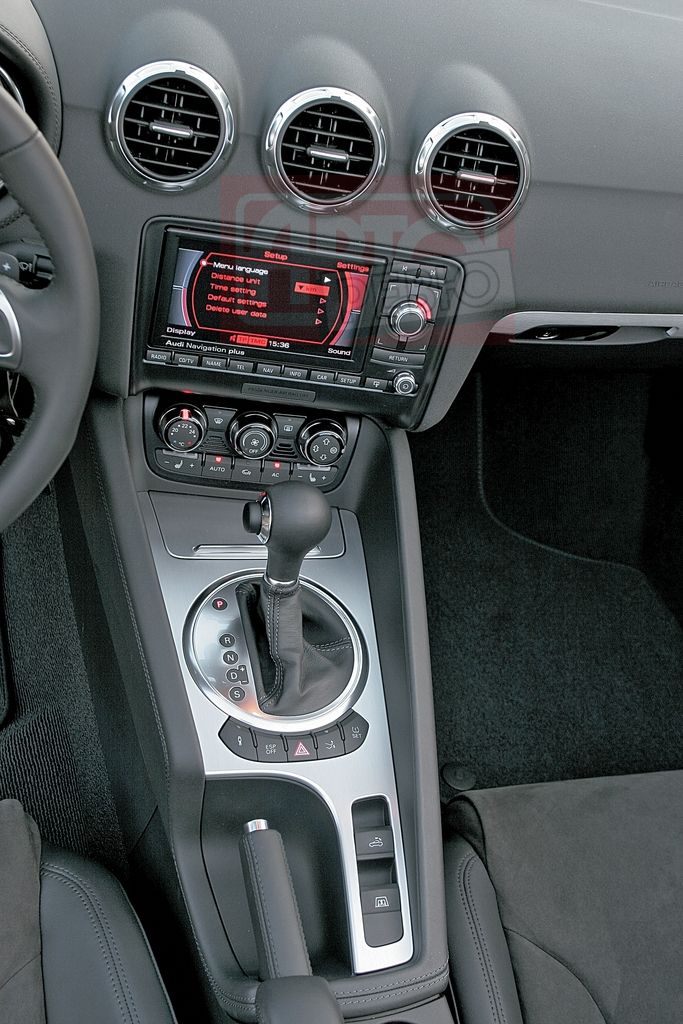 | 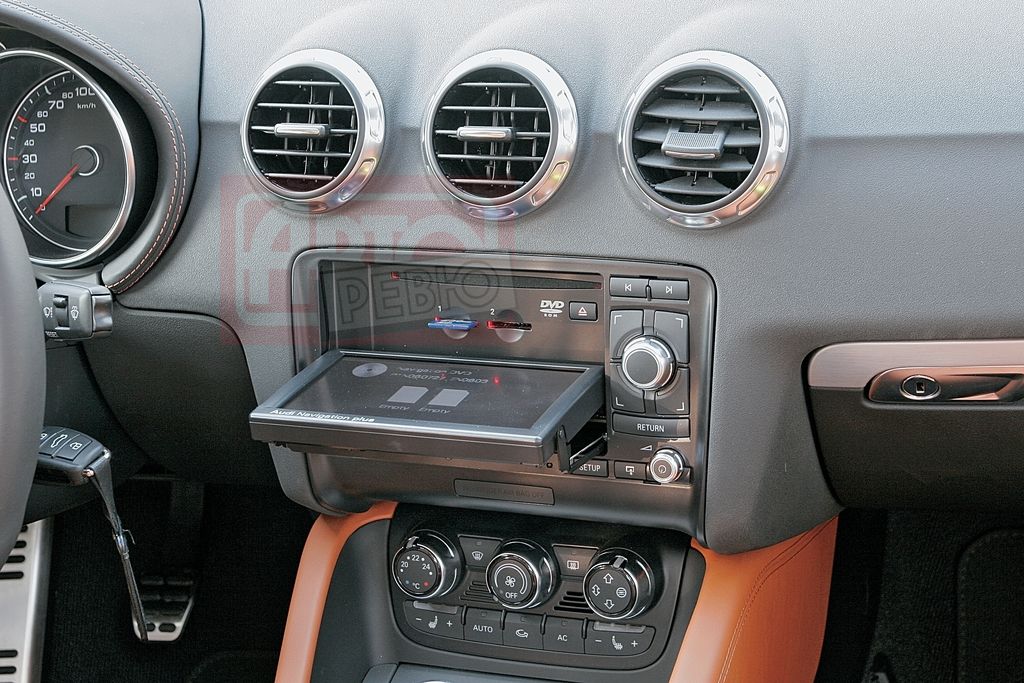 | 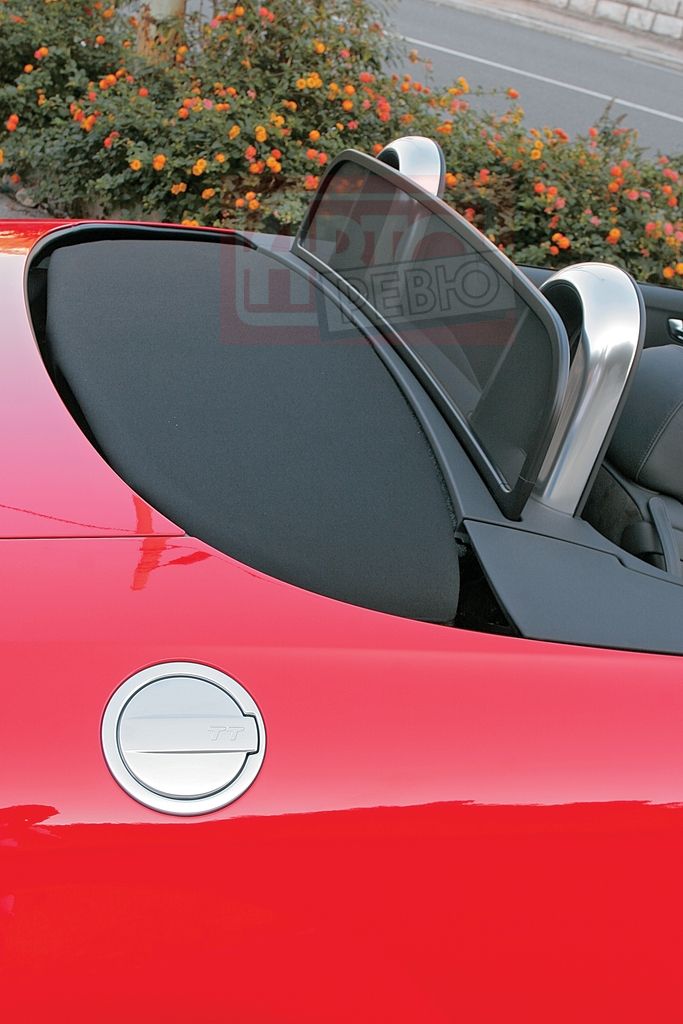 |
| To the right of the parking brake lever are the buttons for the electric roof drive and the aerodynamic screen | As optional equipment, you can install an audio system that plays mp3 files from two "compact flash" cards | The aerodynamic screen on the 3.2 quattro version is electrically operated |
However, the soft roof also required sacrifices: when folded, it occupies the compartment that in the coupe is reserved for the rear seats. That is, the Audi TT Roadster is strictly a two-seater, not an almost four-seater (2+2) like the twin coupe. Interestingly, the compartment where the roof is stowed is not covered by anything at all. Again weight saving?
The electric drive folds the roof in 12 seconds, and the process is fully automated — you don't even need to release the latches. True, all this time you have to hold the button between the seats. That's a minus. But there is a huge plus: the roof can be raised and lowered while driving, up to 50 km/h. I accelerated to those 50 km/h and cautiously pressed the button. The side windows lowered slightly, the latches above the windshield unlocked, and the roof began to fold into an accordion. The Mediterranean wind burst into the cabin. Will the mechanism withstand such pressure? Won't it jam? It worked out. Although in a strong wind, I would still stop: at speed with such a sail, it could blow you off the road.
As in most other open cars, comfortable driving ends at 80 km/h. And then air currents whip across your cheeks and fiercely tousle your hair. In hot summer, such airflow might be fine, but at 15 degrees of warmth it becomes uncomfortable. Even the aerodynamic shield behind the seats, which rises with an electric drive, doesn't save you. Perhaps if I were shorter, this screen would help, but at my 190 cm its effect is barely noticeable.
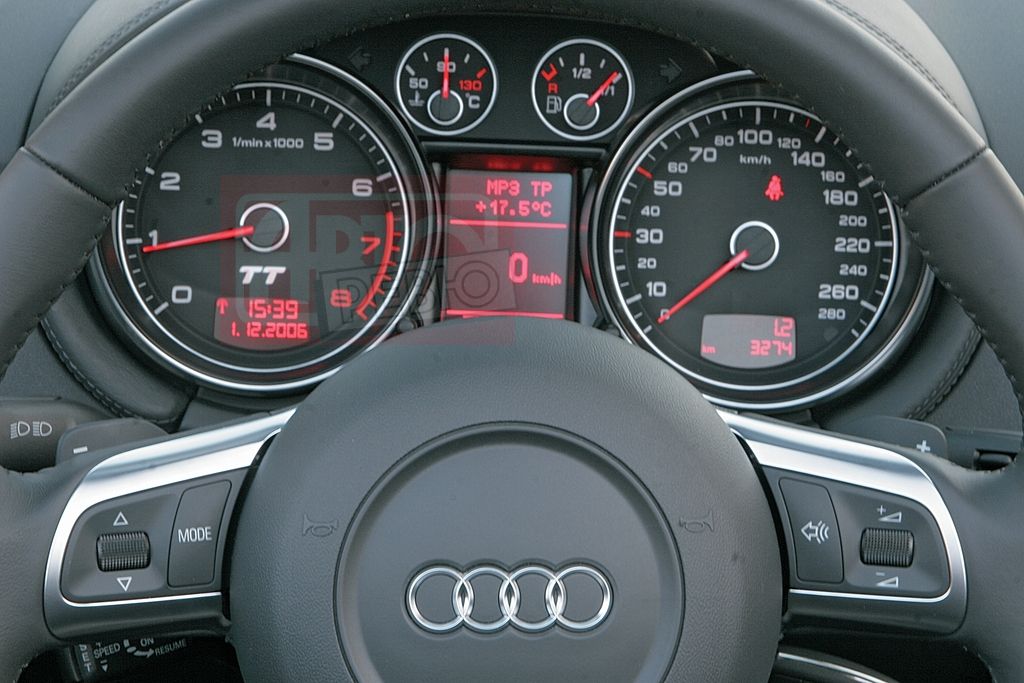 | 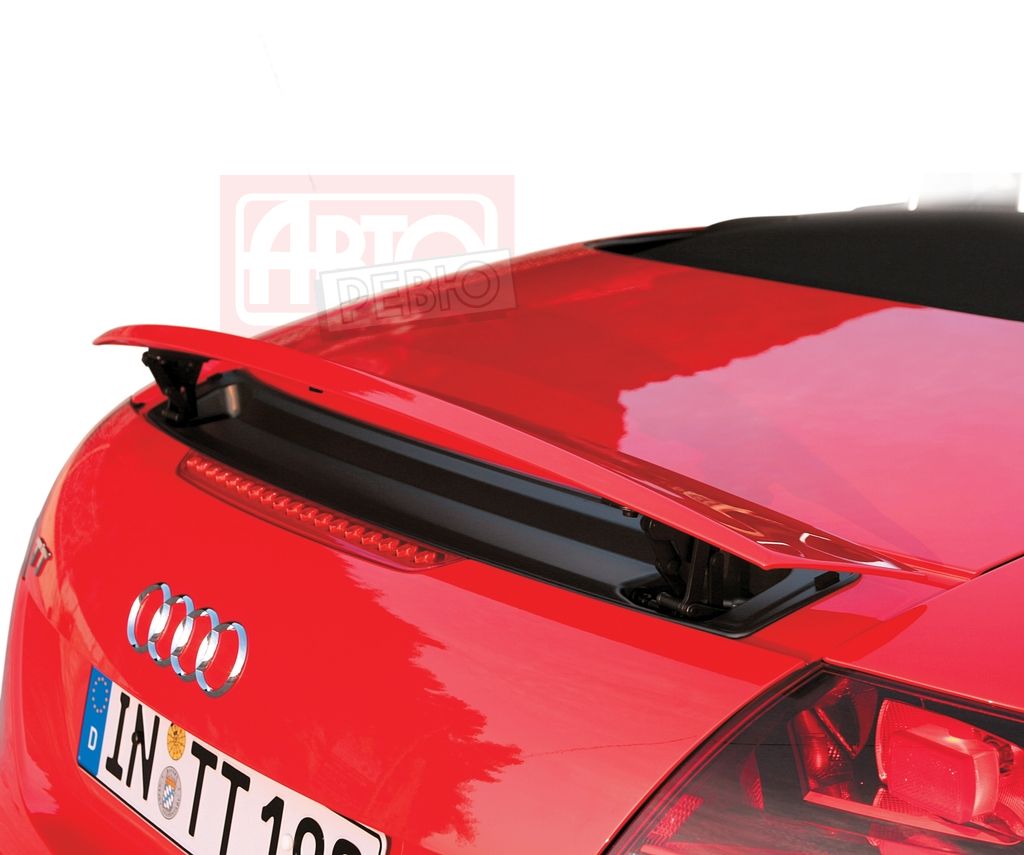 |
| The central display can show speed figures, average fuel consumption, and other useful information | The spoiler, which reduces lift, extends electrically at 120 km/h and retracts if speed drops below 80 km/h |
Turning the heater to full, I still accelerated to 180 km/h. Pure torture: noisy and cold. I slow down to 50 km/h, press the button again — and again reach 180 km/h. That's another matter! It's quiet in the cabin (at least quieter than in other cars with fabric tops that I've had the chance to drive). The reason is that the Audi TT roof is multi-layered, with a "lining" of noise and heat insulating material. And on the outside it is smooth and even — the drag coefficient of the roadster is only slightly worse than that of the coupe (0.32 versus 0.30).
I won't talk about the ergonomics and equipment of the interior — everything here is like on the Audi TT coupe (see AR No. 13–14, 16, 22, 2006). I'll only note that I easily found the optimal seating position in the roadster, and I even had to move the seat forward a bit: the adjustment ranges for a car of this class are simply huge! It's a pity the windshield frame turned out to be too low — it cuts off the view upward. Although if you compare the new roadster with the previous model, visibility is better: the windshield is larger, the exterior mirrors are bigger.
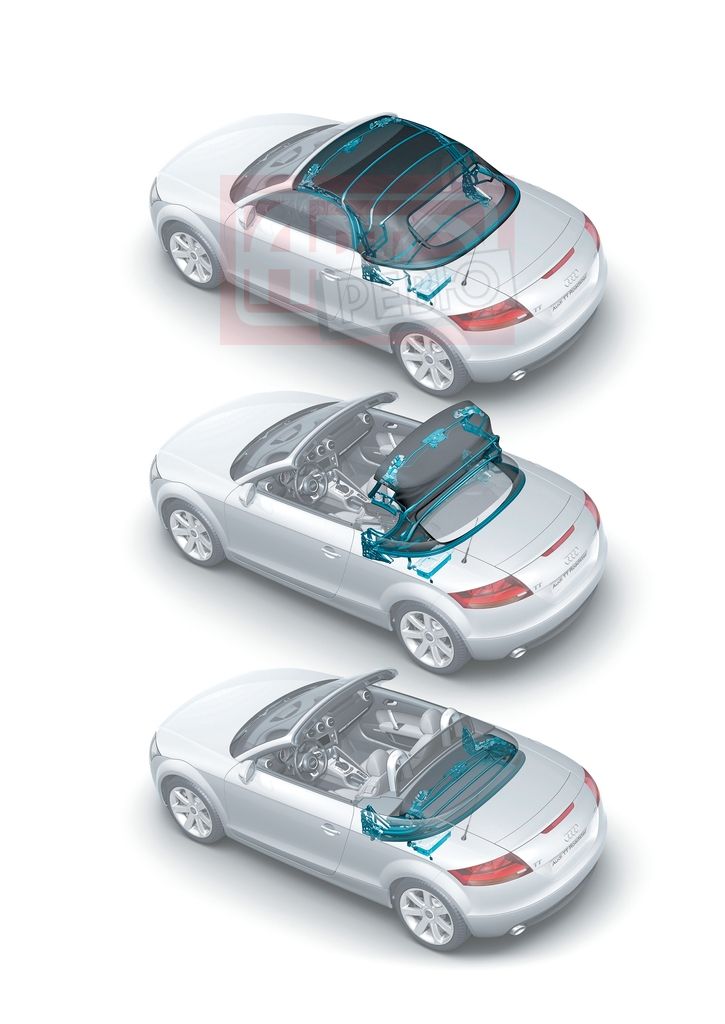 | On the base version Audi TT 2.0 TFSI, the fabric top folds manually. For the electric drive, which retracts the roof in 12 seconds, you need to pay an extra 1700 euros. And for the Audi TT 3.2 quattro, the "automatic" roof is standard equipment |
The roadster's engine lineup exactly mirrors the coupe: the front-wheel-drive version is equipped with a turbocharged "four" 2.0 TFSI with 200 hp, and all-wheel drive is available only with the naturally aspirated VR6 3.2, producing 250 hp. Transmissions are exclusively six-speed: either a classic manual or a robotic DSG, which in control is no different from a conventional "automatic." I had the chance to drive cars with all combinations of engines and transmissions, and I can say: the roadster has not introduced any negative surprises compared to the coupe.
The dynamics are just as spirited, the behavior is the same: slight understeer, which on a straight line at high speed allows you to drive absolutely relaxed, but in sharp turns forces you to steer a bit more actively. Moreover, the all-wheel-drive version with the heavy VR6 in such turns pushes noticeably harder. The exhaust sound is just as pleasant: when I drove with the top open, I deliberately revved the engine to the limiter. The brakes are clear and informative, without surprises.
After driving about a hundred kilometers along mountain serpentines, I found myself in Monte Carlo again. I opened the roof and slowly drove along the luxuriously illuminated streets. The thought is simple: if I lived on the Côte d'Azur, I would definitely buy myself an Audi TT Roadster. But it's funny that the biggest sales of the open version come not from France at all, but from Germany and England, where the climate is much harsher. The third place is the USA. Russia, however, is somewhere at the very end of the list: last year, out of 26 Audi TTs sold in our country, only a couple had a soft top. The rest were coupes. At the same time, global statistics are completely different: out of 270 thousand cars produced since 1999, about 65% are coupes, and the remaining 35% are roadsters.
Russian prices have not been announced yet, but there is a benchmark: in Germany, the most affordable roadster costs a thousand euros more than the coupe. If the proportion holds, our prices will start from about 33,000 euros. For the robotic DSG, you will have to pay an additional 2,000 euros, and the top all-wheel-drive Audi TT Roadster 3.2 quattro will cost about 43,000 euros. Sales will start in spring 2007.
| Specifications | ||
| Vehicle | Audi TT Roadster | |
| Modification | 2.0 TFSI | 3.2 quattro |
| Body type | convertible | convertible |
| Number of seats | 2 | 2 |
| Trunk volume, l | 250 | 250 |
| Curb weight, kg | 1295 (1315)* | 1470 (1490)* |
| Gross weight, kg | 1615 (1635)* | 1790 (1810)* |
| Engine | petrol, with direct fuel injection and turbocharging | petrol, with distributed fuel injection |
| Location | front, transverse | front, transverse |
| Number and arrangement of cylinders | 4, in-line | 6, V-shaped |
| Displacement, cm³ | 1984 | 3189 |
| Cylinder bore/piston stroke, mm | 82.5/92.8 | 84.0/95.9 |
| Compression ratio | 10.3:1 | 11.3:1 |
| Number of valves | 16 | 24 |
| Max power, hp/kW/rpm | 200/147/5100—6000 | 250/184/6300 |
| Max torque, Nm/rpm | 280/1800—5000 | 320/2500—3000 |
| Gearbox | manual, 6-speed (automated manual, 6-speed) | manual, 6-speed (automated manual, 6-speed) |
| Drive | front-wheel drive | all-wheel drive, with Haldex clutch in rear axle drive |
| Front suspension | independent, coil spring, McPherson | |
| Rear suspension | independent, coil spring, four-link | |
| Front brakes | disc, ventilated | disc, ventilated |
| Rear brakes | disc, ventilated | disc, ventilated |
| Tires | 225/55 R16 | 245/45 R17 |
| Maximum speed, km/h | 237 (237) | 250 (250)** |
| Acceleration time 0—100 km/h, s | 6.7 (6.5) | 6.1 (5.9) |
| Fuel consumption, l/100 km | ||
| urban cycle | 10.7 (10.8) | 14.8 (13.0) |
| extra-urban cycle | 6.2 (6.1) | 7.8 (7.4) |
| combined cycle | 7.8 (7.8) | 10.4 (9.5) |
| Fuel tank capacity, l | 55 | 60 |
| Fuel | AI-95—98 | AI-95—98 |
| * Data in parentheses — for vehicles with preselective automatic DSG gearbox | ||
| ** Electronically limited | ||