
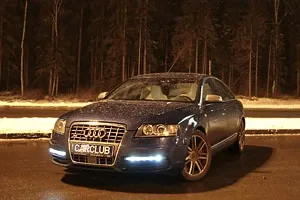
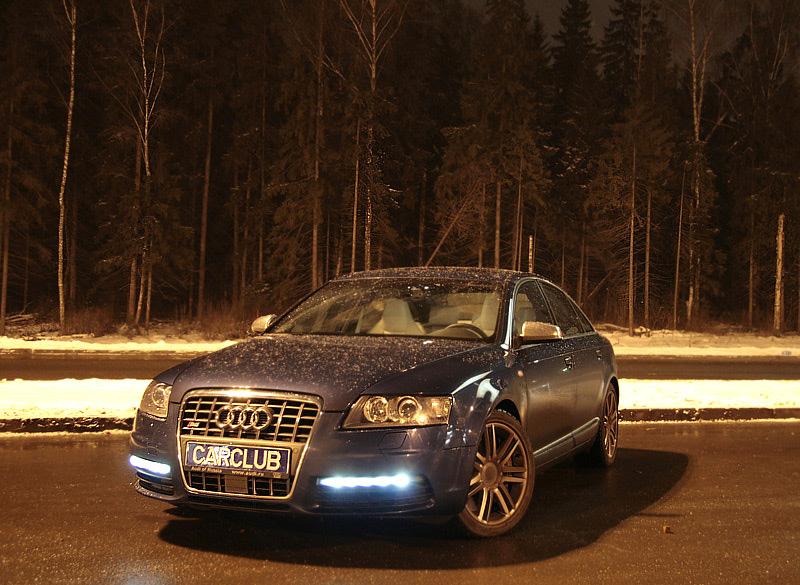
 What is the nature of pleasure, anyway? From a good book, from tasty food, from beautiful clothes, from driving a car through a snowy and perpetually congested city? Can you get joy from something that by definition should be its source? Having overeaten candy—from candy. Having drunk too much—from alcohol. Having left a beloved woman—from another. To get pleasure or at least vivid emotions, you need novelty and a lack of satiety. Audi cars have long become such a familiar and natural source of positivity for us.
But at the same time, tests of Audi are not without difficulties. In Ingolstadt, they don't make simple vans that could surprise a seasoned journalist. But Audi does produce high-quality and expensive cars that are initially obliged to exceed expectations. And what, say, should you expect from a flagship all-wheel-drive sedan with a Lamborghini engine? Only a miracle.
 The most unpleasant thing in our work is the need to write about disappointments. Not about what simply didn't please, but precisely about what deceived expectations. When you expect one thing and get something completely different. If you didn't expect anything, then even some delivery van could strike you right in the heart with excellent handling, precise steering, engine, and suspension—that would be great!
So what is Audi? Today it is the benchmark of restrained and laconic design, impeccable quality of materials and assembly. Plus something to your taste, and all this is a few percent cheaper than BMW or Mercedes. It is this balance of price and quality that brought Audi to the leadership of the "German trio" in Russia. And what is a Lamborghini Gallardo? It is a true Italian supercar with a mid-engine layout, whose quality was refined by the very same engineers from Audi. When it became known that a V-shaped "ten" with a volume of 5 liters was going to be installed in the "six," many fans got nervous. Now that would be a car! A true supercar from Audi to the envy of all competitors! To the envy of BMW and Mercedes! To the envy of everyone! If only…
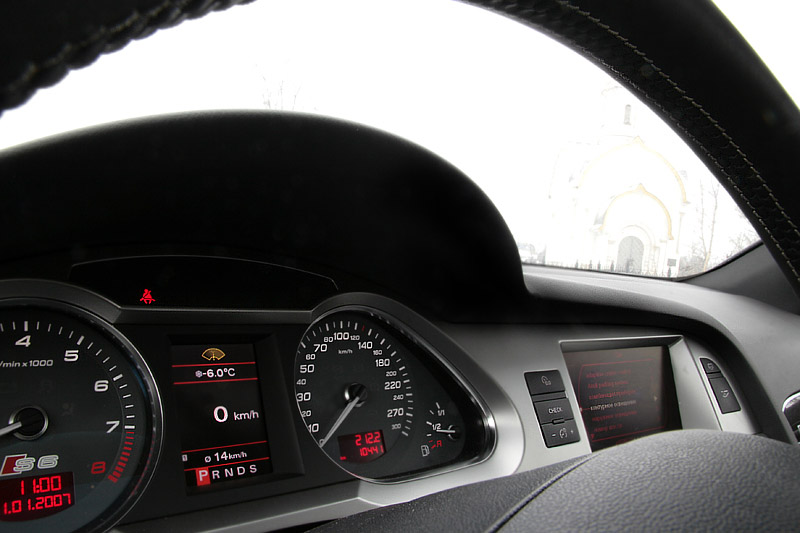
 If only speed records on ordinary roads could explain the essence of this car. On an international highway at three in the morning, we accelerated to 267 km/h—this is not a fantasy, but a real figure shown by the digital speedometer with large numbers in the center of the display. At such a speed, the S6 surprised us with the silence in the cabin—you can talk without raising your voice. Moreover, the main noise came from the winter studded tires! There is no aerodynamic whistle characteristic of many cars at all, and the engine doesn't sound as loud as one might expect. We were lucky that at such a late hour there were no traffic police officers on the road, because on the way back, when we were driving twice as slow, we met them and got off with a slight fright. By the way, it remains a mystery why the limiter didn't work at 250 km/h. Theoretically, the Audi can go faster, but is it worth the risk? Especially since the quality of our roads makes such flights very dangerous—you never know where an open manhole or a freshly laid "sleeping policeman" awaits you.
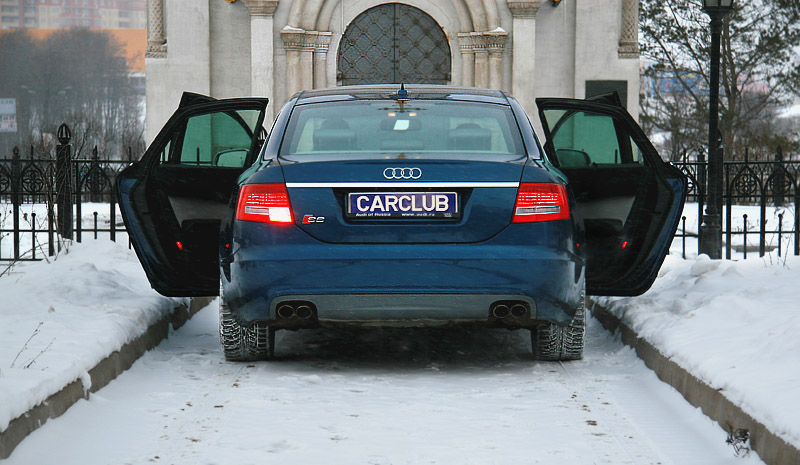
 If only one could judge the S6 by the suspension lowered by a couple of centimeters, wheel arches widened by 14 mm, V10 badges on the fenders, and four exhaust tips. Or by the sound of the engine. Or by the price, which exceeds 100,000 euros. The S6 exudes the confidence of an adult, accomplished, and very wealthy person who dresses simply and expensively, and keeps money in a Swiss bank. On smooth straight roads, the S6 is the king! An ideal means for spirited travel between German cities. The car radiates power and dignity. Therefore, any attempts to race with hot hatches or rare classmates look vulgar. Even calm driving on a congested Moscow Ring Road with periodic "teleportations" of a few hundred meters quickly becomes boring and starts to tire within half an hour. And in a traffic jam, it's sheer torment. The adaptive cruise control only activates above 40 km/h, so you can't count on it. The electronic gas pedal is so sensitive that guessing how many of the 435 horses you'll unleash now—35 or all 400—is not easy. Especially since the peak torque of 540 Nm occurs at 3000 rpm, and 90% of that value is available already at 2300 rpm. How do you like such a hot sporty engine from the Italian lady, which at medium revs pulls like an electric train and at the same time revs up lightning-fast to almost 7 thousand?
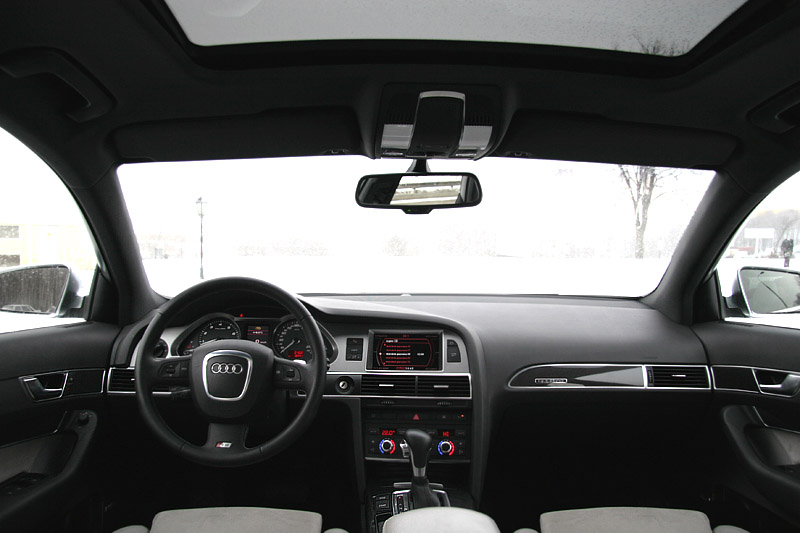
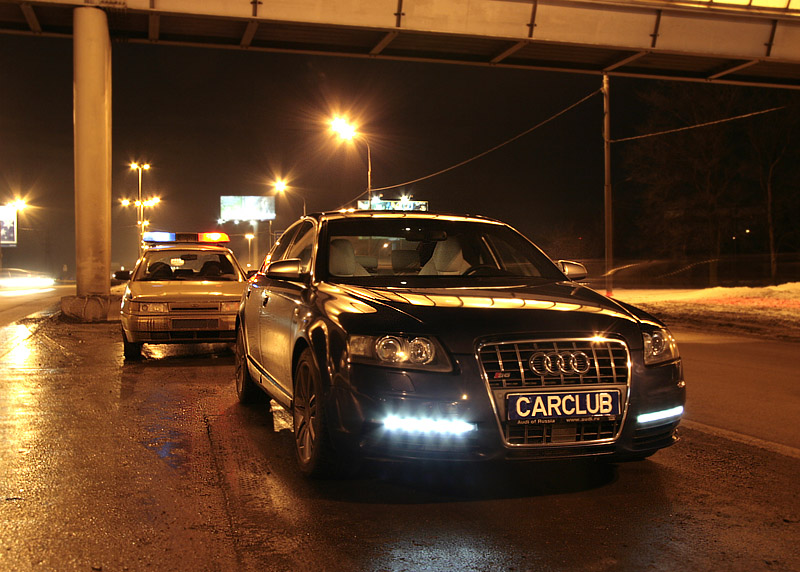 The S6 responds to the gas pedal almost instantly, as if no environmental standards exist. The refined 6-speed automatic matches the engine. This gearbox has always pleased with its speed of operation, and the closer gear ratios made the dynamics even more impressive. For perfectly smooth European roads, the suspension is tuned excellently, but on ours, it gets seriously "shaken." The smallest irregularities are transmitted in detail into the cabin, and the driver can get a complete picture of the depth and shape of every pothole over which the 19-inch low-profile wheels have passed. You can forget about comfort in the usual sense right away. Or you'll have to drive at speeds no lower than 200 km/h. The excellent interior with sporty "bucket" seats in front, upholstered in white leather and Alcantara, and three full-fledged comfortable places in the back won't save you from the shaking. But Audi does have a full-fledged trunk of almost 500 liters. The interior of the "S" itself differs little from the regular A6—only the S6 badges on the steering wheel and instrument panel, and the speedometer markings go beyond 300 km/h.
 But the main disappointment is not the suspension. You expect supercar-like handling from the S6, but it's nowhere near that. Yes, the car dives into corners much more energetically than a regular Audi A6. And it's no surprise—the Torsen center differential distributes torque asymmetrically: 60% to the rear axle and 40% to the front. But the large dimensions and mass make the S6 rather clumsy compared to the lighter and similar-powered RS4. The problem is the mighty V10, which is entirely placed ahead of the front axle—such is the layout of all Audis with a longitudinally mounted engine. Apparently, corners need to be taken sideways, although getting the car into a drift is not so easy. Even with the stability control off, the S6 turns into a corner later and more reluctantly than expected, and even lifting off the throttle at the entrance doesn't help much.
However, such driving is more of a lark; from the point of view of racing handling, the Audi is far from ideal. The heavy engine resists with all its 435 horsepower, and you get the impression that the car is simply "not tuned" for such driving. And, I think, this impression is correct. Because from a supercar, there's only the engine here.
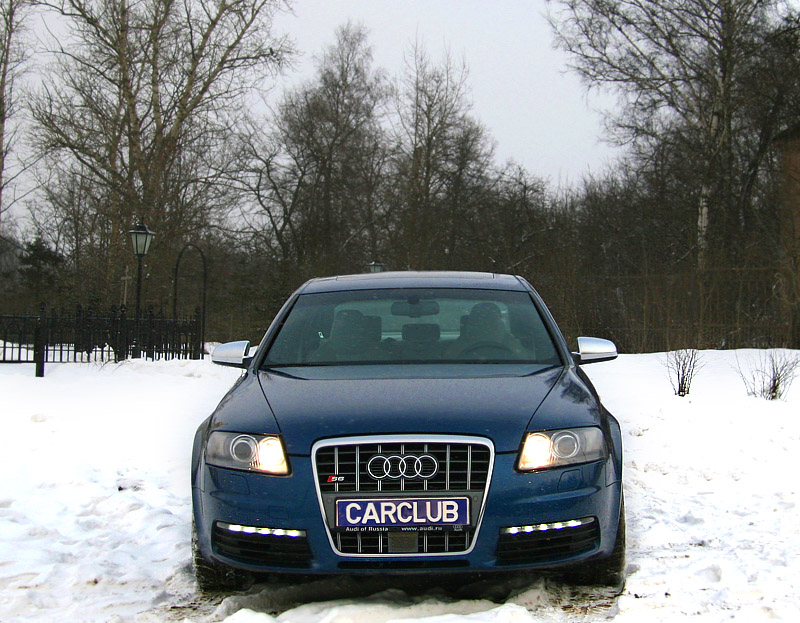
 The perfect appearance with stunning details like LED fog lights in the front bumper and small flaps at the bottom, a luxurious interior, the first Russianized MMI system, a ZF automatic that tries to please the most temperamental drivers, and a stability control system that rescues these temperamental drivers if they make mistakes—everything here is wonderful, except for one thing. The deceived expectations of those who got so excited upon learning about the imminent union of the Gallardo engine and the Audi S6. They are guaranteed disappointment. Because there is excitement, but no satisfaction. Especially if you previously drove an RS4 with its regular V-shaped "eight".
The Audi S6 will only appeal to those who are truly turned on by straight-line acceleration alone—in all other situations, the car leaves a feeling of disappointment with a capital "S". For a car with such an engine and such a stiff suspension, no practical application can be found. The image is present, the refinement is also there, the status is evident, but the point of purchase is completely absent. And why then is this Audi S6 needed at all? Apparently, only as an exhibit in a collection, as a car for rare weekend outings, and as a clear illustration of unfulfilled hopes. A sort of expensive chronometer in the collection of a wealthy Swiss, a specimen of German automotive engineering from the early 2000s. Especially since it costs comparably to some chronometers—from 137 thousand dollars. And what about the claimed 5.2 seconds to 100 km/h and 267 km/h that the car shows if you remove the limiter? Isn't that great? It's great, but only as long as you don't have a single Lamborghini in your garage. Moreover, fast driving is always a risk.