
When we compared the all-wheel-drive sedans BMW 525Xi and Audi A6 at the winter test track (AR No.24, 2005), the "five" took the upper hand — largely thanks to the X-Drive system. However, if the new S6 had represented Audi, the "Bavarian" would have had a hard time. In a regular "six", torque is split evenly between the axles, but the Torsen center differential in the S6 works differently: 60% of the traction goes to the rear axle and only 40% to the front.
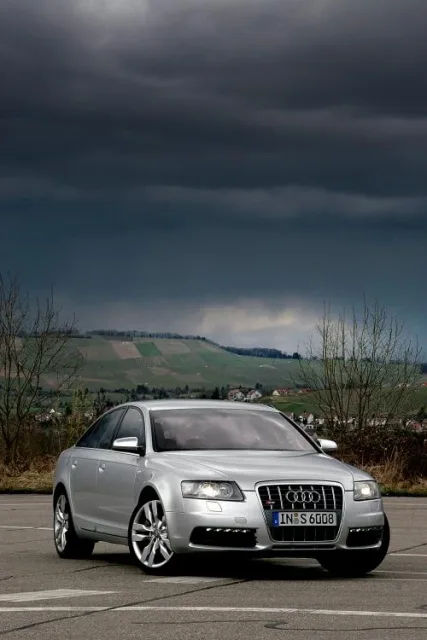
Asymmetric torque distribution is not the only feature of the Audi S6. Many will surely notice that under the hood of the "six" a V10 engine has appeared for the first time — the same one found in the Audi S8, and it is almost a relative of the Lamborghini Gallardo's engine. True, the Italian supercar is more powerful by 65 "horses" and shoots to 100 km/h in 4.2 seconds, while the S6 hits the first hundred in 5.2 seconds. But it's a sin to complain about temperament: ten cylinders, 540 newton-meters, and 435 hp compress time so that it takes your breath away. When you race down the autobahn at the limit, only one thing matters — moving your foot from the gas to the brake in time: the needle is at 250, and other cars seem frozen in place. And they are doing 130 km/h. Some not only drive but try to jump into the left lane without looking in the mirrors... Although the new S6 is hard to miss from afar — in gloomy weather, your eye catches the bright LED strips. A trifle, it would seem, but how it changes perception! The car looks like a predator crouched to the ground before a leap. And the ground clearance has been reduced by 20 mm.
 |  |
| In addition to the analog speedometer, marked up to 300 km/h, the Audi S6 also has a digital speedometer | The MMI multimedia system menu now includes Russian language |
 |  |
| Electronics monitors the increase in tire pressure as they warm up | The rear-view camera gives minimal distortion and shows the car's trajectory |
It is clear that the suspension has become stiffer — even compared to the "sport" one offered as an option for regular A6s. Together with the sharper Servotronic steering, it provides excellent precision at "autobahn" speeds. The 265/35 R19 tires also contribute significantly, which required widening the fenders by 14 mm.
 |  |
| A feature of the S6 version is five one-watt LEDs above each of the side air intakes of the front bumper | Inside, there are "S6" badges and carbon fiber inserts |
 |  |
| Huge brake discs dictate a minimum wheel diameter of 18 inches | Seats upholstered in leather and Alcantara are excellent |
 |
| The V10 FSI engine with direct gasoline injection (at a pressure of 100 bar) and variable valve timing produces 435 hp. This is 15 hp less than the Audi S8 — only because under the hood of the S6 there is no room for straight-through intake and exhaust pipes, which worsens the "breathing" of the naturally aspirated engine |
On the autobahn, the S6 is an undisputed leader. What about on regular roads, in the city? That's where the nuances begin. When pulling away from a traffic light, you need to press the gas pedal as if stepping on thin spring ice. After all, the engine delivers 90% of its torque at just 2300 rpm! In addition, the S6's transmission has a "shortened" final drive with a ratio of 3.80 versus 3.54 or 3.31 on regular A6 quattros. And the ZF "automatic" has a sport program: it shifts gears briskly and adapts to the driving style, evaluating not only throttle opening but also instantaneous longitudinal and lateral accelerations! If the car decelerates sharply, the gearbox downshifts on its own, as a driver would in aggressive mode, and under high lateral loads it won't upshift — shifting in a corner is unnecessary. Still, in the city, such a car feels uncomfortable — like a bird in a cage. I crawl at 60 km/h in Drive mode. Good thing the "automatic" understands that its sporty antics are not needed now — and it engages economical sixth gear. The engine runs almost at idle, but there's enough torque to roll calmly through the streets.
And the suspension is also too stiff in the city. Whatever marketers say about the ideal balance of handling and comfort, priority is clearly given to handling. On the autobahn at 200 km/h, ride comfort is still acceptable, but on city streets, the suspension transmits every pothole in the asphalt. On broken roads, you have to slow down and avoid all irregularities — the tires are low-profile. So parking becomes a whole ritual: without outside help, it's scary to even drive onto a small curb, lest you scratch the wheel or the expensive bumper.
Better to head out of town again. Floor the gas — and the "automatic" instantly jumps from sixth to second. In Sport mode, throttle response becomes even sharper, and sixth gear is completely unavailable. You can engage manual mode and shift using the paddle shifters behind the steering wheel. If you hesitate and rev the engine above 7000 rpm, the next gear will engage automatically. The sound during overtaking is especially pleasing: after 3000 rpm, the engine transitions from a light whisper to a rich sporty roar.
And how does the asymmetric all-wheel drive behave? On regular roads, it's hardly worth testing, and it's not easy to break the car into a slide on those wide 19-inch wheels. But we had a chance to get close to the limit: specifically for the presentation, a section of road winding through vineyards was closed off.
 |  |
| The rear lights on the sedan are regular, while on the wagon they are LED | The Audi S6 Avant wagon is only 17 mm longer than the sedan — and 60 kg heavier |
The S6 enters corners with more eagerness than the regular A6 — you can feel that more torque goes to the rear axle. You can turn off the stability control and take a risk: sharply lift off the gas at the entry, then catch the oversteer with the gas and light steering movements. Everything is transparent and clear, the steering provides excellent feedback. Although, of course, it lacks the sharpness I felt behind the wheel of the Audi RS4 (AR No.18, 2005): for sporty driving on a narrow, winding track, the S6 is much less suitable than for flying along autobahns.
In Russia, there are no "unlimited" autobahns, so it's impossible to experience all the delights of the S6 without breaking the rules. Maybe it has little chance of success in Russia? Over the past year, eight Audi S4s and only one Audi RS6 were sold. But during the same period, 28 BMW M5s were sold. It turns out that BMW's sporty image and more powerful V10 (507 hp) outweighed Audi's all-wheel drive. But brand representatives are not discouraged: in the list of "priority markets" for the new S6, Russia ranks fourth after Germany, the USA, and Switzerland.
Therefore, the car is not only certified but also adapted to Russian operating conditions.
Inside the Audi S6, there is a truly "charged" atmosphere: sport seats with combined leather and Alcantara upholstery, carbon fiber inserts on the center tunnel, a speedometer marked up to 300 km/h, and, which is especially pleasant, a fully Russified interface of the MMI multimedia system. For now, Russian language is an exclusive option only for the S6, but the company plans to teach it to other models with MMI as well. Another interesting option is a color rear-view camera with digital image correction. Unlike those I've seen before, this one doesn't distort the picture: when reverse gear is engaged, a realistic image appears on the seven-inch display, and the computer draws a "calculated" trajectory depending on the steering angle. Parking in tight spaces with such an assistant is a pleasure. And if an obstacle appears in front of the bumper, the screen highlights the car's outline and a red zone where the sensors have detected the object. A very thoughtful solution.
As usual, the wagon is also coming to market alongside the sedan. I drove both — I didn't feel any difference in behavior! And where would it come from: the wagon is only 60 kg heavier, and accelerates to 100 km/h just 0.1 seconds slower. Prices in Germany differ by 2,200 euros — the sedan costs 79,800 euros, and the Avant costs 82,000 euros. In Russia, the cars will only appear by autumn, and prices have not yet been announced, but it seems that the Audi S6 will be cheaper than its main competitors — the BMW M5 and Mercedes-Benz E55 AMG, which start at 123,800 and 116,280 euros respectively.


| Audi S6 (manufacturer's data) | ||
| Body type | 4-door sedan | 5-door station wagon |
| Number of seats | 5 | 5 |
| Trunk volume, l | 546 | 565—1660 |
| Curb weight, kg | 1910 | 1970 |
| Gross weight, kg | 2490 | 2600 |
| Aerodynamic drag coefficient | ||
| Drag coefficient | 0.31 | 0.34 |
| Engine | petrol, with direct fuel injection | |
| Location | front, longitudinal | |
| Number and arrangement of cylinders | 10, V-shaped | |
| Displacement, cm³ | 5204 | |
| Compression ratio | 12.5 | |
| Number of valves | 40 | |
| Max. power, hp/kW/rpm | 435/320/6800 | |
| Max. torque, Nm/rpm | 540/3000—4000 | |
| Gearbox | automatic, 6-speed | |
| Gear ratios | ||
| I | 4.17 | 4.17 |
| II | 2.34 | 2.34 |
| III | 1.52 | 1.52 |
| IV | 1.14 | 1.14 |
| V | 0.87 | 0.87 |
| VI | 0.69 | 0.69 |
| reverse | 3.40 | 3.40 |
| final drive | 3.80 | 3.80 |
| Drive | permanent all-wheel drive, with torque distribution 40:60 and Torsen center differential with increased friction | |
| Front suspension | independent, spring, four-link | |
| Rear suspension | independent, spring, on double wishbones | |
| Front brakes | disc, ventilated | |
| Rear brakes | disc, ventilated | |
| Tires | 265/35 R19 | |
| Maximum speed, km/h | 250* | |
| Acceleration time 0—100 km/h, s | 5.2 | 5.3 |
| Fuel consumption, l/100 km | ||
| urban cycle | 19.7 | 19.7 |
| extra-urban cycle | 9.7 | 9.7 |
| combined cycle | 13.4 | 13.4 |
| Fuel tank capacity, l | 80 | 80 |
| Fuel | petrol AI-98 | |
| * Electronically limited | ||