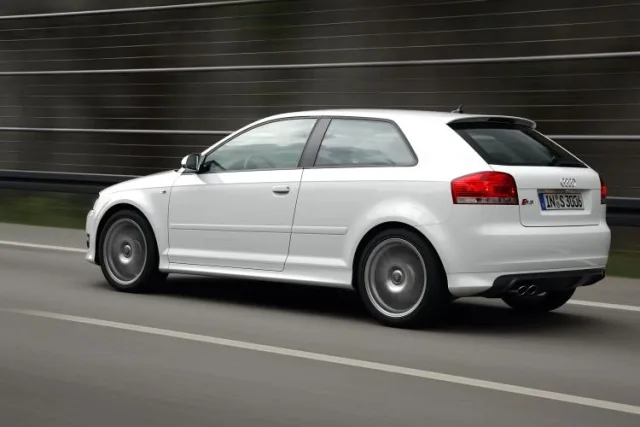
A dream come true! In the middle of a Munich airfield — a space marked with cones, behind the wheel of an Audi S3, and no restrictions! After driving for an hour and a half to my heart's content, I went to the engineers with the question: "What's new in the car?" They unanimously insist that the main change is the software: the algorithms of the electric power steering, the Haldex electro-hydraulic clutch, and the stability control system. Some things were also changed in the "hardware," but the word "software" was heard most often. In my opinion, it perfectly characterizes the car's character, because "soft" in English means "gentle."
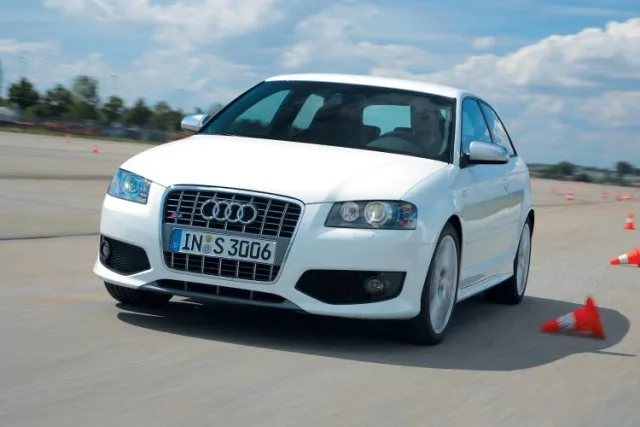
 Audi S3 is the most powerful (265 hp) and spirited "three-door" from Ingolstadt. But not the most expensive: the flagship of the lineup is the A3 with a naturally aspirated 3.2-liter V6 (250 hp), which is offered with either a manual or a robotic DSG. But the S3 owner has no choice: only "manual"! Apparently, sport is sport. Or is software software?
About many sports cars, they say that driving them slowly is simply impossible. But the Audi S3 calmly rolls along even at a snail's pace! However, nothing prevents you from flying headlong either.
The first thing that hints at versatility is the clutch pedal: in "angry" sports cars, it is usually stiff. Here, it is light but uncomfortable. The pedal travel is too long (due to the increased leverage), and after the discs engage, you have to lift your foot high.
 | |
| External speed characteristic of the Audi S3 engine | Engine 2.0 TFSI for S3: reinforced pistons, connecting rods, and cylinder block, enlarged turbocharger. The cylinder head became lighter, boost pressure increased from 0.9 to 1.2 atm. Compared to the original 2.0 TFSI engine (200 hp), power increased by 65 hp, torque by 70 Nm |
If you don't press the gas too hard, the letter S — whether Soft or Sport — doesn't remind you of itself: ride smoothness is slightly worse than in the standard "three-door," the steering wheel doesn't meet with deliberate sharpness, and the engine doesn't provoke. But if you press harder...
Unlike the clutch, the throttle response is excellent: press and you get it. After 3500 rpm, the sensations become brighter — a powerful surge! And beyond 4800 rpm, with the dashing whistle of the turbine, the tachometer needle simply shoots into the limiter! Gears engage briefly and clearly, picking up the acceleration baton. According to the specs, 100 km/h is reached in 5.7 seconds (more than a second faster than the previous S3), but there's no time to appreciate this burst — what's 100 when 200 is within reach!
The car owes such dynamics to the most powerful version of the turbocharged 2.0 TFSI: 265 hp (previously the leader was the 220-hp modification for the Audi A4 DTM Edition). And it's not just about the software with increased boost (from 0.9 to 1.2 atm), but also about the "hardware." Here you have reinforced cylinder block, pistons with connecting rods, a lighter cylinder head, enlarged turbocharger and intercooler. As a result, the torque plateau, although narrower than in the original 200-hp 2.0 TFSI, has risen higher: it was 280 Nm, now it's 350 Nm. The high power-to-weight ratio (265 hp/152 kg) left no chance for naturally aspirated engines to find a place under the hood of the S3. But why didn't Audi engineers take as a base the "double-charged" but lighter Twincharger (1.4 L, 170 hp) from the "hot" Golf GT hatchback?
— Oh, that's an excellent engine! — smiled Wolfgang Uhl, one of the engineers who worked on the S3's powertrain. — But let Volkswagen rather take our engines, as was the case with the 2.0 TFSI for the Golf GTI, than we take theirs. Besides, improving your own is cheaper and more pleasant than improving someone else's.
 |  | |
| Steering wheel with a flattened lower rim and excellent "anatomical" seats from quattro GmbH — for an extra charge | Aluminum mirror housings — a distinctive feature of sporty Audis | Standard seats are beautiful and quite comfortable, but sporty "buckets" are better |
Internal competition in action! And what about external? Why, for example, did the heavily revised TFSI engine retain the previous direct injection scheme with side-mounted injectors, while BMW and Mercedes considered it inefficient and placed injectors strictly in the center of the combustion chamber on new engines?
— Well, it's all about tuning, — Uhl grins. — We are confident in the future of the current FSI injection concept and don't need any other.
Indeed, you wouldn't even dream of a fit German engineer saying something like: "You know, we messed up completely with this engine and now we're wondering who among the competitors we could borrow something better from. Any suggestions?" I recall that when FSI engines still ran on lean mixtures (now they are all "stoichiometric"), Audi specialists also didn't need anything. However, what complaints — the engine is excellent!
And handling? Naturally, the "driving" setup of the hatchback was done at the Nürburgring — nowadays even minivans don't do without it. According to Hans-Martin Gass, an engineer from the chassis tuning department, the main attention was paid to laps on the North Loop, and only a third of the tests were on regular roads. Very interesting. Especially since the handling of the previous Audi S3 didn't cause delight: in most situations, the Haldex clutch didn't lock completely, causing the car to excessively push its front wheels out of the trajectory during "power slides." And sometimes, at the will of the electronic "brains," reactions changed unpredictably. Now, they say, the "brains," i.e., the software, have been corrected. And what did they achieve?
"Around the airfield, around the airfield..." The high-speed "slalom" is my favorite pastime! "Load the front, turn, apply power..." Remembering Yevgeny Vasin's lessons, I start to get into it. Rolls are minimal, reactions are precise, cat-like soft. As speed increases, I "set" the car earlier and try to turn the steering wheel as little as possible. Now the second gear "ends," and that's about 100 km/h... Of course, not everything was so rosy: I made mistakes several times and straightened the trajectory with the gas. And here's what I noticed: as soon as you "set" the car a bit harder and increase the fuel supply, the help of the rear axle is immediately felt: with all four wheels spinning, you can trace the entire arc, which was extremely difficult to do before. In addition, the hatchback pleasantly screws into the corner on throttle lift-off, with high precision of "angular" dosing. It's a pity the steering wheel is "empty": with increasing speed, it fills with effort, but the feeling doesn't leave that you're now stirring not skimmed but regular sour cream.
At first, I drove with the ESP off, and then I became convinced that the stability control system doesn't interfere with fast and error-free driving and even tries to help. As on the Golf GTI, it brakes the unloaded front wheel and, albeit roughly, quite appropriately simulates a front differential lock. But if, with the system on, you need to turn the steering wheel very quickly at large angles, the electric power steering starts to "bite." Software? Hardware? But not Sport.
 |  |
| Characteristic differences of the Audi S3 from the regular Audi A3 quattro | No complaints about the brakes |
The Audi S3 is a successful compromise between sportiness and comfort: on one hand, smooth reactions, on the other, precision. The suspension hasn't undergone fundamental changes: front MacPherson struts with aluminum arms and steering knuckles (instead of steel), rear multi-link. The car sits 25 mm lower, front silent blocks became stiffer, while rear ones remained unchanged. Springs and shock absorbers have been "tightened." Moreover, if shock absorbers for regular Audi A3 are supplied by Monroe and Sachs, then for the S3, the VAG concern makes them itself. And why isn't the electronically controlled Magnetic Ride suspension, known from the new TT coupe, offered for the S3 hatchback?
— Because in the case of the S3, we don't need to please everyone at once, — says Gass, referring to the possibility of the "magnetic" suspension operating in different modes. — The S3 hatchback is still a more "narrowly focused" car than the TT.
It's a pity we couldn't ask the engineers about the TT's suspension, which didn't perform well during our recent test (see AR No. 16, 2006) — they say a different team of testers was responsible for the TT's tuning...
The German manufacturer considers the Bavarian "one" BMW 130i (265 hp) and the Volkswagen Golf R32 (250 hp) to be the main rivals for the Audi S3. They also added the Subaru Impreza WRX to this list, but, in my opinion, in vain: the Japanese model has a completely different balance of comfort and drive. But it is quite possible to compete with the BMW — here you have a powerful engine, an adequate price, and, unlike the competitor from Munich, all-wheel drive. On the German market, the S3 starts at 35,150 euros, which is 2,500 euros more than the BMW 130i and Golf R32. The basic equipment already includes an interesting "racing" option — a lap timer. Among the additional delights are folding bucket seats (the standard seats are also fine, but these are simply gorgeous) and a steering wheel with a flattened bottom, although that is a matter of taste.
The Audi S3 body is only three-door. Marketers say the niche is too narrow, and you need to hit your customer precisely. And the portrait of such a buyer is this: a man of 38, with a decent income, who wants to drive a well-equipped compact sports car every day. Are there many such people here? Forty-year-olds — plenty! With money — also enough. But those who would want to pay a hefty sum for a small hatchback… During the entire production run of the first-generation S3 (1999–2003), out of 32,000 hatchback buyers in Russia, only ten owners of the "hot" version were found. For comparison: in 1999 alone, the Subaru Impreza Turbo sold twice as many units.
So what awaits us in Russia now?
The main question is the price, but it has not been announced yet, so we have to guess. If we look at Germany, where the S3 costs slightly less than the all-wheel-drive A3 with the 3.2 V6 engine (which sells here for 45,255 euros), it turns out to be quite expensive. However, even those who are ready to pay any money will wait until next year: the Germans are worried about how the boosted 2.0 TFSI will handle our AI-98 gasoline, and they are currently collecting fuel samples for tests.
| Audi S3 (manufacturer's data) | |
| Body type | 3-door hatchback |
| Drag coefficient/frontal area, m² | 0.33/2.13 |
| Number of seats | 5 |
| Length, mm | 4214 |
| Width, mm | 1765 |
| Height, mm | 1399 |
| Wheelbase, mm | 2578 |
| Track front/rear, mm | 1522/1506 |
| Trunk volume, l | 281 |
| Curb weight, kg | 1530 |
| Gross weight, kg | 2090 |
| Engine | |
| Location | front, transverse |
| Number and arrangement of cylinders | 4, in-line |
| Displacement, cm³ | 1984 |
| Cylinder bore/piston stroke, mm | 82.5/92.8 |
| Compression ratio | 9.8:1 |
| Number of valves | 16 |
| Max power, hp/kW/rpm | 265/195/6000 |
| Max torque, Nm/rpm | 350/2500—5000 |
| Gearbox | manual, 6-speed |
| Gear ratios | |
| I | 3.36 |
| II | 2.09 |
| III | 1.47 |
| IV | 1.09 |
| V | 1.1 |
| VI | 0.91 |
| reverse | 3.99 |
| final drive | 4.24/3.27* |
| Drive | all-wheel, with electro-hydraulic clutch in rear wheel drive |
| Front suspension | independent, coil spring, McPherson, with stabilizer |
| Rear suspension | independent, coil spring, multi-link, with stabilizer |
| Front brakes | disc, ventilated, with disc diameter 345 mm |
| Rear brakes | disc, ventilated, with disc diameter 310 mm |
| Tires | 225/40 R18 |
| Maximum speed, km/h | 250** |
| Acceleration time 0—100 km/h, s | 5.7 |
| Fuel consumption, l/100 km | |
| urban cycle | 12.4 |
| extra-urban cycle | 7.2 |
| combined cycle | 9.1 |
| Fuel tank capacity, l | 60 |
| Fuel | AI-98 |
| * 4.24 — final drive ratio for I—IV gears, 3.27 — for V, VI and reverse | |
| ** Electronically limited | |