
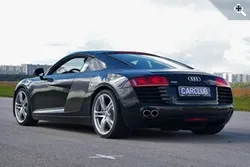
When you study the history of automotive brands, you gradually come to the conclusion that the Audi R8, the brand's first truly modern supercar, has a rather unusual origin. Everyone knows about the relationship of the "eight" with the Lamborghini Gallardo, but we should not forget that the Volkswagen Group concern, which includes Audi, also owns Porsche AG. It turns out that the R8 appeared at the intersection of two legendary brands at once - Lamborghini and Porsche.
Among motorsports enthusiasts and journalists, there is an unofficial division into sports cars and supercars. The former include any cars with a pronounced sporting character, regardless of their power - from the Opel Corsa OPC to the Mercedes E 63 AMG. Owning such a car means an active lifestyle, the ability to confidently hold the steering wheel, and the ability to move quickly on ice without relying on the stability control system.
But supercars are usually considered to be cars with engines from 350 horsepower, preferably with a rear or mid-engine layout, and necessarily with a racing character. Even the 507-horsepower BMW M5, with all due respect to the Bavarians and its phenomenal dynamics, is hard to call a supercar. But the lightweight 700-kilogram Lotus Elise with a 1.8-liter engine is quite a supercar, albeit with a certain stretch.
The demand for supercars, although subject to the whims of fashion, remains quite stable. Such a car cannot be bought spontaneously, under the influence of the moment. Only people seriously obsessed with speed get behind the wheel of such cars, and not all of them. After all, the global supercar market is only a few tens of thousands of cars per year - despite the fact that there are billions of drivers on the planet.
Audi's decision to release a road version of the R8 is truly significant, because against the background of Ferrari or Lamborghini, the German brand looks relatively affordable. Judge for yourself: the base R8 with a robotic gearbox in Russia costs 142,000 euros (about 193,000 dollars), while the prices of Italian competitors confidently exceed 200,000 euros. And in the USA, the Audi R8 is almost a people's car - prices there start from 109 thousand dollars.
Another mandatory attribute of a supercar is the top speed, which must exceed 300 km/h. And here Audi did not disappoint: the manufacturer claims 301 km/h.
Looking at the photos, it is easy to notice the similarity between the Audi R8 and the younger "brother" TT. Both cars are created in a single style and by one designer - Walter de Silva. But in person, everything is perceived completely differently. The "eight" fascinates with its squinted headlights with "eyelashes" of LED parking lights and does not let go of the gaze all the way to the rear lights. And how effectively you can sit on the rear wing - it seems as if it was invented for this very purpose. Not a single girl will drive by if you just raise an eyebrow.
If you look more closely, it becomes noticeable that from the rear and in profile, the Audi is a mixture of ideas from the Audi TT and the Lamborghini Gallardo. There is nothing surprising about this - the German shares a common chassis and many other components with the Italian "bull". This includes all-wheel drive transmission with a viscous coupling on the front axle, which can distribute from 10 to 35 percent of torque, and a robotic 6-speed gearbox. A regular manual is also available for the R8, but demand for it in Russia is minimal. The reasons for this phenomenon will be discussed below.
But let's return to the Audi cockpit. It is precisely a cockpit - everything here is subordinated to the driver, and around him wraps a layer of real Kevlar. Its use in the R8 sometimes even seems excessive, although in any case it is pleasant to realize that each such part is made by hand by highly qualified craftsmen, and Kevlar also significantly saves weight. The tested supercar weighs 1610 kg - and this is with all-wheel drive and a 420-horsepower engine.
We got an R8 with the R-Tronic robotic gearbox, which in principle of operation resembles the transmission of Formula 1 cars. For thrill-seekers, Launch Control is provided - a function for maximum fast start. It is activated when the traction control system is turned off and allows you to literally catapult the car from a standstill to 100 km/h in the claimed 4.6 seconds without much effort. At the same time, you do not need to work the clutch pedal and dose the gas with jeweler's precision: you press the pedal to the floor, and then the electronics will do everything itself. Such acceleration most of all resembles a blow to the head, which is delivered if not by Vitali Klitschko, then certainly by someone from the heavyweights. And if after accelerating to 100 km/h you sharply hit the brakes, you can lose consciousness. By the way, when starting with Launch Control, the "robot" works noticeably faster than in normal mode - gears shift without the slightest pause, whereas usually dips are still felt.
At first, it is extremely difficult to appreciate the handling of the R8 - it seems that it is simply impossible to break the car into a slide: it unquestioningly executes any, even the most absurd commands of the driver, and the steering wheel remains relatively light, but at the same time quite informative. However, there is a limit even for a supercar, and the behavior of the "eight" beyond the limit turned out to be very curious - the mid-engine layout provides incredible lateral G-forces, but here you need to keep your ears open. Due to an excess of traction, the drift develops rapidly, and it is not always possible to control it. With increasing speed, ESP tightens control: in response to a sharp maneuver at a speed of about a hundred, the electronics instantly extinguishes the slide. It is convenient that ESP is turned off in two stages - you can deactivate only the traction control system or turn off the electronics completely. At the same time, despite the all-wheel drive, the R8 behaves like a true rear-wheel drive car and willingly "sweeps its tail" at the driver's first request.
It is unnecessary to say that parting with the Audi R8 was completely unwilling. If you think soberly - and is this even possible when choosing a supercar? - you can come to the purchase of the "eight" in two ways: as a logical step after front-engine cars like Audi "S" or BMW "M", or if you want to get an original supercar of non-Italian origin. Among the rivals of the R8, it is worth noting the more comfortable and touring Jaguar XKR, which is available only with an "automatic", but has an open version, as well as the incredibly fast Porsche 911 Turbo. Oddly enough, with similar power and even blood relationship, the latter turns out to be faster and more aggressive, although not so futuristic - but this is already a topic for a separate test drive. Another worthy competitor is the super-wagon Audi RS6 with 580 hp, recently shown in Frankfurt: the Germans promise that its price will be comparable to the cost of the R8.
P.S. By the way, looking ahead, with a high degree of probability it can be assumed that a version of the Audi R8 with a 5.5-liter V12 TDI turbodiesel will soon appear, which has already brought Audi two victories in Le Mans. Quite recently, this engine debuted under the hood of the Audi R8 V12 TDI concept. In production form, its power will be 500 hp, while in racing specification it produced all 550 "horses". So very soon supercars can be refueled with "diesel fuel", however, you should hardly count on low fuel consumption and economical driving.
EXPERT OPINION
- How do you assess the dynamics and handling of the car?
- The dynamics and speed indicators, in my opinion, fully correspond to the image of the car and are generally very impressive. I would rate them 4 plus. But from the point of view of piloting this car, there are gaps. The R8 has rather dangerous behavior. It falls into a drift too sharply, and the lateral acceleration seemed not high enough.
- What can you say about the ergonomics of the interior?
The seats are very comfortable, especially the driver's seat, and the pedals are positioned perfectly. The trim materials feel dense and clearly do not skimp on quality. But I had questions about the manual gear shifting mode - I had to get used to the gearbox for a long time, and, honestly, a regular "manual" would give more drive. Otherwise, everything is done at a very high level.
- Who will be the main rivals of the "eight" on the market?
- The main competitors are the Lamborghini Gallardo and the Porsche 911 Carrera 4S. It is even strange to compare it with other cars. The "eight" is very close to real motorsport, and even more powerful civilian models look pale against its background.
Text: Leonid Pavlov.