
*Jet lag (English) — disruption of the body's daily rhythm, a biorhythm shift due to flying across several time zones.
Almost at midnight we bet a bottle — not of vodka, but of red wine, because that's what was in our glasses. I argued that if the model was due for a generational change, its name would be different. Indeed, what is the Audi R8? Maybe a "boosted" "eight" from Audi? After all, the brand's hot "sixes" and "fours" carry the RS letters. Why then wasn't the TT coupe called, say, the Audi R3? Especially since the letters R and RS are still free for the "three," and technically the TT is much closer to the A3 than the R8 is to the A8... Ah, TT — is that a nod to history? Okay, they didn't find a sonorous name in racing (the mid-engine Audi Rosemeyer concept appeared six years ago and sank into oblivion, and the name of the legendary pre-war driver is too heavy a burden), then why not the Audi R9? Just between the victorious Le Mans prototypes — the gasoline R8 and the diesel R10, and it wouldn't be confused with the A8...
However, Jens Steingraber, head of Audi's sports programs, repeated like a mantra: Audi R8 is an excellent name. And that's exactly what the coupe will be called going forward.
Have it your way. Actually, that bottle of wine was the only thing I wagered, finding myself in Las Vegas. And I never made it to the casino. A shame: to finally get to Las Vegas — and not blow at least three or four hundred. But after a 16-hour flight with a layover in Atlanta, after a whole day behind the wheel of the Audi R8, only one thing pulsed in my leaden head: sleep, sleep, sleep... Jet lag, the difference is 11 hours.
And as I was falling asleep, I managed to think that the place for the first driving presentation of the Audi R8 was chosen perfectly. Las Vegas is the quintessence of the decorativeness of a great decorative country! Viva Las Vegas! Viva-a-a-a... Good night. Or good morning? Jet lag.
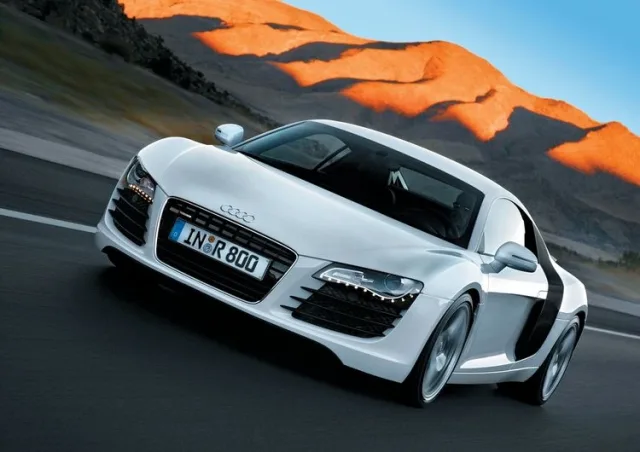
The Audi R8 is a many-faced machine. Glance at it in profile — it's like an Audi TT after unceremonious tuning. Look from the front — a monster. And the huge hood, like the plane of an aircraft wing, simply overwhelms the will: powerful, convincing, beautiful. But the plastic "gills" under the headlights... Truly, a strange combination of fundamental and decorative solutions. And if you turn on the parking lights... May the current chief designer of the entire Volkswagen Group, Walter de Silva, whom we've known for nearly fifteen years, forgive me, and also the exterior designer Frank Lamberty, but this time their sense of proportion failed them. These 12 "bulbs" encircling each headlight — like an inscription "Happy New Year!" curved from glowing Chinese electric tubes. Festive and cozy. Especially on a winter evening, on the facade of a rural store. But boutiques in expensive neighborhoods are styled differently. Oh yes, we're in Las Vegas... That's how it should be!
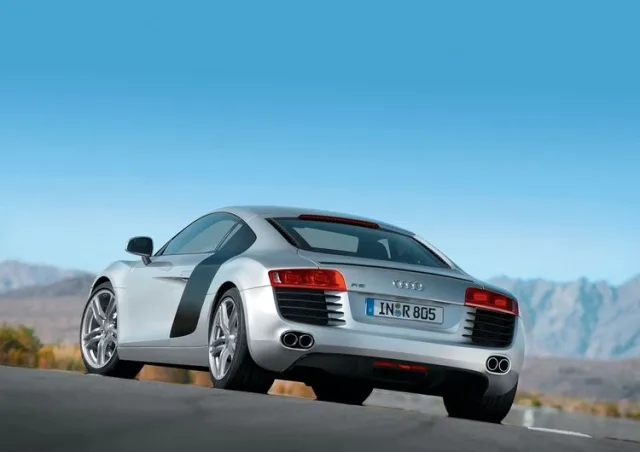
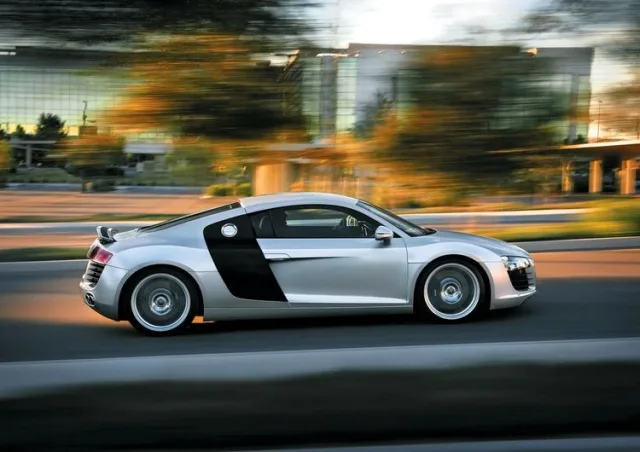
But when you catch the Audi R8 on the track, when you look at the 285-millimeter rollers spitting dust, you're already ready to believe: a supercar. No jokes. It's from the rear, with its faceted-angular flatness, that the Audi R8 most resembles a Lamborghini... We'll talk more about this resemblance, which is deadly for Lamborghini, but for now — welcome to the cabin.
| The almost entirely aluminum body "in metal" weighs only 210 kg. Audi representatives assure that this is a record result for cars of this class. However, "fully assembled," the Audi R8 already weighs 1560 kg — almost 100 kg heavier than the much more "steel" and also conditionally four-seat all-wheel-drive Porsche 911 4S, and 120 kg heavier than the two-seat but also all-wheel-drive Lamborghini Gallardo coupe, equipped with a more powerful and heavier V10 engine | The "aerodynamic scandal" surrounding the first-generation Audi TT coupe, when due to high lift force unloading the rear axle, the car would break away from the road at high speed, was not in vain: engineers assure that the Audi R8 is not affected by lift force at all, up to a maximum speed of 301 km/h. A significant credit goes to the flat bottom and five diffusers that "suck" air from under it, which is then directed to cool various components. True, the drag coefficient is not impressive: Cx=0.34. For the same Porsche 911, this figure is reduced to 0.29, and as our studies in the wind tunnel of the Dmitrovsky autopolygon showed, no problems arise with excess lift force and its distribution across the axles |
The Audi R8 is a two-seater, or more precisely, with a seating formula of 1+1. The main unit is the driver. Very main! Forget about old BMWs and new Alfas with their driver-oriented central consoles and instruments! The lucky one behind the flattened-bottom steering wheel of the Audi R8 is allotted a personal "formula" cockpit. Its forming element — a "carbon-fiber" arc — rises from the left of the door (the door handle is an integrated element of the arc), wraps around the instrument panel, and descends along the central console. The idea is not new, but it's implemented so well for the first time!
The seats — are cut to my measure. Right foot on the brake, key — to the ignition (the instrument needles darted to maximum values and again lay down "at zero"), I turn the starter (waiting for the engine to start is not necessary — it's enough to indicate your intention with an impulse turn of the key) and... The engine started. It just started. The air didn't shudder, and my hands didn't tremble. And that's good: trembling limbs would have stretched the already tedious process of extracting the belt from somewhere behind the left shoulder to a minute — extremely inconvenient!
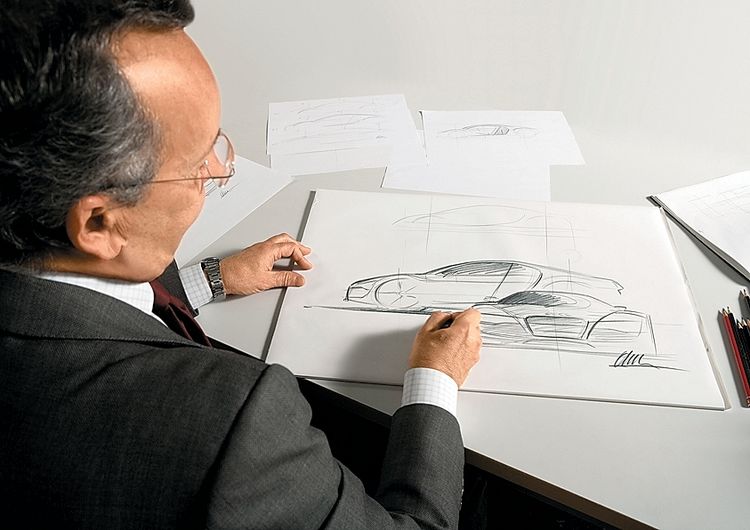 | ||
| Until recently, the famous designer Walter de Silva was responsible for the design of the now-disbanded "temperamental" ("southern") division of the Volkswagen Group, which included Audi, Seat, and Lamborghini. But to say that the Audi R8 or the more "civilian" fifth-series coupe (Nuvolari) is his swan song is premature: de Silva has been promoted and now oversees the design of all Volkswagen Group brands. In addition to the listed brands, this includes Volkswagen itself, Skoda, Bentley, and even Bugatti. It's not an easy job — coordinating the creativity of a hundred ambitious colleagues, each of whom dreams of being the author of a masterpiece under "their" brand. And no matter how clearly de Silva envisions the development paths of each brand, he cannot avoid reproaches that he stifles some talents and promotes others, that he pulls the blanket toward the "favorite" brand... He is unlikely to escape the fact that all cars will be at least a little bit Volkswagens: the inevitable price of unifying platforms and components. True, now the vector may change: they will all be at least a little bit Audis — key positions have been taken by people from Ingolstadt | ||
I had a car with the "semi-automatic" R tronic: it's a six-speed manual gearbox with actuators controlling gear selection and the clutch. There's no clutch pedal, of course, but there are paddle shifters: the right one for shifting "up," the left one "down." You achieve the same effect by pushing or pulling the lever on the central tunnel. Familiar. As is much else, because almost all the "tech" has moved here from the Lamborghini Gallardo! The same gearbox, the same all-wheel drive with a viscous coupling in the front wheel drive, the same one in the base... But the engine is different! For the Audi R8, they decided to install not a V10, but a V8. Otherwise, it would be completely awkward in front of the stepdaughter Lamborghini. They in Italy had just begun to believe in the revival, had just dreamed that it would be Lamborghini that would become the rear-mid-engine embodiment of Audi's sporting ambitions — and then, with a characteristic mixture of sentimentality and cynicism, Lambo is made to understand: we've had you, dear. And you'll see: soon the Audi R8 will also get a V10. And not a diesel, but precisely a gasoline one, updated, with direct injection. Perhaps after they "run it in" on the new-generation Gallardo.
— The one who chooses a Lamborghini needs an extreme car. For the pleasure of speed, this person is ready to sacrifice comfort. But the Audi R8 is a sports car for every day! — Steingraber convinces me (or himself?).
Let's say. In favor of the Audi's comfort, at least the fact that compared to the Gallardo, the wheelbase was stretched by almost 10 cm, while, however, reducing the already negligible geometric ground clearance. It's a pity that no place was found for a second row of at least conditionally child-sized, but still seats. By the way, about "everyday" comfort: I remember, people from Lamborghini also said the same... And who is the competitor then? Who were the ideologists of the Audi R8 aiming at?
— From a technical point of view, we are most interested in the all-wheel-drive Porsche 911 4S.
People at Porsche might be flattered, but now that Porsche owns more than 20% of Volkswagen Group shares...
— We started the project before Porsche acquired that stake. We didn't know about it then.
An awkward topic.
I move the aluminum lever with decorative notching to the left, activating the automatic mode of the gearbox, and try to carefully maneuver out of the parking lot of the luxurious Ritz Carlton country hotel. Plans include a two-hour drive through the Indian reservation, and after that — the famous Las Vegas Motor Speedway oval. But smooth progress doesn't work out: at low speeds, the car jerks — both when you add gas and when you release it. The cause is both the not-so-precise tuning of the accelerator pedal at small angles and the rather rough operation of the automatic clutch.
I put the first flash of irritation down to jet lag. The second one, though, I blame on the organizers: the Americans made us drive in a convoy escorted by military from the local Air Force base. Apparently, colleagues from previous groups had a real blast on the winding roads among the red rocks, and now we have to crawl along in single file… Luckily, the rangers turned a blind eye to little tricks: you let the car ahead get half a mile ahead, find a more or less open corner — and… Even though the speedometer needle only crept past 200 km/h a couple of times and just for a couple of seconds, there's no doubt: there's always enough thrust, and it's exactly what this car needs. And during hard acceleration, the nervous reactions of the "semi-automatic" even please. A jerk when shifting from second to third? Well, that's a great jerk, right?
And that automatic throttle blip on downshifts! R-r-roar, r-r-roar… The engine has a rich, pleasant sound. No comparison to the dry hiss of the V-shaped "ten."
But why no puppy-like delight, why don't I feel like screaming with joy myself? Is it that exhausting jet lag again? No, definitely not now. In terms of throttle response precision, the Audi R8 clearly loses to the Porsche 911, especially on the third pedal. That's one. And the engine's fury is too "linear" to be called fury. That's two. And it's not just about the "flat" torque curve!
There's no sonic hysteria here, no triumphant passionate scream! Okay, let's try again. Second gear. Full throttle. Four thousand rpm, five… Well, where is it? Six, six and a half… Come on, come on… Seven, eight… Come on, darling, come on! Past eight thousand, the tachometer needle hit the limiter, and acceleration stopped. Mundanely, without a shout. Just ordinary breathlessness. Once again, the abundant cosmetics misled me. Thank you, dear, you tried. Everything was wonderful.
And the brakes — that's three. In terms of effectiveness, they're magnificent, even if they do whistle a bit, and there's even an option — fashionable "ceramic composite" (which, by the way, wasn't offered for the Gallardo). But the settings… Okay, I think it's me, spoiled by the Porsche 911's incredible brake feedback, who just can't get used to it: every braking is a nose dive. I yield to the lady from Kommersant. So even she has a complete overdose.
We stop for coffee, and meanwhile I beg colleagues for a car with a "clean stick." Only that way! If, for packaging or economic reasons, they didn't put a proper "automatic" with a torque converter here, if the DSG gearbox can't yet handle 430 Nm of torque, then we'll work with the right hand. Like a man.
That's better, much better! Even though the clutch is long-travel, it's quite informative. I pulled away smoothly. Tried lifting off the throttle at a tiny speed. Again confirmed that reactions aren't polished, but it's still better than in the car with the "pseudo-automatic."
And then — the same scenario. I let the convoy go, second gear, full throttle, eight thousand, third… Damn! The lever hit the tooth of the decorative grille trim — and bounced back! I couldn't engage third! Twenty meters before the corner, where I desperately needed any gear… In calm, traffic mode, I engaged third easily, even pleased with the precision, but in combat mode — I couldn't! Why, oh why are there so many decorations here?..
— I understand. — Steingraber changes his mentor tone to a trusting one. — Honestly, I was against it. But they decided to use the trim. A pretty thing, isn't it?
Pretty.
Ahead is Las Vegas Motor Speedway. True, they didn't let us onto the oval itself (and rightly so: after all, the promised "top speed" is 301 km/h, not everyone is ready), but they let us have a blast on a piece of the "Formula" track, prudently "squeezing" the corners with cones and building "chicanes" from them on the short straights.
Good chassis. And the steering is comfortable. Like the Porsche 911, the steering ratio is quite large — about three turns lock-to-lock, but the reactions are smooth, and most importantly, they're not contaminated by the torque delivered to the front wheels. First, I drove with the ESP collar, then with the traction control system off (a single press of the button near the gear lever), and then, after holding the button for five seconds, we were left one-on-one. Me — and 420 mid-engine "horses." Imagine, not scary! On entry — a brief lift off the throttle, in response — a soft breakaway of the rear axle, at that moment throttle again — and the car obediently, accelerating and smoothly reducing the drift angle, traces the arc of the corner. Good girl, sweetheart!
— And why did you keep the viscous coupling? Yes, the Porsche 911 4S also has a viscous coupling, but the 911 Turbo already has an electronically controlled multi-plate clutch…
— Did you have a good time on the track? Did you lack anything? Then why change the viscous coupling for something else?
Steingraber made some note on my business card (maybe about a bottle of wine?), and we said goodbye. Somehow we parted without saying everything. Well, yes, he repeated twice:
— You see, I have a difficult situation. On one hand, I can't lie to you, on the other, I can't say everything I know…
But I can. The Audi R8, despite all the signs of a supercar, is not yet a supercar. It's powerful and mid-engined, made by competent engineers, handles well, and growls menacingly. But outside, that growl is much more impressive than inside. And that's the essence, the main mission of the Audi R8. The car needs to roar, to scream about itself, to attract attention. With those casino-like parking lights, the stylish but contrived "cockpit," the loud but not "singing for its money" Bang&Olufsen audio system, the stylish but gear-blocking trim comb… The car is too young. It hasn't been blessed, hasn't been suffered over to be a supercar. There's no trail of history and stories behind it… Le Mans victories? But those were completely, completely different cars. That takes years, decades. And as for the latest technologies, like the world's first production LED headlights, you may disagree, but... A supercar shouldn't be hyper-technological, right at the cutting edge. It should be a bit conservative.
I recall a case from the distant nineties when I first went to Western Europe in my "eight," driving through a dozen countries. At the end of the trip, I ended up in West Berlin, and then — beyond the wall, and another two thousand kilometers on the roads of the socialist camp. In one of the local supermarkets, I was spending my last marks on a novelty — a desktop digital clock with a bunch of functions: an alarm with different melodies, a timer, a stopwatch, even a radio. Only 15 marks! I took a couple — one for myself and one as a gift. And then I notice a familiar face — an elderly internationalist from the Ministry of Culture, a calm and sensible man. He was also looking at clocks. What a retrograde! Instead of grabbing a couple of fancy devices, he chose a simple analog Braun alarm clock for the same money — no radio, no digits, no voices, just a button on top and a dial. I kept quiet then, didn't lecture him. But now I have a Braun alarm clock myself. My favorite. And where did those digital ones with FM receivers go? And where are a hundred more like them?
However, don't mind the old grumbler! Viva Las Vegas! They say almost all hundred cars allocated for Russia this year have already found their owners! That's more than the Porsche 911 in all versions sold last year! And there's nothing to say about the eight Lamborghini Gallardos! And 180 thousand dollars is no obstacle! What other arguments are needed?
Sorry, I admit — I'm a fool. Maybe I'll still reform. And I'll give the bottle of wine right now. After all, R8 is a cool name! And the "gills" are just right. Okay, I got carried away. Jet lag, biorhythm disruption.
| Passport data | |
| Parameters | Vehicle |
| Audi R8 4.2 FSI quattro | |
| Body type | 2-door coupe |
| Number of seats | 2 |
| Length, mm | 4431 |
| Width, mm | 1904 |
| Height, mm | 1252 |
| Wheelbase, mm | 2650 |
| Track front/rear, mm | 1632/1593 |
| Trunk volume, l | 100/90* |
| Curb weight, kg | 1560 (1565)** |
| Gross weight, kg | 1860 (1865) |
| Engine | petrol, with direct injection |
| Location | in front of rear axle, longitudinal |
| Number and arrangement of cylinders | 8, V-shaped |
| Displacement, cm³ | 4163 |
| Cylinder bore/piston stroke, mm | 84.5/92.8 |
| Compression ratio | 12.5:1 |
| Number of valves | 32 |
| Max power, hp/kW/rpm | 420/309/7800 |
| Max torque, Nm/rpm | 430/4500—6000 |
| Gearbox | manual, 6-speed (manual, robotic, 6-speed) |
| Drive | permanent all-wheel |
| Front suspension | independent, spring, on double wishbones |
| Rear suspension | independent, spring, on double wishbones |
| Front brakes | disc, ventilated |
| Rear brakes | disc, ventilated |
| Front tires | 235/40 R18 |
| Rear tires | 285/35 R18 |
| Maximum speed, km/h | 301 |
| Acceleration time 0—100 km/h, s | 4.6 |
| Acceleration time 0—200 km/h, s | 14.9 |
| Fuel consumption, l/100 km | |
| urban cycle | 22.1 (20.4) |
| extra-urban cycle | 10.2 (9.6) |
| combined cycle | 14.6 (13.6) |
| Fuel tank capacity, l | 75 (on request — 90) |
| Fuel | petrol AI-98 |
| * Front trunk/rear trunk | |
| ** In parentheses — data for modification with R tronic gearbox | |