
Audi Q7
Engine: petrol, V8
4.2 FSI
Displacement — 4163 cc
Output — 350 hp at 6800 rpm
Peak torque — 440 Nm at 3500 rpm
Top speed — 248 km/h
Sprint to 100 km/h — 7.4 seconds
Gearbox: 6-speed automatic
Tiptronic, quattro all-wheel drive
Fuel consumption (AI-98):
city — 19.5 l/100 km
highway — 10.2 l/100 km
combined — 13.6 l/100 km
Dimensions:
Length — 5086 mm
Width — 1983 mm
Height — 1737 mm
Ground clearance: from 204.8 to 239.8 mm
Curb weight: 2240 kg
Tires: 255/55R18

Alfred Shageev, General Director of Euroshina company, 22 years of driving experience.
I first noticed the Audi Q7 in a TV commercial. A nice-looking car. The large radiator grille, smooth roofline, and sculpted sides combine with flat glass — resulting in a harmonious blend of sportiness and luxury. So my desire to test this car was immense.
Since I drive a Toyota Prado every day, I perceived the Q7 through the prism of comparison with my own car. The first thing that struck me was the engine. I have 4 liters under the hood, the Q7 has 4.2. It would seem a trivial difference, but in terms of feel — it's an abyss. A completely different torque: the car simply surges forward with incredible speed. Especially if you engage sport mode. A real hurricane. You can drive calmly and steadily, but as soon as you hear that velvety roar under the hood, reminiscent of a taking-off airliner, you immediately want to give free rein to the gas pedal.
Despite its dimensions and weight, the Q7 responds excellently to the steering wheel. It's easy to maneuver through traffic as if driving a nimble hatchback — there's plenty of dynamic reserve. And in corners, unlike the Prado, it doesn't lean. On asphalt, the advantage is clearly with the Q7.
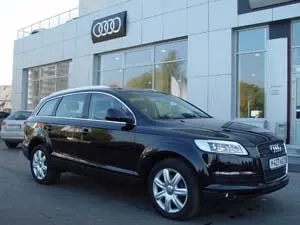
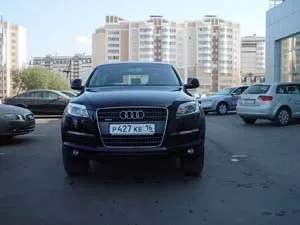
To test its off-road talents, I chose a road I usually take to my dacha. We engaged offroad mode. And here the Q7 behaved worse than in standard mode. It seems this mode is designed not for light off-roading but for serious challenges. On a dirt road, the Prado rides softer. Perhaps it's due to the low-profile tires on the Audi — my car has simpler tires.
Inside, the sound insulation pleased me: on the highway I accelerated to 170 km/h, and it was quiet in the cabin. The trim is quality leather. There are plenty of adjustments and indicators. On one hand, that's a plus; on the other, you don't use half of these functions. Take the same 6-speed automatic: it can work both as an "automatic" and as a "manual." But when you have such an "automatic," you don't feel like switching to manual mode. Especially since the Q7's gearbox is excellent — dynamics are superb, no delays felt.
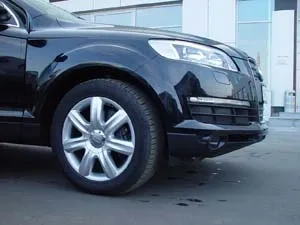
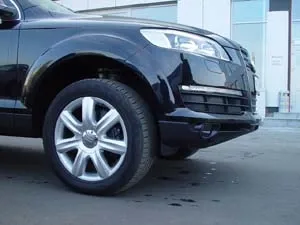
The Q7's price, of course, is impressive. For that money, you could buy two new Prados and still have a decent sum left. But when you look at what the car is packed with, you understand: it's worth its money. This is a car for those who already have everything and can afford such a whim.
When I got back into my Prado, it felt like it just didn't move. No pleasant growl under the hood, no furious acceleration dynamics… As they say, you quickly get used to the good stuff.
Vadim, 9 years of driving experience. Commercial Director of the newspaper "Autoclub-Kazan".
Even before getting behind the wheel, my colleague and I discussed two things: the striking appearance and the cosmic price. Externally, the Q7 is indeed impressive: powerful, sporty, with an expressive radiator grille. And the price leaves no one indifferent — a thought immediately creeps in: isn't it too much? To find the answer, you need to thoroughly examine the interior and assess how the car drives.
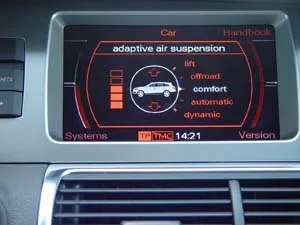

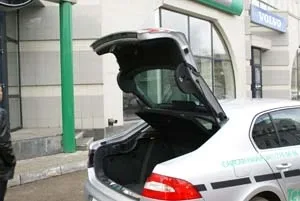
The first obvious plus was shown to us right at the dealership: the air suspension changes ground clearance from 205 to 240 mm! Believe me, that's impressive. The air suspension has another convenient feature: to make loading easier, you can lower the rear. By the way, the tailgate closes electrically. No complaints about the interior finish — everything is done to the highest standard. The only thing that looks a bit odd is the central console between the rear seats: there are two air vents, but no four-zone climate control. Though, that's a feature of this particular trim. The MMI interface turned out to be very convenient. We briefly familiarized ourselves with it on the A6 (see "Autoclub-Kazan" No. 96, September 2006), and it seemed complicated then. But now — as if we'd dealt with it all our lives!
Well, we've had a good look — time to hit the road. The 4.2 FSI V8 engine migrated to the Q7 from the racing Audi R8. The engine is so well balanced that it delivers both decent power at the top end (350 hp, 0-100 km/h in 7.4 sec) and excellent low-end torque (85% of peak torque available at just 2000 rpm). And fuel consumption for such a displacement is quite modest — 19.5 l/100 km in the city. The car is genuinely quick, and in any mode — you don't necessarily have to floor the pedal. After the test, we took a ride in a Land Cruiser with a 4.0 engine. It's clear these are different cars: the Q7 crossover and the body-on-frame LC SUV. But the difference in acceleration with almost the same displacement is like night and day. What surprised me most were the purely "car-like" manners in acceleration and maneuvers. Corners are taken with incredible ease!
And body roll is quite minimal — many crossovers could only dream of that. The proprietary quattro drive with torque redistribution and a self-locking center differential make the car predictable both on asphalt and on dirt.
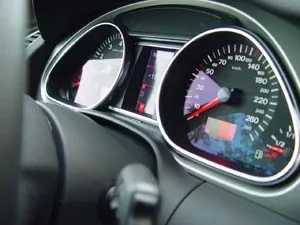
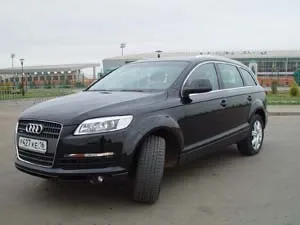
One could write a separate article about the Q7's equipment: there are adaptive headlights that "look" into corners, and a lane-change assist system that detects a car in the blind spot. You can't list everything. So after the ride in the Q7, I can confidently say: it fully justifies its price tag.
Alfred, 11 years of driving experience. Managing Editor of the newspaper "Autoclub-Kazan".
A new hot dish has been served on the premium SUV table. Please, do try it! It's generously stuffed with electronics and drizzled with a spicy sauce of speed, drive, multifunctionality, and prestige.
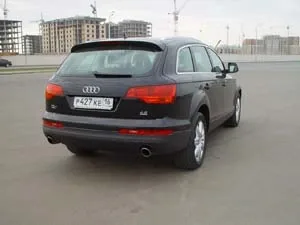
The Q7 commands respect already with its colossal dimensions. For reference: it's the largest European SAV. Its length is over five meters, width — almost two meters. It's built on the extended platform of the VW Touareg and is equipped with a petrol V8 of 4.2 liters and 350 hp.
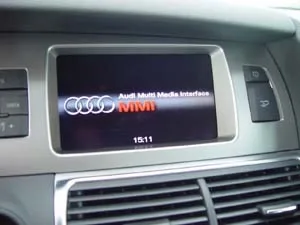
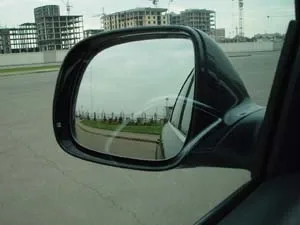
The seating position behind the wheel is like in a regular passenger car: the windshield is heavily raked, so there's no "jeep-like" upright seating. The exterior, by the way, is ambiguous. There's something predatory about it — as if a fantastic lizard crouched on its hind legs, ready to pounce. But the interior is in AUDI's traditionally restrained style, at the highest level. I recognize familiar lines, of course! The instrument panel has almost exactly migrated from the old A6 we recently tested. And that same glovebox opening button, which you can't find right away, is also in place. The MMI system with a color screen has become almost native, though it lacks Russian language support. With it, you can work "miracles." For example, change air suspension modes: "comfort," "dynamic," "off-road," or "lift" — everything is selected manually, or you can simply enable auto-adjustment. If you select lift mode, the car raises by 25 mm — enough to confidently tackle serious obstacles. In the city, the car proved simple and understandable. I realized this immediately, although I started my acquaintance with the Q7 from the back seat and saw the satisfied face of another test participant in the mirror the whole way. It was obvious the car suited him.
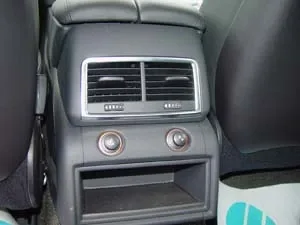
I won't describe passenger impressions, except for the spaciousness and comf… wait, what's this?! Well! In a car of this class, such a "flaw." There's no rear passenger ventilation control. But for some reason, there are two cigarette lighters. Hmm.
Finally, I got to sit behind the wheel. I keep catching myself thinking that the interior strongly resembles the A6 — and this may upset A8 owners a bit, because at a similar price, it's the A8 that offers a more luxurious cabin. I start moving and notice again: only the seating position and the top-down view give away that this is an SAV. What can I say — the car drives, and it drives great. You don't feel at all that there are almost two tons of weight and a five-meter body under you. I wonder how pleased I look in the mirror right now. By the way, about the rearview mirror: I don't want to start with negativity, but I honestly didn't like it — you can only see the headrests in it, and nothing else. The side mirrors with the blind spot hazard indicator save the day. I try to test them in action: I turn on the turn signal and pull up close to the neighboring car. Logically, the sensor should have blinked, warning of a dangerous approach. But the neighbors, seeing my turn signal, just veer away as if I scared them off. The pleasant feeling of superiority will apparently become a constant companion for the owner of such a car. Okay, I won't tempt fate and will just take the manufacturer's word for it — let's assume the function is indeed convenient. The familiar 6-speed Tiptronic works flawlessly as always. The shifts are absolutely imperceptible, without jerks, and speed builds rapidly. For the first time in my life, I accidentally caught the "green wave" on the Southern Highway — I didn't even notice how I accelerated to 140 km/h. It was truly accidental: everything happens so smoothly and quickly that you don't have time to watch the speedometer, and it seems as if the car moves by the power of thought. Switching to manual mode is not something you want to do at all, but I need to test it. And here, "manual therapy" turns out to be a waste of time. The driver isn't given full freedom: both speed and engine RPM interfere. Is it even needed? I return to the normal mode, or rather to Sport, and again am amazed by the car's temperament. There's so much electronics here that you can't master it in a couple of hours. For example, I couldn't get the rear axle to "squat" to make it easier to load the trunk. It turned out that to activate this function, all doors must be closed.
I would really like to take a night ride and see how the xenon headlights turn following the steering wheel.
What, in my opinion, this car still lacks is popularity. It lags behind the X5, Porsche Cayenne, and VW Touareg in this regard, but it is quite capable and ready to push them aside in the market.