
Audi Q7. An American from Slovenia
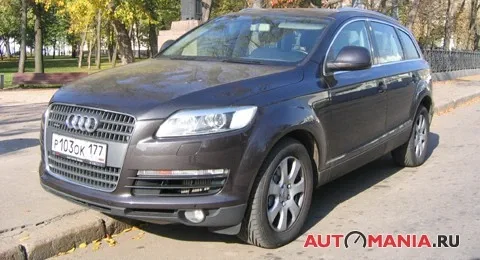
"You'll figure it out" — easy to say! In reality, I had to struggle with this car for all four days. Only on the second day did I realize that the engine could be started without taking the key out of my pocket, on the third — I discovered the function of opening the trunk from the cabin 'hands free' (like the Lexus RX 300), and literally an hour before the end of the test — a very unusual option, namely the lane change assist system, which I'll tell you more about a bit later.
But first, about how the Q7 starts without an ignition key, or rather, with a contactless key. Similar systems have long been available on Nissan and Toyota (there, instead of a key, there's a Start/Stop button), as well as on Renault (there, a card is used). Here everything is arranged somewhat differently: the electronics react to the presence of the key at a certain distance. You approach the car with the key in your pocket and, without taking it out, press your finger on the button on the driver's door (only on it) — the car is open. Then you sit in the seat (you need to get used to it — it's simply bottomless, and lateral support is almost absent) and touch the 'start engine' button. The seats move forward, the steering wheel lowers — you can go. The 'stop engine' command — and the electronics will shut off the engine while you're still in the cabin. After getting out of the car, touch the button on the rear door (only on it) — and the car will close. If you don't like this algorithm, use the key fob. By the way, in 'auto' mode for lights, the fog lights and rear lights will still burn for some time. You'll constantly be reminded that you forgot to turn them off, although in America no one will pay attention to this. For us, this function is a novelty, but there, across the ocean, it's a familiar and very useful thing, for example, when entering a garage. All Russian advisers should get used to overseas comfort!
European concerns are increasingly eyeing the American market. After all, BMW, Audi, VW, and Volvo need to compete with local monsters somehow. And given the mentality of US residents — they believe that nothing can be better than a huge American jeep — Audi engineers took this into account when creating the Q7. They made the car pompous, heavy, aggressive, and even frightening. Some cars smile, others resemble frogs or residents of Asian countries, but the Q7 is not like that — it instills fear at first glance. And, of course, the Q7 is seven-seater and heavy. For Yankees, the question of what the body is made of and how much gasoline the car consumes is secondary. The main thing is that the jeep is bigger and cheaper... The issue of price within the VW concern was resolved quickly. The Q7 is produced at the same plant in Slovenia where Cayennes and Touaregs are made. Moreover, the assembly of the Q7, oddly enough, is carried out on the same line where small VW Polos are assembled. This didn't make the Q7 cheap for Russia, but for America — quite.
Now let's try to understand who the Q7 can compete with. The mentioned Touareg and Cayenne are more like brothers in arms than competitors, the BMW X5 and Mercedes R-class are still somewhat different cars. Perhaps, from those officially sold here — the Cadillac SRX. Nothing else comes to mind.
Although the Q7 is aimed with its aggressive gaze across the ocean, it clearly falls short of the luxury jeeps produced there (for example, the Cadillac Escalade, both first and second generation) in some parameters. Yankees simply can't imagine how a normal car can be without a compass, without display prompts about how many kilometers until an oil change, when it's time to refuel, what the pressure is in each of the four tires. The standard Audi Q7 also lacks such a favorite American gadget as a sunroof. Optionally, you can order a three-section panoramic roof with two sunroofs, but given the huge demand for the Q7, doing this in Russia will be quite difficult. You'll have to wait a long time.
And yet, the Q7 is not an American, but a purebred European. If you decide that due to its weight and dimensions, the jeep (or rather, crossover) is sluggish on the move, uncontrollable at high speeds, and allows large lateral rolls in corners, you'd be mistaken. It's a docile car, ready to do anything for you. Its appearance instills respect in the traffic participants to your right and left, you feel like the king of the road. In four days, there wasn't a single case where someone didn't yield. This reminded me of the Hummer H2 test — absolutely the same scenario. Despite the fact that the number of Q7s in Moscow has long exceeded five hundred, nevertheless, people constantly pay attention to the car, turn around, which is pleasant. You feel like Sharon Stone arriving at the premiere of 'Basic Instinct': they look at you, everyone is curious whether you have panties under your dress.
On the first day, I couldn't get comfortable in the driver's seat. And it wasn't even about the adjustments. The seat is very wide, and that's certainly pleasant — American-style, but then you'd want good lateral support and seat belts that attach not from the side, but from the corners of the seat.
After the first day of travel, I sat in the back. Spacious, like in a limousine. It's strange, though, that with a four-zone climate control, there's no rear seat heating in the back. The Nissan Teana, a newbie in the business class segment, costing 42,000 dollars, has it. However, the Audi A8 also has it. But in the Q7 — no.
Before the test, I read a lot of materials about tests in Germany and Russia and each time came across phrases that the car guzzles almost 25 liters per 100 km and needs to be refueled with almost 98-octane gasoline. Yes, the car is demanding on fuel quality, and according to the instructions, it requires from 95 to 98 (this fact is indicated on the fuel tank cap), while consumption, again from the instructions, is 13.8–15.2 l/100 km in combined mode.
If you don't constantly floor the gas and drive more or less calmly, the result of city driving is 16.8–17.2 liters, and a short trip to Sheremetyevo and back gave a result of 13.2 liters at a speed of 160–170 km/h. Quite decent, given the displacement, power, all-wheel drive, and constantly running four-zone climate control.
Also, the Q7 has a five-position air suspension (exactly like the new generation Allroad) with positions Dynamic, Automatic, Comfort, Allroad, Lift. If in the first position the ground clearance is 180 mm, then in 'lift' it increases to 240 mm (for the Allroad — from 125 mm to 185). This thing switches quite simply — using the MMI joystick interface, familiar from the A6 and A8 models. It's much simpler than BMW's iDrive, but in any case, you wittingly or unwittingly get distracted from the road. Just like when switching stations on the radio.
By the way, speaking of the radio, the sound here is handled by 12 BOSE speakers with a subwoofer located in place of the spare wheel. There's no spare tire — its role is played by a repair kit, a novelty fashionable at Mercedes and BMW. In the trunk, by the way (as well as under the hood), we found a set of keys, a jack, but didn't find... the battery. Shame on us, test drivers — we didn't find it at all. Most likely it's under the rear seats.
The claimed acceleration figure of 7.4 seconds, the Q7 demonstrates 'to the fullest' (for the Allroad with a 3.2-liter engine, it's only 6.3 seconds). Moreover, the automatic transmission works smoothly but quite unusually. On kickdown, it revs the V8 engine to almost 7000 rpm, then drops to three thousand and... off we go. The thrust is powerful, yet the Q7 is perceived as a calm and balanced car. No matter how you drive — pure relaxation!
True, you need to be more careful with off-road. We didn't have any extreme in our test, and we didn't want to dirty the car. After all, honestly, the Q7 cannot be considered a full-fledged SUV. All it's equipped with is permanent drive with a single-speed transfer case and free inter-wheel differentials. When slipping, up to 65% of torque is transmitted to the front wheels, and 85% to the rear. There's also a stability control system that, in case of a rollover risk, selectively brakes the wheels, preventing dangerous lateral roll. So for the Russian winter or country roads of the Moscow region — just what you need, but for real mud, it'll be a bit lacking.
And yet one of the most interesting options is the lane change assist system, side assist, which I mentioned above. The system monitors the appearance of other cars from the side and behind. This is done using two radars that constantly scan the space at a distance of up to 50 meters. When an object appears in the visibility zone, a strip of LEDs lights up in yellow on the mirror housing (left or right). If you turn on the turn signal before changing lanes, the strip will start flashing brightly in strobe mode, warning that overtaking is unsafe. The parking assist system is also well thought out — the rear view camera displays a color picture of everything happening behind the car on the central display. Unlike the similar solution in Nissan, here the camera tracks the rotation of the wheels and additionally warns the driver with a sound signal. If you don't like the video on the screen, you can switch to graphic mode — then the image will be presented as a diagram. The car is excellent, perhaps even magnificent. But we, test drivers, always look for a fly in the ointment. I'll tell you what I didn't like. Why was it necessary to make a third row of seats at all, where even a child is cramped? Why are these places more spacious in the Volvo XC 90 and Land Rover Discovery (both half a meter shorter)? Why the chrome rim around the side air vents on the central panel, which mercilessly glares in the mirrors? It's unclear where the blue reflections on the left part of the instrument panel came from — where the tachometer is — which are clearly visible in photos of the car. The glare on the windshield from the huge speaker on the front panel is not even discussed. They are smaller than in the XC90, but still tire the eyes on a sunny day. But from the sun, not one but two sun visors protect — one on the side, the other in front. Unusual, but very convenient. The Q7 is a very interesting car with a lot of pros and cons, and no one doubts that it will find its buyer in any part of the world. If only there was enough money. Technical specifications: Dimensions (mm) | 5086x1983x1737 Engine | V 8 4.2 Maximum power (hp) | 350/6800 Curb weight (kg) | 2240 Payload capacity (kg) | 720 Max torque (nm/rpm) | 440/3500 Wheelbase (mm) | 3002 Acceleration 0-100 km/h (s) | 7.4 Fuel consumption (l/100 km) | 18.5 (spec) Tires | 255/55R18 Fuel tank capacity (l) | 100 Trunk capacity (l) | 775 Cost of tested version (rub) | 3,161,247 Dmitry SHAVYRIN Source – AUTOMANIA.RU