
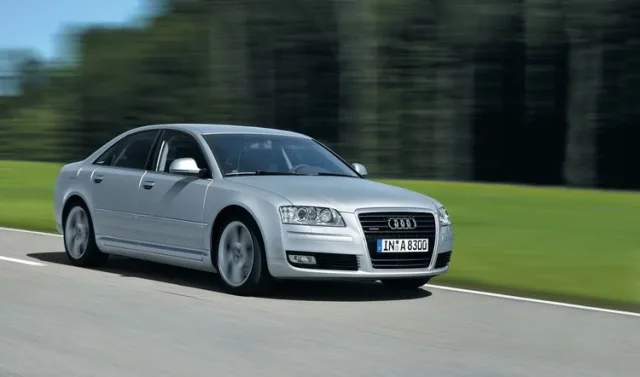
At Munich airport, where even the planes seem to hum in hushed tones, my acquaintance with the updated Audi A8 begins. The silence in the cabin is absolute. I hang my jacket on the hook under the ceiling, settle comfortably into the leather-upholstered seat, pull out of the parking spot... and immediately hear some kind of grinding noise. Where did that come from?
Externally, the facelifted A8 doesn't reveal much: the fog lights went from round to elongated, turn signals appeared in the mirrors, chrome on the door handles, and LED taillights at the rear. But the new alloy wheels, five- or ten-spoke, you notice right away—they are magnificent. As they say, wheels for a car are like legs for a woman.
The interior was left untouched, and rightly so. Here is the perfect balance of quality, ergonomics, and restrained luxury that needs no adjustments.
I start with the 4.2 TDI quattro version—that's all-wheel drive and a diesel with 326 horsepower. The torque of 650 Nm is a figure that takes your breath away: that's 70 Nm more than the gasoline flagship W12! Acceleration literally presses you into the seat, although the automatic transmission sometimes jerks on low gears, not keeping up with the powerful engine. At the same time, the appetite is only 8 liters of diesel per hundred. However, in Russia this version is unavailable: due to the finicky particulate filter that can't handle our fuel, we only get the junior A8 3.0 TDI, which doesn't have such problems.
But that grinding noise wouldn't leave me alone. I get out, inspect the car—everything is fine. I pull away—the sound returns. Moreover, it's audible even during lateral G-forces, and they are considerable here: on the narrow roads of Bavaria winding through cornfields, the heavy "eight" allows a lot. Engineers say the air suspension was retuned toward comfort, reducing friction in the struts by 20%. But I didn't feel the difference—as the A8 was the benchmark of combining handling and smoothness, so it remains.
Only that grinding... What is it—unclear.
Also, the steering wheel vibrates in your hands. That's clear: it's Line Assist—a system that uses a camera at the mirror to monitor lane markings. When you change lanes without a turn signal (I checked, of course, for research purposes!), the electronics start shaking the wheel, and the amplitude can be selected from three options in the MMI menu. It's useful both for combating drowsiness and for teaching road courtesy. True, Honda Legend and Lexus LS with such systems can also steer themselves, keeping the car in the lane.
On the mirror housings, LEDs sometimes flash—Side Assist, a radar-based lane-change assistant that moved to the A8 from the Q7.
Finally, I stop for a coffee break to switch to another car. I turn off the diesel, reach for my jacket... And there it is, the solution! It was the zipper lock scraping against the aluminum grille of the Bang & Olufsen speaker. In the cabin's silence, that metallic squeak was as audible as if it were amplified.
Now—the most modest version, the front-wheel-drive A8 with the new V6 2.8 FSI with 210 hp. This engine debuted back in December on the Audi A6, and its main feature is the Audi Valve Lift system, essentially a clone of Honda's i-VTEC. For each intake valve—two cams: one "economical," the other "power." But, unlike the Japanese, the Germans minimize the intake phase, reducing pumping losses. At low loads up to 4000 rpm, one valve lifts 5.7 mm, while the second only 2 mm—this creates swirl in the cylinder. At full throttle, six solenoids, one per cylinder, shift the couplings to the "power" cams, and both valves open to 11 mm.
The engine is a delight! It pulls strongly from low revs, the voice has a noble metallic note, and it revs smoothly right up to the cut-off at 7200 rpm. Acceleration to a hundred—eight seconds per the specs. On the autobahn, the dynamics were more than enough, and the fuel gauge showed only 11 liters per hundred—very respectable for such driving. Here, both AVL and the 20% reduction in internal friction and the variable-displacement oil pump come into play—the Germans promise 15% savings against the old 2.8 engine. But in Russia, you can't order such a variant for executive needs either: the minimum available version is the A8 3.2 FSI (260 hp) for 78,504 euros, which drinks three liters more in the city and accelerates to a hundred only 0.3 seconds faster.
What's the reason? Marketing—the Germans fear for their image. In Russia, Audi, even without budget versions, leads among the German trio. Yes, the A8 (507 cars sold in six months) noticeably trails the Mercedes S-Class (1,995), but overtakes the BMW 7 Series (421). The updated cars will arrive at dealers in October, prices will rise by 2%, and only for the flagship S8 (from 121,185 euros) and 6.0 W12 (from 136,885 euros)—due to the sunroof in the base.
By the way, last year Audi became the most profitable brand among German manufacturers, even ahead of Porsche and Volkswagen. The plant has already grown a huge customer center: a test area, the Avus restaurant in racing style, a children's zone... And also a museum with a full collection of Audi, Horch, Auto Union, NSU, motorcycles, and DKW bicycles. Want a factory tour—please. Come with your family, look, get inspired. And leave happy in a brand-new Audi. No wonder every fourth Audi sold in Germany comes from here. I ask the guide if they plan a test track like Porsche's in Leipzig. In response—a confident nod. That's how you sell cars with history.