
Journalist presentations almost always come with visual materials. Here, the briefing was organized with particular flair: a load-bearing body frame hung from the ceiling, and next to a shiny pre-production example stood an identical one, disassembled down to the last screw. To show the MMI system, the Germans built a stand with internet access, and a tiny video camera tracked finger movements. They'd better have pointed that camera at the incomprehensible automatic selector in the real car! And also recorded the sound...
Split personality. Looking for something new in the third-generation Audi A8
What an interesting case! Forgetting about the road, I look at the MMI system display, like a possessed clinical psychologist from a Hollywood movie. "What an in-te-res-ting case!" — in scripts, this line usually makes the patient confused. But the Audi A8 is hardware, or rather, a set of parts made of aluminum, steel, glass, plastic, and rubber. And yet it seems as if the headlights are about to blink rapidly and fill with LED tears. The menu is already in red tones, but if the monitor could, it would blush even more from my gaze. And I keep turning the lacquered knob on the center tunnel bulge back and forth, changing the suspension presets. Comfort, Dynamic, Comfort, Dynamic... The odometer shows only ten kilometers, but really, what an interesting case!
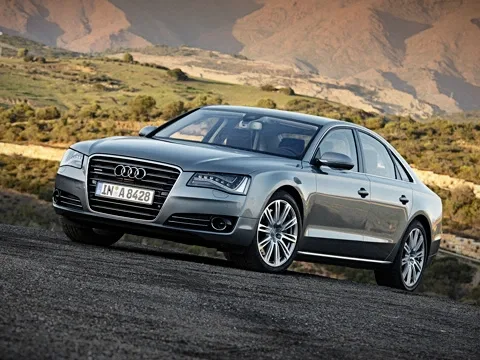
Why hide it — the "eight" was my favorite among executive sedans. A car devoid of image complexes won me over with its accessibility in communication with the driver and ease of piloting. Sure, the car from Ingolstadt didn't spoil rear passengers too much (which, however, didn't stop it from being a bestseller in corporate fleets) — but I never rode in the back. Instead, I was always glad to get behind the wheel, so I tried almost all modifications — from the short-wheelbase front-wheel-drive with the 3.2 FSI engine to the ten-cylinder S8 and the long-wheelbase version with the W12. When someone exclaimed: "Petrovsky sold his soul to Audi," I only wanted to clarify: "Audi A8."
Against the backdrop of the designer "Santa Barbara" with Mercedes and BMW in the lead roles, the newly unveiled Audi flagship looks as if it were created by someone who spent the last seven years in suspended animation. As if those years in Audi's history never happened. The competitors — the S-Class and the "Seven" — are exhausting themselves chasing each other. And the "A-eight," returning as if from outer space, simply looks well-rested.
One could reproach the Audi A8 designers for excessive conservatism, but did exterior designer Torsten Wenzel have any room to maneuver? He needed to fit the A8 into the late-de Silva style, relying on the existing layout. To give Americans the chance to catch steppe midges with a solid radiator grille in states where a front license plate isn't required, and to make maximum use of LED lighting — Audi's calling card. And that's what was done.
**Tech**
In terms of engine lineup richness, the Audi A8 still lags behind its rivals. At launch, only upgraded gasoline and diesel V8s with 4.2 displacement (pictured) are offered, which have become more powerful and economical. And the first available V6 will be the new 3.0 TDI turbodiesel (250 hp, 550 N•m). With the 23 kg lighter "six," the Audi A8 hits 100 km/h in 6.6 seconds, and the start/stop system helps keep appetite at 6.6 L per 100 km. Unfortunately, I didn't get a chance to ride in the less powerful version.
- There's also the newfangled ten-megabit FlexRay bus, familiar from the BMW "Seven." After all, Audi's new eight-speed automatic is the same ZF gearbox as the Bavarians'. But while BMW engineers linked all key chassis components with "FlexRay," the "A-eight" uses the high-speed link only for the powertrain.
- The photo shows the central tunnel from below: no mechanical connections. Gearbox control is by wire.
- The active rear differential Audi Sport Differential is standard equipment for the Audi A8 4.2 TDI and works on the principle of the AYC system in the Mitsubishi Evo. By locking a clutch pack on one of the shafts, the electronics engage an additional overdrive gear, causing the outer wheel to rotate faster than the inner one and tucking the car into the corner.
The suspension with adaptive dampers is controlled via the slowest CAN bus. At the "iron" level, little has changed compared to its predecessor. It's still the same triumph of small aluminum forms and air springs as elastic elements. However, the Germans claim a total revision of elastokinematics, and the torsional stiffness of the front double-wishbone has increased — mainly due to moving the steering rack forward so that it now sits below the wheel axis, and the tie rods take loads directly from the steering knuckles.
The rear multi-link is tucked under a cleverly designed fuel tank. The volume of the air springs on the Sachs struts has been increased on the new car, so the system does without external reservoirs and offers better damping characteristics. The shock absorbers are now mounted directly to the hub, allowing them to be stiffer. The control arm bushings have become softer.
The steering gear ratio — 16.1:1 — can be doubled using an electromechanical reducer with a harmonic drive located on the shaft. Active steering is used by the stability control system for micro-corrections of slides, as on BMW cars. However, the new system was introduced instead of the previous rack with variable tooth pitch primarily to be able to emphasize the difference between comfort and sport chassis modes through reducer settings. Nevertheless, it's an option.
The term Audi Space Frame (ASF) was introduced 15 years ago to denote a spatial structure of aluminum profiles forming the load-bearing body structure of the first-generation A8. Today, the body, including exterior panels, weighs only 231 kg — an eighth of the curb weight of the 4.2 FSI version (1835 kg). The Germans claim that a fully steel body would be about forty percent heavier.
The construction uses 13 different aluminum alloys, with parts made by vacuum casting (35%), stamping (35%), and extrusion (22%). Only on cast parts, such as strut mounts, three kilograms were saved compared to the previous model. Key stiffness elements are stamped from a new multilayer material with a high-strength alloy sandwiched between two layers of aluminum. The stiffness of such elements increased by 25% with a 20% weight saving.
Interestingly, the B-pillars, a key element of passive safety, are steel and are joined to aluminum parts with bolts and adhesive. And body parts programmed to absorb frontal impact energy (below) help distribute the load from the front longitudinal members to the strong transmission tunnel zone.
**Safety**
The A8 has eight airbags. But the level of passive safety as such cannot increase indefinitely, Audi believes. Protection must be comprehensive. The new Audi pre sense system, which brakes the car when a collision threatens, is designed not so much to prevent an accident (too much data is required for such a task) but to mitigate its consequences. Audi experts calculated: if the work of just one belt pretensioner at the last moment before impact reduces overloads by a few percent, then when pretensioners activate during braking, progress is measured in tens of percent.
The sequence of the Audi pre sense system's operation in the event of a frontal collision threat is divided into four phases (illustrated).
- First phase. When a potential danger is detected, a warning sound is emitted, and a red alarm indicator appears on the instrument panel. Pressure in the brake system increases, and the suspension switches to firm mode — for better response in case of an evasive maneuver.
- Second phase. Brake system pressure is at maximum, and the car brakes slightly for 0.5 seconds. Seat belts tighten. If the driver starts braking at this moment, the system saves him 0.1–0.2 seconds in advance, i.e., more than seven meters of braking distance at 130 km/h.
- Third phase. Partial autonomous braking with deceleration up to 3 m/s². Pre sense closes the windows and sunroof and also turns on the hazard lights.
- Fourth phase. Deceleration increases to 5 m/s² if the driver does not react. Pretensioners fully take up the slack in the belts. About half a second before impact, when it's obvious that an evasive maneuver won't follow, the car brakes with maximum force. As a result, speed can be reduced by 40 km/h.
If pre sense detects a risk of rear-end collision, the seats automatically move to an optimal position to reduce the risk of whiplash spinal injury, and the windows and sunroof close.
**Design**
Relatively early exterior sketches dated 2006 allow us to trace the designer's thought process, not yet fully constrained by the technical specification. Interior sketches are interesting primarily for the MMI terminal sketch.
**Behind the scenes**
Test drive photos
Source: DRIVE.ru
Comments
No comments yet. Say the first word.