
Audi A8 2010 sedan features 10
Audi pre sense
Audi lane assist
Audi side assist
The Audi side assist system, part of the Audi pre sense rear package, monitors the situation behind the car. Light indicators are installed in the rearview mirrors. At speeds from 30 km/h, two sensors with a range of up to 70 meters detect other vehicles, determining the distance to them and the difference in speed. If the system decides that these parameters make a lane change unsafe, an information signal lights up on the corresponding mirror — it is visible only when the driver looks into the mirror. When the driver activates the turn signal and the system assesses the adjacent vehicle as too close, the indicator begins to flash brightly several times — this is a warning. The brightness of the signal can be adjusted to one of three levels in the MMI menu. The option is available as additional equipment.
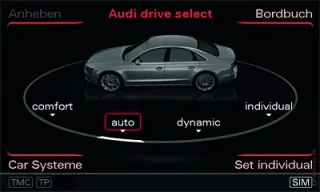
Audi drive select
The Audi drive select® system controls the settings of units and components that affect the vehicle's behavior: the powertrain, transmission, steering mechanism (if equipped), shock absorbers (if equipped), and the sport rear differential (if equipped). The driver can change the response of these components at any time to suit their preferences.
The innovative Audi drive select® dynamics system allows you to adjust the characteristics of the engine, transmission, steering, shock absorbers, and sport rear differential — depending on the equipment. The result is a balance between high comfort and sporty dynamics.
Using a button on the center console, the driver selects one of three modes — Comfort, Automatic, or Dynamic. The characteristics change from maximum comfort to most sporty. With the optional MMI system, you can create your own profile and configure the systems connected to Audi drive select® according to your personal preferences.
Audi drive select® is installed only together with dynamic steering and/or an adjustable shock absorber system, and/or a sport differential.
Night vision system
The night vision system uses a thermal imaging camera to scan the area in front of the vehicle. It detects pedestrians at a distance of 15 to 90 meters and highlights them in color on the display. When a risk of collision is detected, the image color changes to red, and the driver receives an audible warning. The system is activated by a button on the steering column light switch. Image settings, the type of audible signal, and contrast are adjusted in the Car menu. The function is offered as optional equipment.
Light management system
The high beam control system is responsible for automatically switching between low and high beam lighting at night. It uses cameras located in the lower part of the exterior mirrors to analyze the road situation. If oncoming or passing vehicles, as well as street lighting sources, for example in urban areas, come into view, the headlights automatically switch to low beam mode. When the road clears, the system turns the high beam back on.
This solution relieves the driver of manual mode switching and at the same time reduces the risk of blinding other road users. At the same time, the high beam is used as efficiently as possible, increasing the lighting range. Activation occurs at dusk or with the onset of darkness, and control is carried out by a lever on the steering column. In the Audi A8, this function is available only in combination with LED headlights and is not offered with Xenon plus xenon lamps.
MMI touch touchpad
The MMI touch sensor panel is located to the left of the center console. Thanks to the modified design of the gearshift lever, it is always within reach. This is an intelligent device for controlling navigation: the driver can "write" letters or numbers with a finger on the sensitive surface.
The panel recognizes handwriting, allowing control of the MMI navigation plus system intuitively and with minimal distraction from the road. To enter a destination, you need to write letters or numbers sequentially, and to move around the map, use short finger movements. The handwriting recognition function works with different writing styles and is accompanied by voice confirmation. The panel also has six programmable buttons for saving and switching radio stations.
Adaptive Air Suspension
Adaptive air suspension combines the capabilities of air suspension and continuously adjustable shock absorbers. It is controlled by electronics and operates on all four wheels, combining stepless electronic damping adjustment.
The system constantly adjusts the ride height, keeping the body level even under uneven loading. The driver can select modes such as automatic, comfort, dynamic, or lift to change the vehicle's behavior. In the sport version of the chassis, the suspension is tuned stiffer, and the ground clearance is reduced by about 20 mm.
Regardless of load, the suspension adapts to the road and offers driving options from sporty to comfortable. Thus, it combines dynamics and a high level of comfort.

Bang & Olufsen Sound System
The Bang & Olufsen Advanced audio system in the Audi A8 consists of 19 speakers, each with its own amplifier channel. This design ensures clear and immersive sound.

quattro All-Wheel Drive System
The quattro® all-wheel drive system constantly and without pauses redistributes torque between all four wheels depending on the road situation. This ensures reliable traction, high active safety, and stability on straight sections, including in crosswinds.
The active sports differential smoothly and with variable intensity redistributes torque between the rear wheels. This improves maneuverability, makes steering more precise, and enhances active safety. Through targeted control of the magnetic flux, the vehicle enters corners more easily and precisely while maintaining driving stability.