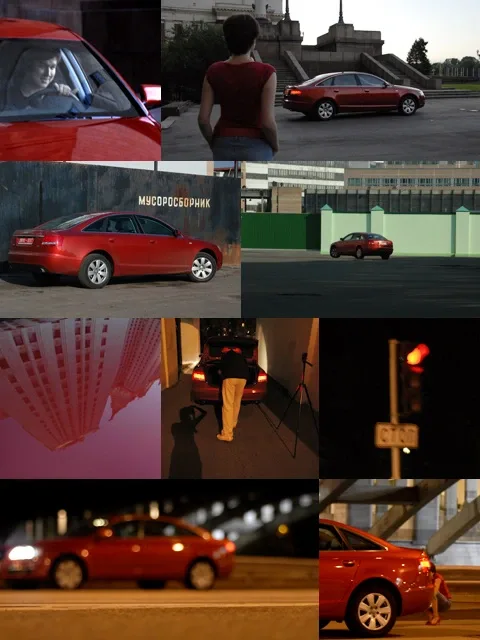
Audi has quite a few trump cards up its sleeve. Take, for instance, the famed quattro all-wheel-drive system—it's what brought the brand numerous rally victories. Or the 250-horsepower 3.2-liter engine with direct FSI injection—it combines power with a quite reasonable appetite. By the way, this very FSI prompted the company's management to expand the museum exhibition: the trophies from Le Mans races won by R8 cars no longer fit on the old shelves. One must also mention designer Walter de Silva, whom Audi lured away from Alfa Romeo—he used to create masterpieces for the Italians, and now he handles the looks of German cars. At the same time, the cars are still assembled in Germany, and they don't fall apart after the first few thousand kilometers—so these are not just beautiful sculptures, but transport quite suitable for everyday life.
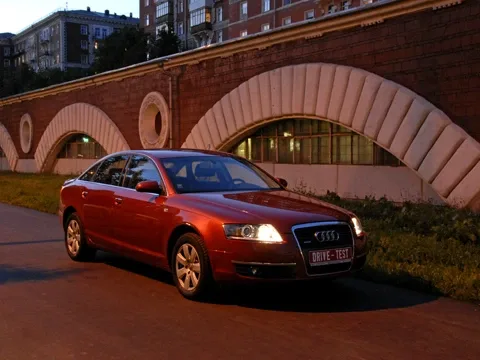
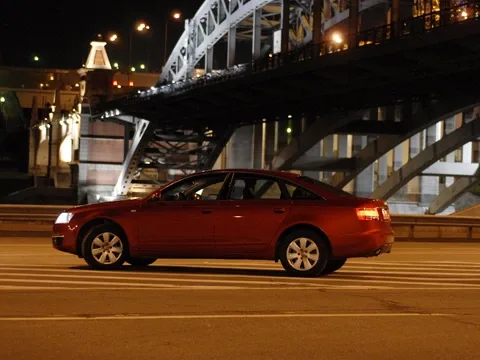
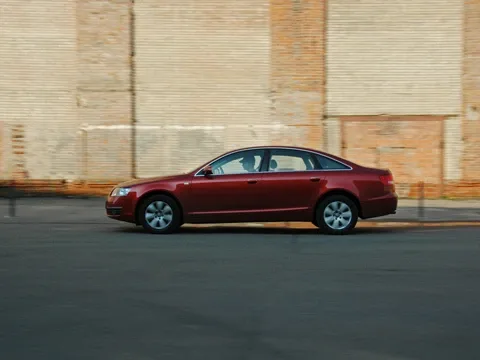
On paper, the Audi looks flawless. And upon personal acquaintance, the impressions got even better—especially because our A6 turned out to be not a boring gray or black, but a bright brick-red (no, not speckled). For a business-class sedan priced at almost 75 thousand dollars, this is a rather bold decision. All passersby turn to look at it, although, it would seem, why? There are plenty of such cars on the roads. But ours is special. And it must be admitted, this flashy shade suits it surprisingly well. However, bright colors are an Audi hallmark: the brand's palette has many interesting and rich shades. This is a gift for those who want a business sedan but wouldn't mind standing out from the flow. Although most buyers will still choose a calm silver or black, it's nice to know the company has such an option for the bold.
The A6's interior is also strict, but not boring. The cabin is built around the driver: the tall and wide central tunnel, along with the instrument cowl, visually separates the driver's workspace from the passenger zone. The rest matches: a comfortable three-spoke steering wheel, front seats with noticeable but not aggressive lateral support, and upholstery in leather with Alcantara. It's hard to find fault with the ergonomics. Except that at first, I couldn't find the audio system volume control on the central console. What saved me was that there was always a convenient wheel on the steering wheel—something like a computer mouse scroll wheel. I did eventually find the regular knob—it was hiding on the central tunnel. Unusual, but quite convenient, especially since it's located next to the MMI multimedia system, which is responsible for absolutely everything. The MMI itself pleased with logical and intuitive control—you don't need to complete nuclear physics courses to master it.
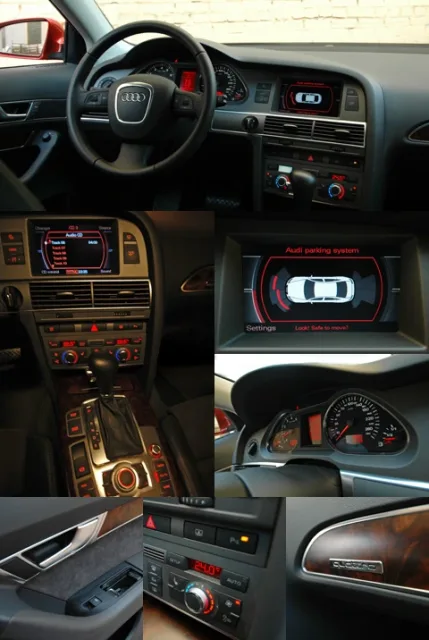
The interior is quite bold for a car of this class. But ergonomics, build quality, and materials—everything is top-notch.
While the driver has fun with the MMI, passengers have no complaints either. In the back, the A6 has plenty of space. There are separate air vents on the B-pillars, armrests, and all other amenities. However, expecting anything else from a business-class car 4916 mm long would be strange.
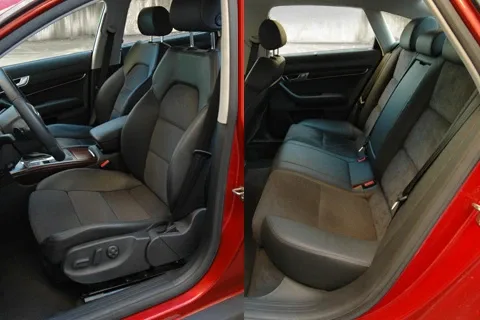
The front seats delight with clear lateral support and "grippy" upholstery materials, while the rear ones—with space.
Honestly, I was initially skeptical about some of the A6's features. For example, the layout. The fact is that the engine here is mounted longitudinally and entirely shifted beyond the wheelbase, that is, literally hanging over the front axle. And this immediately raises questions. For instance, how will such a car turn? After all, even though the weight distribution isn't badly off, the moment of inertia is still noticeably greater than in other cars. And what will happen to the heavy "nose" in a limit turn? That's right—there will be understeer, and quite noticeable. True, after exercises on the test site, I remembered that the A6, besides the engine placement, also has a quattro badge. And here's what turned out: when this very understeer begins, there's no need to frantically recall extreme driving skills—just slightly turn the steering wheel a bit more! The all-wheel drive will do the rest, neatly turning the car into the corner. Moreover, even in situations where it would seem physically impossible. In the end, I jotted down in my planner that it would be a good idea to reread a physics textbook. Well, in ordinary, civilian modes, of course, no problems arise at all: the car holds a straight line perfectly, responds to steering inputs adequately and without delay, and body roll is moderate. In a word, everything is very balanced.
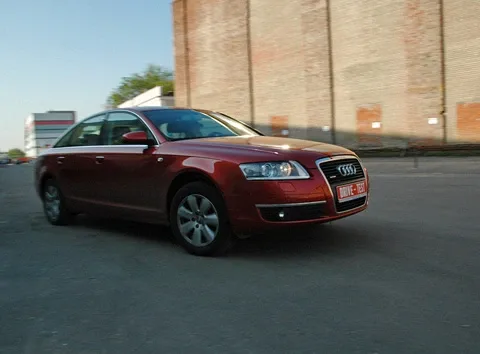
So no debunking happened, and my fears were not confirmed: the "wrong" engine placement turned out to be very right in practice and doesn't hinder excellent handling at all. At least on asphalt. By the way, another question for the physics textbook: the A6, despite its far from small mass, feels like a very light car in handling, and it's clearly not about the power steering settings. Perhaps all the magic is in this very quattro.
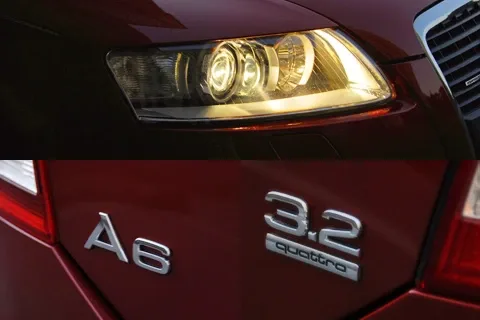
The 3.2-liter direct-injection engine is not only powerful but also economical.
True, the A6's lightness has a downside—the car behaves more nervously than you'd expect from a car of this class. No, it doesn't get thrown around in ruts, don't be alarmed, but all road surface imperfections are clearly transmitted to the steering wheel. However, after thinking it over, I decided this is also good. After all, the Audi doesn't annoy with an intrusive "road feel" and allows you to drive it quite relaxed. At the same time, it informs the driver: "so, there's a rut here, and there the asphalt under the right wheels is a bit more slippery,"—whereas in other cars, he would be deprived of this information. So it's still a question whether this is a drawback or an advantage. And in general, tearing along in this car at high speed is a huge pleasure.
Speaking of high speeds. The 3.2-liter V6 engine with direct injection is something else. It provides the rather heavy A6 with acceleration you wouldn't expect from it at all. Especially impressive is the acceleration at high speeds. For a six-cylinder engine, the dynamics are simply excellent. But about the operation of the six-speed gearbox, there's essentially nothing to say. No, it doesn't cause complaints, doesn't annoy with thoughtfulness or jerks. You simply don't notice it. Another thing you don't notice in the Audi is speed. The acceleration, though fast, is very smooth. Add to this exemplary sound insulation—and it starts to seem like the speedometer is shamelessly lying.
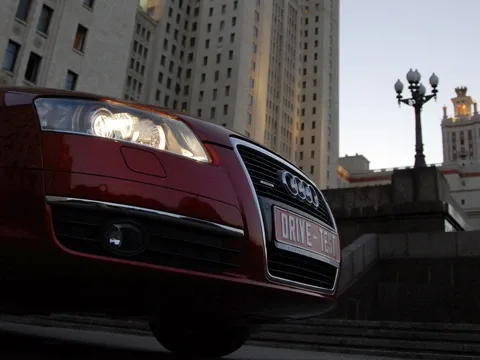
The large Audi Single Frame grille in the style of pre-war Auto Union racing cars is a design find by Walter de Silva.
Ride smoothness is also in order. Overall, the A6 has a wonderful balance between handling and softness. And here I was almost caught out again. Watching how the suspension digests small bumps at low speed, I thought: wouldn't it become unsettled and sloppy at higher speeds? But you add gas—everything is still fine. A bit more—also nothing. Then a little more—and you hit the limiter. What kind of Audi is this: wherever you look—it's all deception! You think that at least here you'll find a flaw, but no—everything is fine. However, I did eventually manage to find fault with the A6: it, you see, shakes passengers quite noticeably on short waves, and once I unexpectedly bottomed out the suspension on a "flat" spot. True, that was the only such case, and it handled all other bumps admirably.
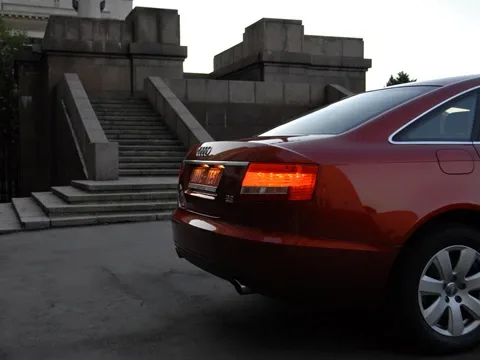
In the final analysis, the car turned out to be very cohesive, pleasant, and balanced. Even my extremely picky eye this time failed to find any obvious shortcomings. So the bright A6 was memorable not only for its provocative color but also for its driving manners. It manages to combine luxury with comfort while remaining a truly "driver's" car. It's fast, but speed doesn't translate into constant visits to the gas station. It's big and spacious, but handles surprisingly easily. It has a strict classic appearance, but it stands out in traffic. Of course, it still can't be called ideal—but where, one might ask, is the increased off-road capability, third row of seats, and "coupe-cabriolet" body? No, ideal cars don't exist. But there are excellently balanced ones—for those who don't want to choose between comfort, handling, power, and economy. And it seems to me, the Audi A6 is just such a case.
Technical specifications
| Specifications | $73928 |
|---|---|
| Dimensions | |
| Wheelbase, mm | 2843 |
| Length, mm | 4916 |
| Width, mm | 1855 |
| Height, mm | 1459 |
| Front track, mm | 1612 |
| Rear track, mm | 1618 |
| Engine | |
| Engine type | V6, petrol, with direct injection |
| Displacement, cc | 3123 |
| Power, hp at rpm | 255/6500 |
| Torque, Nm at rpm | 330/3250 |
| Drive type | Permanent all-wheel drive quattro® |
| Transmission | 6-speed automatic tiptronic with DSP and Sport mode |
| Performance | |
| Top speed, km/h | 250 |
| Acceleration 0-100 km/h, s | 7.1 |
| Fuel consumption | |
| City, l/100 km | 15.7 |
| Highway, l/100 km | 10.9 |
| Combined, l/100 km | 9.7 |
| Fuel type | Unleaded, "Super", AI-95 |
| Wheels/Tires | |
| Rims | Alloy, 7.5 J x 16 |
| Tires | 225/55 R 16 |
| Body/Weight | |
| Curb weight, kg | 1680 |
| Permissible gross weight, kg | 2260 |
| Permissible trailer weight at 12% gradient / at 8% gradient, kg | 1900 / 2100 |
| Fuel tank capacity, l | 80 |
| Trunk capacity, l | 546 |
Equipment of the tested car
- Standard equipment of Audi A6
- Alloy wheels 7J x 16, design "9 spokes"
- Tires 205/60 R16
- Electronic stability control ESP (combines ABS, EBV, ASR, EDS)
- Brake Assist system
- Automatic brake disc cleaning system
- MMI Plus — Multi Media Interface with monochrome 6.5" display
- Radio with CD player, digital sound processing system DSP, 6-channel amplifier, three-way speaker combination, 10 speakers with total power of 160 W, antenna unit
- Servotronic
- Immobilizer
- Alarm system monitoring the interior; with tilt sensor; signaling unauthorized door opening, with autonomous power supply
- Audi parking system plus: acoustic parking system front and rear with optical display on MMI screen
- Climate control "Plus" with air quality and humidity sensors and intensive air conditioning for the rear of the cabin (additional vents in the B-pillars)
- Safety steering column with mechanical adjustment in 2 directions
- Leather steering wheel
- Airbags for driver and front passenger with two-stage activation system
- Side airbags for driver and front passenger in combination with head airbags (Sideguard)
- Crash-management system: crash sensors — located around the perimeter of the car. In case of an accident, airbags and "active" head restraints are automatically activated; seat belt tension is adjusted; engine and fuel supply are shut off
- Front seats with electric drive: longitudinal adjustment, seat height, seat and backrest tilt adjustment, as well as electrically adjustable lumbar support Ergomatic
- Heated front seats
- Head restraints for five seats; "active" head restraints for front seats
- Heat-insulating glass, windshield — with tinted upper part
- Central locking for doors, trunk and fuel filler flap with remote control
- Electrically adjustable exterior rear-view mirrors with heating (right convex, left aspherical)
- Interior rear-view mirror with automatic dimming
- Electromechanical parking brake
- Seat upholstery in Meridian fabric
- Decorative aluminum trim
- Front center armrest
- Three-point automatic seat belts for five seats
- Seat belt usage sensor for front seats
- Wiper with adjustable intermittent mode
- Automatic activation of low beam; coming home function
- Rain sensor
- Bi-xenon headlights with intensive headlight washer
- Front fog lights and rear fog light
- Electric headlight leveling with automatic stabilization system
- First aid kit and warning triangle
- Folding rear seat backrest, split 1/3 and 2/3
- Disc brakes front and rear
- Spare wheel, full-size
- Heated windshield washer nozzles
- Make-up mirrors in sun visors left and right
- Floor mats front and rear
- Luggage net
- 12-volt socket in trunk
- Adaptation for Russia
- Reinforced suspension
- Antifreeze (down to -35°)
- Engine protective cover underneath
- Increased ground clearance
- Operating instructions and service book in Russian
- Additional equipment
- Sport seats (front) with pronounced side bolsters for better support during driving
- Combined seat upholstery Alcantara/leather
- Heated front and rear seats, separately adjustable
- "Adaptive" headlights illuminating the area in the direction of turning. Activation occurs at speeds up to 70 km/h with low beam on and turn signal or by steering angle sensor signal, as well as when reversing
- CD changer (for 6 CDs)
- Remote trunk lid opening
- "MMI — Multi Media Interface with 7-inch color display. Radio with CD changer, digital sound processing system DSP, 6-channel amplifier, three-way speaker combination, 10 speakers with total power of 160 W, antenna unit
- Advanced key — remote electronic key identification system; engine start by pressing a button on the center console
- Multifunctional sport leather steering wheel with shift function for tiptronic/multitronic transmission, with Airbag System; for controlling radio and D/GSM phone. Design — "3 spokes"
- Impact-absorbing steering column with electric adjustment for length and height
- Hatch in rear seat backrest with bag-cover for transporting long items
- Decorative trim: walnut root, brown, matte
- Storage package: cup holders in center armrest; nets on front seat backs; drawers under front seats
- Wheel lock bolts
The car for the test was provided by Audi of Russia.
Behind the scenes