
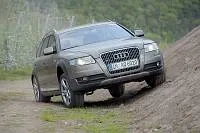
I don't consider myself a coward, but that first drive in the all-wheel-drive Audi Allroad wagon along Moscow's Leninsky Prospekt still haunts me. I glanced at the instrument panel and went cold: the needle had passed 150 km/h. Of course, I blamed not myself but the air suspension, which so "smoothed out" the capital's road that I completely lost touch with reality. The harder you press the gas, the more you lift off the ground... After that, I got behind the wheel of the "all-road" Audi more than once, but I never managed to bridge that invisible chasm between myself, the car, and the asphalt. I didn't favor this car and, frankly, was a bit afraid of it. So I headed to Italy to meet the new generation without much enthusiasm.
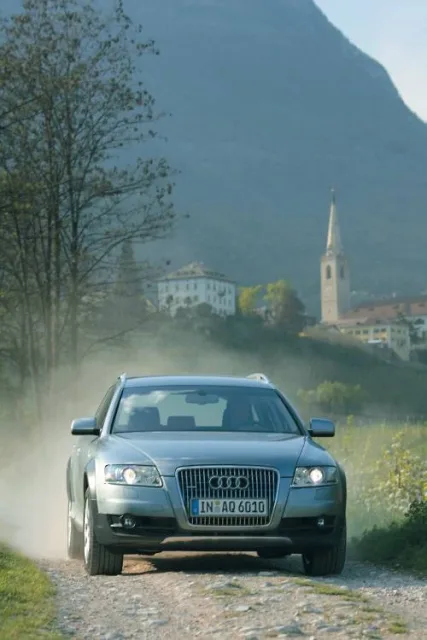
The Germans know how to keep secrets. Two years ago, at the premiere of the new-generation Audi A6, I tried to pry even a hint about the fate of the Allroad model from the engineers and PR people. They said nothing. And when information surfaced about the imminent arrival of the large Audi Q7 crossover, I figured the Allroad would be retired. Not so: the second-generation Allroad occupies exactly the same niche as its predecessor.
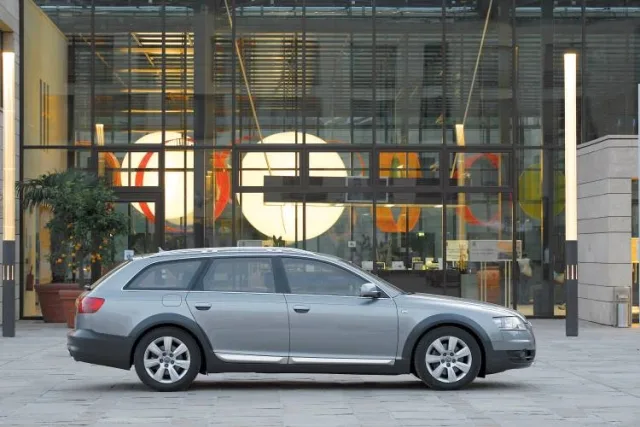
 At first, I didn't even recognize the newcomer—I took it for a regular Audi A6 Avant wagon. Remember the old Allroad: it was distinguished by black cladding on the wheel arches, a black front bumper with a stainless steel skid plate, chrome side sills, and roof rails—all of which made the car stand out from the crowd. It seems all these details are still there, but the new Allroad looks "less off-road." Previously, the plastic body kit was exclusively dark (unpainted plastic), but now it can be ordered in the body color. Inside, there are also few changes. The exterior mirrors have become larger, and some small details in the trim have changed. But overall—it's the same Audi A6.
Which car should we start the test with—the gasoline or diesel one?
— With the diesel, — actress Maria Golubkina, who happened to be in my crew, told me. — The gasoline Allroad 3.2 FSI has a manual, and I'm used to an "automatic."
I didn't dare argue with Golubkina! Let it be the turbodiesel. We got to talking—and it turned out that Masha bought herself an Allroad a few years ago and drives it almost daily from her country house to the capital.
— I had no complaints. Every thirty thousand kilometers or so, they replace various small parts in the suspension, and now, with the mileage over a hundred thousand, the running gear required more serious repairs—the service quoted about three thousand dollars. Do you think that's not too expensive?
 |
| The interior is almost no different from the interiors of regular "sixes." It's nice that, unlike the Audi Q7 crossover, which surprised with its pro-American "lever" for the parking brake, the Allroad got an "advanced" electromechanical "handbrake" with a button. The design, build quality, and materials are nearly flawless, as with all recent Audis |
If you drive on dirt roads every day, that's not expensive. But Maria doesn't race—she drives very calmly, with a margin. And even in that mode, the diesel seemed too noisy to her. True, she compares it with her own car—with the V6 2.7 biturbo engine. But overall, the diesel is excellent! Its motto is always! Three liters, six cylinders. A crazy reserve of torque on any of the six "automatic" gears. It's just that the gearbox could be a bit quicker...
Later, I switched to the version with the 3.2 FSI gasoline engine and a manual. And, oddly enough, no pleasure. First, I spent a long time adjusting the seat—I needed to position myself so that it was comfortable both to steer and to depress the long-travel clutch. Second, when pulling away, I nearly stalled, right in front of the engineers—especially unpleasant. And since I had to do a two-point turn in a tight courtyard, I had to "burn" the clutch to keep the revs from dropping to zero again. As it turned out, I wasn't the only one who faced such difficulties.
The new six-speed manual with close-ratio lower gears is called sporty by Audi. The lever is comfortable, and the shift mechanism works with rifle-like precision. But it's not comfortable to drive. When shifting through a gear—for example, when braking from fourth directly to second—you need to catch the moment very precisely and work the pedals carefully, otherwise jerks are unavoidable. And after half an hour, the left leg is already tired from the stiff clutch. Masha is right: better to get the "automatic" and not suffer.
The old Allroad with a manual gearbox had one undeniable advantage over versions with "automatics": for an extra charge, you could order a two-speed transfer case for diesel cars—like on real SUVs! The control button for the reduction gear with an electro-hydraulic actuator was right on the gearshift lever.
Now there's no button: the reduction gear has disappeared from the options list. This means the Allroad has been demoted—it has become even closer to regular all-wheel-drive passenger cars and, accordingly, further from serious SUVs. The optional 18-inch wheels with elegant silver plastic covers also point to this. At first glance, you can't tell the "plastic" from metal—until you tap them with your knuckles. Beautiful! But will these covers withstand even light dirt?
 |
| The Allroad is equipped with permanent all-wheel drive with a single-speed transfer case and open cross-axle differentials. The trend of asymmetric torque distribution, noticeable on new Audi models (including the Q7 crossover), bypassed the Allroad. Under normal conditions, the Torsen center differential splits torque equally between the axles. And during wheelspin, up to 75% of the supplied torque can go to the front or rear wheels. The electronics EDL provide feasible assistance to the "hardware," braking the spinning wheels and simulating the operation of self-locking cross-axle differentials |
We couldn't test this: for the off-road test, we were sent not to a quarry or even a forest dirt road, but to packed paths among local vineyards. Had it been Moldova or the Caucasus, extreme conditions would have been guaranteed. But here, on the well-kept grounds of Count Michael Hess-Enzenberg, there's no off-road at all. Gravel-covered, tightly packed paths are within the capabilities of even a regular Audi A6 with coil springs. Even the rain that unexpectedly started couldn't wash away the years-compacted gravel.
The ride height is now controlled not by buttons on the center console, as in the old car, but by one of the submenus of the MMI multifunction interface—as on the Audi Q7. Buttons that were always at hand were easier to operate: press, and wait for the result. But the MMI system works more clearly: you select the desired position in the menu—and press the controller dial. After a few seconds, the body rises or lowers by one or several steps—depending on the task.
The air suspension now has not four but five modes—Dynamic, Automatic, Comfort, Allroad, and Lift (as on the Audi Q7). But if the old Allroad in the highest body position resembled a hut on chicken legs, the new one, raised to the limit (Lift position), no longer looks like an "all-terrain vehicle." It's not just about the design. The old car had a maximum ground clearance of 208 mm, but now it's only 185 mm. Again—closer to regular all-wheel-drive passenger cars. And that's a pity. After all, what made the first Allroad unique? Its special status, since there were simply no other "all-road" models in Audi's lineup. Now it's different. The air suspension, which was once the Allroad's privilege, can now be ordered even for the A6 sedan, and also an active one—allowing you to change the ground clearance, albeit not in such a wide range. The engine lineup has also lost its "exclusivity": the "big" engines have become available to all Audi A6s. And with the arrival of the Audi Q7 crossover, the Allroad's exclusivity has finally evaporated.
Already guessed why the new Allroad wasn't made more "off-road"? To avoid competing with the Q7. The "all-road" Allroad is designed to occupy a place in the middle between regular all-wheel-drive A6 Avant quattro wagons and the "almost off-road" Q7 monster. Hence the less aggressive appearance, the "truncated" air suspension, and the absence of a low-range gear in the transmission.
On the other hand, was that reduction gear even needed? Who really required it—except perhaps the Americans, for whom the first Allroad was created? But how many drivers in the States are there who not only know how to handle a "manual" but also understand why a low-range gear is needed? And the Allroad didn't cause much of a stir in the US either. For residents of remote ranches, a conservative lot, it turned out to be too complex and expensive. Such hermits still choose pickups with a spacious bed and leaf springs at the rear—it's more familiar and reliable. And city dwellers have even less need for the Allroad. As a result, the bulk of sales, contrary to expectations, came not from America but from Europe. The car was especially loved in Germany, where on autobahns without speed limits you can fully enjoy low-altitude flights thanks to the air suspension.
And in Russia, there were few willing to buy an Allroad with a manual gearbox: in the best years, such cars accounted for no more than 20% of sales. And those who would also want a reduction gear were very few. So producing such a version is simply unprofitable.
 |  |  |
| The petrol V8 4.2 FSI engine gives the Allroad a fighting character. This 350-horsepower unit is a detuned engine from the Audi RS4 |
In my opinion, the most correct choice is the new Allroad with the V8 4.2 FSI engine. To avoid upsetting Maria, I dropped her off under a plausible pretext: it was just lunchtime, and in one of the wine halls of the estate, a luxurious table had already been set. A woman off the wagon — and I'm off to the mountain serpentine. I hope there's a button to disable the stability control system here? There is! Air suspension — into Dynamic mode. And — full throttle!
What a cannon! The Allroad is about 300 kg lighter than the Q7. And if the Q7 4.2 seemed ponderous and sluggish to me (see AR No. 5, 2006), the Allroad 4.2 is just the thing! As speed increases, the steering fills with rich, informative effort, and there's plenty of torque in reserve. I'm flying at over 200 km/h, and everything is under control.
Of course, on bends, the Allroad is not as good. With a squeal of tires, it starts to push its front wheels wide: this car doesn't like sharp turns, and neither do I. Its element is multi-kilometer straights where you can open it up to the max — and fly, forgetting about ground clearance, the automatic transmission, and the reduction gear.
 |
| Six-cylinder cars come standard with 17-inch wheels, while the Allroad 4.2 FSI gets 18-inch ones. I liked these optional 18-inch wheels. Note: the decorative bolt-on covers are made of plastic |
And Masha, after lunch, also decided to look for a button: she dreams of a power tailgate — to make it easier to load bags. And she was lucky: in the long row of test cars, we found an Allroad with full options (the power fifth door is on the options list). Masha pressed the button on the key fob — and the door went up. She pressed it again — and the door closed. Moreover, the drive can be programmed so that the door opens to a certain height — to avoid damaging it in a garage with a low ceiling.
It seems that the creators of the new car were targeting buyers like Masha, who are loyal to the Audi brand in general and to the Allroad wagon in particular. Over a few hours, we went through in our minds almost all the all-wheel-drive cars that could theoretically replace her old Audi. Large SUVs were ruled out for two reasons: too flashy and too high — inconvenient to get in and out of, especially in winter when the whole car is dirty. All-wheel-drive passenger wagons (for example, the BMW 5 Series) are also unsuitable: you can't really drive them on dirt roads. That leaves the closest competitors — the Volvo XC70 and Subaru Legacy Outback, but they don't have adjustable air suspension, and they're not as comfortable on rough roads. And the Allroad, while remaining a prestigious and superbly equipped passenger car, can also carry 630 kg of cargo and tow a trailer with a gross weight of 2.1 tons. By the way, Masha is an avid horsewoman and plans to buy a large trailer to transport her pets.
So there will be demand for the new Allroad. They say that over the years, a special caste of devotees of this model has even formed. And although dealers invited many of them to the premiere of the Audi Q7 crossover, a considerable number of "old believers" preferred to wait for the new Audi Allroad — more compact, more dynamic, and slightly more affordable than the Q7.
The first cars are expected in Russia in mid-June. Initially, only petrol versions will be sold: the V8 4.2 FSI (from $96,706) and the V6 3.2 FSI (from $76,019). The turbodiesel Allroad will hit the market later — purely for technical reasons. The fact is that the new turbodiesels are equipped with particulate filters and are designed for fuel that meets Euro 4 standards. Such diesel is not sold everywhere even in Moscow, let alone in other cities. Therefore, the Germans are currently conducting additional tests: it is possible that the electronic "brains" of the new engines will be recalibrated to account for the quality of our fuel.
And I've stopped being afraid of this car, or rather, of myself behind its wheel. Whether the Allroad has become more grounded, or I'm starting to lose the sharpness of sensations. But I hope the reason is still not me.
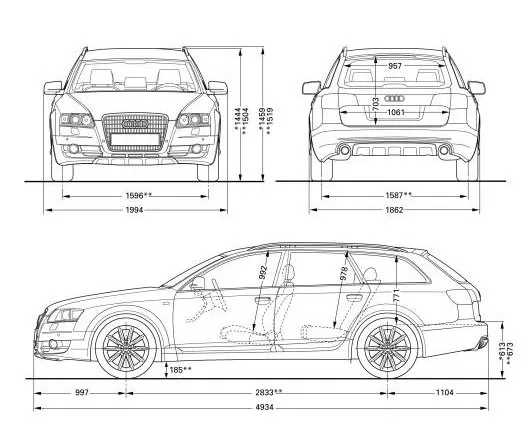
*Dynamic mode
**Lift mode
The adaptive air suspension is standard. Up front, struts with air springs made of a special multilayer elastomer reinforced with woven polyamide cord are used. Four transverse links are cast from aluminum alloy. The upper strut mounts are also aluminum. To further reduce weight, the stabilizer bar is hollow. Larger-diameter silent blocks reduce vibration transmission to the body.
The rack-and-pinion steering is equipped with Servotronic power assistance with a speed-dependent boost ratio.
The trapezoidal links of the rear suspension are cast from aluminum. The transverse links are made of steel.
The air suspension allows ground clearance to be varied within 60 mm. Five suspension modes are provided, activated via the MMI interface — Dynamic, Automatic, Comfort, Allroad, and Lift. In Automatic mode, ground clearance is 140 mm. When driving at speeds above 120 km/h, the clearance automatically decreases by 15 mm — to the Dynamic level. In Comfort mode, this reduction does not occur. In Allroad mode, ground clearance is 175 mm. When reaching speeds of 80 km/h and 120 km/h in this mode, the clearance automatically decreases by 15 and 20 mm, respectively. In Lift mode, ground clearance is 185 mm — 65 mm more than the Audi A6 Avant. Upon reaching 35 km/h, the electronics automatically lower the clearance to the Allroad level
| Audi A6 Allroad quattro (manufacturer data)* | |||
| Modification | 3.0 TDI | 3.2 FSI | 4.2 FSI |
| Body type | 5-door station wagon | 5-door station wagon | 5-door station wagon |
| Number of seats | 5 | 5 | 5 |
| Trunk volume, l | 565—1660 | 565—1660 | 565—1660 |
| Curb weight, kg | 1880 | 1800 (1760) | 1880 |
| Gross weight, kg | 2510 | 2430 (2390) | 2510 |
| Engine | turbodiesel, common rail | petrol, direct injection | petrol, direct injection |
| Location | front, longitudinal | front, longitudinal | front, longitudinal |
| Number and arrangement of cylinders | 6, V-shaped | 6, V-shaped | 8, V-shaped |
| Displacement, cm³ | 2967 | 3123 | 4163 |
| Compression ratio | 17.0:1 | 12.5:1 | 12.5:1 |
| Number of valves | 24 | 24 | 32 |
| Max power, hp/rpm | 233/4000 | 255/6500 | 350/6800 |
| Max torque, Nm/rpm | 450/1400—3250 | 330/3250 | 440/3500 |
| Gearbox | automatic, 6-speed (manual, 6-speed) | ||
| Gear ratios | |||
| I | 4.17 | 4.17 (3.67) | 4.17 |
| II | 2.34 | 2.34 (2.05) | 2.34 |
| III | 1.52 | 1.52 (1.42) | 1.52 |
| IV | 1.14 | 1.14 (1.07) | 1.14 |
| V | 0.87 | 0.87 (0.85) | 0.87 |
| VI | 0.69 | 0.69 (0.73) | 0.69 |
| reverse | 3.4 | 3.40 (3.40) | 3.4 |
| final drive | 3.31 | 3.68 (4.11) | 3.31 |
| Drive | permanent all-wheel drive with Torsen center differential | ||
| Front suspension | independent, four-link, air | ||
| Rear suspension | independent, two-link, air | ||
| Front brakes | disc, | disc, | disc |
| ventilated | ventilated | ventilated | |
| Rear brakes | disc | disc | disc, ventilated |
| Tires | 225/55 R17 | 225/55 R17 | 245/45 R18 |
| Maximum speed, km/h | 230 | 240 (242) | 250 |
| Acceleration time 0—100 km/h, s | 7.8 | 7.7 (7.2) | 6.3 |
| Fuel consumption l/100 km | |||
| urban cycle | 11.8 | 15.8 (15.6) | 15.7 |
| extra-urban cycle | 7 | 8.2 (8.4) | 8.6 |
| combined cycle | 8.8 | 11.0 (11.0) | 11.2 |
| Fuel tank capacity, l | 80 | 80 | 80 |
| Fuel | diesel | AI-95 | AI-98 |
| * In parentheses — data for the car with manual transmission | |||