
The question of body type becomes the main stumbling block when you try to figure out what the Sportback was actually designed for. Audi representatives brush it off with vague phrases about it being an exclusive solution for those who want to combine the incompatible: the practicality of a station wagon and the character of a sports coupe. They avoid the word "hatchback" as if it were taboo.
For now, under the hood of the Sportback are the same engines as in the A5 coupe. The two-liter gasoline engines 2.0 TFSI with 180 and 211 horsepower have a lively and, so to speak, direct temperament. As for the 3.2-liter gasoline V6 (265 hp), it impresses with its brutal torque. On the European market, three turbodiesels are offered (2.0, V6 2.7, and V6 3.0), but I focused on the gasoline modifications that are relevant for Russia.
"Touch wood, begone! Don't you dare say that! We were inspired by the lines of the 1970 Audi 100 Coupe — our first truly sporty Audi in modern history." At the same time, it is kept quiet that that car (left in the photo) was a two-door three-box fastback with mediocre handling and an engine of at most 115 horsepower. The example is clearly far-fetched, but there seems to be no other to find.
Although in fact the company already had experience with the five-door Avant hatchback, which appeared in the second generation of the Audi 100 in 1977. Almost twenty times fewer of those cars were sold than standard sedans. Interest in such body styles in the family and higher classes rapidly faded by the end of the seventies. Therefore, in the next generation, the Avant name was assigned to the much more popular station wagon.
Honestly, I don't understand why the sleek and complete family of "fours" and "fives" needs this extra detail. Of course, the fancy front end from the real A5 coupe looks good with the unusual body, all four doors here are also frameless, like in the coupe, and folding the rear seat can noticeably increase interior space. But the front part from the two-door still doesn't give the right to call the car sporty.
Audi employees themselves admit that they don't count on serious demand outside Europe. This model is a relic of the pre-crisis era, when it was customary to build many different cars on one platform in the hope that at least one of them would hit the market.
I can't imagine who would believe me if I started claiming that I bought a coupe, not a hatchback with pillars shortened by 36 mm, which makes you hit your head on the ceiling. Although if you set aside marketing tricks, it's worth admitting: the car itself is not bad.
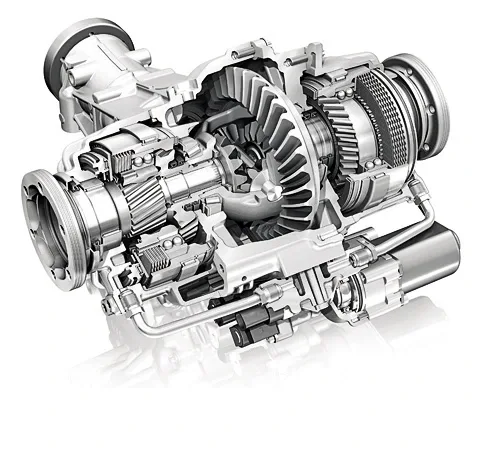
Apparently, to justify the car's special status, almost all the technical innovations that the company has introduced over the past couple of years were added to its equipment. Like, those not won over by design will be finished off by the filling. Vorsprung durch Technik, so to speak. The five-door "five" (let me call it "five-five" for convenience) can be equipped for an extra charge with the interactive Drive Select system, a steering mechanism with variable ratio, an active rear differential with torque vectoring, and a seven-speed preselective "robot". Up to the 333-horsepower supercharged V6 from the top S4 version, although not immediately after the start of sales.
Unsurprisingly, apart from the pressing ceiling, there are no complaints about the Sportback's behavior on the road: it's a one hundred percent recognizable car with four rings, reliable and confident on any decent road. And at the same time, there is no zest in how it drives.
In most Audi cars, there is no that very spark that makes the car behave a little differently every time. Audi reproduces its first-class drive on any serpentine road as if by carbon copy. Everything here is done in a German, autobahn-correct way. Audi follows European roads in detail, but without being intrusive. The steering effort seems small, but only until the speedometer needle creeps into three-digit values.
The perception of the car changes greatly depending on the engine and gearbox in a particular example that is currently devouring kilometers of winding Tuscan roads. Take, for instance, the naturally aspirated 3.2 with the new "robot". It seems that 265 hp doesn't yet make the Sportback an "S", but with such an engine it's a very brisk car. And obedient. I thought that the heavy "six" over the front axle would push the car out of the corner like an anchor thrown into the depths. But no!
Under a loud, albeit almost faceless roar, the "five-five" handles any turn excellently. The rear differential of the all-wheel-drive transmission really screws the car into the corner, transferring more torque to the outer rear wheel and not allowing the nose to dig into the grass on the roadside.
The degree of intervention of the active differential is adjusted through the Drive Select menu — just like the engine response, shock absorber stiffness, and steering sharpness. When I first drove the A5 coupe, all this mechatronics didn't exist yet — it appeared with the new A4 sedan. And now I wonder: how did Audi owners manage without the ability to tune the car to their liking?
Five minutes of fiddling with the MMI controller — and I have the perfect car in my hands. With instant throttle responses and lightning-fast gearbox reactions, with a not-too-heavy but "short" steering wheel and shock absorbers in the standard (or rather, automatic) mode. But without the Drive Select system, the car's balance is questionable. It always lacks something: either reasonable steering effort in a sharp turn, or ride smoothness. If you order the car with a non-adaptive lowered sports suspension, you can forget about any comfort right away.
I also got to drive the front-wheel-drive modifications. They are now equipped with turbocharged two-liter TFSI engines with 180 and 211 horsepower, plus diesel versions with 2.0 and 2.7 liters, producing 170 and 190 hp respectively. These cars behave noticeably calmer and are not as exciting. But even the single-drive "five-five" can bring a smile — thanks to the electronic imitation of the front differential lock. When you press the gas properly in the middle of a turn, a almost sporty excitement arises: the inner wheel is slightly braked and helps push the car onto the trajectory. True, the question is how many owners of front-wheel-drive Audis dare to press the pedal to the floor at the apex?
No, I'm all for all-wheel-drive versions with Torsen. Especially since this differential now transfers most of the traction to the rear axle, partially correcting the innate weight distribution problems. Even without the optional active differential, the quattro system allows you to quickly and effectively navigate a series of turns in a controlled drift, constantly feeling how the rear wheels push the car.
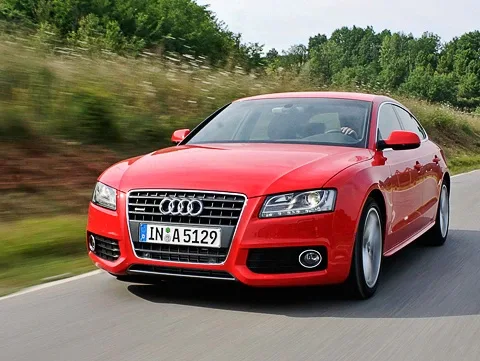
The rear active differential is available only on top six-cylinder versions — the gasoline 3.2 (265 hp) and the three-liter turbodiesel with 240 hp. In Russia, only the gasoline "six" will be sold. Of the diesel modifications, only the version with the 170-horsepower two-liter "four" will be brought to us.
Especially since even the less powerful but lighter two-liter turbocharged "four" with 211 hp is perfect for such driving. Just a masterpiece, a real masterpiece! Maximum torque is achieved already at 1500 rpm, and this shelf stretches to 4200 rpm. And the engine delivers peak power closer to the red zone of the tachometer, allowing you to fully enjoy the wild spin-up to 6000 rpm. The only thing I regret in such moments is that the newest S-tronic "robot" shifts up on its own. It seems the engine is capable of even more.
But didn't they say all the same things about the new A4 sedan? Does the Sportback have its own trick in behavior? Hmm... The fact is that its chassis, by design, should be the ideal combination of the sedan's long wheelbase and the A5 coupe's wide track. Therefore, the main difference of the "five-five" in motion is a greater margin of longitudinal and lateral stability. However, the car irons the road so perfectly that you involuntarily wonder: can such balance of character be called a zest?
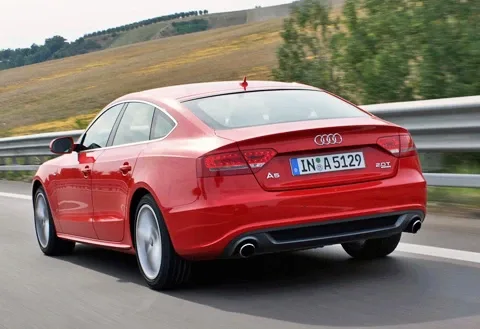
The new "five-five" is a contradictory car doomed to debate. But at the same time, it remains a one hundred percent representative of Ingolstadt. It's not a car for those who expect some unpredictability from an auto. It's for the majority. You can reproach the Germans for the speculative nature of the body concept, but there is one weighty argument in its favor.
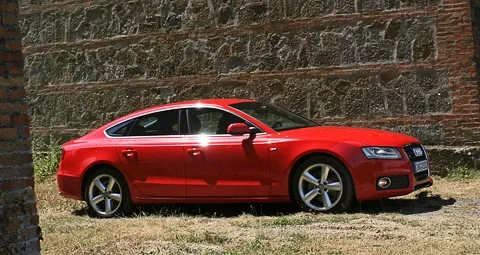
For most versions, the base gearbox remains the six-speed manual with a very precise shift mechanism, but with a long-travel and light clutch pedal. If desired, front-wheel-drive modifications can be "automated" with the Multitronic CVT with eight "virtual" gears.
The five-door with pretensions to a sporty image, a decent trunk (which becomes huge if you fold the rear seats) and enough legroom in the second row costs about 700 euros less in Europe than the regular A5 coupe. And after driving this strange and attractive "five-five", it became clear to me: the coupe is not so much more stylish as it is less practical. Okay, personally I would choose the regular Avant station wagon — it's even cheaper and more practical. But the Sportback is the choice of aesthetes, and I don't count myself among them. And aesthetes have long had an answer to the question of why a dog needs a fifth leg: for image.
Specifications
| Model | Audi A5 Sportback 2.0 TFSI | Audi A5 Sportback 3.2 FSI |
|---|---|---|
| Body | ||
| Number of doors/seats | 5/4 | 5/4 |
| Length, mm | 4711 | 4711 |
| Width, mm | 1854 | 1854 |
| Height, mm | 1391 | 1391 |
| Wheelbase, mm | 2810 | 2810 |
| Track front/rear, mm | 1590/1575 | 1590/1575 |
| Curb weight, kg | 1615 | 1650 |
| Gross weight, kg | 2145 | 2180 |
| Trunk volume, l | 480–980 | 480–980 |
| Engine | ||
| Type | petrol, turbocharged with direct injection | petrol, with direct injection |
| Location | front, longitudinal | front, longitudinal |
| Number and arrangement of cylinders | 4, in-line | 6, V-shaped |
| Number of valves | 16 | 24 |
| Displacement, cm3 | 1984 | 3197 |
| Max power, hp/rpm | 211/4300–6000 | 265/6500 |
| Max torque, N•m/rpm | 350/1500–4200 | 320/3000–5000 |
| Transmission | ||
| Gearbox | automated, seven-speed | automated, seven-speed |
| Drive | all-wheel | all-wheel |
| Chassis | ||
| Front suspension | independent, coil spring, on four transverse links | independent, coil spring, on four transverse links |
| Rear suspension | independent, coil spring, on trapezoidal links | independent, coil spring, on trapezoidal links |
| Front brakes | disc, ventilated | disc, ventilated |
| Rear brakes | disc | disc |
| Ground clearance, mm | n/a | n/a |
| Performance characteristics | ||
| Maximum speed, km/h | 241 | 250 |
| Acceleration time from 0 to 100 km/h, s | 6.6 | 6.6 |
| Fuel consumption, l/100 km | ||
| — urban cycle | 9.3 | 13.5 |
| — suburban cycle | 6.3 | 6.8 |
| — combined cycle | 7.4 | 9.3 |
| Toxicity standard | Euro-5 | Euro-5 |
| Fuel tank capacity, l | 64 | 64 |
| Fuel | AI-95 | AI-95 |
Technology 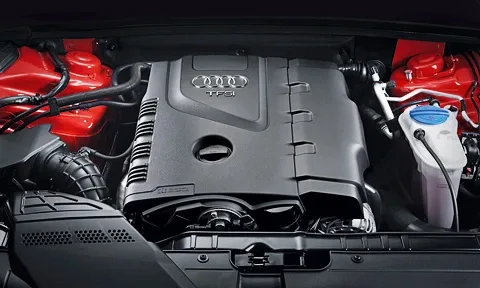
The four-cylinder petrol engines of the TFSI family are a symbiosis of direct injection and turbocharging. Recently, a variable valve lift system has appeared on the intake, similar to Honda's i-VTEC. This is done to reduce pumping losses, and in combination with variable valve timing on intake and exhaust, it has allowed achieving good low-end torque and excellent high-end power. Note the specifications table: there is a plateau not only for the torque curve but also for power — 4300–6000 rpm!
Design 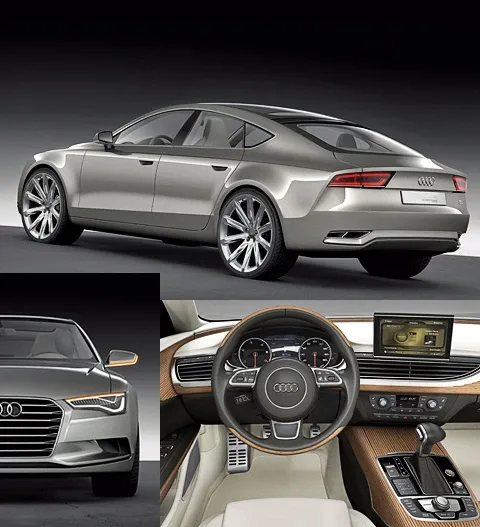
History 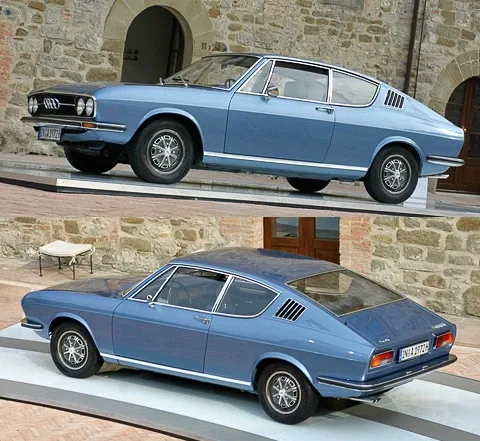
Explaining the origins of the new Sportback's design, German designers for some reason refer to the Audi 100 Coupe S of 1970. A strange comparison, because that car had a fastback body and an isolated trunk. Moreover, it was not particularly popular: only 30,000 units were produced over six years. Meanwhile, about 800,000 regular Audi 100 sedans were sold in the same period.
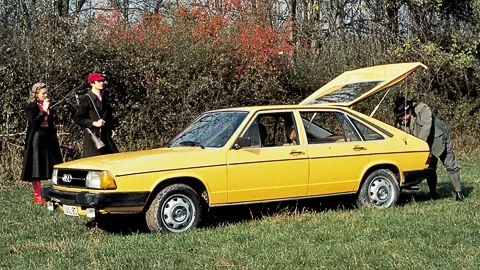
And here is the direct predecessor of today's Sportback. The Audi 100 Avant hatchback, produced since 1977. This car was also positioned as a choice for outdoor enthusiasts, but externally it too closely resembled the much more popular Volkswagen Passat. The result — only 40,000 hatches sold out of a total of 988,000 units of this generation of the "hundred".
Behind the scenes 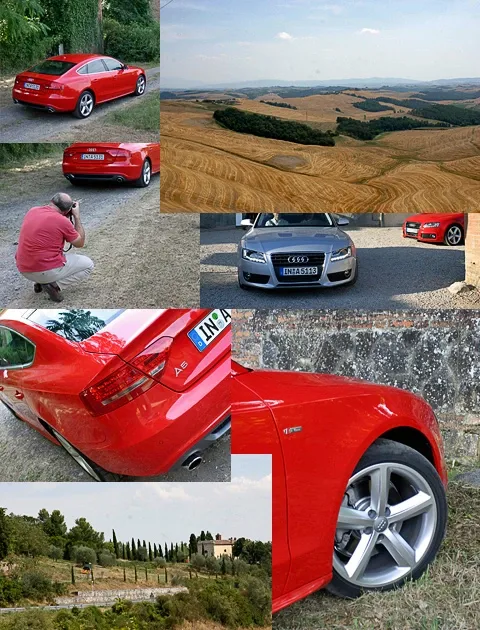
The test took place in the Italian province of Tuscany — a land of endless fields and excellent wine. In the homeland of the greatest people of the past: Michelangelo, Petrarch, Botticelli, Machiavelli... By the way, an interesting observation: if a car company (especially German companies) wants to emphasize the design perfection of its car, its test is usually arranged on the Apennine Peninsula. So to speak, closer to the cradle of European culture.